
Introduction
What Is Hanuman Jayanti
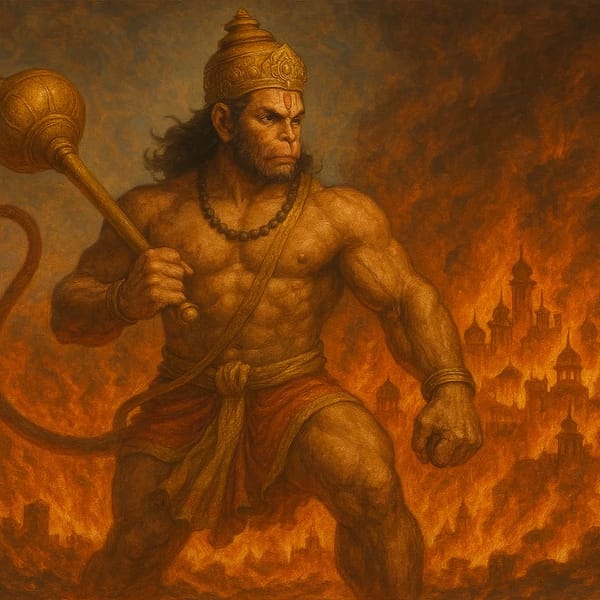
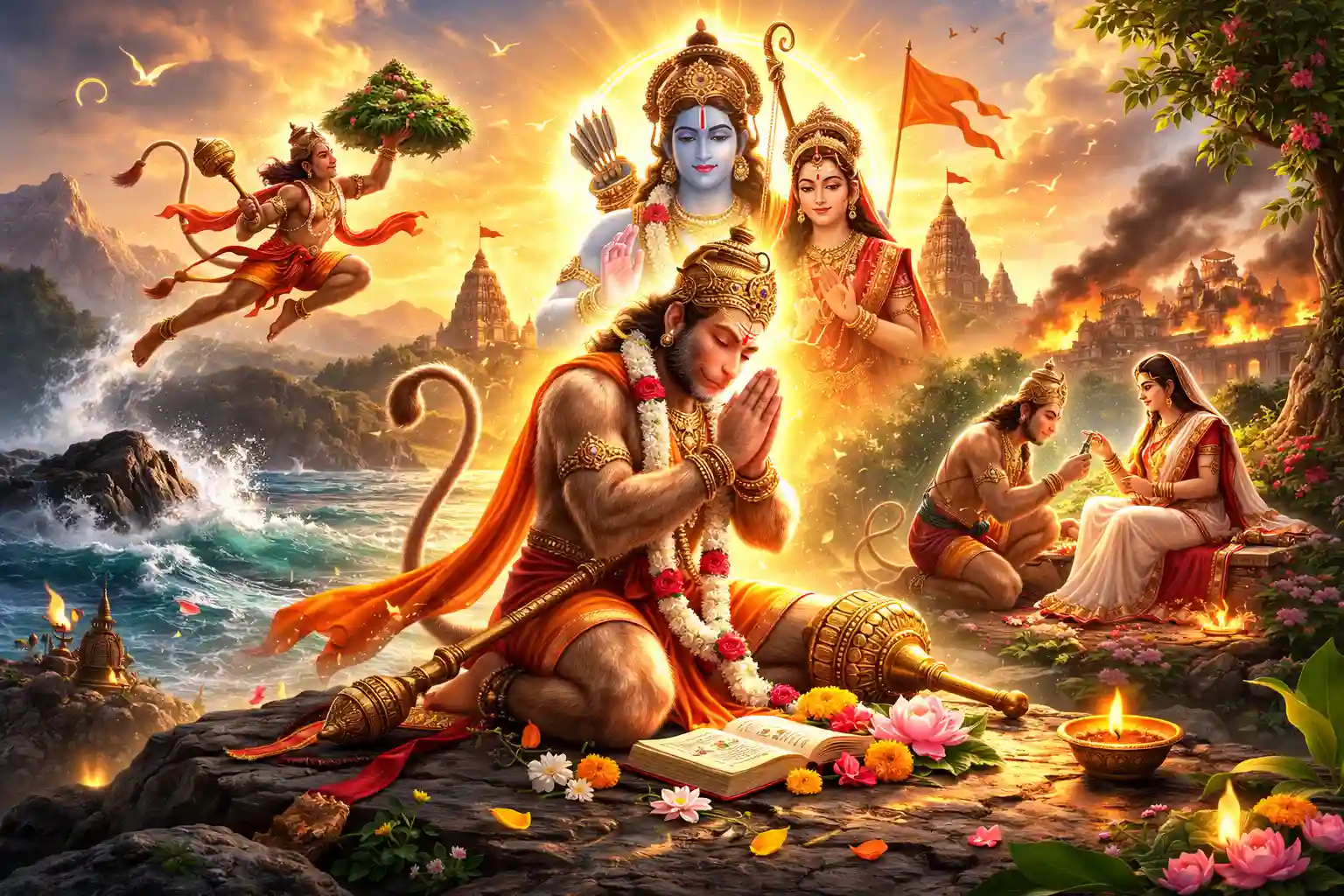
Hanuman Jayanti is the sacred festival that celebrates the birth of Lord Hanuman, the revered devotee of Lord Rama and one of the most beloved figures in the Ramayana. It is observed with deep devotion by millions of devotees across India and around the world. Temples resonate with the recitation of the Hanuman Chalisa, homes are filled with prayer and reverence, and devotees gather to remember the extraordinary life of the mighty sevak of Lord Rama. Revered for his immense strength, courage, and wisdom, Hanuman ji holds a unique place in the hearts of devotees as the embodiment of unwavering devotion, humility, and selfless service.
Yet Hanuman Jayanti is not merely a celebration of heroic feats or physical strength. The life of Hanuman reveals something far deeper, the extraordinary power of devotion. The Hanuman Chalisa beautifully captures this spirit in the line “राम काज करिबे को आतुर”—ever eager to carry out the work of Lord Rama. Every action of Hanuman, whether leaping across the vast ocean in search of Mother Sita, confronting the forces of evil in Lanka, or carrying the Sanjeevani mountain to save Lakshman, was inspired by one guiding force: his boundless love and devotion for his Lord.
Hanuman ji's life reminds us that true strength does not lie in power alone; it lies in a heart completely surrendered to the Divine. His devotion was so pure that worldly honors, treasures, and even personal liberation held no attraction for him. His greatest joy was simply serving Lord Rama and fulfill His divine will.
As we celebrate Hanuman Jayanti, we are invited to reflect on this deeper message. The festival reminds us that devotion has the power to transform strength into service, intelligence into wisdom, and life itself into a sacred offering to God. In remembering Hanuman, we are reminded that the greatest strength a devotee can possess is a heart filled with love, humility, and unwavering faith in the Lord.
Devotion Expressed Through Service
Hanuman’s devotion to Lord Rama was not confined to words or prayer alone; it found expression in tireless service and courageous action. Every ability he possessed, his immense strength, keen intelligence, and fearless spirit, dedicated entirely to the service of his Lord. The Ramayana beautifully reveals how Hanuman placed all these qualities at the feet of Lord Rama, using them only to fulfill the sacred mission entrusted to him.
One such moment occurred during his journey to Lanka in search of Mother Sita. On his way, Hanuman encountered Surasa, who rose from the ocean and attempted to block his path, demanding that he enter her mouth before proceeding further. Rather than allowing the encounter to delay his mission, Hanuman responded with remarkable intelligence and presence of mind. As described in the Sundar Kand, Ramayana:
“जस जस सुरसा बदन बढ़ावा,
तासु दून कपि रूप दिखावा।”
As Surasa kept widening her mouth to swallow Hanuman,
Hanuman expanded his form to twice its size each time.
This beautifully conveys the exponential expansion, Hanuman matching Surasa’s growth with even greater expansion, demonstrating both power and intelligence.
As Surasa widened her mouth, Hanuman expanded his form even larger. Then, in a moment of brilliant strategy, he suddenly reduced himself to a tiny size, swiftly entered and exited her mouth, thus fulfilling her condition while continuing his journey.
This episode beautifully reveals that Hanuman’s strength was guided by wisdom and discernment. His devotion was not only courageous but also thoughtful, enabling him to overcome obstacles without losing sight of the divine mission entrusted to him.
Meeting Mother Sita in Ashok Vatika — Sensitivity, Intelligence, and Humility

Having crossed the ocean and entered the city of Lanka, Hanuman searched with great meticulous care until he finally beheld Mother Sita seated beneath a tree in the Ashok Vatika. Surrounded by harsh demonesses and weighed down by the agony of separation from Lord Rama, she appeared lost in deep sorrow, her mind absorbed only in the remembrance of her beloved Lord. The stillness of that moment was filled with quiet suffering. Witnessing her condition, Hanuman’s heart was moved with compassion, yet he did not approach her immediately.
With remarkable intelligence and sensitivity, he chose first to observe the situation quietly from the branches of a tree, understanding that a sudden appearance might disturb or alarm her. Waiting patiently for the right moment, he gently revealed his presence by dropping Lord Rama’s ring before her. As Mother Sita recognized the ring, the sorrow that had weighed upon her heart began to lift, and a faint glimmer of hope arose within her. Hanuman then humbly introduced himself as the sevak of Lord Rama and conveyed the Lord’s message of reassurance, devotion, and unwavering resolve to rescue her.
When Mother Sita wondered how such a small vanara could accomplish the task of overcoming the mighty forces of Lanka, Hanuman, in order to instill confidence in her, briefly revealed his immense strength by expanding his form. As described in the Ramcharitmanas:
“कनक भूधराकार सरीरा,
समर भयंकर अति बलबीरा।”
Yet even in that moment of displaying such extraordinary power, Hanuman remained deeply humble. Folding his hands, he bowed with reverence before Mother Sita, his heart filled with reverence and surrender. His actions revealed not only courage and intelligence, but also a profound gentleness born of love for his Lord.
In that sacred meeting, Hanuman became more than a messenger, he became a bearer of hope. Through his words and presence, he assured Mother Sita that the darkness of separation would soon give way to the light of reunion, and that Lord Rama would surely come to rescue her.
Burning of Lanka — Strength Used for Dharma
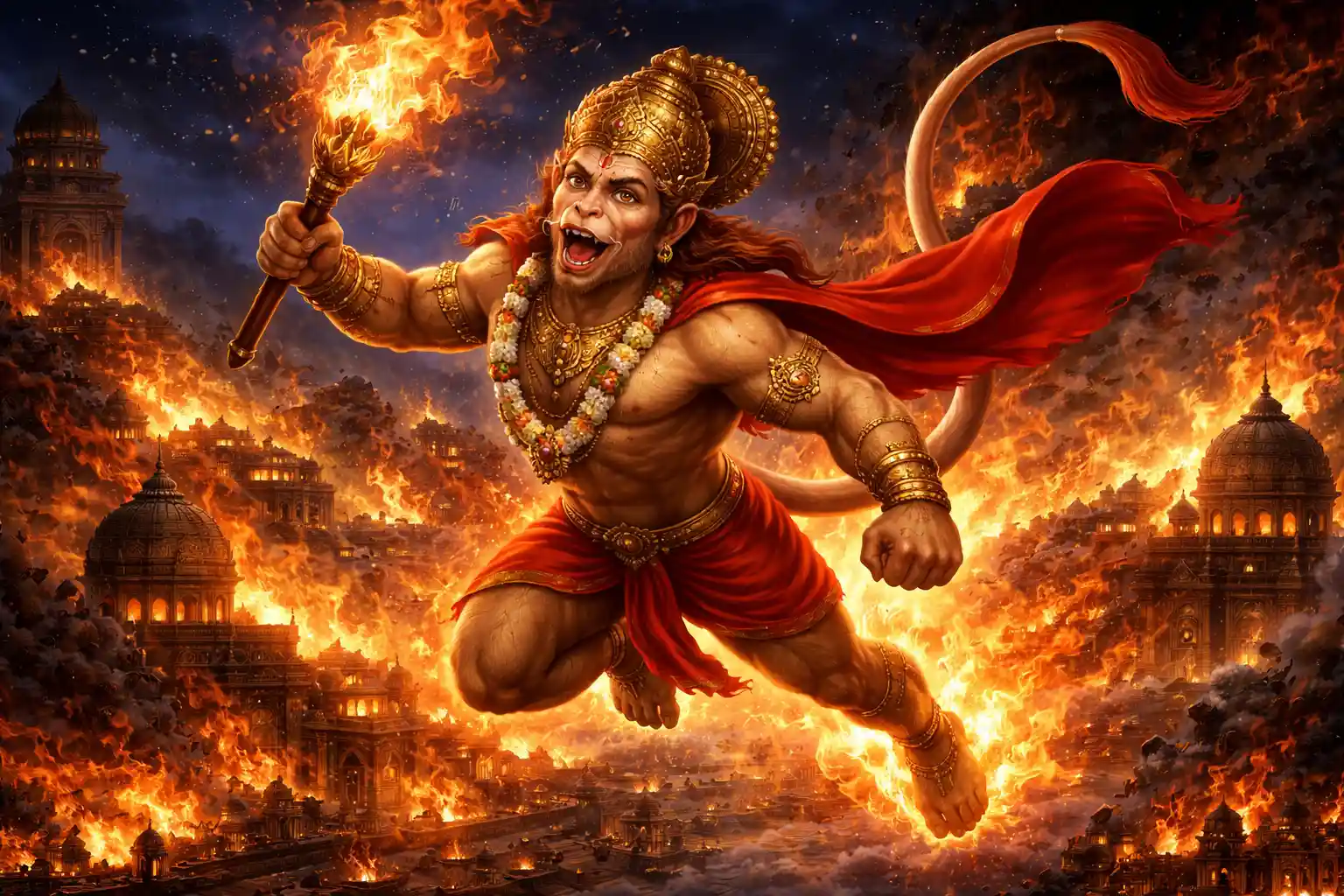
After meeting Mother Sita and delivering Lord Rama’s message of hope, Hanuman chose to remain in Lanka a while longer, thinking as a shrewd diplomat. He allowed himself to be captured so that he could assess the strength and strategies of Ravana’s kingdom. Brought before Ravana in the royal court, Hanuman stood fearless and composed. With calm conviction, he urged the demon king to return Mother Sita to Lord Rama and seek the Lord's forgiveness. Blinded by arrogance, Ravana was enraged by these words and ordered that Hanuman’s tail be wrapped in cloth and set on fire.
What was meant as an act of humiliation soon became a revelation of divine strength. As the flames rose, Hanuman effortlessly freed himself and began to move swiftly across the city. Leaping from roof to roof, he used the very fire meant to punish him as an instrument of justice. In moments, the golden city of Lanka was engulfed in flames, and fear spread through the hearts of the demons, foreshadowing the inevitable fall of Ravana’s tyranny.
Yet even in this fierce display of power, Hanuman’s mind remained anchored in his sacred purpose. There was no anger, no pride, only the steady awareness of his Lord’s mission. Before leaving Lanka, he returned once again to the Ashok Vatika to ensure that Mother Sita was safe. With folded hands, he offered his respectful salutations to her, and only then did he leap back across the ocean to carry the message of her whereabouts to Lord Rama.
Through this episode, Hanuman reveals that true strength, when guided by devotion, becomes a force for dharma. His power was not his own,it was an offering, used solely in the service of righteousness and in fulfillment of his Lord’s will.
Carrying the Sanjeevani Mountain — Devotion in Selfless Service
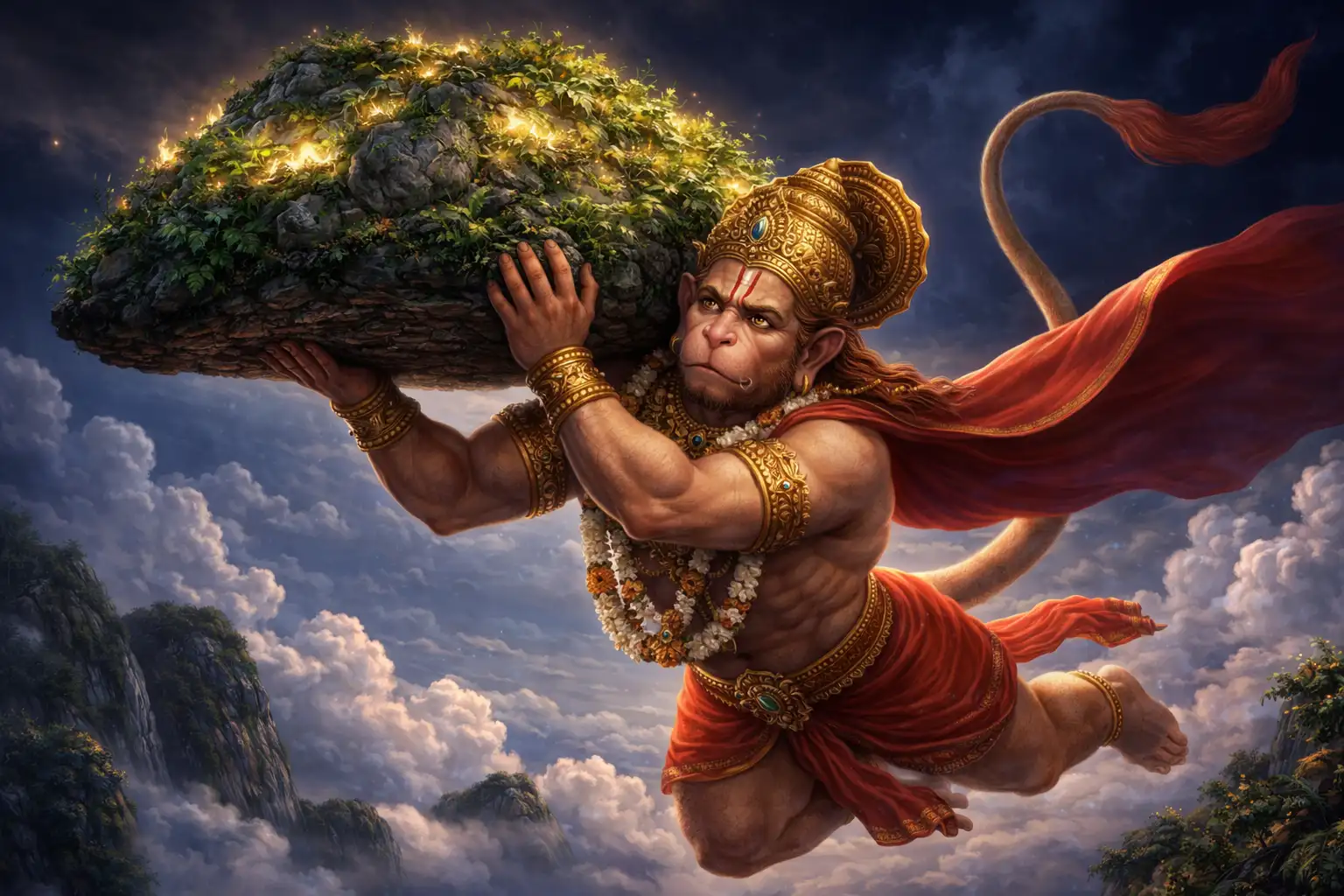
During the fierce battle between Lord Rama’s army and the forces of Ravana, Lakshman was struck by a powerful weapon and fell unconscious on the battlefield. As he lay motionless, the atmosphere was filled with anxiety and grief. For Lord Rama, the sight of his beloved brother in such a condition was unbearable. The only hope lay in a rare life-saving herb, the Sanjeevani, which grew on a distant Himalayan mountain.
In that critical moment, Hanuman did not pause to think, he responded. With complete dedication and urgency, he set out immediately, driven by one thought alone: Lakshman must be saved, for this is the will of my Lord.
As he sped toward the mountain, even powerful obstacles arose to delay him. The demon Kalnemi, sent with deceit to hinder his path, tried to mislead him. But such distractions could not shake Hanuman’s resolve. Recognizing the deception, Hanuman swiftly overcame the obstacle and continued his journey without the slightest delay. Nothing could divert him from his purpose.
Reaching the mountain in the darkness of night, Hanuman faced yet another challenge. Surrounded by countless herbs, he was unable to identify the Sanjeevani. Time was slipping away. Yet even in that moment, there was no confusion, no doubt, no retreat. His devotion did not allow hesitation.
In a decisive act born of pure service, Hanuman lifted the entire mountain and soared across the sky, carrying it back so that the life-saving herb could be found without delay.
This was not merely an act of strength, it was an expression of love. Hanuman did not act to display his power, but to fulfill the need of his Lord. In his heart, there was no room for distraction, no space for self-concern, only an unwavering resolve to serve.
For Hanuman, devotion meant this: when the Lord’s work calls, one does not question, one does not delay, one does not turn back, one simply acts.
Devotion Above Worldly Pleasures
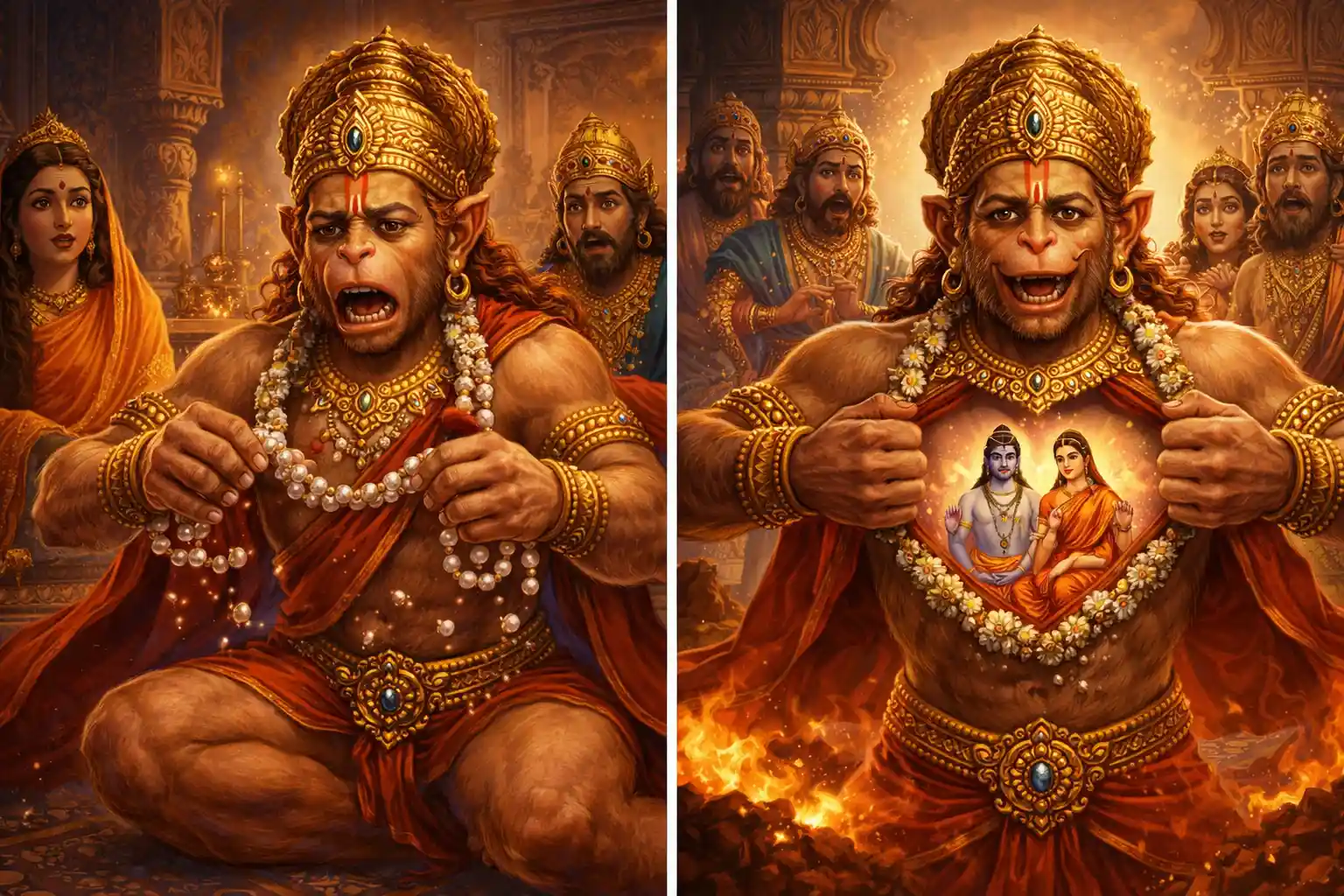
Hanuman’s devotion to Lord Rama was so absolute that worldly honors and treasures held no value before him. His heart recognized only one true wealth: the presence of his beloved Lord. A powerful incident from the Ramayana reveals the depth and intensity of this devotion.
After the victory over Ravana and the joyous reunion of Lord Rama and Mother Sita, the atmosphere in Ayodhya was filled with gratitude and celebration. Deeply moved by Hanuman’s unmatched service, Mother Sita lovingly offered him a precious pearl necklace as a mark of her affection.
Hanuman accepted the gift with humility. Yet, instead of admiring its beauty, he began to examine each pearl closely, breaking them one by one and looking within. The royal court watched in astonishment. What seemed like a priceless ornament to them held no meaning for him. Unable to contain their concern, they questioned him, “Why are you destroying such a valuable necklace?”
Hanuman replied with simple conviction and deep humility that he was searching within the pearls for Lord Rama. For him, anything that did not contain the presence of his Lord was empty, however valuable it might appear.
Perplexed by his response, some courtiers questioned him further, almost in disbelief. “If your Lord resides in everything that you value, does He also reside within you?”
At that moment, Hanuman’s devotion could no longer remain contained in words. With unwavering faith and complete surrender, he is said to have opened his chest, revealing within his heart the divine presence of Lord Rama and Mother Sita. The court fell silent. What stood before them was not a display of power, but the undeniable truth of a devotee who’s entire being was filled with his Lord.
In that moment, all doubt dissolved. It became clear that for Hanuman, devotion was not a sentiment, it was his very existence. Wealth, honor, and worldly pleasures had no hold over him, for his heart was already filled with the highest treasure. Where the Lord resides, nothing else remains to be desired.
Devotion That Lives for the Happiness of the Lord
Time moves forward even for the most sacred of earthly pastimes. When the divine mission of Lord Rama on earth had reached its completion, the moment came for Him to conclude His earthly presence. The atmosphere around Ayodhya was filled with a quiet, unspoken sorrow. For those who had lived in the light of Rama’s presence, the thought of separation was almost unbearable.
Among them, none felt this more deeply than Hanuman. Every breath of his life had been dedicated to the service of his beloved Lord. For him, existence itself held meaning only in serving Rama. The thought of remaining in the world without the Lord’s visible presence pierced his heart with grief. Like a child unwilling to be separated from a loving parent, Hanuman longed to accompany Lord Rama wherever He would go.
But the Lord, in His divine wisdom, had a different wish for His faithful sevak. Instead of taking Hanuman with Him, He entrusted him with a sacred responsibility, to remain on earth, to protect His devotees, and to bless all those who remember and chant His name with faith and devotion.
For a moment, the pain of separation lingered. Yet Hanuman’s devotion was so complete that even this deep longing bowed before the will of his Lord. With folded hands and a heart full of love, he accepted the command without hesitation. His happiness did not lie in being near the Lord, but in fulfilling the Lord’s wish.
This is the highest expression of devotional truth deeply emphasized by Swami Mukundananda. The joy of a true devotee lies not in personal fulfillment, but in the happiness of the Lord. When love for God becomes complete, the devotee does not seek comfort, recognition, or even liberation. The only desire that remains is to serve.
This spirit finds a beautiful expression in a bhajan sung by Swamiji:
“ना भुक्ति माँगूँ, ना मुक्ति माँगूँ,
बस राम चरण रति देहु।”
The devotee seeks neither worldly enjoyment nor liberation but only loving attachment to the Lord’s feet. In that state, even separation becomes service, and even longing becomes surrender.
Hanuman therefore chose not liberation, but service. Though his heart longed for the Lord, he remained, carrying within him the living presence of Rama, continuing to bless and protect all those who remember Him with faith and devotion.
Hanuman Serving Devotees Through the Ages
The Story of Saint Tulsidas
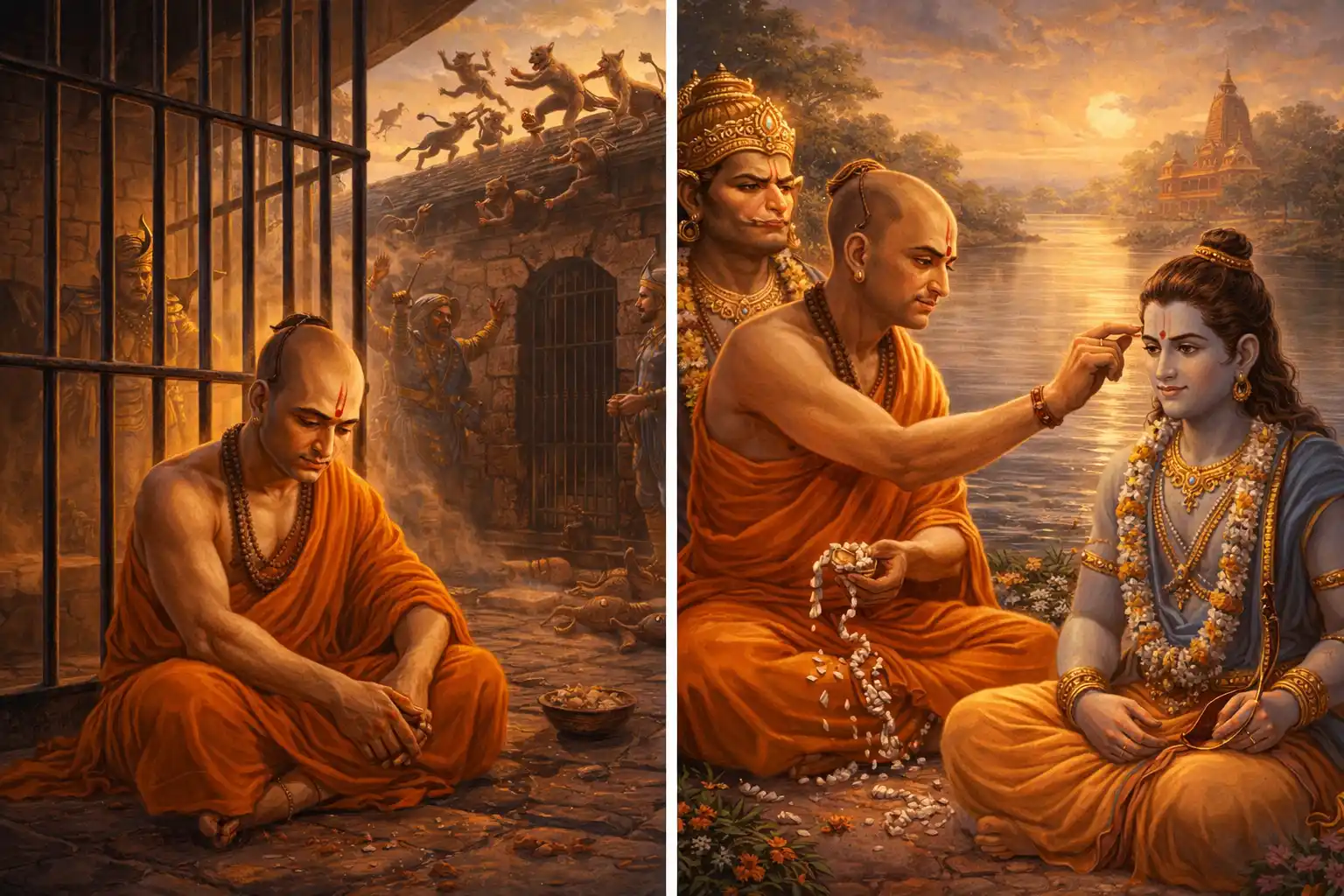
The promise that Hanuman would remain on earth to bless and protect devotees is not merely a belief,it finds living expression in the lives of great saints. One such powerful example is the story of Saint Tulsidas, the revered author of the Ramcharitmanas, whose life was immersed in unwavering devotion to Lord Rama.
Tulsidas lived in constant remembrance of his Lord. For him, the name of Rama was not just a prayer, it was his very breath. His devotion was so deep and sincere that it touched the hearts of all who encountered him, and his spiritual influence spread far and wide.
It is said that Emperor Akbar, having heard of the saint’s growing fame, summoned him to his royal court. Curious to witness the power of such devotion, Akbar asked Tulsidas to perform a miracle and demonstrate the greatness of his Lord.
With folded hands and deep humility, Tulsidas replied that he possessed no miraculous powers. He was only a humble devotee who knew nothing but the name of Lord Rama. Displeased by this response, Akbar ordered that the saint be imprisoned.
Confined within the walls of the prison, Tulsidas remained undisturbed. His faith did not waver, nor did his devotion diminish. In that solitude, he turned even more deeply toward his Lord, chanting the name of Rama with unwavering trust. With full surrender, he invoked the grace of Hanuman, the ever-vigilant protector of Rama’s devotees. It is believed that during this time, he composed the sacred verses of the Hanuman Chalisa, pouring into them the depth of his faith, love, and surrender.
Then, something extraordinarily unfolded.
Thousands of monkeys suddenly descended upon the city and the royal palace, creating chaos everywhere. The guards and soldiers were helpless before this overwhelming force. Fear spread rapidly, and the entire city was thrown into confusion.
It soon became clear that this was no ordinary event. Recognizing the divine connection, Akbar understood that the imprisoned saint was under the protection of a higher power. Without delay, he ordered Tulsidas to be released. With reverence, he acknowledged the strength of the devotee’s faith.
For devotees, this incident is not merely a story, it is a revelation. It affirms that Hanuman continues to fulfill the sacred command given to him by Lord Rama. He remains ever present, ever alert, protecting those who remember the Lord with sincerity and faith.
Across the ages, Hanuman’s devotion has not diminished, it continues to live on, responding to the call of every true devotee.
Hanuman’s grace was not limited to protecting the Lord’s devotees from danger or adversity. Seeing the deep yearning, humility, and complete surrender in the heart of a true devotee, he also blesses them with the highest gift, the divine vision of the Lord Himself.
This deeper dimension of Hanuman’s compassion is beautifully reflected in the life of Tulsidas, where devotion was answered not only with protection, but with the Lord’s own darshan.
चित्रकूट के घाट पर भई संतन की भीड़,
तुलसीदास चंदन घिसे, तिलक देत रघुबीर।”
In this divine vision, Tulsidas beheld Lord Rama Himself, applying tilak with his own hands,a moment where devotion found its fulfillment in grace.
Celebrating Hanuman Jayanti Today
Even today, the devotion of Lord Hanuman continues to inspire millions of devotees across the world. Hanuman Jayanti is observed not merely as a remembrance of the great sevak of Lord Rama, but as a living expression of faith, courage, and devotion that continues to guide seekers in their spiritual journey.
Across temples and homes, the day becomes an opportunity to reconnect with the ideals that Hanuman embodied, selfless service, unwavering faith, and complete surrender to the will of the Lord. Through prayer, chanting, and reflection, devotees seek not only to honor Hanuman ji, but to imbibe his spirit in their own lives.
Temple Devotion
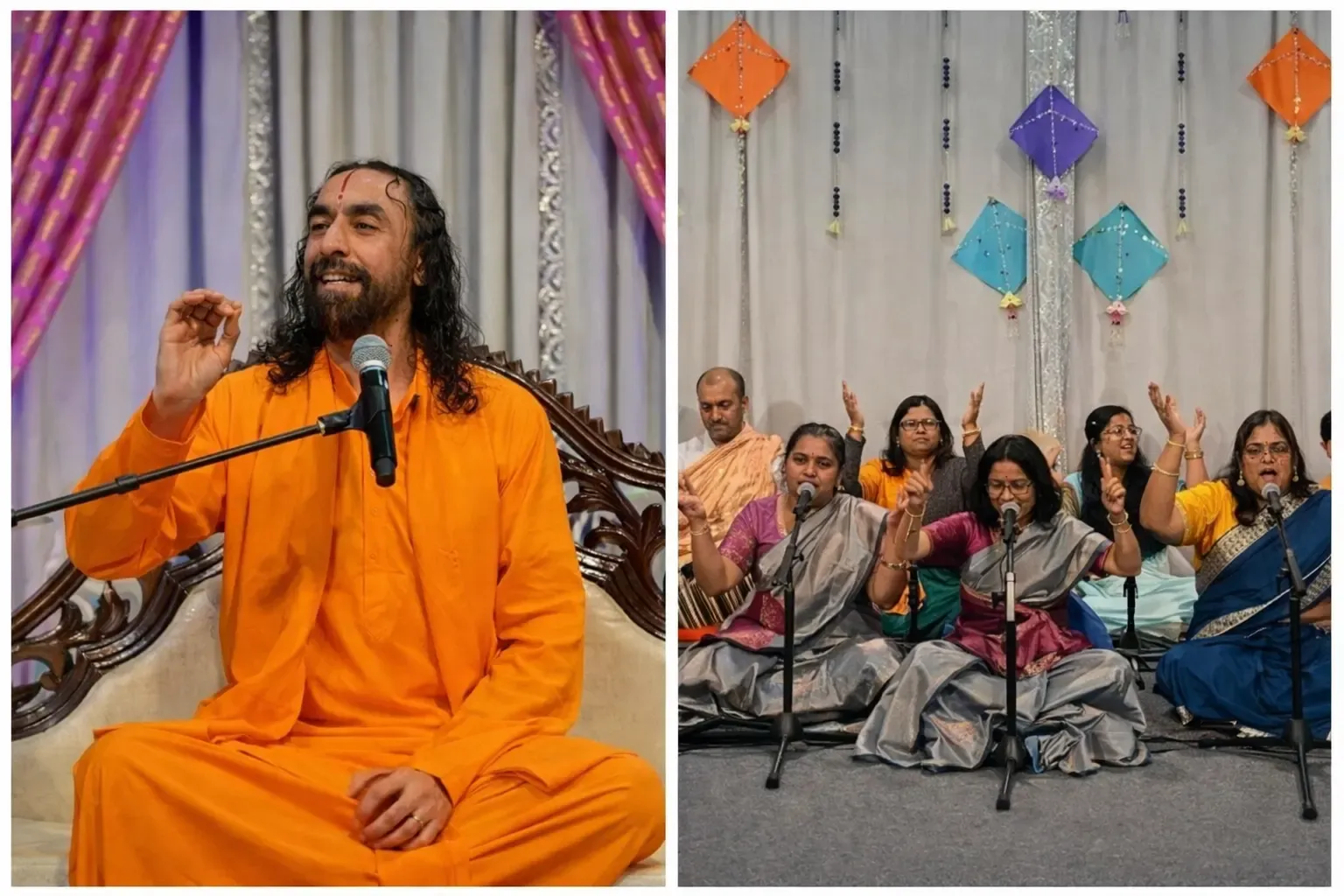
On Hanuman Jayanti, temples dedicated to Lord Hanuman come alive from the early hours of the morning. The air resonates with the rhythmic chanting of the Hanuman Chalisa, the recitation of the Sundar Kand, and devotional hymns that glorify the strength, compassion, and unwavering devotion of Hanuman. Devotees gather with folded hands, offering flowers, sindoor, and sweets, while many observe fasting and spend the day immersed in prayer and remembrance of the Lord’s beloved sevak.
In this collective devotion, a powerful spiritual energy is felt. As voices rise together in prayer, hearts are drawn closer to the ideals Hanuman embodied faith that does not waver, service that does not tire, and devotion that knows no condition. The temple becomes not just a place of worship, but a space where devotees feel inspired to walk the path of devotion with sincerity and dedication.
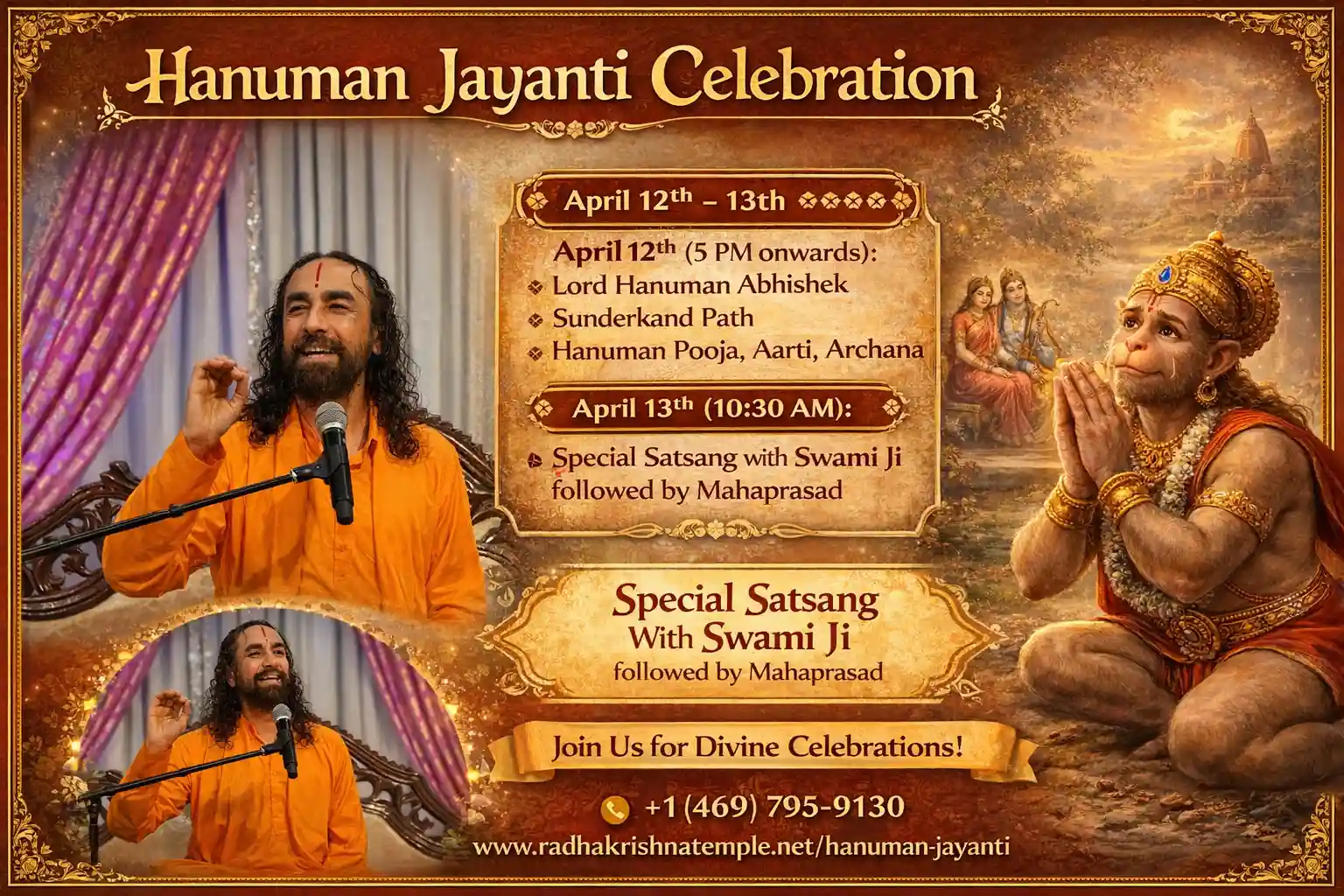
At the Radha Krishna Temple in Dallas, Hanuman Jayanti is celebrated with deep devotion and vibrant participation. Devotees gather in large numbers to take part in collective chanting, special kirtans, and recitations of the Hanuman Chalisa and Sundar Kand. The temple atmosphere becomes charged with devotion as hearts unite in remembrance of Hanuman’s unwavering love for Lord Rama. Through such celebrations, devotees not only honor Hanuman but also experience the joy of satsang and the inspiration to strengthen their own path of devotion and service.
Devotion in the Home
Hanuman Jayanti is also observed with equal devotion within the quiet sanctity of the home. Families gather before their home altars, lighting lamps and offering prayers with love and reverence. The Hanuman Chalisa is recited with faith, and stories of Hanuman’s courage, humility, and devotion are lovingly shared with children, passing on these timeless values to the next generation.
In these simple yet heartfelt acts, devotion becomes personal and intimate. The spirit of Hanuman Jayanti moves beyond ritual and becomes a way of living—where remembrance of the Lord and service to others find a place in daily life.
Whether in the grandeur of temples or the quiet devotion of homes, the message remains the same: Hanuman’s presence continues to inspire, guide, and protect all those who remember Lord Rama with faith and sincerity.
Swamiji’s Teachings on the Strength of Devotion
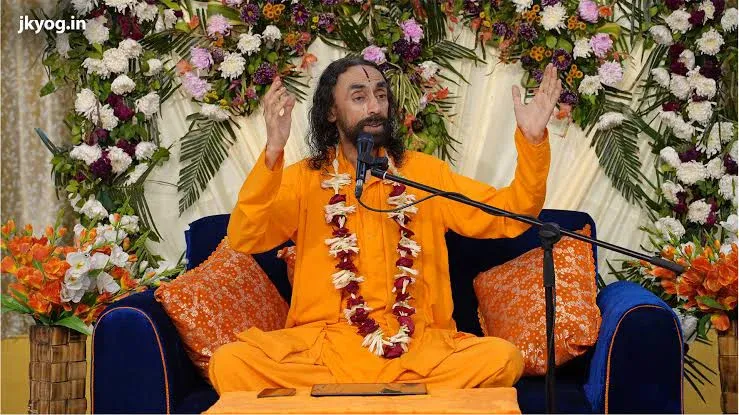
The life of Lord Hanuman offers timeless lessons on the nature of true devotion. Through his strength, humility, intelligence, and unwavering service to Lord Rama, Hanuman ji stands as the perfect example of what it means to live a life centered on God. Swami Mukundananda often explains that devotion is not merely an emotion expressed through prayer or ritual; it is a way of living in which every thought and action is offered in loving service to the Divine.
One of the profound truths emphasized by Swamiji is that the happiness of a true devotee lies in the happiness of the Lord. This spirit is beautifully reflected in Hanuman’s life. When Lord Rama asked him to remain on earth instead of accompanying Him, Hanuman accepted the command with complete surrender. His joy did not lie in personal liberation, but in fulfilling the wish of his Lord and serving His devotees.
Swamiji also teaches that genuine devotion gradually frees the heart from attachment to worldly pleasures. Hanuman’s response to the pearl necklace given by Mother Sita reflects this truth. For Hanuman, the greatest treasure was not jewels or honor, but the presence of Lord Rama in his heart.
Swamiji also teaches that devotion transforms one’s abilities into instruments of divine service. Hanuman’s strength, intelligence, and courage were never used for personal glory. Every power he possessed was dedicated entirely to the service of Lord Rama and the protection of righteousness.
A beautiful conversation between Lord Rama and Hanuman reflects this humility. After the victory in Lanka, Lord Rama is said to have asked Hanuman how he was able to accomplish such extraordinary feats—crossing the ocean, defeating powerful demons, and burning the mighty city of Lanka.
With folded hands and deep humility, Hanuman replied:
“All this is your glory Raghurai,
O Lord, I have no authority.”
All this was possible only through Your grace, O Lord.
I possess no power of my own—I am merely Your servant.
Through Hanuman’s life, Swami Mukundananda reminds seekers that devotion has the power to transform the human heart. When love for God becomes the center of life, strength becomes service, wisdom becomes humility, and every action becomes an offering to the Divine.
Conclusion — Hanuman as a Living Example for the Modern Seeker
The life of Lord Hanuman continues to inspire seekers across generations because it reveals the true essence of devotion. His extraordinary strength, wisdom, and courage were never used for personal glory, but were wholly dedicated to the service of Lord Rama. Whether leaping across the ocean, comforting Mother Sita in Ashok Vatika, carrying the Sanjeevani mountain to save Lakshman, or humbly attributing all his achievements to the grace of his Lord, Hanuman stands as a living example of devotion in action.
Hanuman also teaches us that true devotion rises above worldly attachments. The story of the pearl necklace reminds us that when the heart is filled with love for God, worldly treasures lose their charm. For Hanuman, the greatest wealth was the constant remembrance of Lord Rama within his heart.
Even in the face of deep sorrow, Hanuman chose to remain on earth to fulfill the will of his Lord. His happiness lay not in personal liberation, but in serving the divine mission entrusted to him. As Swami Mukundananda teaches, the joy of a true devotee lies in bringing joy to the Lord.
For the modern spiritual seeker, Hanuman remains a powerful guiding light. In a world driven by ambition, pride, and constant distraction, his life reminds us of the transformative power of humility, faith, and selfless service. By remembering the Lord, serving others with sincerity, and surrendering the ego, we too can begin to walk the path of devotion that Hanuman embodied.
Hanuman Jayanti, therefore, becomes more than a celebration of a divine birth—it becomes an invitation. An invitation to awaken the strength of devotion within ourselves, to serve with humility, to act with courage, and to keep the presence of the Divine alive in our hearts. Wherever the name of Lord Rama is remembered with love, Hanuman’s grace continues to guide and protect.
राम काज कीन्हे बिना मोहि कहाँ विश्राम।
“Without completing the work of Lord Rama, I can know no rest.”
Hanuman’s life reminds us that true devotion finds its strength in selfless service. When love for God fills the heart, every action becomes an offering, and every challenge becomes an opportunity to serve the Divine.
To deepen this understanding of devotion and experience Hanuman’s spirit through Swamiji’s wisdom, listen to this inspiring discourse.
Call to Action
As we celebrate Hanuman Jayanti, let us not only admire the greatness of Lord Hanuman but strive to imbibe his spirit in our own lives. Let us remember that true strength lies not in power or achievement, but in a heart filled with devotion, humility, and selfless service.
Take a moment today to pause, reflect, and turn inward. Chant the name of Lord Rama with faith. Offer your actions, however small, in the spirit of seva. Let Hanuman ji’s example inspire you to rise above ego, overcome challenges with courage, and walk the path of devotion with sincerity.
May the strength of Hanuman ji’s devotion awaken within your heart, guiding you toward a life of purpose, peace, and divine connection.
“Join us in celebrating Hanuman Jayanti with devotion, satsang, and divine joy.”
Key Takeaways
- Devotion is Strength: True strength lies not in power, but in complete surrender to the Divine.
- Seva is the Highest Expression of Bhakti: Like Hanuman, offering our abilities in service transforms our actions into worship.
- Intelligence Guided by Devotion: Hanuman teaches us to act with wisdom, not impulse.
- Detachment from Worldly Pleasures: When the heart is filled with God, material attractions lose their hold.
- The Devotee Lives for the Lord’s Happiness: True joy lies in fulfilling the will of the Divine, not personal desires.
- Hanuman is a Living Presence: His grace continues to guide and protect those who remember the Lord with sincerity.
Frequently Asked Questions (FAQs)
1. What is the significance of Hanuman Jayanti?
Hanuman Jayanti marks the birth of Lord Hanuman and celebrates his unparalleled devotion, strength, humility, and selfless service to Lord Rama.
2. Why is Hanuman considered the symbol of true devotion?
Hanuman dedicated every thought, action, and ability to Lord Rama. He neither sought personal gain nor liberation, making him the perfect example of selfless devotion.
3. What can we learn from Hanuman’s life?
Hanuman teaches us to cultivate humility, unwavering faith, courage, and the spirit of seva, while surrendering our ego to the Divine.
4. How is Hanuman Jayanti celebrated?
Devotees observe fasting, chant the Hanuman Chalisa, read the Sundar Kand, visit temples, and engage in prayer and devotional singing.
5. What is the deeper spiritual message of Hanuman Jayanti?
The festival reminds us that devotion has the power to transform our lives—turning strength into service, knowledge into wisdom, and actions into offerings to God.
6. Does Hanuman still protect devotees today?
According to devotional tradition, Hanuman continues to bless and protect those who remember Lord Rama with sincerity and faith.
References & Citations
Primary Scriptures
- Ramayana
- Ramcharitmanas (especially Sundar Kand)
- Hanuman Chalisa
- Key Verses Referenced
- “राम काज करिबे को आतुर” — Hanuman Chalisa
- “जस जस सुरसा बदन बढ़ावा, तासु दून कपि रूप दिखावा” — Ramcharitmanas Sundar Kand
- “कनक भूधराकार सरीरा…” — Ramcharitmanas Sundar Kand
- “राम काज कीन्हे बिना मोहि कहाँ विश्राम” — traditional devotional verse (associated with Hanuman’s spirit of seva)
- “ना भुक्ति माँगूँ, ना मुक्ति माँगूँ…” — Bhajan by Swami Mukundananda
Spiritual Teachings & Interpretations
- Discourses and teachings of Swami Mukundananda on:
- Devotion (Bhakti Yoga)
- Seva (selfless service)
- The ideal devotee