

In a world overflowing with distractions, anxiety, and endless demands on our attention, the search for inner peace has become more important than ever. Despite unprecedented technological advancement, many people continue to struggle with stress, uncertainty, loneliness, and a lack of deeper purpose. In such times, humanity naturally turns toward timeless sources of wisdom that transcend changing circumstances.
Among the spiritual treasures of Sanatan Dharma, the Srimad Bhagavatam shines as one of the most profound guides to understanding life, the soul, and our relationship with the Divine. Revered as the ripened fruit of Vedic knowledge, it is not merely a collection of stories or religious teachings: it is a spiritual roadmap that reveals how to attain lasting fulfillment through devotion to God.
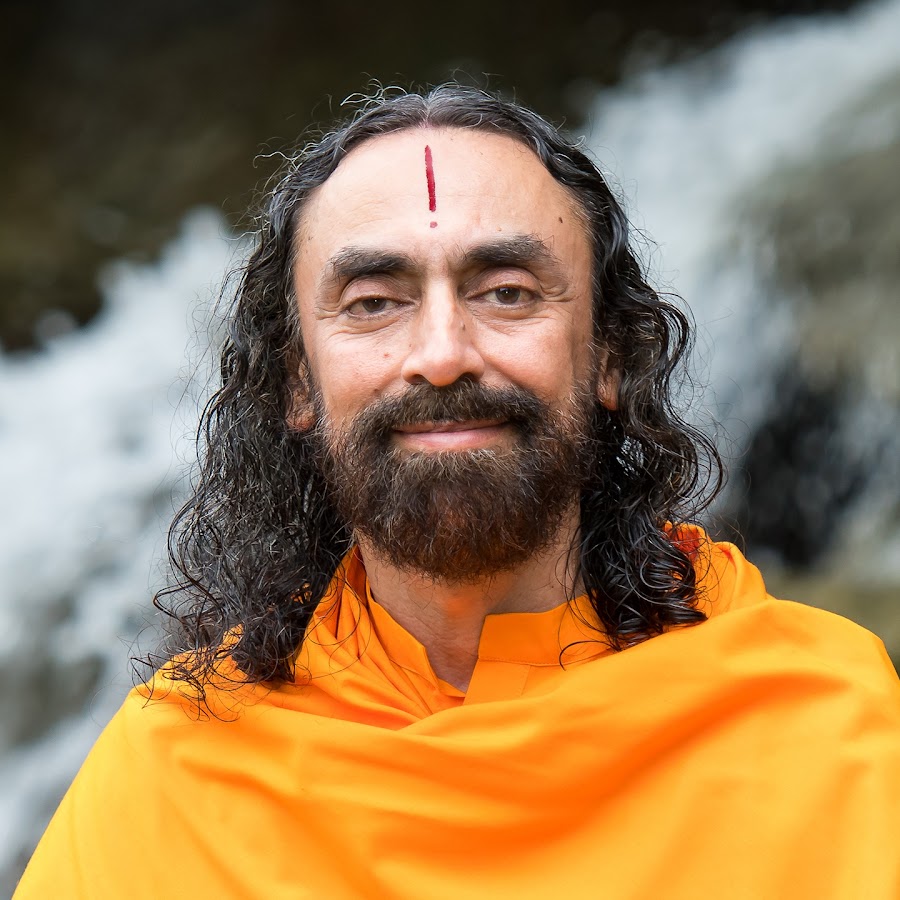
In a captivating discourse, Swami Mukundananda explores the foundational questions that gave birth to the Srimad Bhagavatam. These questions were raised thousands of years ago by enlightened sages, yet they remain strikingly relevant today. Their answers address universal concerns about purpose, spirituality, devotion, and the destiny of humanity.
As we celebrate Janmashtami, the appearance day of Lord Krishna, these timeless teachings offer an opportunity to deepen our understanding of His divine mission and discover practical wisdom for navigating modern life.
The Setting: 88,000 Sages Seek the Truth
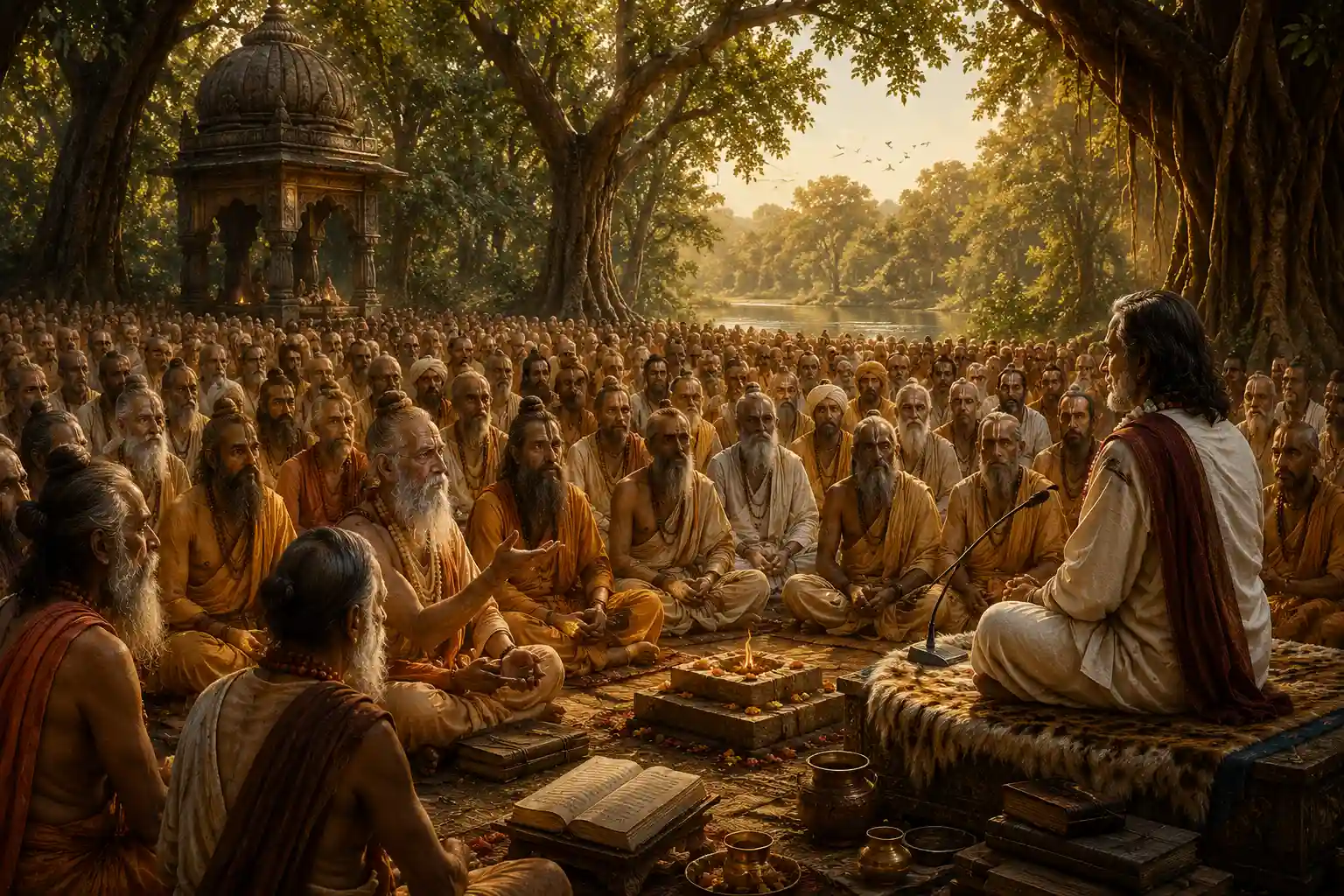
To appreciate the significance of these six questions, we must travel back nearly 4,900 years to the sacred forest of Naimisharanya, one of the holiest places in ancient India.
The world had just entered Kali Yuga, the age characterized by spiritual decline, materialism, conflict, and confusion. The sages foresaw the challenges that future generations would face, such as shortened lifespans, weakened memory, diminished spiritual discipline, and increasing distractions.
Concerned about the welfare of humanity, 88,000 enlightened sages assembled in Naimisharanya to deliberate on how people could attain true happiness and liberation despite the difficulties of the age.
Leading the assembly was the revered Shaunak Rishi, who directed six profound questions to Suta Goswami, a highly realized saint who had received the wisdom of the Bhagavatam through an authentic spiritual lineage.
These six questions became the very foundation of the Srimad Bhagavatam and continue to serve as a guide for seekers across generations:
- What is the means of attaining welfare in Kali Yuga?
- What is the essence of all Vedic scriptures?
- Why did Lord Krishna descend to Earth?
- What are the divine pastimes of Krishna?
- Who are the other Avatars of the Supreme Lord?
- After Krishna's departure, where did Dharma take shelter?
The answers to these questions form a complete spiritual philosophy, addressing everything from the purpose of life to the path of God-realization.
Question 1: How Can We Attain Welfare in Kali Yuga?

The first question is perhaps the most practical and urgent.
The sages recognized that people living in Kali Yuga would face immense obstacles. Unlike previous ages, where individuals practiced intense meditation for thousands of years or performed elaborate sacrifices, modern humanity lacks the time, discipline, and mental focus for such rigorous practices.
So what hope remains?
Suta Goswami's answer is both simple and profound:
Selfless, uninterrupted devotion to God is the highest welfare for all living beings.
True spirituality is not measured by external rituals, scholarly knowledge, or social status. Rather, it is measured by the purity of one's love for God.
The Bhagavatam teaches that devotion should be:
- Ahaituki: without selfish motive.
- Apratihata: uninterrupted by circumstances.
When love for God becomes free from personal agendas and continues regardless of success or failure, pleasure or pain, the heart experiences genuine peace.
Swami Mukundananda emphasizes that Bhakti Yog is uniquely suited for the present age because it is accessible to everyone. One does not need to renounce family life, possess extraordinary intelligence, or perform severe austerities. Through sincere prayer, chanting, remembrance, and service, anyone can cultivate a loving relationship with God.
In a world obsessed with achievement and acquisition, Bhakti reminds us that the deepest fulfillment comes not from what we gain, but from whom we love.
Question 2: What Is the Essence of All Scriptures?
The vastness of Vedic literature can seem overwhelming. The Vedas, Upanishads, Puranas, Mahabharata, Ramayana, and numerous philosophical texts contain countless teachings and practices.
Naturally, the sages wanted to know:
What is the central message that unites them all?
Suta Goswami answers through one of the most celebrated verses of the Bhagavatam:
वदन्ति तत्तत्त्वविदस्तत्त्वं यज्ज्ञानमद्वयम् ।
ब्रह्मेति परमात्मेति भगवानिति शब्द्यते ॥ (SB 1.2.11)
This verse reveals that all authentic spiritual paths ultimately lead toward realization of the same Supreme Truth, which can be understood in three progressively deeper ways:
Brahman
The all-pervading spiritual energy that exists throughout creation.
Paramatma
The Supersoul residing within every living being, witnessing and guiding all actions.
Bhagavan
The Supreme Personal God possessing infinite beauty, love, power, knowledge, and divine qualities.
Swami Mukundananda explains that these are not different realities but different levels of realization of the same Divine Truth.
Just as a mountain appears differently from a distance, halfway up, and at its summit, the Supreme Reality is experienced according to one's spiritual advancement.
The essence of all scriptures is therefore not ritual, philosophy, or theology for their own sake: it is to bring the soul closer to God and awaken divine love within the heart.
Question 3: Why Did Shree Krishna Descend?
One of the most fascinating questions concerns the appearance of Lord Krishna Himself.
Why would the Supreme Being descend into the material world?
The Bhagavatam explains:
शृण्वतां स्वकथाः कृष्णः पुण्यश्रवणकीर्तनः
हृद्यन्तःस्थो ह्यभद्राणि विधुनोति सुहृत्सताम्
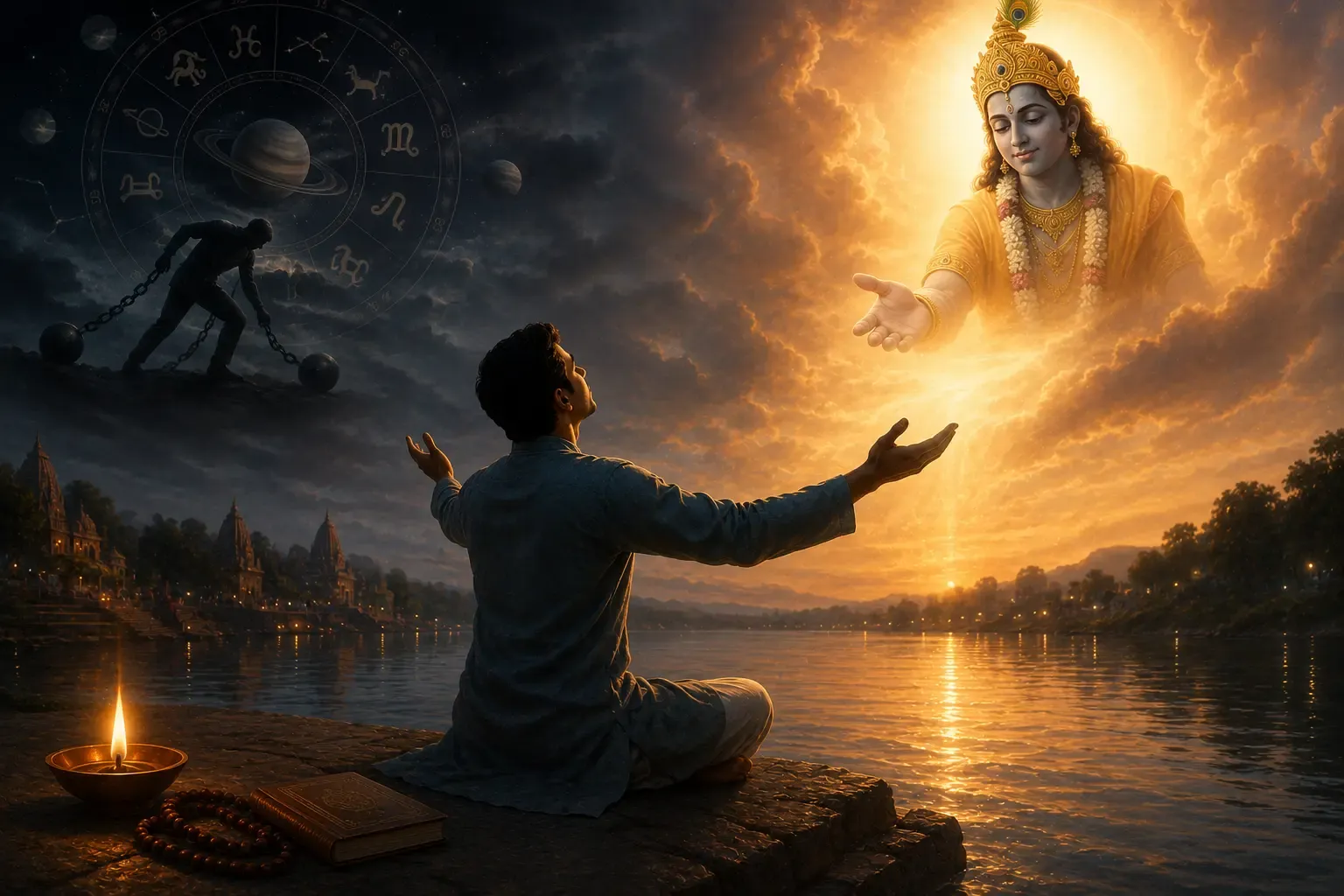
Shree Krishna descends out of compassion for humanity.
Without His appearance, how would we know His divine name, form, qualities, pastimes, and abode? How could we develop a personal relationship with Him?
While philosophers may contemplate an impersonal Absolute, the human heart naturally longs for loving connection. Krishna fulfills that longing by revealing Himself in a beautiful, relatable form.
As a child, He steals butter.
As a friend, He plays with the cowherd boys.
As a protector, He lifts Govardhan Hill.
As a guide, He delivers the Bhagavad Gita.
Through these interactions, Krishna demonstrates that God is not distant or inaccessible. He is infinitely loving and eager to reciprocate with His devotees.
According to Swami Mukundananda, Krishna's descent is ultimately an invitation for every soul to rediscover its eternal relationship with the Divine.
Question 4: What Were Shree Krishna's Divine Leelas?
The Srimad Bhagavatam is filled with captivating accounts of Krishna's divine pastimes, or Leelas.
Unlike ordinary stories, Krishna's Leelas possess spiritual potency. Merely hearing them purifies the heart and awakens devotion.
Some of the most beloved pastimes include:
- The appearance of Krishna in Mathura.
- His childhood adventures in Gokul and Vrindavan.
- The slaying of powerful demons.
- The lifting of Govardhan Hill.
- The enchanting flute melodies that attracted all beings.
- The divine Ras Leela with the gopis.
- His role in guiding the Pandavas and establishing Dharma.
Swami Mukundananda explains that every Leela reveals a unique aspect of God's nature, be it His compassion, humor, courage, wisdom or boundless love.
The more one reflects upon these divine pastimes, the more the mind naturally becomes absorbed in God. This absorption gradually transforms the heart, replacing worldly attachments with divine affection.
Thus, Krishna's Leelas are not merely events from the distant past; they are living sources of spiritual inspiration that continue to nourish seekers today.
Question 5: Who Are the Other Avatars of the Lord?
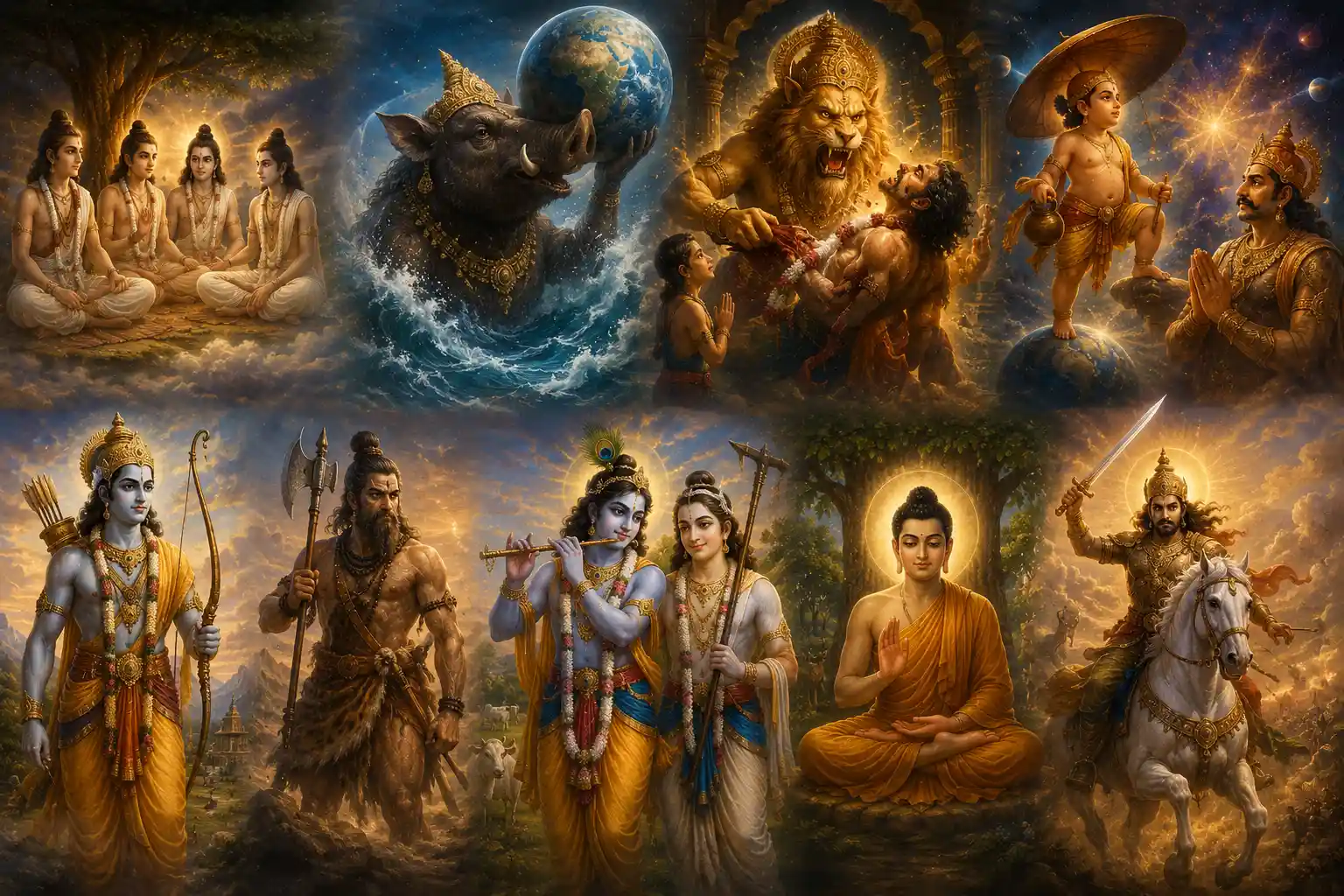
The Bhagavatam beautifully describes the many incarnations through which God descends to protect righteousness and guide humanity.
Each Avatar appears at a specific moment in cosmic history to fulfill a unique divine purpose.
Among the most notable are:
Sanat Kumaras
The eternally youthful sages who exemplify spiritual wisdom and detachment.
Varaha Avatar
The divine boar incarnation who rescued Mother Earth from the depths of the cosmic ocean.
Narasimha Avatar
The extraordinary half-man, half-lion form who appeared to protect Prahlad and demonstrate that God's protection transcends all limitations.
Vaman Avatar
The humble dwarf Brahmin who humbled the mighty King Bali and revealed the glory of surrender.
Lord Rama
The embodiment of righteousness, duty, and ideal conduct.
Parashuram
The fierce warrior sage who restored balance when power was misused.
Balaram and Krishna
Divine manifestations who demonstrated perfect strength, love, and devotion.
Buddha
An incarnation foretold centuries before His appearance, who emphasized compassion and nonviolence.
Kalki
The future Avatar destined to appear at the end of Kali Yuga to reestablish righteousness.
These Avatars reveal an important truth: God continually intervenes in the world out of compassion for His creation. Whenever Dharma declines and confusion spreads, divine guidance appears in forms suitable for the needs of the time.
Question 6: Where Did Dharma Go After Krishna's Departure?
When Krishna concluded His earthly pastimes and returned to His divine abode, the sages were deeply concerned.
Would righteousness disappear from the world?
Would future generations be left without guidance?
The Bhagavatam provides a beautiful answer:
Dharma took shelter in the Srimad Bhagavatam.
Just as the sun illuminates the world after darkness, the Bhagavatam shines as a spiritual light for humanity in Kali Yuga.
Through its teachings, stories, and philosophy, it preserves Krishna's presence for future generations.
Every verse serves as a reminder that although Krishna may no longer be physically visible, His wisdom, grace, and guidance remain available to anyone who sincerely seeks Him.
For this reason, the Bhagavatam is often called the literary incarnation of God—a sacred scripture capable of transforming hearts and illuminating lives.
How the Srimad Bhagavatam Reached Us: A Divine Lineage
The authority of the Srimad Bhagavatam rests not only on its teachings but also on the sacred lineage through which it was transmitted.
The journey begins with Ved Vyas, the compiler of the Vedas and author of numerous scriptures. Despite his unparalleled accomplishments, Vyas experienced a sense of dissatisfaction.
Sensing his unease, Narad Muni visited him and explained the reason: although Vyas had described many spiritual paths, he had not fully glorified the supreme path of pure devotion to God.
Inspired by Narad's guidance, Vyas entered deep meditation and composed the Srimad Bhagavatam, presenting the highest teachings of divine love and Bhakti.
His son, Shukadev Goswami, a fully realized saint, then recited the Bhagavatam to King Parikshit during the king's final seven days of life.
Among those present was Suta Goswami, who carefully absorbed every word. Later, he shared this wisdom with the 88,000 sages assembled at Naimisharanya.
Final Reflection: The Bhagavatam's Message for Modern Life
The six questions asked in Naimisharanya were not meant only for ancient sages. They were asked for us.
In an age of distraction, the Bhagavatam teaches devotion.
In an age of confusion, it reveals truth.
In an age of anxiety, it offers hope.
Finally, in an age of spiritual hunger, it nourishes the soul with the nectar of divine love.
As Swami Mukundananda beautifully explains, the ultimate purpose of the Srimad Bhagavatam is not simply to inform us about God: it is to help us fall in love with Him.
This Janmashtami, may we take inspiration from these timeless teachings, deepen our devotion to Lord Krishna, and begin our own journey toward spiritual awakening and divine bliss.
Practical Applications of the Srimad Bhagavatam Teachings
The Srimad Bhagavatam isn't just a spiritual epic: it is a living guide for personal growth, emotional resilience, and divine connection. Below are key teachings from the six questions and their real-world applications:
| Teaching | Practical Application in Daily Life |
|---|---|
| Selfless and Uninterrupted Bhakti is the highest dharma | Practice daily prayer, chanting, or meditation without seeking rewards—just pure love for God. |
| All scriptures aim to realize God in personal or impersonal form | Focus on God-consciousness over ritualism. Use scripture as a means, not an end. |
| Krishna’s Avatar provides an accessible form of God | Meditate on His name, form, virtues, and pastimes to stabilize the mind and heart. |
| Divine Leelas are tools for spiritual upliftment | Reflect on Krishna’s stories as symbolic life lessons—humility, courage, love, and detachment. |
| God manifests in many forms to guide us | Be open to divine intervention in unexpected forms or people in your life. |
| Dharma now resides in Srimad Bhagavatam | Study or listen to Bhagavatam regularly to realign with truth and righteousness. |
| Guru-disciple lineage is vital for transmission of wisdom | Respect and seek guidance from realized souls or authentic spiritual teachers like Swami Mukundananda. |
| Bhakti transcends caste, intellect, or social status | Encourage spiritual inclusivity—everyone is eligible for God's grace through devotion. |
| Faith and detachment enhance meditation | Detach from material expectations; meditate with a pure and surrendered heart. |
Call to Action
Deepen Your Connection with Lord Krishna Through the Srimad Bhagavatam
The Srimad Bhagavatam is not merely a scripture to be read—it is a spiritual companion that illuminates the path of devotion, wisdom, and divine love. Whether you are beginning your spiritual journey or seeking to deepen your relationship with God, its teachings offer timeless guidance for every stage of life.
This Janmashtami, take a step closer to Lord Krishna by studying the Bhagavatam, participating in satsang, engaging in kirtan, and reflecting on His divine pastimes. The wisdom that transformed the lives of sages thousands of years ago can transform ours today.
Join us in celebrating Janmashtami and discover how Krishna's timeless teachings can bring peace, purpose, and devotion into your life.
Frequently Asked Questions
1. What is the Srimad Bhagavatam?
The Srimad Bhagavatam, also known as the Bhagavata Purana, is one of the most revered scriptures in Hinduism. It contains the teachings, pastimes, and divine glories of Lord Krishna and emphasizes the path of Bhakti Yog, or loving devotion to God.
2. Why is the Srimad Bhagavatam important?
The Bhagavatam is considered the essence of Vedic wisdom because it focuses on developing pure love for God. It provides practical spiritual guidance and answers life's deepest questions about purpose, devotion, and liberation.
3. What are the six questions discussed in the Srimad Bhagavatam?
The six foundational questions address:
- The welfare of humanity in Kali Yuga
- The essence of all scriptures
- The purpose of Krishna's descent
- Krishna's divine pastimes
- The various Avatars of God
- The shelter of Dharma after Krishna's departure
4. Why is Bhakti considered the best path in Kali Yuga?
According to the Bhagavatam, selfless and uninterrupted devotion to God is the most effective spiritual practice in this age because it is accessible to everyone regardless of background, knowledge, or circumstance.
5. What is the essence of all Vedic scriptures?
The Bhagavatam teaches that all Vedic scriptures ultimately aim to help souls realize and develop a loving relationship with the Supreme Lord.
6. Why did Lord Krishna descend to Earth?
Lord Krishna appeared to establish Dharma, protect devotees, destroy evil, and reveal His divine form, qualities, and pastimes so that souls could easily develop devotion toward Him.
7. What can we learn from Krishna's divine Leelas?
Krishna's Leelas teach lessons about love, surrender, faith, compassion, courage, and the nature of divine grace. They also serve as powerful tools for meditation and spiritual growth.
8. How is the Srimad Bhagavatam relevant today?
Its teachings address modern challenges such as stress, materialism, confusion, and lack of purpose by providing practical wisdom for inner peace and spiritual fulfillment.
9. Who preserved and transmitted the Bhagavatam?
The Bhagavatam was composed by Ved Vyas, taught to Shukadev Goswami, passed to Suta Goswami, and then shared with the sages of Naimisharanya through an authentic spiritual lineage.
10. Why is the Srimad Bhagavatam especially significant during Janmashtami?
Janmashtami celebrates the appearance of Lord Krishna, and the Bhagavatam contains the most detailed and loving descriptions of His life, teachings, and divine pastimes, making it an ideal scripture to study during this sacred festival.
Watch the Bhagavatam Series by Swami Mukundananda
Want to experience the full depth and bliss of this teaching?
Watch here and let the divine vibrations of this series fill your heart with joy and clarity:
Further Resources for More Transformational Wisdom!
Transform your life with spiritual knowledge and guided wisdom:
 Swami Mukundananda
Subscribe to Swami Mukundananda’s YouTube Channel now!

Join a global community of seekers growing in devotion, self-realization, and joy.