

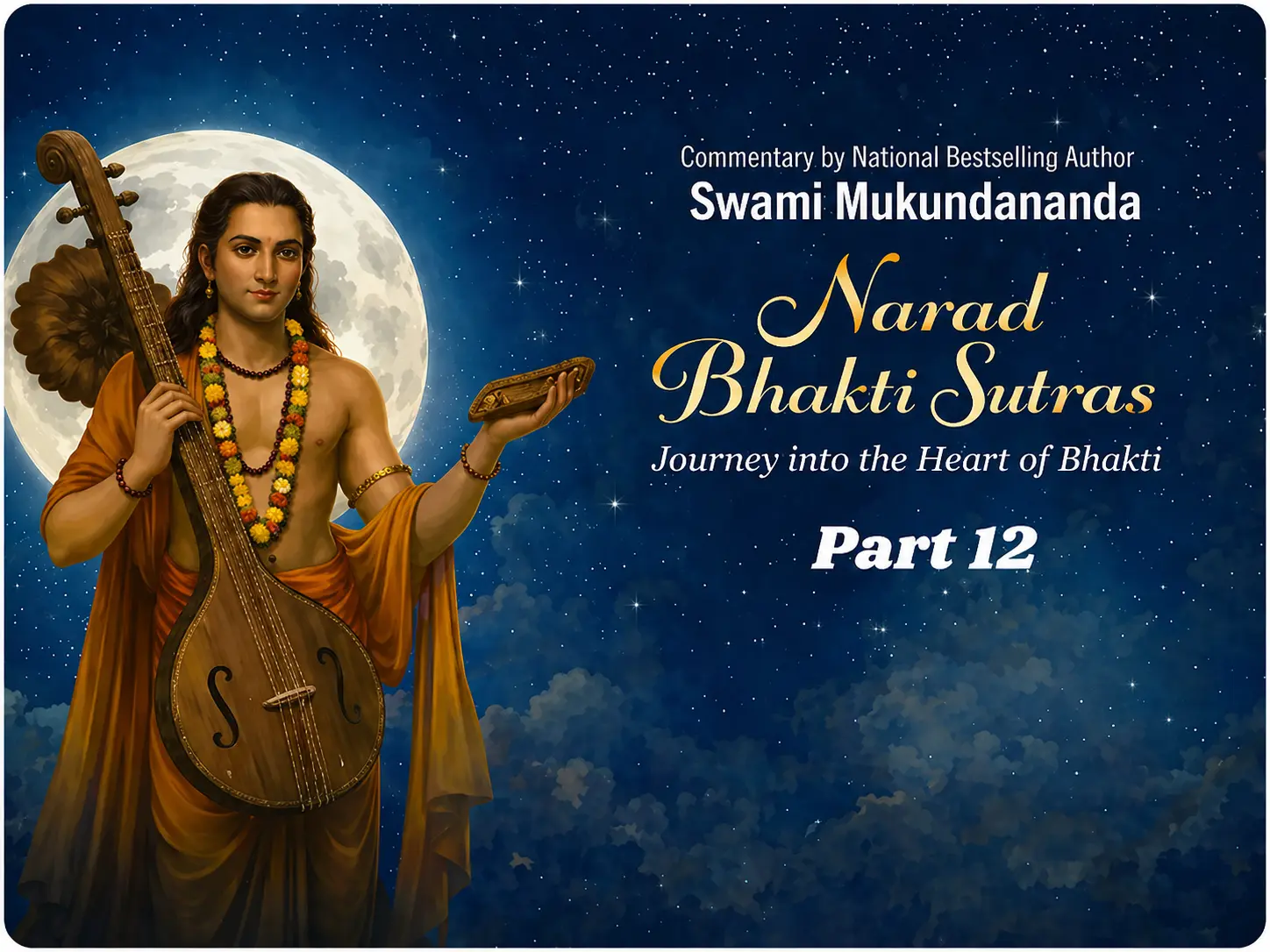

Why Do We Feel So Hurt? A Spiritual Inquiry into Ego, Devotion, and Inner Freedom
Why is it that a few careless words can linger in the mind long after they are spoken? Why does a passing remark echo louder than praise? Why do we carry invisible wounds from moments that, on the surface, seem so small?
Look closely, and you will notice something unsettling. The pain we feel is rarely proportional to the event itself. A simple disagreement can disturb our peace for days. A moment of disregard can feel like a rejection of our very being. It is as though the mind is not merely reacting. It is defending something fragile, something deeply invested in being seen, validated, and affirmed.
We live in an age where identity has become sacred. Opinions are extensions of the self. Beliefs are worn like armor. Recognition feels like nourishment, and neglect feels like deprivation. In such a world, even the slightest friction can ignite an inner storm. But the question remains. What exactly is being threatened?
The sages of India have long contemplated this mystery. Through the insights of Swami Mukundananda ji, the devotional depth of the Narada Bhakti Sutra, and the timeless wisdom of the Bhagavad Gita, a profound answer emerges.
The source of our hurt is not the world. It is the self we have constructed within it.
This self is not the soul, which is eternal, unchanging, and untouched by external events. Rather, it is a mental construct. It is an identity woven from memories, roles, achievements, appearances, and beliefs. This constructed self seeks constant reinforcement. It wants to be acknowledged, respected, and preserved. When it is challenged, it reacts, not with clarity, but with pain.
This is what we call the ego.
The ego is subtle. It does not always appear as arrogance or pride. Often, it hides behind sensitivity, righteousness, or even vulnerability. It whispers, “You deserve better,” “You are right,” “You have been wronged.” In doing so, it creates a narrative where the world becomes the problem and we become the victim.
But what if this narrative is incomplete?
What if the hurt we experience is not a reflection of reality, but a distortion created by identification? What if the mind, in trying to protect us, is actually the source of our suffering?
This blog is an invitation to look inward. It is not about suppressing emotions, but about understanding them at their root. It is a journey into the mechanics of the ego, the nature of attachment, and the possibility of inner freedom.
Because beyond the turbulence of hurt lies a state of being that is untouched, unshaken, and deeply peaceful.
And the path to that state has already been mapped through wisdom, devotion, and self-awareness.
The source of our hurt is not the world. It is the self we have constructed within it.
The Illusion of Ego and the Power of Humbleness

Swami Mukundananda ji explains a simple but profound truth. We do not feel hurt because of what others say. We feel hurt because of our ego.
Ego, in spiritual terms, is not merely arrogance or pride. It is a false sense of identity. It is the deep-rooted belief that “I am this body,” “I am this mind,” “I am my achievements,” and “I am my opinions.”
This false identification creates a fragile self-image that constantly needs protection.
When someone criticizes you, they are not attacking your soul. Your ego perceives it as a threat, and so it reacts.
This is why:
- A disagreement feels like a personal attack
- A correction feels like humiliation
- A rejection feels like worthlessness
The ego turns neutral events into emotional wounds.
But this raises an important question. If the ego is the source of our hurt, what is its deeper nature, and why does it create such inner disturbance?
Spiritual wisdom offers a clear insight. The ego thrives on recognition and superiority, yet it is fundamentally disconnected from truth. It creates an illusion of importance that neither God nor the world truly values.
It is often said that God loves humbleness and rejects egotism. Interestingly, the world reflects the same principle. When someone boasts or displays pride, they may believe they are impressing others, but in reality, they evoke discomfort, envy, or even resentment. On the other hand, humility naturally attracts respect and harmony.
This reveals a profound paradox. While we dislike ego in others, we unknowingly nurture it within ourselves. The very force that distances us from others also distances us from inner peace.
In this way, the ego is not just the cause of hurt. It is also the barrier that prevents us from experiencing genuine connection, acceptance, and spiritual growth.
The Root of Ego: False Identification
If the ego is the source of our hurt, then we must go deeper and ask an even more fundamental question. What gives rise to the ego in the first place?
The answer lies in what the sages call false identification.
At its core, the ego is built upon a simple but powerful misunderstanding. We begin to identify ourselves with things that are not truly us. We say, “This is me” and “This is mine,” without ever questioning the truth behind these claims.
Maharshi Patanjali has thrown profound light on this when he explained that false identification is the basis of pride. It is the biggest lie in our life, and it primarily makes our own selves unhappy
This occurs when we incorrectly extend our sense of "self" to external things rather than recognizing ourselves as the soul. This process often begins in childhood, such as when a child extends their sense of self to a toy and feels personally shattered if the toy is snatched away because they believe it is "mine". As we grow, this false identification extends to our physical bodies, our thoughts, and our beliefs. Identifying so strongly with our own beliefs can even make us feel we have the right to resent or harm those who disagree with us. Ultimately, this false identification that forms the basis of pride is described as the biggest lie in our life and is the primary source of our own unhappiness
Over time, these layers form a constructed identity, one that feels real but is inherently fragile. And because it is fragile, it must constantly be protected.
This is where hurt arises. When something we have identified with is questioned or threatened, the ego reacts as though the self itself is under attack. In reality, it is not the soul that is disturbed, but the illusion we have built around it
“Edging God Out”: The Spiritual Meaning of Ego
A powerful way to understand ego is through the acronym:
E.G.O. = Edging God Out
Where ego enters, divine presence exits.
This is not just poetic—it is deeply philosophical.
According to the Bhagavad Gita, our true nature is divine. We are not the body or mind—we are the eternal soul (Atman). But when we identify with temporary labels, we disconnect from that truth.
In Chapter 2, Verse 71, Krishna says:
विहाय कामान्य: सर्वान्पुमांश्चरति नि:स्पृह: |
निर्ममो निरहङ्कार: स शान्तिमधिगच्छति || 71||
That person, who gives up all material desires and lives free from a sense of greed, proprietorship, and egoism, attains perfect peace.
This verse directly addresses ego. The sense of “I” and “mine” is the root of suffering.
When we cling to identity, we create vulnerability. When that identity is challenged, we feel hurt.
The Architecture of Hurt: How Ego Defends Itself
The ego is not passive—it is highly active and strategic.
Swami Mukundanandaji describes how the ego creates defense mechanisms to protect itself. One of its most common tools is hurt.
Hurt is not an accident—it is a strategy.
When you say:
“I am hurt because they said this…”
The deeper truth is:
“My ego is hurt because it feels threatened.”
The ego thrives on:
- Being right
- Being superior
- Being validated
- Being recognized
When any of these are challenged, it reacts
From Hurt to Grievance
If hurt is repeated, it evolves into grievance.
A grievance is a sustained emotional narrative:
- “They always disrespect me”
- “People don’t appreciate me”
- “I deserve better”
The ego feeds on these stories. It uses them as fuel to stay alive.
In fact, the ego prefers resentment over peace—because peace dissolves it.
Ego as a Cancer Cell

Swami ji provides a powerful analogy:
The ego is like a cancer cell.
A cancer cell:
- Grows uncontrollably
- Consumes resources
- Destroys the organism it lives in
Similarly, the ego:
- Expands through identification
- Feeds on negativity
- Destroys inner peace
It does not care about your happiness—it only cares about its survival.
The Root of Ego: False Identification

If the ego is the source of our hurt, then we must go deeper and ask an even more fundamental question. What gives rise to the ego in the first place?
The answer lies in what the sages call false identification.
At its core, the ego is built upon a simple but powerful misunderstanding. We begin to identify ourselves with things that are not truly us. We say, “This is me” and “This is mine,” without ever questioning the truth behind these claims.
Maharshi Patanjali has thrown profound light on this when he explained that false identification is the basis of pride. It is the biggest lie in our life, and it primarily makes our own selves unhappy
This occurs when we incorrectly extend our sense of "self" to external things rather than recognizing ourselves as the soul. This process often begins in childhood, such as when a child extends their sense of self to a toy and feels personally shattered if the toy is snatched away because they believe it is "mine". As we grow, this false identification extends to our physical bodies, our thoughts, and our beliefs. Identifying so strongly with our own beliefs can even make us feel we have the right to resent or harm those who disagree with us. Ultimately, this false identification that forms the basis of pride is described as the biggest lie in our life and is the primary source of our own unhappiness.
Over time, these layers form a constructed identity, one that feels real but is inherently fragile. And because it is fragile, it must constantly be protected.
This is where hurt arises. When something we have identified with is questioned or threatened, the ego reacts as though the self itself is under attack. In reality, it is not the soul that is disturbed, but the illusion we have built around it
While this explains the root of ego, the Bhagavad Gita further reveals how this inner disturbance unfolds within the mind.
Bhagavad Gita: The Psychology of Hurt
ध्यायतो विषयान्पुंस: सङ्गस्तेषूपजायते |
सङ्गात्सञ्जायते काम: कामात्क्रोधोऽभिजायते || 62||
BG 2.62: While contemplating on the objects of the senses, one develops attachment to them. Attachment leads to desire, and from desire arises anger.
In these verses, the Bhagavad Gita describes how suffering develops step by step. When the mind dwells on external objects, attachment begins to form. From attachment arises desire, and when that desire is not fulfilled, it leads to frustration and anger. This anger clouds judgment, creating confusion and a loss of clarity, which ultimately results in inner downfall.
Within this sequence, hurt arises at an early stage. It begins with attachment, whether to identity, expectations, or outcomes. The moment the mind becomes dependent on how things should be, it becomes vulnerable. When reality does not align with these expectations, hurt naturally arises.
In this way, the Bhagavad Gita reveals that hurt is not an isolated emotion. It is the beginning of a deeper chain, rooted in attachment and sustained by the ego.
Narada Bhakti Sutra 27: Humility and the Dissolution of Ego
If ego is the root of our hurt, then the next question naturally arises. Is there a state in which hurt completely disappears?
The answer is found in the teachings of the Narada Bhakti Sutra, particularly Sutra 27:
ईश्वरस्याप्यभिमानद्वेषित्वाद् दैन्यप्रियत्वाच्च ॥ २७ ॥
īśvarasyāpy abhimāna-dveṣitvād dainya-priyatvāc ca
Deeper Meaning
This sutra states something very subtle yet powerful:
Even God dislikes pride and is naturally drawn toward humility.

At first glance, this may sound like a moral teaching. But it is much deeper than that. It is not about God having preferences like a human. It is about the very nature of divine reality.
Narada explains that the nature of devotion becomes clearer when we understand the relationship between the Divine and the human heart. Even God does not respond to pride, because pride creates a sense of separation. It builds a wall around the individual, reinforcing the feeling of “I” and “mine,” which distances the soul from its true essence.
On the other hand, humility softens the heart. It removes the barriers created by ego and allows the individual to become receptive to divine grace. In a state of humility, there is no insistence on recognition, no demand for validation, and no need to defend an identity. The mind becomes calm, open, and aligned with a higher truth.
In this sutra, Narada uses the word “api”, meaning “also,” to convey a subtle yet profound idea. It indicates that even the Supreme Being reflects qualities that we can relate to. Just as human beings naturally prefer humility over pride, the Divine too is drawn toward those who are humble and rejects ego.
God is described as a compassionate friend of the fallen. He is not distant or judgmental, but deeply accessible to those who approach Him with sincerity and humility. This is why He is lovingly addressed by names such as Patit Pavan, the savior of the fallen, and Dinbandhu, the friend of the destitute.
This understanding carries a powerful implication. If we wish to experience divine grace, we must align ourselves with the nature of the Divine. By cultivating humbleness and letting go of pride, we make our hearts receptive to God’s presence.
Humility reflects the absence of ego. Where ego divides, humility unites. Where ego creates tension, humility brings peace.
The same ego that distances us from the Divine is also the source of our emotional suffering. It constantly seeks validation, recognition, and importance, and when these are not fulfilled, hurt arises.
As humility deepens, this cycle begins to dissolve. The need to protect an identity weakens, dependence on external validation fades, and the mind gradually becomes free from these patterns.
The relationship between ego and separation is beautifully illustrated in the divine pastimes of Krishna and the Gopis.
The Maharas and the Rise of Pride According to the scriptural accounts of the Bhagavatam, on the enchanting autumn full moon night (Sharad Purnima), Shree Krishna played his divine flute, drawing the Gopis of Vrindavan into the forest. To reciprocate their intense devotion, Krishna miraculously multiplied his form, appearing beside every single Gopi so that each one felt He was dancing exclusively with her. As they immersed themselves in the ecstasy of the dance, a subtle pride began to creep into the minds of the Gopis. They started to think, "We are the most fortunate, beautiful, and exalted women in the universe, for the Supreme Lord is entirely captivated by us." This moment perfectly illustrates the root of pride mentioned in your sources: false identification. The Gopis temporarily extended their sense of "self" to their physical beauty and their privileged status, losing sight of pure devotion.
The Disappearance of Krishna
"God hates egotism and loves humbleness. Because the ego is fundamentally an acronym for "edging God out," the divine presence cannot coexist with pride. As Swami ji emphasizes, if you wish to savor divine love (prem), you cannot simultaneously harbor pride, because "in one sheet two swords will not fit." True to this principle, the moment the Gopis' egos inflated, Shree Krishna abruptly vanished from their midst. As Swami ji explains "wherever the ego comes in God goes out."
The Purification Through Separation
Krishna's sudden disappearance plunged the Gopis into agonizing grief. They wandered frantically through the Vrindavan forest, weeping and asking the trees, the rivers, and the animals if they had seen their beloved. This intense agony of separation completely shattered their illusion of superiority. By experiencing this profound loss, their false pride was entirely washed away. It was only when they were stripped of their ego and returned to a state of absolute, desperate humbleness that Krishna reappeared to them, allowing the blissful Maharas to resume.

This story reveals a timeless truth. Ego creates distance, while humility restores connection.
A Powerful Philosophical Insight
This sutra reveals a deep truth:
Hurt is not just a psychological issue. It is a spiritual symptom of ego.
And therefore:
Freedom from hurt is not achieved by controlling the world, but by dissolving the ego.
Connection with Swami Mukundananda
This aligns beautifully with Swami Mukundananda ji’s teaching:
- Hurt is a defense mechanism of pride
- Ego thrives on being acknowledged
- When not acknowledged, it creates suffering
Narada Bhakti Sutra 27 adds:
The very ego that causes hurt also prevents divine connection.
So the solution is not external adjustment, but inner transformation through humility and devotion.
Narada Bhakti Sutra 27 reveals that God is naturally drawn to humility and repelled by pride. This is not a judgment, but a reflection of spiritual reality. Ego creates separation, while humility dissolves it. The same ego that makes us seek validation also makes us vulnerable to hurt. When humility arises, the need to defend an identity disappears, and with it, the very foundation of emotional pain begins to fade.
While Narada Bhakti Sutra 27 reveals that humility dissolves ego and opens the heart to devotion, the Bhagavad Gita deepens this understanding by showing that humility is also the foundation of true knowledge and inner stability.
Bhagavad Gita 13.8: Humility as the End of Hurt
अमानित्वमदम्भित्वमहिंसा क्षान्तिरार्जवम् ।
आचार्योपासनं शौचं स्थैर्यमात्मविनिग्रहः ॥ १३.८ ॥
Explanation and Connection
In this verse, Bhagavad Gita begins to define what true knowledge really is. Instead of describing intellectual ability or philosophical understanding, Krishna lists qualities of inner character. Among the very first are humility and the absence of pride.
Humility, or amanitvam, means freedom from the desire for respect and recognition. Pridelessness, or adambhitvam, means the absence of false prestige and the need to project an inflated self-image.
This connects directly to the experience of hurt.
We feel hurt because we expect acknowledgment. We feel hurt because we want to be valued, appreciated, and agreed with. When these expectations are not fulfilled, the ego reacts, and that reaction manifests as emotional pain.
Krishna’s teaching reveals a deeper truth. The more we depend on external validation, the more fragile our inner state becomes. The more we build an identity that seeks recognition, the more vulnerable we are to disturbance.
Humility transforms this completely.
When there is no demand for respect, there is nothing to be denied. When there is no ego to defend, criticism loses its power. The mind becomes steady, not because the world has changed, but because the inner dependence has dissolved.
In this way, Bhagavad Gita 13.8 shows that humility and the absence of pride are not just virtues. They are the foundation of inner freedom. They dissolve the expectations and identities that give rise to hurt, allowing the individual to remain peaceful even in the face of external challenges.
While these teachings provide a profound understanding of ego and humility, their true value lies in how they transform our everyday experience.
Understanding the Subtle Workings of Ego
As expectations grow, hurt naturally arises. But beneath this pattern lies a deeper tendency of the ego that often goes unnoticed. One of its most persistent traits is its need to be right. To the ego, admitting “I am wrong” feels like a form of defeat. It threatens the very identity it has constructed. As a result, instead of accepting mistakes, the ego shifts into defense. It begins to blame others, justify its position, and search for faults. This is why arguments often escalate beyond reason. What appears to be a search for truth is, in reality, a struggle for psychological survival.
This tendency expresses itself most clearly through fault-finding. A simple way to recognize the presence of ego is to observe the mind when it complains. Whenever the mind is engaged in criticism or negativity, it is often the ego speaking. Fault-finding is rarely about genuine improvement. It is about reinforcing a sense of superiority. The ego feels stronger when it places others in a lesser position, even if that strength is temporary and hollow.
Spiritual wisdom, however, does not ask us to suppress the ego by force. Instead, it invites us to observe it with awareness. Self-awareness becomes the first step toward freedom. When we pause and reflect, asking questions such as why a particular situation hurt us, what part of our identity felt threatened, and whether the reaction was truly about the situation or about our perception of it, we begin to loosen the grip of ego. Through observation, the ego loses its unconscious control.
The Nature of an Impure Mind
The primary sign of an impure mind is its tendency to see faults even in places where goodness exists. Influenced by ego and pride, it constantly focuses on defects in others. Although the world contains both good and bad qualities, such a mind is naturally drawn toward the negative.
This inner impurity expresses itself in subtle but powerful ways. One of the clearest signs is constant complaining. Whenever the mind complains, it is often the voice of pride speaking from within. The ego seeks to be right, and in doing so, it turns others into the ones who are wrong.
Another sign is the tendency to hold onto grudges and grievances. The ego feeds on resentment, using it to sustain its sense of identity. In the process, it disturbs inner peace and creates distance in relationships.
In contrast, a pure mind reflects a very different vision. It possesses the rare ability to see goodness even in imperfect situations. It does not ignore flaws, but it is not defined by them. Instead, it chooses to focus on what uplifts, connects, and brings clarity.
As this awareness deepens, acceptance begins to emerge naturally. The ego resists reality, insisting that people and situations should conform to its expectations. This resistance creates inner conflict. Acceptance, on the other hand, dissolves this tension. When we begin to accept life as it unfolds, the ego gradually loses its hold.
It is important to understand that acceptance is not a sign of weakness. It does not mean passive approval or inaction. Rather, it reflects a shift from emotional reactivity to clarity of response. In acceptance, the mind becomes steady. It no longer reacts impulsively but responds with awareness and balance.
As the mind becomes calmer, a higher practice becomes possible. The ability to see the good in others begins to develop. This is not a naive perspective, but a transformative one. An impure mind tends to find faults even in good people, while a purified mind learns to recognize goodness even in imperfect situations. This shift in perception gradually changes the way we experience the world.
True spiritual maturity is the ability to see goodness and learn from every being, no matter how ordinary they may appear.
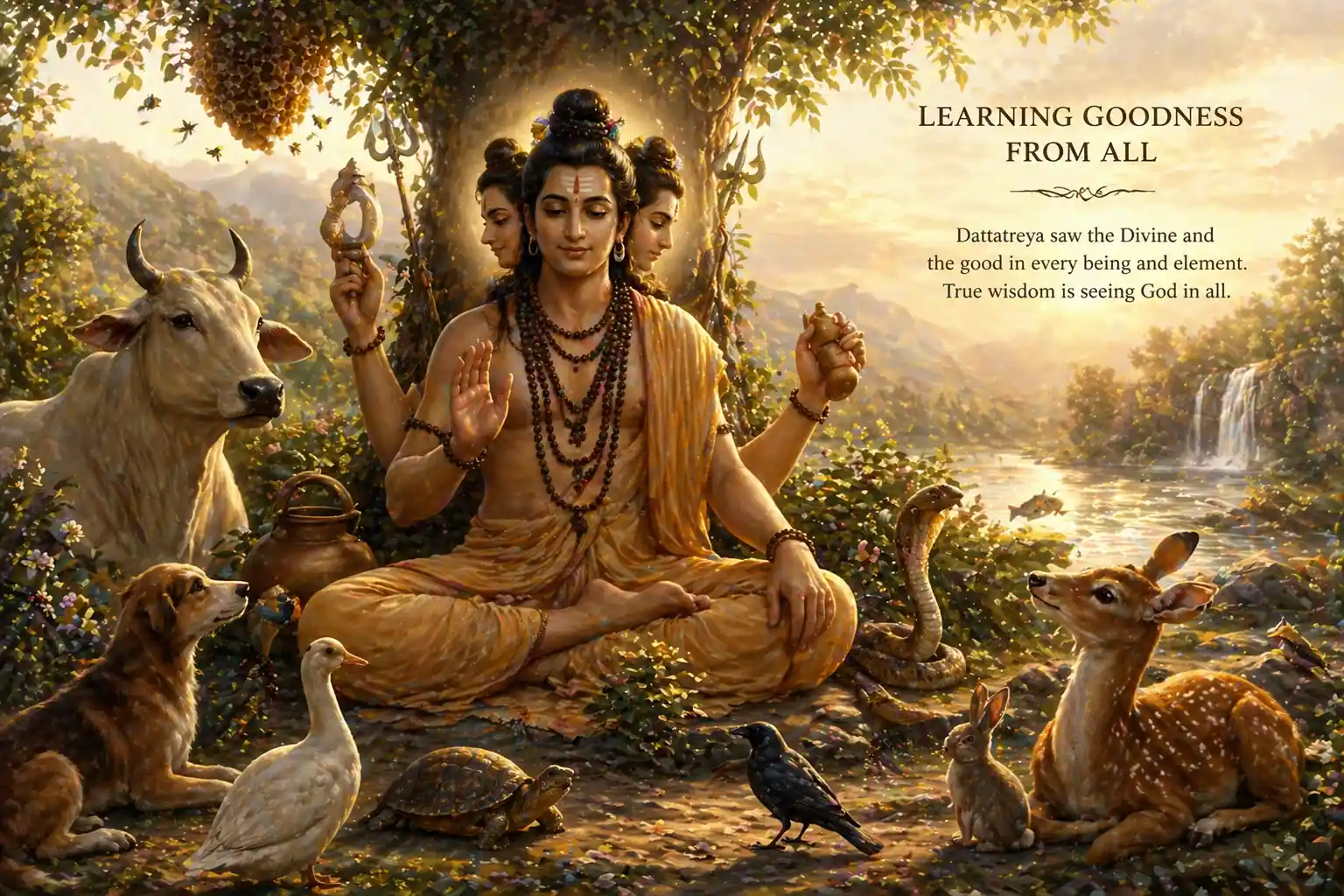
A powerful example of this vision is seen in the life of Sage Dattatreya. He was able to learn from a dog, an elephant, and even a prostitute. His ability to see value in all beings reflects a profound level of spiritual maturity. It reminds us that wisdom is not limited to ideal conditions, but can be discovered everywhere when the mind is free from judgment.
At the highest level, this vision expands even further into the realization of seeing the Divine in everyone. This is not merely a poetic idea but a lived experience. When one truly perceives divinity in all beings, the sense of separation dissolves. In that state, there is no room for hatred, no basis for superiority, and no reason for hurt. The perception of “otherness” disappears, and with it, the emotional reactions that arise from it.
Practical Steps to Overcome Hurt
Understanding the ego is only the beginning. Real change comes from applying this awareness in daily life.
Start by pausing before reacting. Instead of immediately responding to hurt, observe the emotion. This creates space for clarity.
Then, question the ego. Ask yourself, “What part of me is hurt?” This reveals the expectation or identity behind the reaction.
Next, cultivate humility. Remind yourself that your perspective may not be complete. This softens the need to defend yourself.
It is also important to let go of the sense of ‘mine.’ The less attached you are to identity, the less vulnerable you become.
As you go deeper, cultivate devotion by shifting from self-centeredness to a higher focus. This gradually weakens the ego.
At the same time, train your mind to see the good in others. This purifies perception and reduces negativity.
Finally, practice acceptance. Accept people and situations as they are. This removes inner resistance and brings peace.
Through these simple yet powerful steps, the hold of ego begins to loosen, and with it, the intensity of hurt gradually fades.
Conclusion
Ultimately, our tendency to feel hurt easily is not shaped by the world around us or by the actions of others. It is the inevitable reaction of a fragile ego struggling to protect a false identity. What we experience as hurt is not an injury to the soul, but a disturbance in the illusion we have created about who we are. When this illusion is threatened, the ego rises in defense, feeding on grievances, fault-finding, and complaint, much like a cancer that consumes the very being it inhabits.
To recognize this is the beginning of freedom.
Spirituality offers us the clarity and self-awareness to break this cycle. It teaches us to stop nurturing the grudges that quietly poison our inner life and instead to accept reality as it unfolds. In that acceptance, the ego begins to lose its power, because it is no longer sustained by resistance, comparison, or the need to be right. The measure of our progress then shifts. It is no longer about winning arguments or proving superiority, but about the purity of our perception and the quiet strength of our inner peace.
The lives of great sages remind us of what is possible. Like the sage Dattatreya, who found wisdom in a dog, an elephant, and even a prostitute, we are called to cultivate a vision that sees value everywhere. This is not a superficial positivity, but a deep transformation of perception. It is the ability to rise above judgment and discover meaning in every encounter, no matter how ordinary or imperfect it may seem.
While the highest realization lies in seeing the Divine in all beings, our immediate task is both simple and profound. In our daily practice, or sadhana, we must consciously purify the mind. This begins with a deliberate choice to see the good in others rather than dwell on their faults. Each such choice weakens the ego and strengthens the heart.
In the end, the path is not about changing the world. It is about transforming the way we see it. As we turn away from negativity and toward goodness, the ego gradually dissolves. In its place arises humility, clarity, and a deeper capacity to love.
And in that space, where the ego no longer dominates, hurt loses its foundation, and the heart becomes a vessel for divine peace.
Key Takeaways
- Emotional hurt arises from the ego’s need for validation and identity.
- Attachment to expectations makes the mind vulnerable to disturbance.
- Humility weakens the ego and brings inner stability.
- A pure mind sees goodness, while an impure mind focuses on faults.
- True peace begins when we observe the ego instead of reacting to it.
- Acceptance dissolves inner resistance and reduces emotional suffering.
- The ego thrives on comparison, judgment, and the need to be right.
- Letting go of pride opens the heart to deeper connection and peace.
- Spiritual growth begins with self-awareness and honest introspection.
- Seeing good in others purifies the mind and transforms perception.
🌟 Final Call to Action
👉 For more life-changing teachings, subscribe to the official YouTube channels:
👉 Watch the complete Narad Bhakti Sutra series on the Bhagavad Gita Krishna Bhakti Channel:
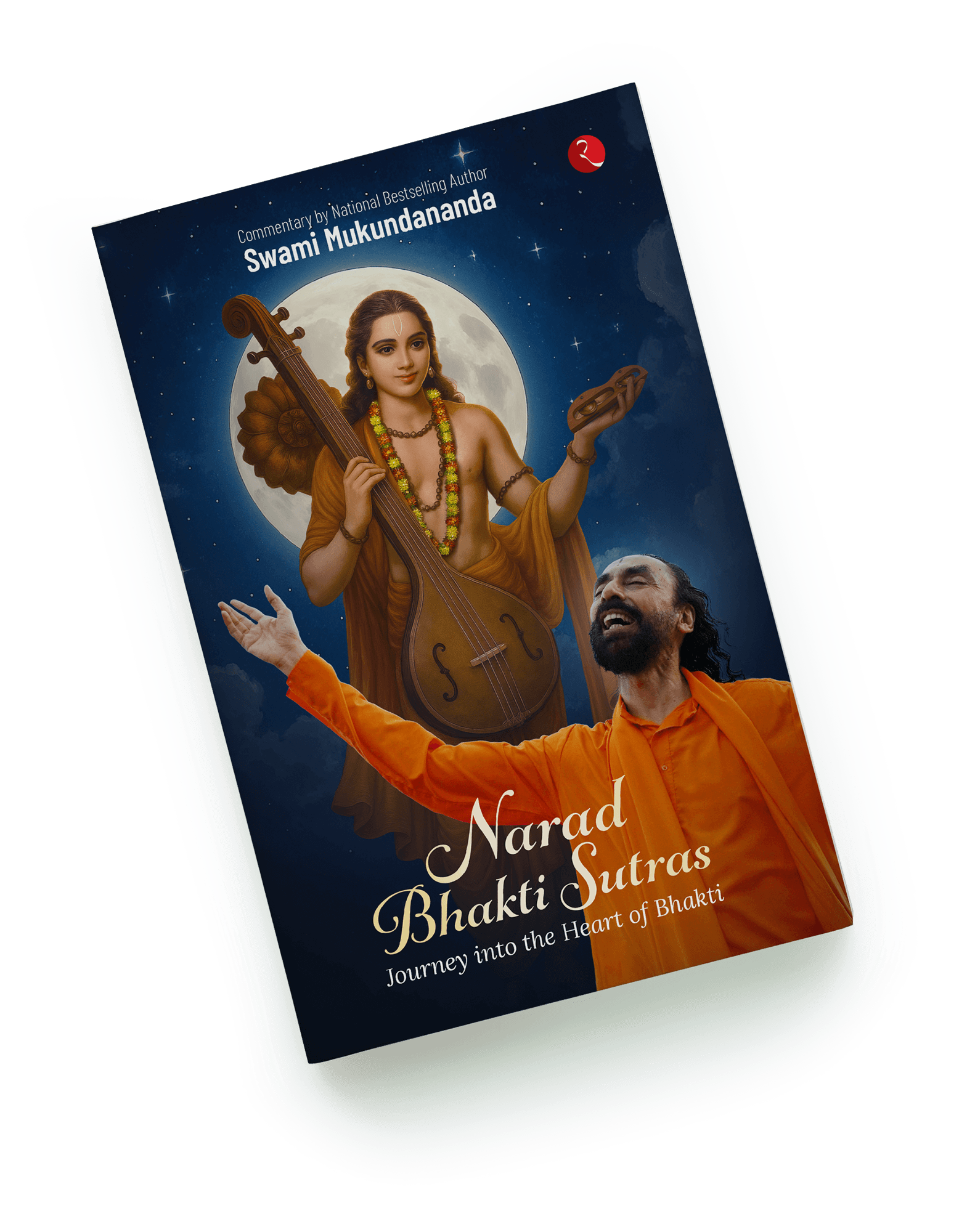
Buy the "Narad Bhakti Sutras" by Swami Mukundananda
Now that we’ve explored the divine wisdom of the Narad Bhakti Sutras, it’s time to take the next step on your spiritual journey. To deepen your understanding of the Narad Bhakti Sutras, we highly recommend Swami Mukundananda’s commentary, which beautifully unpacks each mantra providing a clear and practical guide for modern seekers.
Order the Book: Swami Mukundananda’s Commentary
Unlock the deeper wisdom of the Narad Bhakti Sutras with this insightful commentary by Swami Mukundananda. Perfect for modern seekers who wish to explore the divine teachings in greater depth.
Order the Book Now (India)Order the Book Now (USA)
FAQs
1. Why do we feel hurt so easily?
Because the ego feels threatened when our expectations or identity are challenged.
2. What is the root cause of emotional hurt?
Attachment to identity, expectations, and the need for validation.
3. How can I reduce emotional hurt?
By practicing self-awareness, humility, and acceptance.
4. What does the Bhagavad Gita teach about hurt?
It shows that attachment leads to suffering, and detachment brings peace.
5. How does devotion help in overcoming ego?
True devotion dissolves the sense of “I,” removing the source of hurt.
.