


The Silent Saboteur: Understanding Laziness through Bhagavad Gita Wisdom
We’ve all experienced it. A planned morning slips away. Tasks get postponed. The fire within flickers faintly under the weight of inertia.
What stops us isn’t always fatigue or lack of talent—it’s something subtler and far more dangerous: ālasyam, laziness.
In ancient Sanskrit wisdom, it is said:
"Ālasyam hi manuṣyānām śarīrastho mahān ripuḥ"
“Laziness is a great enemy residing in the body.”
In the Bhagavad Gita, this inner enemy is identified as a symptom of tamoguna, the quality of darkness and inertia.
“O Arjun, tamo guṇa, which is born of ignorance, is the cause of illusion for the embodied souls.”
—Bhagavad Gita 14.8
🔗 Read Full Verse
Swami Mukundananda explains that tamas does not merely make us tired; it dulls our intellect, clouds our judgment, and erodes our inner fire. Laziness isn’t just “doing nothing”—it’s the absence of meaningful action when it’s most needed.
Laziness in Disguise: The Many Faces of Tamas
Laziness often disguises itself:
- “I deserve to rest” becomes a habit of avoiding growth.
- “I’ll do it later” morphs into indefinite postponement.
- “I’m not feeling it today” becomes a personality trait.

This is how tamas works. It camouflages itself in the language of comfort, convenience, and false self-care. But true self-care, as taught in the Bhagavad Gita, is alignment with one’s swadharma—our higher duty.
“You should thus perform your prescribed Vedic duties, since action is superior to inaction. By ceasing activity, even your bodily maintenance will not be possible.”
—Bhagavad Gita 3.8
🔗 Read Full Verse
Why We Become Lazy: The Guna Game
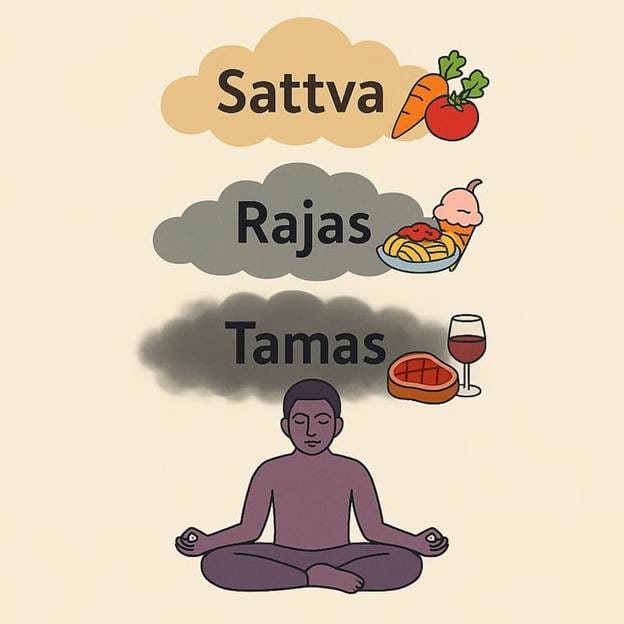
In Chapter 14, Shree Krishna introduces the concept of the three gunas that influence the human mind:
1. Sattva (purity) – clarity, peace, and contentment
2. Rajas (passion) – activity, restlessness, and desire
3. Tamas (ignorance) – lethargy, delusion, and inertia
“O mighty-armed Arjun, the material energy consists of three guṇas (modes)—sattva (goodness), rajas (passion), and tamas (ignorance). These modes bind the eternal soul to the perishable body.”
—Bhagavad Gita 14.5
🔗 Read Full Verse
Swami Mukundananda compares this to a spinning wheel—sometimes sattva lifts us into clarity, sometimes rajas drives us into ambition, and sometimes tamas drags us into darkness. Laziness flourishes when tamas prevails.
The key is vigilant self-awareness. Observe which guna is dominating you, and take conscious steps to elevate your state.
The True Cost of Laziness
The real danger of laziness isn’t just lost productivity. It’s spiritual regression. It:
- Weakens willpower
- Erases self-belief
- Blocks spiritual elevation
- Reinforces ego and excuses
Shree Krishna’s counsel is clear:
“O Arjun, nescience, inertia, negligence, and delusion—these are the dominant signs of the mode of ignorance.”
—Paraphrased from Bhagavad Gita’s collective messages on tamas (14.11–14.13)
🔗 Read Full Verse
The soul does not rejoice in comfort—it rejoices in effort, alignment, and evolution. Every moment spent in tamas is a moment stolen from our divine potential.
Reclaiming Mastery: The Bhagavad Gita’s Call to Discipline
“Elevate yourself through the power of your mind, and not degrade yourself, for the mind can be the friend and also the enemy of the self.”
—Bhagavad Gita 6.5
🔗 Read Full Verse
We are our own friend and our own enemy. When we allow tamas to rule us, we degrade the Self. But when we discipline the mind, we rise.
Swami Mukundananda puts it simply:
“Your mind can be your best friend or your worst enemy. Train it. Don’t obey it blindly.”

Your body and mind are tools—but only when you claim control. If untrained, they drag you down. If disciplined, they serve your divine goal.
Tools for Discipline: Bhagavad Gita Inspired Daily Practices
Discipline isn’t born. It is cultivated—daily.
“Only by practice and detachment can the mind be controlled.”
—Bhagavad Gita 6.35
🔗 Read Full Verse
1. Start Small but Be Consistent
Don’t wait for motivation. Begin with a 5-minute morning sadhana, a short walk, or one focused task. The soul rejoices in direction more than magnitude.
2. Create a Sattvic Morning Routine
“But those who are temperate in eating and recreation, balanced in work, and regulated in sleep, can mitigate all sorrows by practicing Yog.”
—Bhagavad Gita 6.17
🔗 Read Full Verse
Rise during Brahma Muhurta (4–6 am). Meditate. Journal. Chant. Let the early stillness reshape your day.
3. Sadhana: The Anchor of the Soul
Your spiritual practice is not optional—it is your lifeline. Just as food sustains the body, sadhana nourishes the soul.
“Whatever you do, offer it to Me.”
—Bhagavad Gita 9.27
🔗 Read Full Verse
4. Purify Your Environment
Laziness thrives in tamasic spaces. Create order. Surround yourself with reminders of your divine aspiration—books, mantras, art, and clean surroundings.
5. Show Up—Even Without Inspiration
Don’t wait for “feeling like it.” Shree Krishna advises to act from duty, not desire.
“Act without attachment, being steadfast in yog.”
—Bhagavad Gita 2.48
🔗 Read Full Verse
Cultivating Inspiration: A Fire You Build
Inspiration is not a gift—it’s a byproduct of repeated right action.

The Bhagavad Gita’s Path to Inspiration:
1. Effort (Abhyāsa) – Push through inertia.
2. Detachment (Vairāgya) – Don’t chase fruit.
3. Grace (Kripā) – When the soul is ready, light descends.
“Shree Krishna said: O mighty-armed son of Kunti, what you say is correct; the mind is indeed very difficult to restrain. But by practice and detachment, it can be controlled.”
—Bhagavad Gita 6.35
🔗 Read Full Verse
Shedding the “Chalta Hai” Mentality
Mediocrity isn’t harmless—it is spiritual negligence.
Shree Krishna urges Arjun not to settle:
“Therefore, with the sword of knowledge, cut asunder the doubts that have arisen in your heart. O scion of Bharat, establish yourself in karm yog. Arise, stand up, and take action!”
—Bhagavad Gita 4.42
🔗 Read Full Verse
Excellence is not perfection. It is a sincere, wholehearted effort.
Sadhana: The Daily Fire to Burn Laziness
If you truly want to defeat laziness, adopt a daily spiritual practice—a sadhana.
Why?
Because sadhana does what no motivational video or productivity hack can do. It aligns your actions with your soul.

When you sit to chant, meditate, read scripture, or pray—you’re reminding yourself:
- I am not the body.
- I am not the mind.
- I am the soul.
- And the soul craves connection with the Divine.
You wouldn’t skip a meal, would you? Then why skip the food of the soul?
The body is mud. The soul is eternal. Sadhana is more important than eating.
Final Reflection: Your Soul Deserves Better
You are not a creature of comfort—you are a spark of the Divine. You were not born for mediocrity, but for mahatma-hood—greatness of soul.
“Thus, constantly keeping the mind absorbed in Me, the yogi of disciplined mind attains nirvāṇ, and abides in Me in supreme peace.”
—Bhagavad Gita 6.15
🔗 Read Full Verse
Swami Mukundananda says:
“Each day is a divine opportunity. Don’t let tamas steal your time. Walk with courage, act with discipline, and God will walk with you.”
Call to Action: Begin Your Inner Revolution
✅ Wake up early with a purpose
✅ Begin a 10-minute sadhana
✅ Recite one Bhagavad Gita verse daily
✅ Watch Swami Mukundananda’s YouTube for guidance
✅ Reflect: What tamas can I replace with tapas (discipline) today?
Discipline is the bridge between aspiration and realization. Cross it daily.
📚 Resources
1. 🎥 Swami Mukundananda on Laziness and Discipline
From Laziness to Light – YouTube Video
2. 📘 7 Divine Laws to Awaken Your Best Self
🛒 Buy on Amazon
3. 🧘♀️ JKYog Daily Sadhana Resources
🌐 Visit JKYog.org
❓ Related FAQs
1. What is the root cause of laziness according to the Bhagavad Gita?
Laziness stems from the dominance of tamoguna—the mode of ignorance. As explained in Bhagavad Gita 14.8, tamas clouds the intellect, promotes sleep, and binds the soul in delusion. Swami Mukundananda explains that when tamas controls our mind, it becomes passive, avoidant, and spiritually stagnant.
2. Is laziness a sin or just a habit in Vedic philosophy?
In the Bhagavad Gita, laziness is not labeled as sin but as a mental bondage that delays our soul’s evolution. It is considered a major obstacle to spiritual progress, like an internal thief of time and willpower. It must be purified through discipline, sadhana, and conscious living.
3. How can I tell if tamas is dominating my mind?
When tamas is dominant, symptoms include:
- Excessive sleep or drowsiness
- Apathy toward purpose
- Procrastination
- Negative or depressive thinking
- Lack of clarity
You may also feel physically heavy and mentally foggy. Bhagavad Gita 14.13 describes how tamas results in delusion and heedlessness.
4. What’s the difference between laziness and needed rest?
Rest is restorative and intentional, while laziness is an escape rooted in inertia. Rest energizes; laziness drains. Swami Mukundananda emphasizes that true rest rejuvenates us to fulfill our dharma, whereas laziness distracts us from it.
5. What if I try to be disciplined but keep failing?
Don’t be discouraged—willpower is like a muscle. Each effort, no matter how small, makes it stronger. The Bhagavad Gita encourages abhyāsa (steady practice) and vairāgya (detachment from outcome) as the twin tools to succeed over time (Bhagavad Gita 6.35).
6. Why is daily sadhana so effective in overcoming laziness?
Sadhana is the spiritual fire that burns tamas. By connecting with the Divine daily—through chanting, meditation, or reading scripture—you awaken the soul’s energy. Swami Mukundananda teaches that sadhana shifts us from identification with the lazy body and mind to our eternal, vibrant soul.
7. How do I stay inspired long-term and not relapse into laziness again?
According to both the Bhagavad Gita and Swami Mukundananda:
- Maintain sattvic habits (pure food, sleep, thoughts)
- Stay in spiritual company (satsang)
- Review your purpose regularly
- Practice discipline over motivation
- Set reminders of your divine identity (you are the soul, not the body)
8. Does the Bhagavad Gita say anything about working even when you don’t feel like it?
Yes. Shree Krishna advises karm yog—to act without attachment to feelings or results. In Bhagavad Gita 3.19, He says:
“Therefore, without being attached to the fruits of activities, one should act as a matter of duty.”
This principal trains us to show up consistently, not emotionally.
9. What’s one powerful Bhagavad Gita verse to contemplate on when feeling lazy?
uddhared ātmanātmānaṁ
nātmānam avasādayet
ātmaiva hy ātmano bandhur
ātmaiva ripur ātmanaḥ
In Bhagavad Gita 6.5, Shree Krishna says:
Elevate yourself through the power of your mind, and not degrade yourself, for the mind can be the friend and also the enemy of the self.
Repeat it with faith. Your soul is stronger than your excuses.