

From the Editor’s Desk
As human beings, we often assume that what we see is reality itself. Yet Vedic wisdom gently but firmly challenges this assumption. We do not perceive the world as it is, but according to our faulty beliefs. Our inner state acts as a lens, shaping how we interpret people, situations, and even God’s presence in creation.
While our internal lens can be colored by different kinds of emotions, envy is one of the most powerful distortions of this vision. It quietly alters perception, making us focus on what others possess rather than on the abundance that already surrounds us.
Utilizing the knowledge (i.e., tattva jnana) taught by Swami Mukundananda ji, this issue of JKYog’s E-Journal, Samarpan, addresses the meaning of envy, its harmful impact, causes, consequences, and ways to overcome it. Embellished with vignettes from the Mahabharat, the goal is to enable us to become aware of this defect and to overcome the emotion.
Vedic Wisdom & Application
Challenge of the Month
A Vedic Perspective on Envy: Its Causes, Consequences, and How to Overcome It
Reflection Questions
- What is Envy?
- Why is Envy so Harmful?
- What are the Causes of Envy?
- What are the Consequences of Envy?
- How can we Overcome Envy?

Envy is usually conceived as a moral flaw or an undesirable emotion – something one should feel ashamed of, suppress, or overcome. Yet such an approach often fails, because it treats envy as an isolated feeling rather than as a deeper distortion in how we perceive reality. Two people can observe the same event of success, the same blessing, or the same good fortune, yet one feels inspired and uplifted, while the other feels diminished and resentful. The external situation is identical, but the inner vision is far from similar.
Vedic wisdom invites us to look at envy not merely as an emotional reaction but as a problem of perception. How we see ourselves, others, and the world determines what we experience in our inner world. When the vision is clear, the mind is at ease; when it is distorted, suffering follows naturally. The scriptures consistently emphasize that transformation does not begin by controlling the external world but by refining our drishti – our internal lens of perception.
From this perspective, envy is not something to be fought aggressively, nor something to be justified quietly. It is something to be understood deeply. When seen clearly, envy begins to lose its grip, making way for equanimity, compassion, and inner freedom.
What is Envy?
Vedic scriptures describe envy as an inner aversion toward another’s happiness, success, or well-being (e.g., irsha, jugupsa, and vijigupsa). Envy is not simply wanting what someone else has; it is the discomfort that arises when others prosper, especially when that prosperity seems to highlight one's own perceived lack.
This distinction is important. Healthy aspiration or competition can motivate growth and self-improvement. Envy, by contrast, resents growth itself, particularly when it occurs in someone who harbors resentment for the successful person. Rather than asking, “How can I grow?” an envious person silently asks, “Why do they get all the recognition when my work product is better and performed with dedication?”

Scripturally, envy is understood as a material quality, born of ego-identification. When the sense of self is tightly bound to external markers like status, recognition, achievement, or possessions, life becomes a zero-sum game. Another person’s gain feels like a personal loss.
Envy is harmful not only because it feels unpleasant, but because it quietly corrodes the mind and heart. Unlike anger, which flares up and often resolves, envy can persist subtly for long periods, shaping perception without drawing attention to itself.
On a psychological level, envy creates chronic restlessness. The mind habitually seeks outwardly, scanning for comparisons and judgments. Satisfaction becomes elusive because fulfillment is always measured relative to others. Even genuine accomplishments lose their sweetness when they are constantly weighed against someone else’s perceived advantages. Emotionally, envy erodes compassion. The ability to rejoice in another’s good fortune is replaced by indifference or quiet resentment. Over time, this diminishes emotional warmth and creates inner isolation.
From a spiritual standpoint, envy is especially obstructive. The Bhagavad Gita describes the spiritually mature person as one who is free from envy, seeing the same divine reality in all beings. Envy cannot coexist with humility, devotion, or surrender, because it keeps the ego firmly at the center. As long as life is interpreted through “me versus them,” the heart will remain contracted.
Why is Envy so Harmful?
What makes envy particularly dangerous is that it often disguises itself as fairness, realism, or even moral judgment. One may rationalize envy as criticism, discernment, or concern, without recognizing the underlying aversion. In this way, envy distorts perception while convincing the mind that it is seeing clearly. When envy is allowed to persist, it does not remain an occasional emotion; it becomes a lens through which everything is seen.
Envy is also harmful because it rarely announces itself openly. More often, it appears in subtle patterns of thought and behavior that feel normal or justified.
Harmful Effects of Envy
- Creates an Inner Narrative of Deficiency. When the mind habitually measures itself against others in terms of external appearance, success, intelligence, recognition, etc., it creates an inner narrative of deficiency.
- Creates Hidden Resentment. Outwardly, relationships may remain polite or cordial, but inwardly, there is bitterness toward another’s happiness. Compliments feel forced; appreciation feels incomplete. This creates emotional distance even when social harmony appears intact. Over time, such emotions “kill” any existing virtues.
- Inability to Celebrate Others’ Success. Good news from someone else may trigger discomfort, silence, or a quick shift of attention back to oneself. Over time, this damages relationships and undermines trust, because at its core, envy arises because people fail to recognize the Divine presence permeating all beings and circumstances.
When envy festers unchecked, it does not remain confined to thought; it eventually seeks expression through action.
For example, Duryodhan did not lack power, wealth, opulence, or privilege. He lacked peace of mind. Every excellence of the Pandavas – Yudhisthir’s righteousness, Bhim’s strength, Arjun’s mastery, and the fondness of the elders for them felt like a personal insult to him. Even after unjustly forcing the Pandavas into exile and seizing their kingdom, his heart found no rest. Their very existence disturbed him.
When he witnessed the prosperity of Indraprastha, his envy deepened into obsession. Instead of perceiving the success of his cousins as a reflection of divine blessings for their righteous living, he experienced it as humiliation, especially after Draupadi's sarcastic comment. No counsel could influence him, neither the wisdom of elders nor the compassionate advice of Shree Krishna.

Envy narrowed Duryodhan’s vision so completely that he began to justify all forms of cruelty and injustice. In the end, it was not the Pandavas who defeated him but his own inability to tolerate their resilience and perseverance under Shree Krishna's divine guidance and support.
What are the Causes of Envy?
Envy does not appear without cause. Its roots lie deep within the psyche. Swamiji beautifully explains envy as a complex social emotion triggered when individuals perceive themselves as lacking a quality, possession, or achievement that another person enjoys. Unlike jealousy, which typically involves a fear of losing a relationship to a third party, envy is rooted in a desire for what someone else possesses.
In his commentary on the Ishavasya Upanishad, Swamiji beautifully expounds on the causes of envy, which manifests in the form of the toxic qualities of jugupsa and vijugupsate, the latter of which is characterized by hatred and envy towards others (Mantra 6).
यस्तु सर्वाणि भूतान्यात्मन्येवानुपश्यति ।
सर्वभूतेषु चात्मानं ततो न विजुगुप्सते ॥ ६॥
yastu sarvāṇi bhūtānyātmanyevānupaśhyati
sarvabhūteṣhu chātmānaṁ tato na vijugupsate
All living beings are situated in God, and He resides in all living beings. One who clearly perceives this Truth does not hate anyone (p. 69).
Mantra 6 states that the mind's propensity for negative emotions stems from two primary sources:
- Interference in Fulfillment of One’s Desires: When the mind's cravings are not met, the person blames those who interfered with the fulfillment of their desires, leading to aversion and bitterness. The feeling of lack or "emptiness" due to thwarted desires can lead to hatred upon seeing others attain objects of their own desire. The frustration escalates into anger (corroborated in the Bhagavad Gita, Verses 2.62 and 2.63).
- Ego Defense Mechanisms: Witnessing others' achievements can highlight one's own deficiencies. To cope, the ego engages in fault-finding to preserve its self-image. This is particularly intense when comparing oneself to those perceived as similar in status, age, or background. Thus, when identity is built on comparison, another’s success feels threatening (e.g., “If they are rising, I must be falling”), manifesting as condemnation and criticism.
There are other causes for envy as well, explained by Swamiji in his lectures:
- Scarcity Mindset: The belief that success, recognition, love, grace, and happiness are finite resources leads to the false belief that someone else's gain is my loss.
- Social Media Projections: Platforms that showcase curated highlights of others' lives create unrealistic benchmarks, exacerbating feelings of inadequacy and "FOMO" (fear of missing out).
- Low Self-Esteem and Insecurity: Individuals who lack confidence and self-worth are more likely to view another person's success as a personal failure or a threat to their identity.
- Perceived Injustice: Envy may arise if someone believes another person's success or recognition is unearned or that opportunities to succeed are unfairly distributed.
- Evolutionary Roots: Historically, envy may have served as a survival mechanism, motivating ancestors to compete for resources or social standing to ensure their own survival and that of their offspring.
Vedic scriptures explain that our faulty perception is shaped by the three material gunas, i.e., sattva (goodness), rajas (passion), and tamas (ignorance). These influence how we interpret reality. A greedy person tends to see greed everywhere. A fearful person perceives a threat even where none exists. Similarly, an envious heart projects envy outward, assuming others are motivated by the same impulses. At its core, envy arises because we fail to recognize the Divine presence permeating all beings and circumstances. When envy festers unchecked, it does not remain confined to thought; it eventually seeks expression through action.
The Bhagavad Gita repeatedly points out that suffering arises when the self is mistaken for the body, the role, or the achievement. Envy flourishes precisely in this misunderstanding. When we forget our intrinsic completeness and define ourselves by comparison, another’s success becomes a threat rather than a shared celebration of life’s abundance, as was seen in the life of Karna, Duryodhan’s friend.

Karna’s tragedy was not a lack of virtue but an unresolved wound. Rejected and humiliated in his early life, he longed for recognition. When he encountered Arjun’s brilliance, admiration slowly turned into rivalry, and rivalry into resentment. Duryodhana offered Karna what the world had denied him – honor, friendship, and status. Bound by gratitude and pride, Karna aligned himself with a path he knew was morally compromised. Though moments of clarity arose, comparison always pulled him back.
Karna’s envy was subtle, not malicious. Yet it kept him tethered to rivalry, preventing him from choosing truth when it mattered most. His life stands as a reminder that unhealed pride can quietly transform admiration into envy and potential into tragedy.
What are the Consequences of Envy?
The Shrimad Bhagavatam describes the destructive consequences through verses and elaborate narratives. Specifically, Verse 11.10.21 discusses how material happiness, even in the celestial abodes, is contaminated by envy. It states that material happiness is polluted by jealousy, envy, decay, and death. The living entities are disturbed by rivalry with equals and envy of those superior to them, meaning true happiness cannot be found anywhere.
Individual and Emotional Consequences
- Loss of Inner Peace. An envious mind remains restless, perpetually measuring itself against others. Satisfaction becomes elusive because fulfillment is always postponed until others are diminished.
- Eroded Emotional Well-Being. Instead of celebrating goodness, the heart contracts. Joy becomes conditional. Even blessings lose their sweetness when filtered through comparison.
- Hardened Heart. Unlike open anger, envy operates silently. It hides beneath civility and politeness, making it more corrosive. Left unexamined, it gradually hardens the heart.
Spiritual and Relational Consequences
- Envy Halts Inner Spiritual Growth. Devotion requires humility, surrender, and trust – qualities incompatible with resentment toward others’ success. The envious mind struggles to bow, to revere, or to feel grateful.
- Envy Fractures Trust. It creates invisible walls where openness once existed. Appreciation turns into a silent rivalry. Support becomes conditional.
Societal Consequences and Contrasting Visions
On a societal scale, envy fuels division. The world becomes fragmented into “mine” vs. “yours,” and “us” vs. “them.” Cooperation gives way to competition driven by insecurity rather than excellence. On a broader level, envy contributes to social fragmentation. When individuals or groups operate from this way of thinking, cooperation gives way to rivalry.
The Upanishadic vision offers a stark contrast. Where envy sees separation, wisdom sees unity. Where narrow intellect clings to personal gain, expanded consciousness embraces the ideal of the world as one family. Envy shrinks the heart; wisdom enlarges it. The Upanishadic vision of Vasudhaiva Kuṭumbakam – the world as one family is replaced by division and competition. What is lost is not only harmony, but the deeper recognition of shared being.
This vision can be evidenced in the life of Ashwatthama, the son of Dronacharya, who sided with Duryodhan and the Kauravas.
Ashwatthama carried the burden of comparison all his life, measuring himself against others, against expectations, against his father’s legacy. When defeat and humiliation came, envy curdled into vengeance. Unable to face loss with humility, he chose cruelty. Under the cover of night, he committed acts that even seasoned warriors found abhorrent. In that moment, discernment was eclipsed entirely.
His fate was not swift death but prolonged suffering. He was forced to live with the consequences of actions born from envy and wounded honor. Ashwatthama’s life shows how envy, when unchecked, can strip even a warrior of moral clarity.

How can we Overcome Envy?
Vedic wisdom does not propose suppressing envy through force of will. Instead, it offers a more sustainable solution, i.e., transforming vision. In fact, Shree Krishna explained to Arjun:
श्रेयान्स्वधर्मो विगुण: परधर्मात्स्वनुष्ठितात् |
स्वभावनियतं कर्म कुर्वन्नाप्नोति किल्बिषम् || 47||
shreyan swa-dharmo vigunah para-dharmat sv-anushthitat
svabhava-niyatam karma kurvan napnoti kilbisham
It is better to do one’s own dharma, even though imperfectly, than to do another’s dharma, even though perfectly. By doing one’s innate duties, a person does not incur sin (Bhagavad Gita, Verse 18.47).
The wisdom in this verse, as explained by Swamiji, is that each of us is meant to walk our own path. If we make comparisons, it should be our own past self. Are we managing our mental afflictions better than previously? What strengths did we develop or nurture? Which weaknesses did we transcend? This is the pathway to inner peace and contentment.
Here are some points to reflect on to facilitate this journey.
- The first step is to recognize that success, fulfillment, and grace are not limited commodities. Life is not a closed system where one person’s gain diminishes another’s worth. This understanding loosens the grip of scarcity and comparison.
- Practically, this vision is cultivated through daily awareness. When encountering another’s success, one can consciously pause and acknowledge the divine order at work. By acknowledging that the skills and abilities of others are evidence of God’s glory, we will rejoice in their accomplishments instead of feeling envious.
- Gratitude and reverence naturally replace comparison when this shift occurs. Others are no longer competitors. Compassion arises not as a moral obligation, but as a spontaneous response to shared being.
- Contemplation on scriptural knowledge is crucial. Through repeated reflection on teachings that affirm the same divine presence in all beings, the intellect is trained to reinterpret experience. The Bhagavad Gita emphasizes that one who sees God in everyone and everyone in God does not hate, envy, or fear.
As the saying goes, “change the vision, and the world changes,” is not a poetic exaggeration but a spiritual truth. The outer world may remain the same, but its impact on the inner world is transformed.
The ultimate lesson from the Mahabharat shows us what freedom from envy looks like in lived experience. While Duryodhan incessantly plotted against the Pandavas, Yudhishthir remained equipoised amid betrayal, humiliation, exile, and war. Despite being repeatedly wronged, he did not allow envy to take root in his heart. Even after victory, he felt sorrow rather than triumph. His strength lay not in retaliation but in clarity. He viewed events through a larger moral and divine order, where personal grievance did not overshadow righteousness. Because envy did not cloud his vision, wisdom could guide him.

Yudhisthir’s life reminds us that freedom from envy is not weakness. Such a heart remains open to grace even in the midst of suffering.
This freedom is not achieved by condemning envy or pretending it does not arise. It emerges naturally as understanding deepens and vision clarifies. When one’s identity is anchored in something deeper than comparison, in intrinsic fullness, envy loses its foundation.
The Vedic vision assures us that when God is seen everywhere, envy dissolves effortlessly. What remains is humility, kindness, and a quiet joy in witnessing life unfold in its many forms. Such a state is not only spiritually liberating; it is profoundly human.

Tools for Your Personal Growth
This tool helps you to notice how envy may subtly creep into your thoughts, emotions, and relationships. Answer honestly and gently. There are no “right” or “wrong” answers. A downloadable tracking sheet is available for you to use.
If you wish to speak with anyone about this topic or your practice, please contact us at [email protected], and give us time to respond. Thank you.

Gems of Wisdom from Swamiji
Here are a few YouTube video titles with related links and books where Swamiji has described the concept of envy.
Watch this Video to Understand the Harmful Effects of Comparison
- Train your Mind for Krishna Bhakti – 2 Powerful Keys
- Shree Ram & Guru Vasistha’s Wisdom to Achieve the Impossible
- Mukundananda, S. (2025). Narad Bhakti Sutras. Rupa Publications Pvt Ltd: New Delhi, India.
- Mukundananda, S. (2025). Bhagavad Gita for Everyday Living: Selected Verses with Key Takeaways. Rupa Publications Pvt Ltd: New Delhi, India.
- Mukundananda, S. (2025). Ishavasya Upanishad. Rupa Publications Pvt Ltd: New Delhi, India.
- Mukundananda, S. (2024). Spiritual Secrets from Hinduism: Essence of the Vedic Scriptures. Rupa Publications Pvt Ltd: New Delhi, India.

Hold Your Breath! Check out an Upcoming Event
We are very excited to share one very devotional event with you!
JKYog’s Jagadguruttam Diwas
There is a lot of significance associated with Jagadguruttam Diwas for JKYog devotees.

Jagadguru Shree Kripaluji Maharaj, the 5th original Jagadguru in Indian history, descended on the beautiful Sharad Poornima night in October 1922, in the village of Mangarh in North India. Even as a child, Maharajji displayed signs of divinity as recounted by His family members and close associates. In 1957, at the very young age of 34 years, Shree Maharajji was venerated with the title of Jagadguruttam by the Kashi Vidvat Parishat. Since then, January 14th has been celebrated as Jagadguruttam Diwas. Shree Maharajji, the personification of the nectar of divine love, has inspired millions toward the bhakti marg.
All three Radha Krishna Temples of JKYog, including Dallas (Allen), Bay Area (CA), and North Carolina, will soon announce the celebration for the 69th Jagadguruttam Diwas on January 14, 2026. There are numerous devotional, uplifting, inspirational, and fun events planned that you do not want to miss.
Mark your calendar and tune in to the Radha Krishna Temple's website for details.

JKYog Transforming Communities
Here, we share evidence of amazing activities and news about the programs and initiatives of JKYog and its various U.S. centers.
JKYog TV
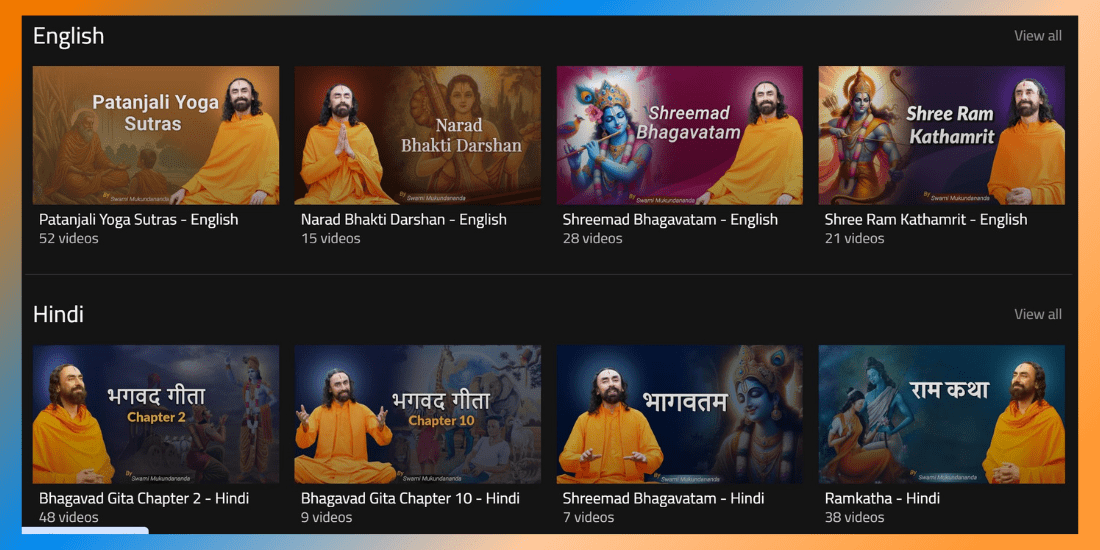
JKYog TV is a platform that offers access to spiritual discourses and content related to Vedic wisdom. There are numerous benefits of subscribing to it, especially if you are Swamiji’s dedicated follower. Some of the features and benefits associated with JKYog TV include:
- Comprehensive Discourses: Access to full-length discourse series in both Hindi and English on topics like the Bhagavad Gita, Patanjali Yoga Sutras, 7 Mindsets, Ram Katha Rahasya, Sant Charit, etc.
- Ad-Free Environment: A platform designed to provide a focused spiritual environment without advertisements or unrelated content suggestions or digital clutter.
- Platform Availability: Content can be accessed on various devices and home theater systems, including Android TV, Roku, and Apple TV. This allows families to watch discourses together on a large screen with a high-quality, professional interface.
- Support for Charitable Activities: Subscription fees contribute to the non-profit organization JKYog and its initiatives in healthcare and education.
- New Content: Regular additions of new discourse series and spiritual content.
These aspects aim to provide a dedicated space for individuals interested in spiritual learning and practice. Subscribe now if not done already!

JKYog’s Bhagavad Gita Krishna Bhakti App
Transformative Challenges for Daily Spiritual Growth
One of the most appreciated features of JKYog’s Bhagavad Gita Krishna Bhakti App is its Challenges – a series of structured, joyful journeys designed to foster inner growth. Each day, seekers are invited to engage in spiritually nourishing activities, typically featuring:
- Wisdom: Short, impactful video clips and Q&A sessions with Swamiji.
- Meditation: Guided sessions led by Swamiji to calm and focus the mind.
- Reflection: Thought-provoking activities and quizzes to reinforce understanding.
- Action: Soul-stirring kirtans and small seva (i.e., selfless service) tasks that translate inspiration into daily practice.
The app currently offers four curated experiences:

- Bhagavad Gita (21 Days)
- Get Closer to God (21 Days)
- Kartik Maas Bhakti Sadhana (30 Days)
- Spiritual Secrets from Hinduism (30 Days)
By blending learning, meditation, and service, these Challenges transform spiritual growth from a passive pursuit into a lived, experiential process.
Download the Bhagavad Gita Krishna Bhakti App today to deepen your devotion and begin your journey toward divine consciousness.