


Introduction
Do you ever feel that despite all your achievements, a sense of emptiness persists within? You are not alone. We all fight a silent battle every day—the battle within our own mind. This internal conflict, if unchecked, can steal our peace and sabotage our best efforts . Swami Mukundanandaji, in his transformative book "The Science of Mind Management," bridges the timeless wisdom of the Bhagavad Gita with the practical challenges of modern life. He reveals that the ultimate solution to mastering our chaotic thoughts is not just willpower, but the profound science of devotion (Bhakti Yog). This blog explores seven powerful principles from his teachings, designed to help you transform your mind from your worst enemy into your greatest ally, leading you to a life of lasting bliss and inner peace.
The Mind: Your Greatest Ally or Worst Enemy
The quality of your life is not determined by your bank balance or your status, but by the quality of your mind. It is a fertile field; what you cultivate in it determines whether your life yields thorns of sorrow or flowers of joy .
Understanding the Four Aspects of Your Inner World
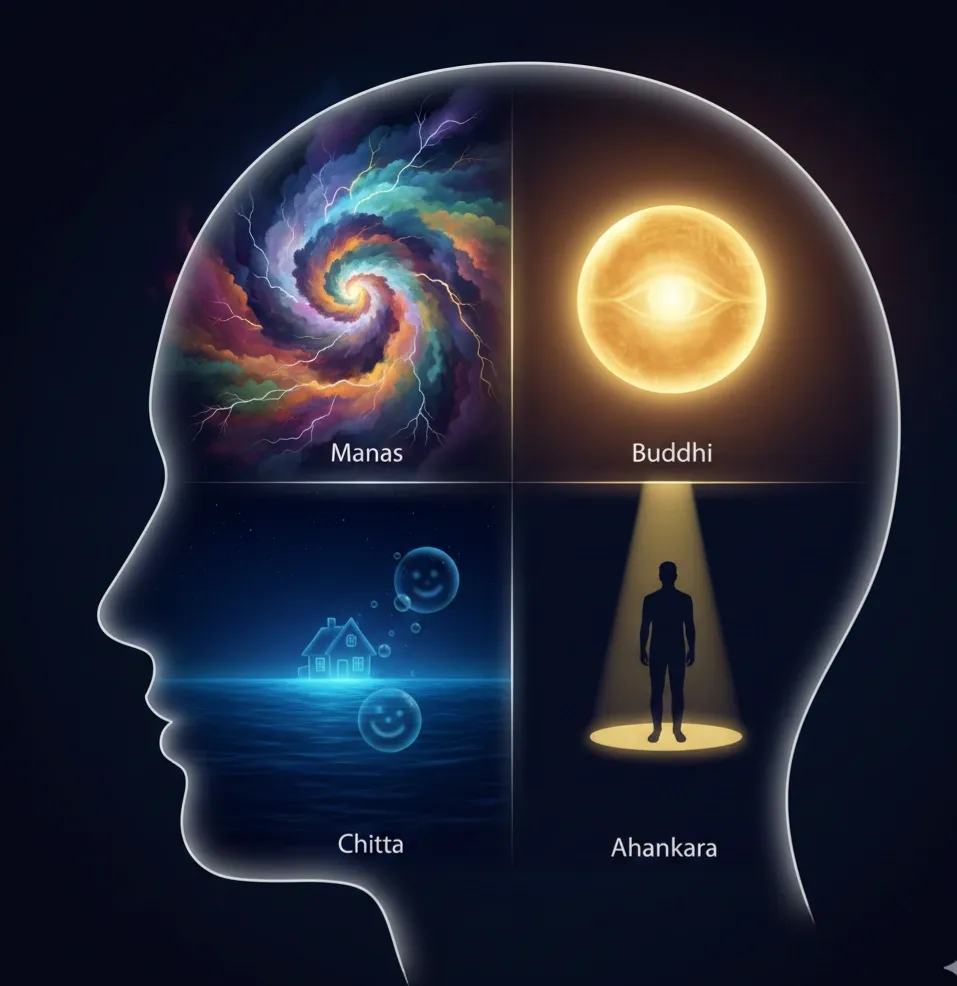
Within us exists a sophisticated internal apparatus called the antahkarana. It comprises the mind (manas), which generates countless thoughts and desires; the intellect (buddhi), which decides and reasons; the subconscious (chitta), which stores memories and impressions; and the ego (ahankara), which creates the sense of "I" and "mine" . Our life's direction depends on which of these voices we allow to dominate.
The Bhagavad Gita's Diagnosis of Our Suffering
Why do we lose our peace over small things? Lord Krishna provides a chillingly accurate diagnosis in verse 2.63. He explains that from unchecked desire arises anger. When desire is unfulfilled, anger clouds our judgment, leading to confusion and the destruction of our intellect . This chain reaction is the root of our ruin. The true battle is not with the world outside, but with these internal foes—desire, anger, and greed.
The Illusion of External Happiness
We constantly run after sensory pleasures, mistaking them for true happiness. The Vedas describe two paths: preya (that which is pleasurable now but harmful later) and shreya (that which is beneficial in the long run) . The mind, by default, chases preya. However, Swamiji reminds us that our soul, being a fragment of the Divine, will never be content with temporary, material happiness. It craves the eternal bliss (Anand) for which it is longing .
The Role of Intellect in Channeling the Mind Towards Devotion
If the mind is an unruly child, the intellect is the wise parent. The key to mind management is empowering the intellect to take charge, guiding the mind away from poison and towards nectar.
The Intellect as the Charioteer
Imagine a chariot where the horses (senses) are powerful but blind. The reins (mind) control them, but it is the charioteer (intellect) who must know the destination . If the charioteer is weak or uneducated, the horses will run wild. Similarly, if our intellect is not illumined with higher knowledge, our senses will drag us into the mud of materialism.

Buddhi Yog: Empowering Your Intellect
How do we strengthen the charioteer? Lord Krishna calls this Buddhi Yog, the Yoga of the Intellect. It means feeding our intellect with divine knowledge from sources like the Bhagavad Gita . A mind fed on news, gossip, and social media becomes restless and anxious. But an intellect empowered with scriptural wisdom develops the power of discernment, known as vivek. This vivek is what separates a human being from a beast .
Using Vivek to Choose the All-Blissful Lord
The mind constantly seeks attractive forms and pleasurable sounds. Swami Mukundananda teaches that we cannot simply tell the mind to stop wanting. Instead, we must use our empowered intellect to redirect its desires . Instead of letting the mind crave worldly cinema, we teach it to contemplate the captivating, all-blissful Form of Lord Krishna. When the mind is fixed on the all-pure God, it too becomes pure . This is not suppression; it is sublime redirection.
The Three-Step Process to Internalize Devotional Wisdom
Knowing that we should love God is not enough. We must internalize this truth until it becomes a part of our very being. The Vedic scriptures provide a foolproof, three-step process for this transformation.
Shravan - Hearing with a Hungry Heart
The first step is Shravan, which means attentively hearing or reading divine knowledge . In today's noisy world, we must create a quiet space to listen to the glories of God from scriptures like the Bhagavad Gita or Srimad Bhagavatam. Just as a radio must be tuned to the right frequency to receive music, our heart must be tuned to the divine frequency through regular listening.
Manan - Contemplating to Digest the Truth
Simply hearing is not enough. We must then practice Manan, or deep contemplation . Swamiji advises us to write down a gem of knowledge in a spiritual diary and reflect on it repeatedly. For example, if we hear that "God is our true well-wisher," we must contemplate: "How has God protected me today? How has He provided for me?" This process of "churning" the knowledge allows its essence to permeate our consciousness .

Nididhyasan - Resolving with Unshakable Conviction
The final and most transformative stage is Nididhyasan, where, after hearing and contemplating, the intellect develops a firm, unshakable conviction . This belief becomes our moral compass, guiding our thoughts, attitudes, and actions automatically. The conviction that "I am an eternal servant of Krishna, and He is my only protector" is far more powerful than any self-help affirmation. It aligns the mind, senses, and body with our highest goal .
Transforming Work and Life Through Karm Yog
Most of us spend our lives stressed about work, anxious about results. The Gita offers a revolutionary path to transform this very source of stress into a source of spiritual growth.
Offer the Fruits, Not the Worries
Lord Krishna's most famous teaching is in verse 2.47: "You have a right to perform your prescribed duties, but you are not entitled to the fruits of your actions." This is the essence of Karm Yog . Swamiji explains that we should work with full sincerity and excellence, but mentally offer the results to God. This removes the crushing anxiety of "What will happen if I fail?" because we are no longer the enjoyer; we are simply an instrument in the Lord's hands.

From Attachment to Results to Attachment to God
A common doubt arises: "If I shouldn't be attached to results, how can I be motivated?" The secret is to shift your attachment from the result to the person for whom you are working . When you work for a loved one, you do it with love, not for the paycheck. Similarly, when all our work—whether cooking, cleaning, or coding—is done as an offering to please Shree Krishna, it ceases to be a burden and becomes a labor of love.
Acting with a Spirit of Sacred Service
This attitude transforms our life into a continuous yajna (sacrifice) . The workplace becomes a temple. Every conversation becomes an offering. When we eat, we offer the food to Krishna first, turning it into sanctified prasad . By seeing everything we possess—our body, mind, and talents—as belonging to God, we dissolve the ego and experience a profound sense of peace and purpose in every moment.
Invoking Divine Grace Through Surrender
Despite our best efforts, we often find ourselves slipping back into old, bad habits. This is because the power of Maya—God's divine, illusionary energy—is incredibly strong. We cannot overcome it by our might alone; we need divine grace.
The Reality of Maya and Our Helplessness
Maya is the energy that makes the impossible possible, making us forget our true spiritual identity and get attached to the temporary world . We are like a small boat in a vast, turbulent ocean. By our own oars, we cannot cross it. Acknowledging this helplessness is not a sign of weakness, but the beginning of wisdom. It opens the door for a higher power to intervene.
The Sixfold Path of Surrender (Sharanagati)
Grace is not random; it is a logical response to our qualification. Vedic scriptures describe six aspects of surrender (Sharanagati) that make us eligible for God's grace :
- Resolve to do only what pleases God.
- Reject everything that displeases God.
- Have firm faith that God will protect us.
- Accept God as our sole guardian.
- Offer our entire being to God.
- Feel utterly humble and dependent on His grace.
Grace: The Final Piece of the Puzzle
When we practice these attitudes, we are not "bribing" God; we are simply removing the obstacles that block His grace from flowing into our lives. As Swamiji explains, surrender is the ultimate act of mind management . It is handing over the reins of our mind from our feeble, anxious hands to the all-powerful, all-loving hands of God. With His grace, the impossible becomes possible, and the mind, once our enemy, becomes our greatest friend.
The Ultimate Destination: Everlasting Bliss and Divine Love
What is the point of all this mind management? It is not just to be stress-free and productive. It is to reclaim the birthright of our soul: everlasting bliss and divine love.
The Soul's Natural Craving for Sat-Chit-Anand
Our soul is a tiny fragment of God, who is the ocean of Sat (eternality), Chit (absolute knowledge), and Anand (infinite bliss) . Therefore, our soul will never be content with anything less. This is why no amount of wealth, fame, or sensory pleasure can ever truly satisfy us. We are like a fish dying of thirst in the ocean, not realizing it is surrounded by water. The bliss we seek is already within us, waiting to be awakened through devotion.
Experiencing the "Science" of Devotion First-Hand
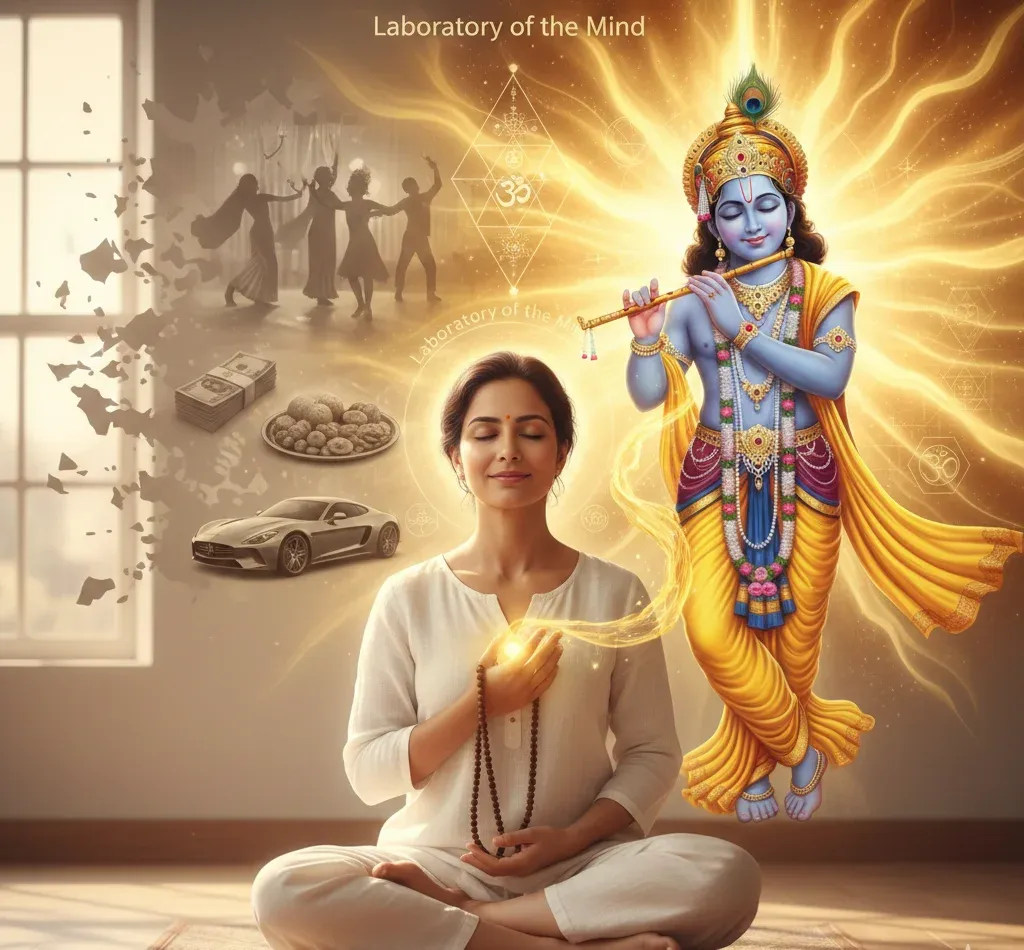
Bhakti is not blind faith; it is a verifiable science. It is an experiment to be conducted in the laboratory of your own mind. When you practice Roop-Dhyan (meditating on God's form) or chant His names with love, you begin to experience a higher taste—a sweetness that far surpasses the temporary pleasures of the world. As the Gita promises, by engaging the mind in meditation upon Krishna through Bhakti Yog, the mind transcends the material modes and becomes divine . This personal, direct experience transforms belief into living reality.
The Perfection of Life: Love for God
The pinnacle of mind management is not a calm, empty mind, but a mind fully absorbed in love for the Divine. This is the state of perfect devotees like the Gopis of Vrindavan or Meerabai. They did not just control their thoughts; they flooded their consciousness with such intense love for Krishna that there was no room left for any worldly thought . This is the ultimate victory—when every thought, every emotion, every fiber of your being is united in a single, continuous flow of love towards your Beloved Lord.
Conclusion
The journey from a restless mind to a surrendered heart is the most significant journey you will ever take. The Bhagavad Gita, illuminated by the wisdom of Swami Mukundananda, provides not just the map, but the vehicle and the fuel. It assures us that the mind, which seems like our worst enemy, can indeed become our greatest ally through the science of devotion. It is a journey from anxiety to peace, from emptiness to fulfillment, and from selfishness to selfless love.
Start today. Begin with just one principle—perhaps offering your food to God, or spending five minutes in the morning contemplating His divine form. As you practice this "science," you will find your inner world transforming. The stress will melt, the mind will focus, and your heart will fill with a joy that the world can neither give nor take away. The victory in your inner battle is not just possible; it is promised, for those who take shelter of this divine science.
Here is a deep FAQs section and a powerful Call to Action, designed to complement the blog content and leave a lasting impact on the reader.
Frequently Asked Questions
Q1: What is the difference between self-help and the "Science of Devotion" taught by Swami Mukundananda?
Self-help typically relies on willpower and mental conditioning to achieve worldly success. It strengthens the ego. The Science of Devotion, rooted in the Bhagavad Gita, goes deeper. It purifies the mind by redirecting its attachment from the world to God. It is not about becoming a "better" person by worldly standards, but about realizing your true spiritual identity and surrendering the ego to the Divine, thereby invoking His grace for ultimate liberation.
Q2: How can I practice devotion when my mind is constantly distracted by worldly thoughts?
This is the common struggle for all spiritual aspirants. The solution is not to fight the thoughts directly, but to replace them. As outlined in the blog, use the three-step process of Shravan (hearing divine knowledge), Manan (contemplating on it), and Nididhyasan (resolving with conviction). When the mind wanders, gently bring it back to the names, forms, and pastimes of God. This is a practice; the mind will slowly become trained to find a higher taste in the Divine than in worldly distractions.
Q3: Is it practical to "surrender" everything to God in today's competitive world? Won't it make me passive?
Absolutely not. Surrender is not about becoming passive; it is about shifting the doership from "I" to "God." You act with full sincerity and excellence, but you offer the results to Him. This removes the anxiety of success and failure, allowing you to work with a calmer, more focused mind. It is the difference between feeling solely responsible for the outcome versus feeling like an instrument in a higher plan. This attitude enhances performance, not hinders it.
Q4: How do I know if I am making any progress on this path?
Progress in the Science of Devotion is measured by inner transformation. Ask yourself: Is my attachment to the world decreasing? Is my taste for God's name and pastimes increasing? Am I more peaceful, forgiving, and compassionate? True progress is not about dramatic visions or miracles, but about a quiet, steady increase in inner joy and a decrease in the reactions to the world's dualities of praise and insult, success and failure.
Call to Action: Your First Step Towards Inner Victory
You now possess the timeless wisdom of the Bhagavad Gita's Science of Devotion. You understand the diagnosis of the restless mind and the prescription for lasting peace. But knowledge without action is like a powerful medicine left on the shelf. The transformation you seek will only manifest when you take that first, courageous step.
The choice is yours. Will you remain a prisoner of your restless mind, or will you become its master?
If you are ready to trade anxiety for peace, emptiness for fulfillment, and restlessness for divine love, here is your roadmap forward.
- Start Your Day with the Divine
- Wake up just 15 minutes earlier than usual.
- Sit in a quiet corner and read one verse from the Bhagavad Gita.
- Spend five minutes meditating on the beautiful form of Lord Krishna.
- This single practice will set a powerful tone for your entire day.
- Transform Your Work into Worship
- Before starting any task, mentally offer it to God.
- Repeat this simple prayer: "O Lord, let this work be an offering to You. I accept the outcome as Your grace."
- Watch how this shifts your focus from anxiety about results to peace in the present moment.
- Practice the Presence of God Throughout the Day
- While eating, mentally offer the food to Krishna before consuming it.
- While commuting, listen to divine bhajans or discourses by Swami Mukundananda.
- Before sleeping, review your day and express gratitude for one blessing you received.
- Create a Spiritual Support System
- Join a local satsang or online community of like-minded seekers.
- Surround yourself with people who uplift your spiritual mood.
- Share your experiences and learn from the journey of others.
- Commit to the Three-Step Process Daily
- Shravan: Dedicate time each day to hear or read divine knowledge.
- Manan: Write one spiritual gem in a diary and contemplate its meaning.
- Nididhyasan: Resolve firmly that God is your only protector and beloved.
Remember this truth from Swami Mukundananda:
The mind is your best friend when controlled, and your worst enemy when uncontrolled. The choice of who it becomes is entirely in your hands.
The science is perfect. The path is clear. The grace is waiting. You do not need to transform your entire life today. You simply need to take one step. Just one.
Your journey from a restless mind to a surrendered heart begins now.
Will you take that step?