
Inspired by the Teachings of Swami Mukundananda Ji
"The miracle of God is in every atom of creation, we need only open our eyes to see it."
The Question That Never Lets Us Go
There is a question that has haunted the human heart since the dawn of consciousness — a question that has sparked revolutions, silenced philosophers, and driven seekers to the farthest ends of the earth.
Does God exist?
Most of us have, at some point, stood beneath a star-filled sky and felt a trembling in the chest — a whisper that something vast and intelligent is breathing behind all of this. And yet, the rational mind pushes back, demanding proof. It wants evidence. It wants logic. It wants certainty.
For centuries, this question divided the world into two camps: those who believed on faith alone, and those who rejected God in the name of reason. But Swami Mukundananda ji — a man of razor-sharp scientific intellect, a graduate of IIT and IIM, who traded the corridors of corporate excellence for the feet of the Divine — offers us something extraordinary.
Not blind faith. Not irrational belief. But the proof of God's existence woven right into the fabric of creation itself.
He does not ask you to abandon your intelligence. He asks you, lovingly and firmly, to use it more fully. Because when we look at creation with open, honest eyes, we do not find a universe that is silent about its Maker. We find one that is shouting His name from every atom, every cell, every sunrise, every heartbeat.
Sit with this. Open your heart. Because what follows may change not just what you think — but how you see everything.
The Universe Is Not an Accident
Imagine standing in a grand library — wall-to-wall shelves, millions of books in perfect order, every volume indexed, every page numbered, every sentence coherent and purposeful. Would you, for even one moment, entertain the thought that this library created itself through a random explosion?
Of course not. The very presence of order, meaning, and complexity screams of intelligence behind it.
Now turn your gaze to the universe itself.
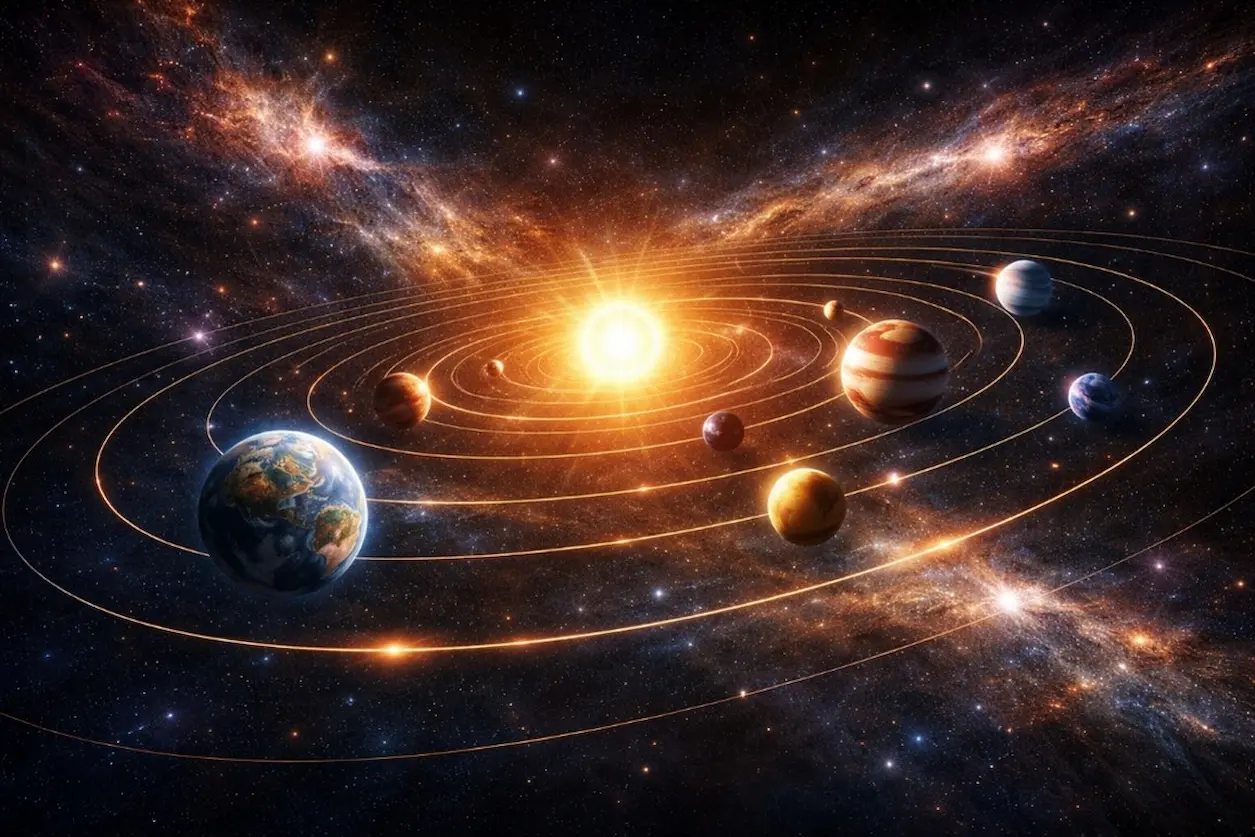
The cosmos follows laws so precise that scientists can predict planetary movements centuries in advance. The speed of light is constant across all of space. The gravitational constant is tuned to a decimal precision that, if altered by even a fraction, would result in either an instant cosmic collapse or a universe too sparse and cold for life to form. The atomic forces hold matter together in a perfect, ceaseless dance. Every star, every cell, every breath — governed by flawless, unbreakable laws.
Swami Mukundananda ji dismantles the "cosmic accident" theory with the gentlest and most devastating of analogies:
"You cannot say that Shakespeare's works were created by a random explosion in a typewriter shop. Imagine — keys randomly pressing, lines forming, pages completing — and suddenly the complete works of Shakespeare appear. Impossible."
Think about this for a moment. We would never attribute a single sonnet — fourteen lines, one poem — to randomness. We know, instinctively, that words arranged with beauty and meaning demand a mind that arranged them.
So how — with what intellectual honesty — can we attribute the entire, staggeringly complex universe to randomness? A universe with 100 billion galaxies. A universe with DNA and consciousness and music and love. A universe where the same mathematical constants that govern the movement of planets also govern the behavior of subatomic particles — as though the whole thing was written in a single hand, by a single mind, for a single coherent purpose?
Randomness produces chaos. The universe produces extraordinary, breathtaking order. And behind that order must stand an infinitely intelligent Creator.
God Reveals Himself in the Qualities of Creation
In the seventh chapter of the Bhagavad Gita, Shree Krishna does something astonishing. He doesn't merely declare His existence — He points to Himself everywhere.
Bhagavad Gita 7.8: "I am the taste in water, O son of Kunti, and the radiance of the sun and the moon. I am the sacred syllable Om in the Vedic mantras; I am the sound in ether, and the ability in humans."
He says: look at water, and know Me as the taste within it. Look at the sun, and know Me as that blazing, life-giving radiance. Listen to Om, and know it as My own resonance echoing through the cosmos. Know Me in every quality that makes creation what it is.
Swami Mukundananda ji illuminates this with a simple, unforgettable example. Take a bowl of mashed potatoes and add just one teaspoon of salt. That tiny teaspoon transforms the entire bowl. It is not the quantity — it is the quality. Salt is a fraction of the bowl, yet it defines the experience of eating it entirely.
In the same way, wherever you witness a distinctive, overwhelming quality in creation — the sweetness of honey, the brilliance of a diamond, the tenderness of a mother's love, the radiance of the rising sun — know it to be the potency of God manifesting there. He is not the object. He is the quality within the object that makes it what it is.
The Miracle of the Sun
Consider the sun for a moment — truly consider it.
In 1986, the Chernobyl nuclear disaster sent shockwaves of terror across the world. A single nuclear plant, built by our finest engineers, malfunctioned — and the consequences scarred an entire generation. In 2011, a Japanese tsunami crippled nuclear plants, and humanity watched in horror as one of our most powerful technologies buckled under nature's force.
These plants — the products of our best minds, our most advanced materials, our most careful engineering — failed.
And yet the sun, a nuclear furnace of incomprehensible scale, producing energy equivalent to millions of nuclear power plants working simultaneously, has been burning perfectly — flawlessly, continuously — for over 4.5 billion years. Not once has it stuttered. Not once has the fusion process failed. Not once has the sun risen late.
Morning after morning, it appears on the horizon. Evening after evening, it sets in a blaze of gold. In perfect, sacred, unbroken rhythm.
As Swami Mukundananda ji asks with such quiet and powerful simplicity: How is that happening?
The honest answer — the answer that goes beyond physics into the territory of wonder — is that this is God's glory manifesting. It is His sustaining power, His intelligence, His love for all living beings who depend on that light, operating without pause, without failure, without end.
The Miracle Dog — Are We Even Willing to See?
Swami Mukundananda ji tells a story that is funny on the surface and devastating at its core.
A man bought a pet dog and, while walking him by a lake one day, threw a ball into the water. The dog did something extraordinary — he ran across the surface of the water, retrieved the ball, and came back, his paws barely wet.
The man could not believe his eyes. He tried again. Same miracle. A third time and again, the dog trotted across the water as though it were solid ground.
Trembling with excitement, the man called his neighbor the next day. "Come on a walk with me — I have to show you something." At the lake, he threw the ball. The dog sprinted across the water, retrieved it, returned. The man turned to his neighbor with a huge, expectant smile.
No reaction.
He tried again. Nothing. A third time — still his neighbor stood there, arms folded, expressionless.
Finally, the man asked: "Do you see anything strange?"
His neighbor shrugged. "I see this stupid dog doesn't know how to swim."
The miracle was happening directly, undeniably, right before his eyes. And he did not see it — not because it was not there, but because he had decided, before he even looked, that miracles do not exist.
This is the human condition.
The evidence of God is not hidden. It is not locked away in ancient scripture, accessible only to sages on mountaintops. It is happening right now — in every breath you take, in every heartbeat, in the astonishing, impossible, beautiful complexity of your very cells.
The question was never truly "Is there proof of God?"
The deeper, more honest question is: "Am I willing to see?"
When we dismiss creation with a shrug and say, "It's just a big bang" or "It's just chemistry," we are the neighbor — standing before a dog walking on water and seeing only a bad swimmer. We have filtered out the miracle because our worldview has no room for it. But reality does not change because our filters deny it. The miracle keeps happening. The dog keeps walking on water. And God keeps writing His name across every inch of creation — waiting, patiently, lovingly, for us to look up and see.
What Science Itself Confesses
Here is where the argument becomes impossible to dismiss because it is not only saints and sages who point toward God. The greatest scientific minds of our age, men and women who have devoted their lives to evidence and rigorous reasoning, arrive at the same breathtaking conclusion when they look deeply enough.
Francis Collins led the team that decoded the entire human genome — the complete biological instruction manual of the human being. He later served as the Director of the U.S. National Institutes of Health. He is, by any measure, one of the greatest scientists of the modern era.
He confessed something extraordinary. He admitted that after decoding the human genome, he should have been able to declare there is no God. That was what the scientific worldview around him expected. But instead, his faith in God deepened.
Why? Because of the complexity. Because what science found at the innermost level of our biology was not simplicity, not randomness but an architecture of such staggering, mind-bending intelligence that it felt less like an accident and more like a masterpiece.
Swami Mukundananda ji lays out the numbers, and they are numbers that should stop you in your tracks:
- There are 37 trillion cells in the human body. Each cell is not a simple unit — biologists have spent entire careers studying a single cell and still say, "I don't know much."
- If you were to write out the human genome — the instruction set packed into each of those 37 trillion cells — on paper, the stack would reach the height of the Washington Monument.
- If you were to read it aloud at three syllables per second, it would take you 31 years to finish. That is reading non-stop, 24 hours a day, for over three decades.
- If you were to stretch the DNA contained in just one of your cells, it would extend for two meters. Multiply that by 37 trillion cells — the total DNA in your body, placed end to end, would travel from the earth to the sun and back twice.
And all of this is packed, folded, organized, and functioning in each microscopic cell in your body.
An ophthalmologist, when asked how much of the human eye they truly understand, will tell you: approximately 4%. We understand 4% of one organ. One. And we have tens of thousands of organs, systems, and processes, all interdependent, all synchronized, all working in perfect harmony right now as you read this sentence.
Even Newton — Isaac Newton, the man who gave us gravity, calculus, the laws of motion, and the foundations of modern physics, stood at the height of his genius and said:
"I was like a child playing with pebbles on the seashore, while the vast ocean of truth lay undiscovered before me."
What breathtaking humility. What breathtaking honesty.
Yet today, some look at the tiny pile of pebbles we have gathered and declare: "This is all there is. Science has explained everything. There is no God." The humility of Newton seems to have evaporated. And with it, the openness to the infinite.
Swami Mukundananda ji — himself an engineer, himself a man trained in the scientific method — answers the challenge with a smile: "People ask me, 'Swamiji, you are a man of science — how do you believe in God?' And I say: 'Because I use my common sense.'"
Because if we use even a little common sense — the same common sense that tells us Shakespeare wrote his plays, that a library implies a librarian, that a watch implies a watchmaker then this astonishing, impossibly intricate, breathtakingly ordered creation must have a divine intellect behind it.
The complexity is not the absence of God. The complexity is the signature of God.
The Story of Agni — When God Withdraws His Power
There is a story from the Vedas that Swami Mukundananda ji shares a story so simple in its telling and so profound in its implication that it settles itself permanently in the heart.
Once, the devas, the celestial beings, grew proud of their own power. They had won great victories and began to believe that the glory belonged to them. To humble them, God appeared before them as a mysterious, blazing divine presence — a Yaksha — beyond their comprehension.
Agni, the god of fire, stepped forward confidently.
"I am Agni," he declared. "I have the power to burn the entire universe."
God placed a single blade of dry grass before him. "Then burn this."
Agni turned his full force upon the blade. He raised his temperature to billions of degrees — the kind of heat that could reduce galaxies to ash. He strained with his entire being.
But God had simply switched off the power.
Agni cooled down, helpless and humiliated, unable to so much as singe a single blade of dry grass.
The ability was not Agni's. It had always been borrowed from God.
This story is not mythology. It is a mirror held up to every one of us.
Shri Krishna declares in the Gita: "Know Me to be the ability in humans." Every morning you wake up with the ability to think, to speak, to see, to love, to create. You have perhaps achieved great things in your life. Perhaps you are intelligent, skilled, and accomplished. And it is entirely natural to think: "I have this ability. I earned this. I built this."
But suppose — just suppose — He switches it off. In an instant. The mind stops. The voice silences. The hand stills. The thought dissolves. The light goes out.
Every human ability — every flash of genius, every act of compassion, every creative surge — is borrowed power. It flows from the infinite reservoir of God into us, through us, as us. We are not the source. We are channels. And the Source can widen the channel or close it at any moment.
When this truth lands — truly lands, not just as an idea but as a felt reality — something extraordinary happens. Pride dissolves. The tight fist of ego opens. And in its place, gratitude floods in warm, unstoppable, overwhelming. Suddenly every ability becomes a gift. Every morning becomes a grace. Every breath becomes a prayer.
That is the beginning of bhakti. Not in a temple, not in a scripture but in the recognition, in the marrow of your bones, that everything you are and everything you have is a gift from God.
Feeling God's Presence: From Proof to Bhakti

There is a difference between knowing that God exists and feeling that God exists. The first is intellectual. The second is transformative.
Swami Mukundananda ji does not merely want us to win a philosophical debate. He wants us to experience what the ancient rishis experienced that breathtaking, heart-melting recognition that God is not distant, not theoretical, not locked inside a stone statue or a temple wall. He is the taste on your tongue right now. He is the breath in your lungs. He is the love you feel for those who matter most to you. He is the beauty that moves you to tears in a piece of music or a mountain vista. He is in every quality, every wonder, every inexplicable moment of grace that peppers your ordinary days.
The Bhakti tradition teaches us that God-realization is not a matter of accumulating more proof. It is a matter of softening the heart enough to receive what is already, endlessly, being given. The sun rises every morning as an act of divine generosity. Your heart beats without your instruction as an act of divine sustenance. The food that nourishes you, the water that quenches you, the beauty that moves you, all of this is God, pouring Himself into your experience, moment by moment, breath by breath.
The Sanskrit word for this recognition is Darshan, the vision of the Divine in all things. It requires not a microscope or a telescope, but a clean, grateful, humble heart.
Begin there. Begin with one moment today when you hold a glass of water, close your eyes, feel the taste on your tongue, and whisper with absolute sincerity: "This taste is You."
In that one moment, the boundary between seeker and sought dissolves. Proof becomes presence. Philosophy becomes prayer. The great question — does God exist? — is no longer a debate to be won. It is a reality to be lived. And the existence of God is no longer something you argue for. It is something you breathe.
The Five Pillars of Proof — A Summary
Let us gather the threads. Swami Mukundananda ji has given us not one but five interlocking, irrefutable pillars of proof for the existence of God:
1. The Argument from Order The Universe operates under precise, mathematical laws. Order of this magnitude cannot arise from chaos. It demands an intelligence behind it vast, infinite, and purposeful. Just as Shakespeare's works demand Shakespeare, this creation demands a Creator.
2. The Argument from Qualities Wherever we encounter a supreme, extraordinary quality — the taste of water, the radiance of the sun, the sacred resonance of Om — the Gita tells us to recognize these as the direct manifestations of God's energy. He reveals Himself through the qualities of creation.
3. The Argument from Complexity The human body alone — 37 trillion cells, a genome that would take 31 years to read aloud, DNA that would stretch to the sun and back twice — cannot be a product of chance. The scientists themselves confess their wonder. Complexity at this level reveals a Designer of unfathomable intelligence.
4. The Argument from Borrowed Ability Every human capacity — thought, speech, sight, creativity, love — is borrowed from God. He is, as the Gita declares, the ability in humans. When we trace any ability to its ultimate source, we arrive at Him.
5. The Argument from the Longing of the Heart Deep within every human being is a longing that the world cannot satisfy. We seek perfect love, perfect knowledge, perfect joy — and find only fragments here. That longing itself is proof — pointing always, persistently, irresistibly toward the One in whom all fullness eternally rests. As Saint Augustine said across a different tradition: "Our heart is restless, until it repose in Thee." The longing is the homing signal. God placed it there so we would find our way back.
Call to Action: Don't Just Believe — Experience
The door to God was never locked. The miracle is happening right now.
🪔 Watch Swami Mukundananda Ji's full video — "Does God Exist" — freely on YouTube @SwamiMukundananda
Frequently Asked Questions
1. Doesn't the Big Bang explain creation without God? It describes how the universe expanded — not why its laws are so perfectly calibrated for life. The deeper question remains: what ignited it?
2. How do I personally experience God's presence? Start small — notice the miracle in ordinary moments. Add meditation, chanting, and scripture study. Over time the veil between you and the Divine naturally dissolves.
3. What does "God is the ability in humans" mean? Every ability you possess is God's energy flowing through you. Recognizing this transforms pride into gratitude and effort into devotion.
4. What is the significance of Om? Om is the primordial vibration underlying all creation. Chanting it sincerely is not ritual — it is tuning yourself to the frequency of the Divine.
5. Is it wrong to doubt God's existence? Doubt is the beginning of genuine inquiry. Take it seriously enough to investigate — most sincere seekers find the deeper they look, the more undeniable God's presence becomes.