
The Shreemad Bhagavatam is a timeless treasure passed down through a venerated spiritual lineage. Sage Ved Vyas imparted this sacred knowledge to Shukadev, who in turn shared it with King Parikshit. Suta Goswami, a witness to this discourse, later became a pivotal voice in disseminating its teachings to thousands of seekers.
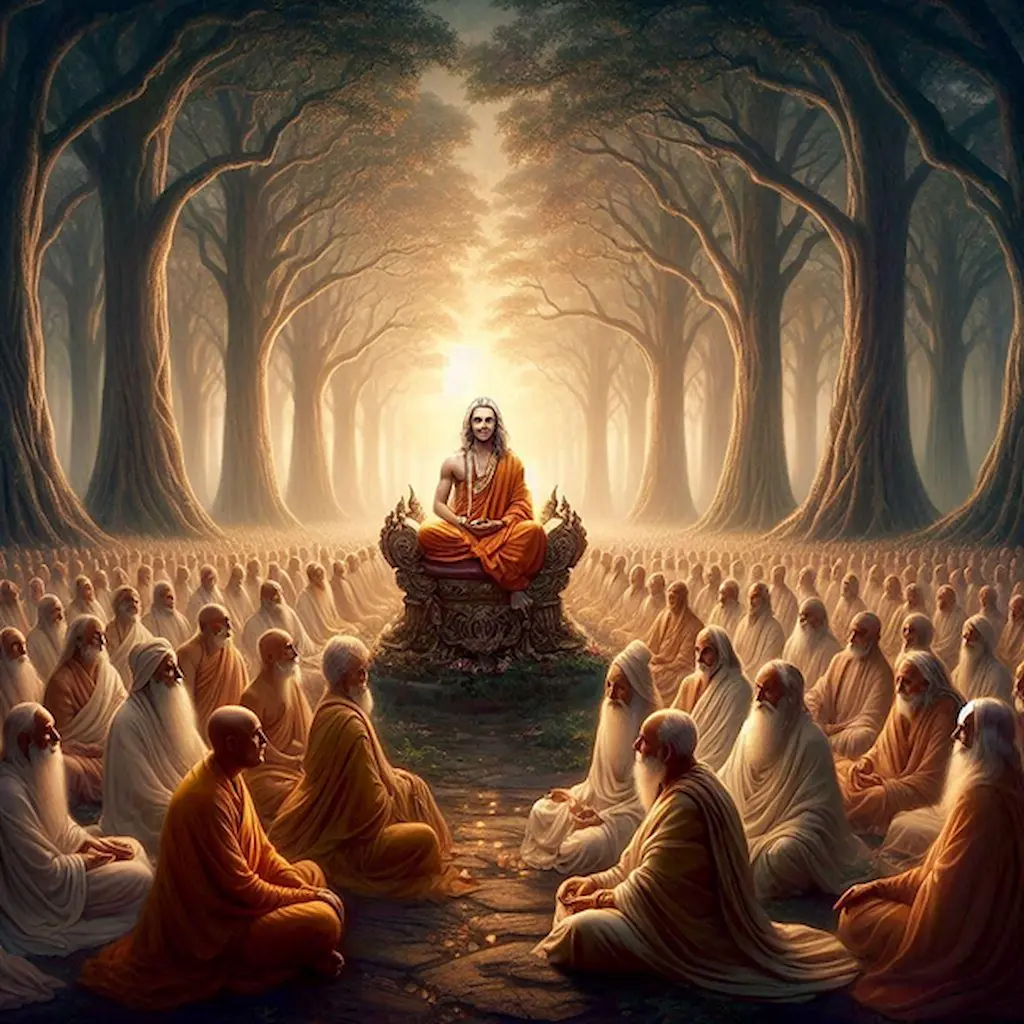
Nearly 4,900 years ago, when a century of Kaliyug had passed. Eighty-eight thousand sages gathered in the Naimisharanya forest. Led by Shaunak Rishi, they revered Suta Goswami as their Vyas and seated him upon the throne of wisdom. With humility, they then placed before him six profound questions… seeking to unveil the mysteries of existence.
Amidst the Mire of Kaliyug
The sages began by reflecting on the age of Kali, an era overrun by human vices: minds had grown restless, morality had waned, deceit prevailed, the environment became polluted, food lost its purity, health declined, and lifespans shortened. Perturbed by these grim realities, they asked:
- In Kaliyug, what is the path to true welfare for humanity?
- Among the multitude of Vedic scriptures, what is their essence?
- Why did the Supreme Lord, Shree Krishna, descend as an avatar?
- What divine pastimes (leelas) did He perform?
- Who were the other avatars of the Supreme Lord?
- After Shree Krishna returned to His divine Abode, where did dharma find refuge?
Keen to elucidate, Suta ji first addressed the path to true welfare, citing a celebrated verse from the Bhagavatam:
स वै पुंसां परो धर्मो यतो भक्तिरधोक्षजे ।
अहैतुक्यप्रतिहता ययात्मा सुप्रसीदति ॥ ६ ॥
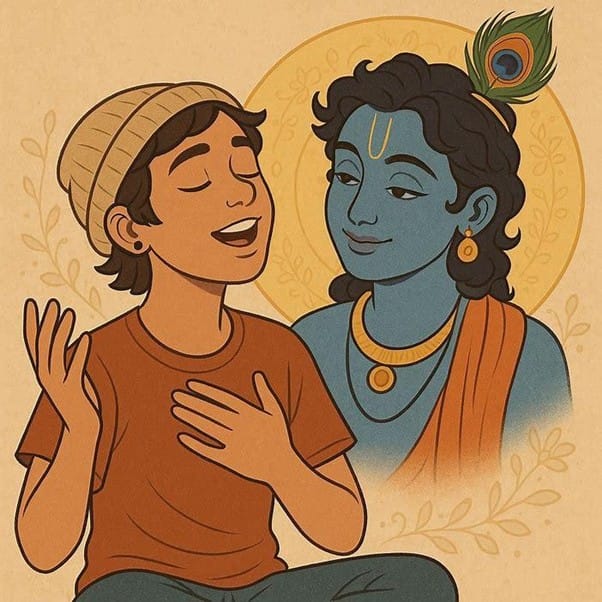
He affirmed the observations of the Shaunakadik sages: Kaliyug is indeed an ocean of faults. Yet amidst this mire lies a jewel of hope—a singular means of salvation, the param dharma, the supreme duty of humankind: devotion to God. Today, most people remember God only for a while—often in temples, seeking material favors. As soon as they step outside, His presence slips from their minds. And if their wishes go unfulfilled, many even lose faith.
However, that is not the kind of devotion that Suta ji describes. True devotion, or bhakti, must possess two qualities. First, ahaituki—unalloyed, without cause or motive. Love God not for reward or liberation, but simply because He is lovable. Second, apratihata—uninterrupted. No obstacle, circumstance, or distraction should sever the bond of remembrance and love for Him. Suta ji concluded: The only path of true welfare in this age of darkness, lies in pure, selfless, and uninterrupted love for God.
Realizing the Almighty
To answer the second question, the sage recited another illuminating verse:
वदन्ति तत्तत्त्वविद्स्तत्त्वं यज्ञमद्वयम्।
ब्रह्मेति परमात्मेति भगवानिति शब्द्यते ॥ ११ ॥
The aim of all scriptures is to lead the soul to God; everything else in the Vedas is a stepping stone towards this goal. However, the human intellect often resists—some deny God’s existence; others argue science does not confirm Him. Recognizing this, the Vedas offer gradual approaches, gently elevating seekers through rituals, philosophy, and meditation before revealing the highest truth: loving devotion to God.
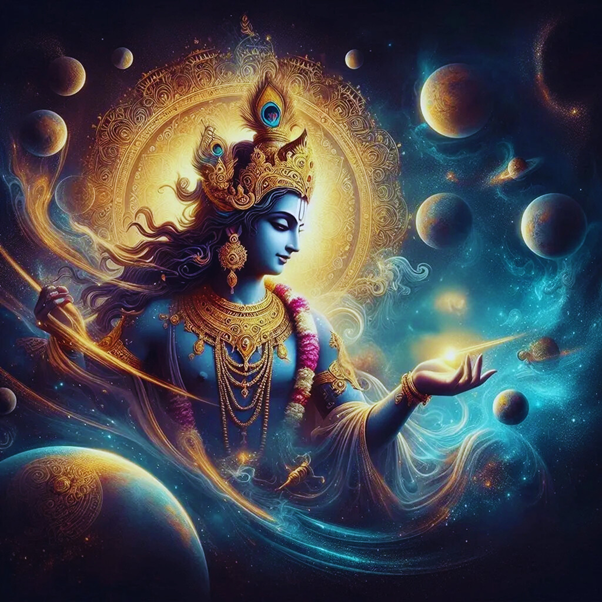
Behind these preparatory teachings lies the final destination: God. As Shree Krishna declares in Bhagavad Gita (Verse 15.15), “I alone am to be known by all the Vedas.” He is realized in three aspects:
● Brahman: God’s all-pervading presence, dwelling in every particle of existence—ghat ghat vasi.
● Paramatma: God within every heart, witnessing our actions and administering their results.
● Bhagavan: God in personal form, descending to perform divine pastimes and reciprocate with devotees.
These are not separate Gods, but three aspects of the same divine entity. Knowing Him leaves nothing else to know; hearing of Him leaves nothing else to hear; attaining Him leaves nothing else to attain.
शृण्वतां स्वकथा: कृष्ण: पुण्यश्रवणकीर्तन: ।
हृद्यन्त:स्थो ह्यभद्राणि विधुनोति सुहृत्सताम् ॥ १७ ॥
In response to the third question, Suta ji explicated that in Kaliyug, most spiritual disciplines are difficult to practice, but bhakti stands out as the simplest and most effective path. To make this devotion accessible, Shree Krishna descended in His personal form and performed enchanting leelas, which naturally draw even the restless minds towards Him. Without His descent, the Divine would remain abstract to the human mind. By revealing His Name, Form, Virtues, Pastimes, He made devotion a natural, joyous experience. Hence, out of His boundless compassion, He made the path of bhakti attainable for everyone.
Furthermore, the Lord’s pastimes are extremely purifying to hear. By immersing ourselves in His names and leelas, the heart, burdened with lifetimes of impurity, gets cleansed. Consequently, God’s grace manifests, breaking material bondage, dispelling ignorance, destroying accumulated karmas, and ultimately granting union with Him.
As for the fourth question regarding the divine pastimes of Lord Krishna, Suta ji assures that these leelas will unfold gradually throughout the text. The scripture does not follow a strict chronology; its structure is deliberate, designed to elevate the seeker’s consciousness step by step towards realization of the Absolute Truth.
The Avatars of God and Beyond
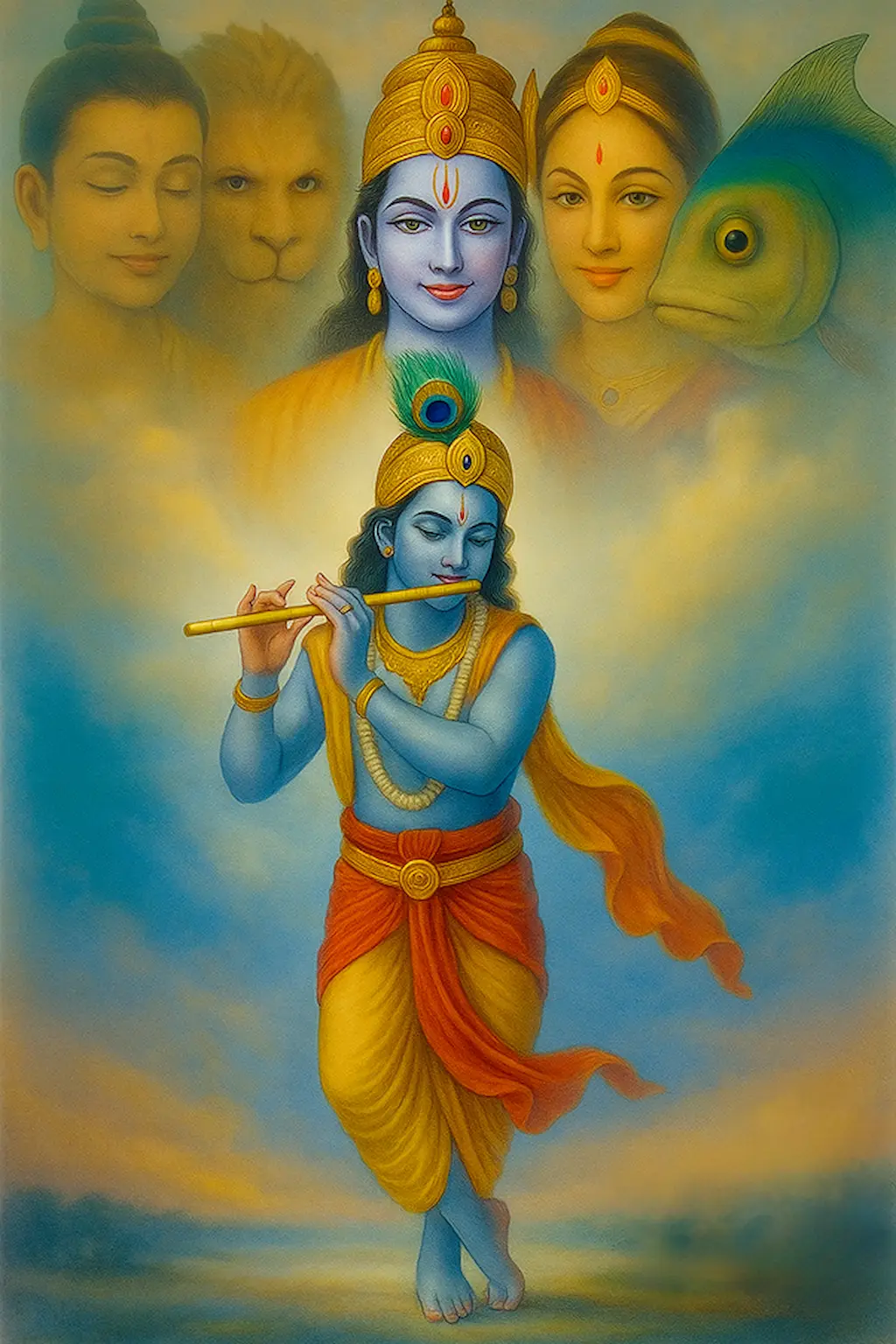
Addressing the fifth question, Suta Goswami narrates the famous incarnations of the Lord:
❖ Four Kumaras—Sanak, Sanandan, Sanatan, and Sanat. Remaining in their childhood form, they embraced brahmacharya and absorbed themselves in the Supreme Brahman, setting an example of perfect renunciation and detachment.
❖ Varaha, the mighty boar, lifted the earth from the cosmic waters and slew Hiranyaksh.
❖ Sage Narad, eternally wanders the three realms, singing the glories of God.
❖ Twin sages Nar and Narayan, dwelling in Badarikashram, inspire souls towards the path of auspiciousness and truth.
❖ Maharshi Kapil, son of Kardam and Devahuti, propounded the Sankhya system of philosophy.
❖ Dattatreya, the avadhut, exemplified detachment and established the path for countless renunciates and forest-dwellers.
❖ Rishabhdev led a renounced life. He is honored by the Jains as the first of their 24 Tirthankaras.
❖ Yagya Bhagavan revealed worship through yajna (fire sacrifices), catering to ritualistic seekers.
❖ King Prithu, a sovereign incarnation, transformed the earth into a more fertile and inhabitable realm for all beings.
❖ Matsya, the divine fish, retrieved the Vedas from the ocean and reinstated them.
During the churning of ocean (Samudra Manthan), three avatars appeared:
❖ Kurma, the giant tortoise bore the churning rod on His back.
❖ Dhanvantari emerged carrying the pot of nectar and imparted the knowledge of Ayurveda for the health of humanity.
❖ Mohini, the divine enchantress distributed the nectar of immortality to the celestial gods.
Beyond these, the Lord further descended as:
❖ Narasimha, half-man, half-lion, protected His devotee Prahlad and destroyed the tyrant demon Hiranyakashipu.
❖ Vaman, the dwarf brahman, approached King Bali and, with three steps, took possession of the three worlds, ultimately blessing the humble monarch.
❖ Parashuram, the warrior-sage, rid the earth of oppressive Kshatriyas when their arrogance grew unbearable, restoring righteousness and balance.
❖ Ved Vyas, the literary form of God, divided and recorded the Vedas and composed the great scriptures for the upliftment of humankind.
❖ Lord Ram, Maryada Purushottam established the proper code of conduct by following it Himself and showing it in His life as an ideal human being.
❖ Balaram, the son of Rohini.
❖ Shree Krishna, revealed through His enchanting pastimes that God is Bhakt Vatsal—enslaved by the love of His devotees—and emphasized the importance of loving devotion.
❖ Buddha appeared to guide souls with compassion and wisdom. His descent was foretold in the Bhagavatam nearly 5,000 years ago, long before He appeared about 2,500 years ago.
❖ Kalki will descend at the close of Kaliyug in a fierce form, to annihilate the evil and restore Satyug, the age of righteousness.
Thus, in every age, the Lord descends in diverse forms, each guiding humankind towards spiritual progress.
For the final question, Suta Goswami revealed that when Shree Krishna concluded His divine leelas and returned to His eternal abode, Dharma in the age of Kali found refuge in the Shreemad Bhagavat Mahapuran. Rising like a radiant sun, it illuminates humanity amidst the darkness of this age. Hearing this, Shaunak and the sages felt deeply gratified. With reverence, they asked Suta about the origin of this sacred scripture. Suta ji replied with humility, “I received it from my revered Guru, Shukadev.” The sages were perplexed. Shukadev, famed as the very embodiment of renunciation, wandered the earth untouched by worldly ties, utterly absorbed in divine consciousness.
स गोदोहनमात्रं हि गृहेषु गृहमेधिनाम् ।
अवेक्षते महाभागस्तीर्थीकुर्वंस्तदाश्रमम् ॥ ८ ॥
He would pause at a householder’s door only long enough to milk a cow—solely to sanctify the dwelling—then quietly accept alms and depart. How could one so withdrawn, so aloof from all social bonds, become the vessel through which the boundless treasure of the Bhagavat was poured forth? Suta ji clarified: Shukadev had received it from his father and guru, the great Ved Vyas. Eagerly, the sages pressed further: “And how did Ved Vyas receive it, Gurudev? Tell us the story of Ved Vyas, of Shukadev, and of their guru, Narad.” Thus began the timeless account of how the Shreemad Bhagavat flowed down through this exalted lineage of realized masters.
Birth of the Shreemad Bhagavat
Suta Goswami continued the tale.
Maharishi Ved Vyas had composed a vast treasury of scriptures—the four Vedas, the Mahabharat with its hundred thousand verses including the Bhagavad Gita, the Brahma Sutras, and seventeen Puranas. Yet, despite this monumental work, a void lingered in his heart. He had expounded the paths of Dharma, Artha, Kama, and Moksha, but they felt incomplete; lacking something that could truly touch and transform people’s hearts. Pondering deeply, he penned a verse:
किं वा भागवता धर्मा न प्रायेण निरूपिता: ।
प्रिया: परमहंसानां त एव ह्यच्युतप्रिया: ॥ ३१ ॥
“Is it that I have not sufficiently elaborated upon that pure, selfless devotion—so dear to the great sages, so dear to the Supreme Lord Himself?”
At that moment, the celestial sage Narad appeared, sensing the turmoil in Ved Vyas’s heart. With compassion, he explained that though Ved Vyas had bestowed humankind with immense wisdom, he had not fully emphasized nishkaam bhakti—selfless devotion, the one force that can truly awaken the hearts of people.
To illustrate his point, Sage Narad recounted his spiritual journey. Once a celestial being, he was reborn as the son of a maidservant in a noble Brahmin household due to a curse. During the four months of Chaturmas, when ascetics paused their travels, great sages resided there. Each day, they spoke of Lord Krishna’s leelas and the path of devotion. Young Narad listened attentively, receiving their blessings—the dust of their feet, the water that had washed them, and the remnants of their meals. Millennia later when the Supreme Lord descended as Shri Chaitanya Mahaprabhu, he also echoed the same profound insight: The dust of the feet of a devotee, the water that has washed the feet of a devotee, and the remnants of food left by a devotee are three very powerful gateways to bhakti. ~ Caitanya Caritamrita, Antya 16.60
Unknowingly, Narad had received them all.
When the sages departed, he felt as if his life’s treasure had slipped away. Soon, his mother’s death severed his final worldly ties. Alone and yearning, he sought God, and at a holy place, he entered deep meditation. By divine grace, Shree Krishna appeared in his heart, bestowing a brief yet blissful union that soon faded. Narad performed austerities for years, yet the Lord did not reveal Himself again. Finally, a celestial voice resounded: “Do not grieve, Narad. The glimpse you received was My causeless grace, meant to awaken your yearning. You are not yet fully qualified. Persevere with devotion and sincerity, and in your next life, you shall remain ever united with Me.”
From then on, Narad remained steadfast in bhakti. When his mortal body perished, the cosmos itself dissolved, and at the dawn of the next creation, he was reborn from the mind of Lord Brahma as the celestial sage Narad. Since then, he has traversed the three worlds, singing the glories of Shree Krishna and inspiring devotion wherever he goes. Concluding his tale, Narad emphasized that what was truly needed was not intricate philosophy or ritual, but a scripture steeped in pure, selfless love for the Divine. Deeply moved, Ved Vyas internalized this wisdom, withdrew into deep meditation and austerity, and beheld the vision of God. Filled with divine realization and compassion for souls ensnared in Maya, he penned his magnum opus—the Shreemad Bhagavat Mahapuran—a beacon of divine love.
Final Reflection
From these timeless truths emerge questions for our own journey:
🙏 In this age of distraction, am I practicing true devotion to God?
🌈 Do I recognize that all spiritual paths ultimately lead to the same Divine?
👑 How often do I reflect on the Lord’s compassion in taking countless forms to guide and uplift humanity?
🧘♂️ Am I seeking the company of the wise and pure, knowing their influence can transform my heart?
Video Resource
6 Life-Changing questions that Srimad-Bhagavatam Answers - MUST Watch | Swami Mukundananda