
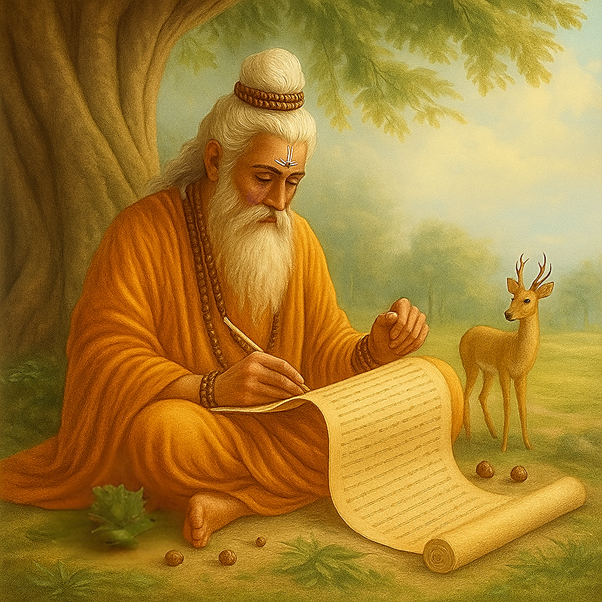
Having inscribed the divine knowledge of the Bhagavatam, a sense of unease still lingered within Ved Vyas. “This is not enough,” he thought. Unless its truths were heard and lived by the world, the very purpose of the scripture would remain unfulfilled. But who would propagate it? Old age had dimmed his vigor; the mission called for someone youthful. His thoughts naturally turned to his son—Shukadev.
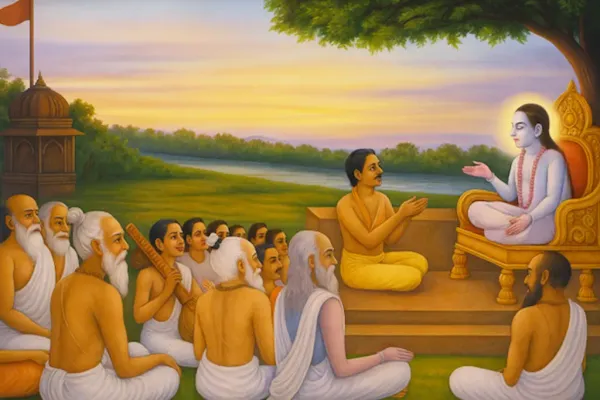
And thus begins the extraordinary story of Shukadev, as narrated by Suta Goswami. Offering his humble obeisance, Suta ji says, “I bow to my revered Guru, Shukadev Maharaj.”
सूत उवाच
यं प्रव्रजन्तमनुपेतमपेतकृत्यं
द्वैपायनो विरहकातर आजुहाव ।
पुत्रेति तन्मयतया तरवोऽभिनेदु-
स्तं सर्वभूतहृदयं मुनिमानतोऽस्मि ॥ २ ॥
With these words, Suta Goswami then begins recounting the marvels of Shukadev’s birth.
Born Detached
While still in his mother’s womb, Shukadev’s body developed like that of any other child over nine months. But unlike ordinary children, this realized sage exercised full conscious control over his body, choosing to remain in the womb—not for days or weeks, but for twelve long years. Even in the womb, his brilliance shone forth. When Ved Vyas recited the Vedic mantras, the unborn Shukadev would point out fallacies in his father’s enunciation, leaving Ved Vyas astonished.
In awe, Ved Vyas asked, “My child, who are you?” Shukadev gave a profound reply saying that he was but an eternal soul, forever journeying through the cycles of birth and death. Recognizing his son’s extraordinary wisdom and elevated consciousness, Ved Vyas said, “You are supremely knowledgeable—now, please come into the world.” But Shukadev resisted, saying, “If I emerge, Maya will ensnare me. Here in the womb, I remain safe.” Such was his conviction that even the prospect of birth seemed a trap of illusion. It was only when Sage Narad intervened and whispered through his mother’s ear, assuring him he would be safe outside, did Shukadev finally consent to be born.
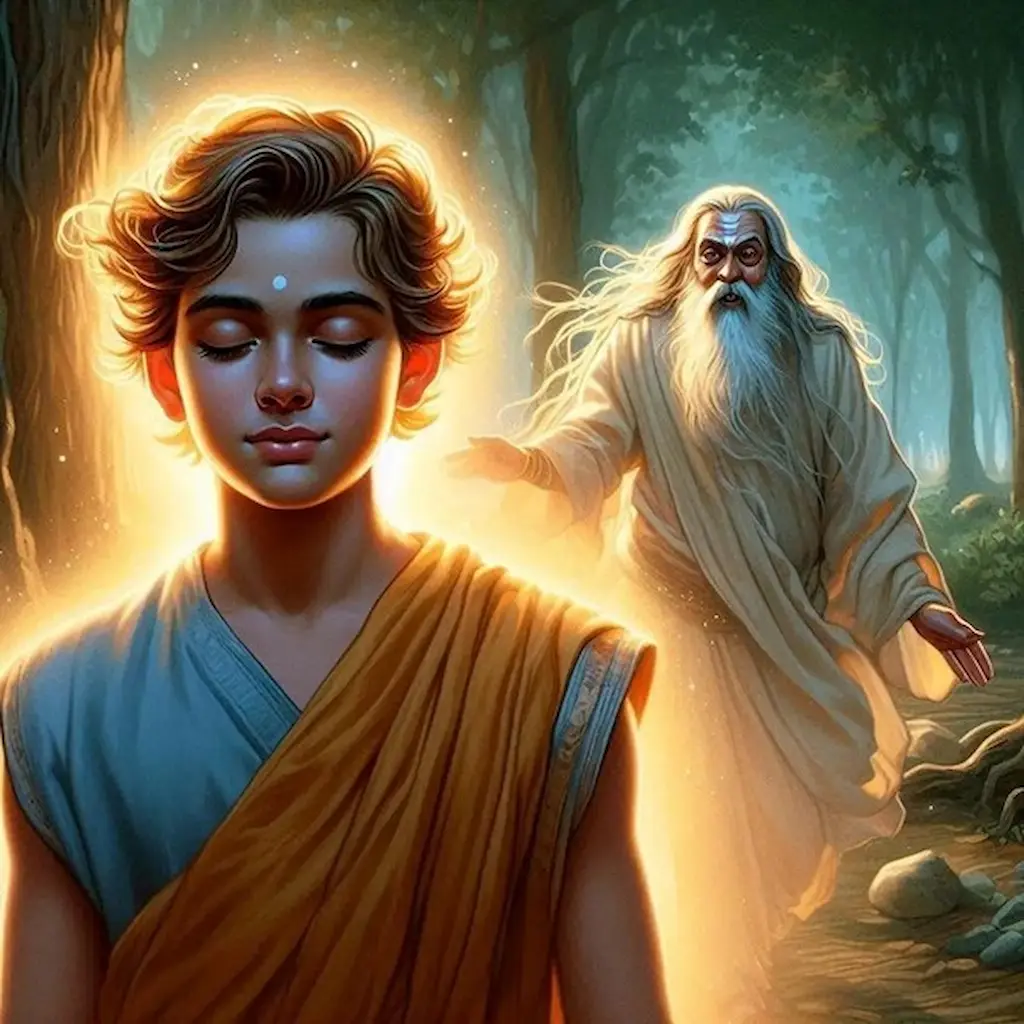
The moment he entered the world, Shukadev revealed the depth of his renunciation. By his yogic powers, he instantly assumed the form of a twelve-year-old. Without a word to his father, he walked away in silence. Ved Vyas, overcome with longing, called out, ‘Putra! Putra!’ But Shukadev neither turned nor responded, already absorbed in samadhi (deep meditation). In the state of Advait (oneness of the individual soul with universal consciousness, Brahman), he perceived no distinction between himself and the world; all he saw and heard was the Self. Thus, Shukadev continued on his way, while Ved Vyas had no choice but to return.
Soon, a telling episode took place.
Shukadev’s Turning Point
Some women were bathing in a lake when Shukadev passed by. Though he was in the bloom of youth, the women continued without embarrassment. A little later, his father Ved Vyas approached. At once, the women covered themselves. Surprised and indignant, Ved Vyas asked, “My young son passed by, and you remained unbothered. Yet when I, an old man, came, you covered yourselves. Why this difference?”
The women replied respectfully, “Maharaj, your son is a Paramhans, while you are a Hans.” A Hans is one who sees both Maya and God but chooses God.
The Ramcharitmanas offers a vivid imagery in this context:
जड़ चेतन गुन दोषमय विस्व कीन्ह करतार
संत हंस गहहिं पय परिहरि बारि बिकार || 6 ||
The Almighty has created the universe with both virtues and evil. The saintly take the milk of goodness rejecting evil; as swans separate milk and discard water.
But a Paramhans perceives only God, nothing else. The women continued, “We felt the purity of Shukadev’s vision—it remained unchanged whether he saw rocks, trees, rain, or us. In your glance, however Maharaj, we sensed an awareness of Maya, so we covered ourselves.”
This incident revealed Shukadev’s exalted state. Soon after, Shukadev withdrew deep into the forest and entered Nirvikalp Samadhi, the highest state beyond all dualities. During this period, Ved Vyas composed the Mahabharat. One day, as his disciples gathered wood, they spotted a young boy absorbed in deep meditation. Mistaking it for a charade, they playfully tested him—poking his ear, slipping a twig into his nose, even blowing into his eye. Yet he remained unmoved. Perplexed, they took the matter to Ved Vyas, who instantly knew it was his son. To rouse him from that trance, Ved Vyas instructed his disciples to recite a verse from the Bhagavatam, renowned for its poetic description of Shree Krishna’s divine charm.
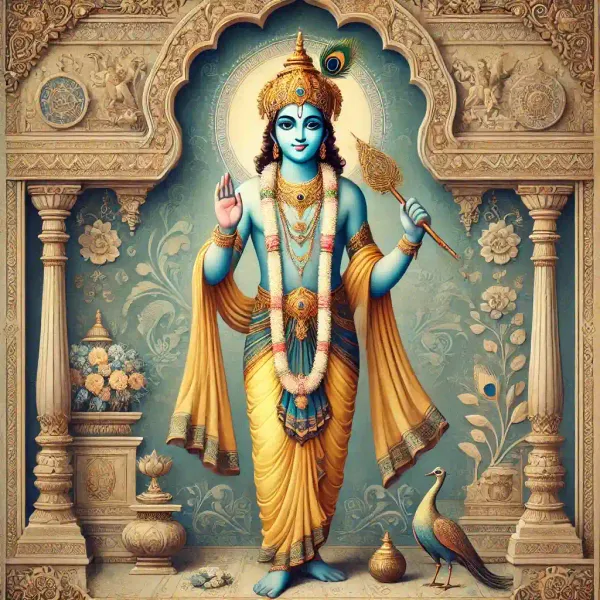
बर्हपीडं नटवरवपु: कर्णयो: कर्णिकारं
बिभ्रद वास: कनककपिशं वैजयंती च मंगलम्।
रन्ध्रान् वेनोर्धरसुधया पुरयन्गोपवृन्दै-
रवृन्दारण्यं स्वपद्रमणं प्रविषद् गीतकीर्ति: ॥ 5 ॥
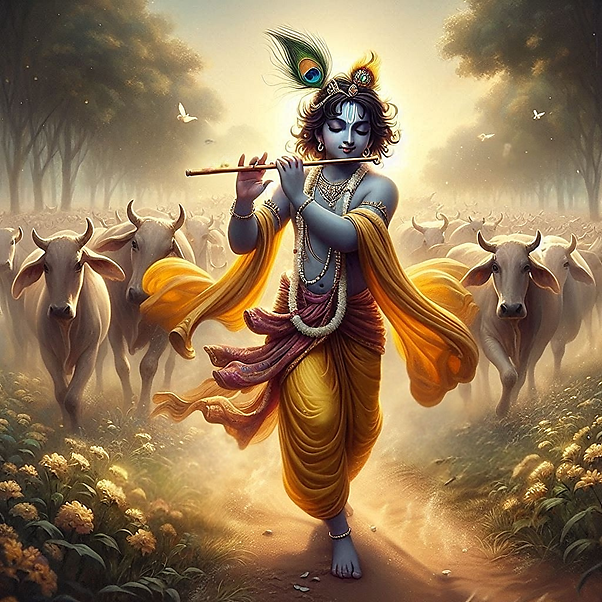
Shree Krishna strolling through Vrindavan, cows trailing behind Him, their dust gently decking his dark-complexioned form. The peacock feather on His crown swaying in the breeze, and His yellow pitambar (silk cloth) flowing gracefully over His shoulders. With soft curls around His face, Krishna raising the flute to His lips, and playing a tender melody that beckoned the gopis.
That single verse shattered the stillness of Shukadev’s samadhi. Though immersed in the formless Brahman, where even thoughts could not arise, the moment he heard the verse, the formless Absolute took on the supremely enchanting form of Lord Krishna. Shukadev wondered: why seek the formless when the Lord’s personal form is overflowing with sweetness and beauty? Captivated, he opened his eyes and urged the boy to repeat the verse again and again. Upon learning that it was from a new composition of Ved Vyas, he rushed to his father to hear the entire holy text—thus becoming the destined speaker, the great Vakta of the Shreemad Bhagavatam.
The Mahabharat War Aftermath
Next, Suta Goswami relates the tale of King Parikshit, the great listener of the Shreemad Bhagavat Mahapuran. Recognizing Parikshit’s spiritual maturity, Shukadev imparted to him the most esoteric wisdom. This account unfolds against the backdrop of the Mahabharat, leading to Parikshit’s birth and the extraordinary circumstances that destined him to receive this transcendent knowledge.
The great war of the Mahabharat had ended. Countless warriors lay slain on the battlefield, and from the Kaurava army only four survived—Duryodhan, Kripacharya, Kritavarma, and Ashwatthama. Following this, Bhim had wounded Duryodhan intensely in a mace fight. And Duryodhan lay on the ground for days, struggling for his life airs. Meanwhile, Ashwatthama, Dronacharya’s son, restless and vengeful, resolved to act. Knowing he could not defeat the Pandavas in fair battle, he chose treachery. Under the cover of night, he crept into the Pandava camp. Shree Krishna, the eternal protector, had warned the Pandavas not to sleep in their usual tents. Instead, their five young sons, appearing like adolescent warriors, rested there. Mistaking the boys for their fathers, Ashwatthama struck brutally, severing their heads.
Carrying the heads by their hair, he rushed to Duryodhan, exclaiming, “Victory at last! Behold, the heads of the Pandavas!” Duryodhan, in disbelief, demanded proof. “Give me Bhim’s head.” Ashwatthama handed him the largest one, but when Duryodhan crushed it in his hands, it crumbled. Horror struck him; this was not Bhim, but his own nephew, one of the Pandavas’ sons. In anguish he cried, “What have you done?” Though long hostile to the Pandavas, Duryodhan was horrified at the massacre. Unable to bear the weight of the heinous deed, he abandoned his will to live and gave up his body.
At dawn, Draupadi entered the tent to serve her husbands, only to find the lifeless bodies of her children. Her piercing cry shook the camp, drawing the Pandavas to the tragic scene. Arjun, witnessing his wife’s heartbreak and the slaughter of his sons, was consumed with fury. He vowed to punish Ashwatthama and set out with Shree Krishna at his side. As Arjun drew near, fear overtook Ashwatthama, and he invoked the Brahmastra (powerful celestial weapon). Arjun bewildered turned to Krishna who guided him to counter it with his own Brahmastra. The two celestial weapons collided with blinding force before dissolving into silence. With the peril averted, Arjun surged ahead, seized Ashwatthama, and dragged him before Draupadi.
Arjun stood tall, his voice resolute. “Behold, the killer of your five sons—the architect of this unspeakable atrocity. Today, I shall end him.” But Draupadi, though grief-stricken, said, “Do not kill him. I know the agony of losing a child. Why should another mother suffer the same sorrow? Spare him.” Bhim, enraged, protested, “This is wrong! He is a cold-blooded murderer. Justice demands his death.” Yudhishthir, ever the voice of dharma, calmly sided with Draupadi: “No, let forgiveness prevail.” Thus, two opposing stances emerged—one demanding justice, the other advocating mercy.
Birth of Parikshit
Arjun, torn between the cry for justice and the call of mercy, sought Krishna’s counsel. Lord Krishna declared: “One who acts through adharma deserves punishment, yet the son of a Brahmin must not be slain.” By weighing both sides, he suggested a middle path—punishment without execution.
Grasping his master’s intent, Arjun acted decisively. Ashwatthama bore a radiant jewel on his forehead, a mark of power and prestige. Arjun tore it away and shaved off his shikha (the mark of a Brahmin). Stripped of honor and dignity, Ashwatthama’s life was spared, but he suffered a punishment worse than death—public disgrace. Humiliated, he fled from there.
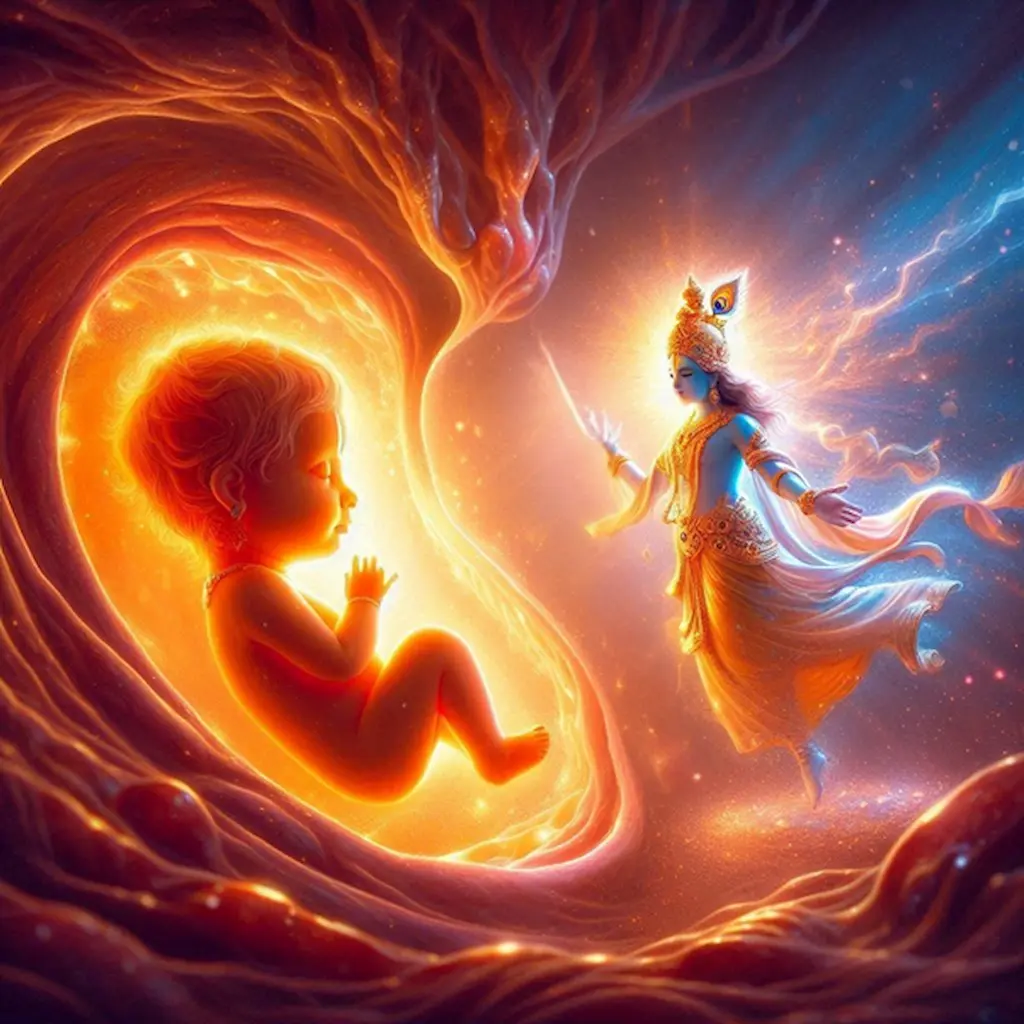
But evil rarely rests. Though forgiven, Ashwatthama’s malice festered. He once again invoked the Brahmastra. This time, he aimed it at the womb of Uttara, the widow of Abhimanyu, son of Arjun. Abhimanyu had already fallen in battle, but his child—yet unborn—was the sole surviving heir of the Pandavas’ lineage. Terrified, Uttara cried out to Lord Krishna for protection. Moved by her plea, Shree Krishna assumed a subtle form and entered her womb. There, He shielded the unborn child, neutralizing the destructive power of the Brahmastra. The child received Krishna’s divine darshan even before birth. That blessed soul, preserved by the Lord’s grace, was later born as Parikshit—the very listener of the Bhagavatam.
With Ashwatthama subdued, peace gradually returned to Hastinapur. Shree Krishna remained there for some time, offering solace to the Pandavas and the people. About twenty days after the war, as He prepared to return to Dwaraka, Kunti approached Him.
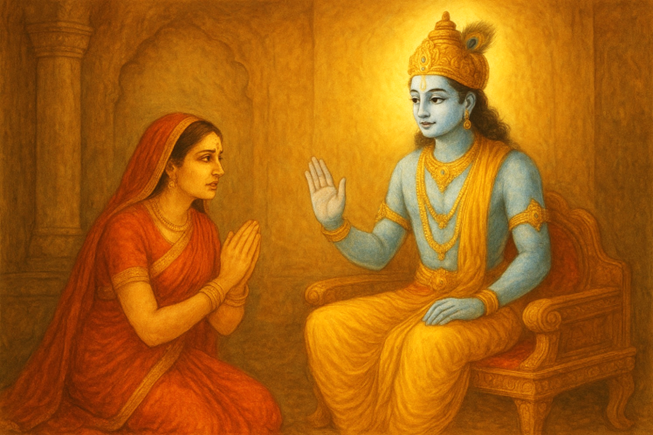
“O Krishna,” she said, “You are the very support of our lives. If You leave us, how shall we go on?” With folded hands, she poured out her prayers. Pleased with her devotion, Shree Krishna offered her a boon of her choice.
With deep conviction she prayed:
विपद: सन्तु ता: शश्वत्तत्र तत्र जगद्गुरो ।
भवतो दर्शनं यत्स्यादपुनर्भवदर्शनम् ॥ २५ ॥
O Jagadguru, grant me calamities, grant me hardships, grant me oppressive circumstances.
Shree Krishna was astonished. “After all your suffering, why would you desire more?”
Before the Supreme Lord stood a woman who had known nothing but hardship. As a child, she was separated from her father; after marrying Pandu, joy eluded her. Widowhood brought more sorrow. She endured Kauravas’ malice, the fire of the wax palace, Draupadi’s humiliation, and the long exile in the forest. Shree Krishna asked, “And now, at last, your son Yudhishthir sits on the throne of Hastinapur. Should you not ask for peace and prosperity?”
Kunti replied with profound wisdom:
जन्मैश्वर्यश्रुतश्रीभिरेधमानमद: पुमान् ।
नैवार्हत्यभिधातुं वै त्वामकिञ्चनगोचरम् ॥ २६ ॥
It is worldly opulence, pleasure, and luxury that distract the mind from God. When these are taken away, the truth becomes clear—that happiness does not reside here, but in You. Therefore, calamities are blessings, for they turn our hearts away from material illusion and direct them towards Your lotus feet. To think happiness lies in this world is the greatest misery; to know that it does not, is the greatest gift.
Lord Krishna, touched by her prayer, remained in Hastinapur a few more days before returning to Dwaraka. Thus, even in the aftermath of war, the lessons of forgiveness, divine protection, and the wisdom of detachment shone forth.
Final Reflection
From the moment Shree Krishna’s flute stirred Shukadev’s heart, to Draupadi’s choice of forgiveness amid unbearable loss, and Kunti’s vision of hardship as a path to God, every soul is touched by the subtle threads of divine grace. Parikshit, cradled in Krishna’s loving protection even before birth, blossoms into the devoted listener of the Bhagavatam. In this symphony of timeless tales, love, compassion, and surrender triumph, beckoning seekers to find solace in the eternal embrace of the Supreme.