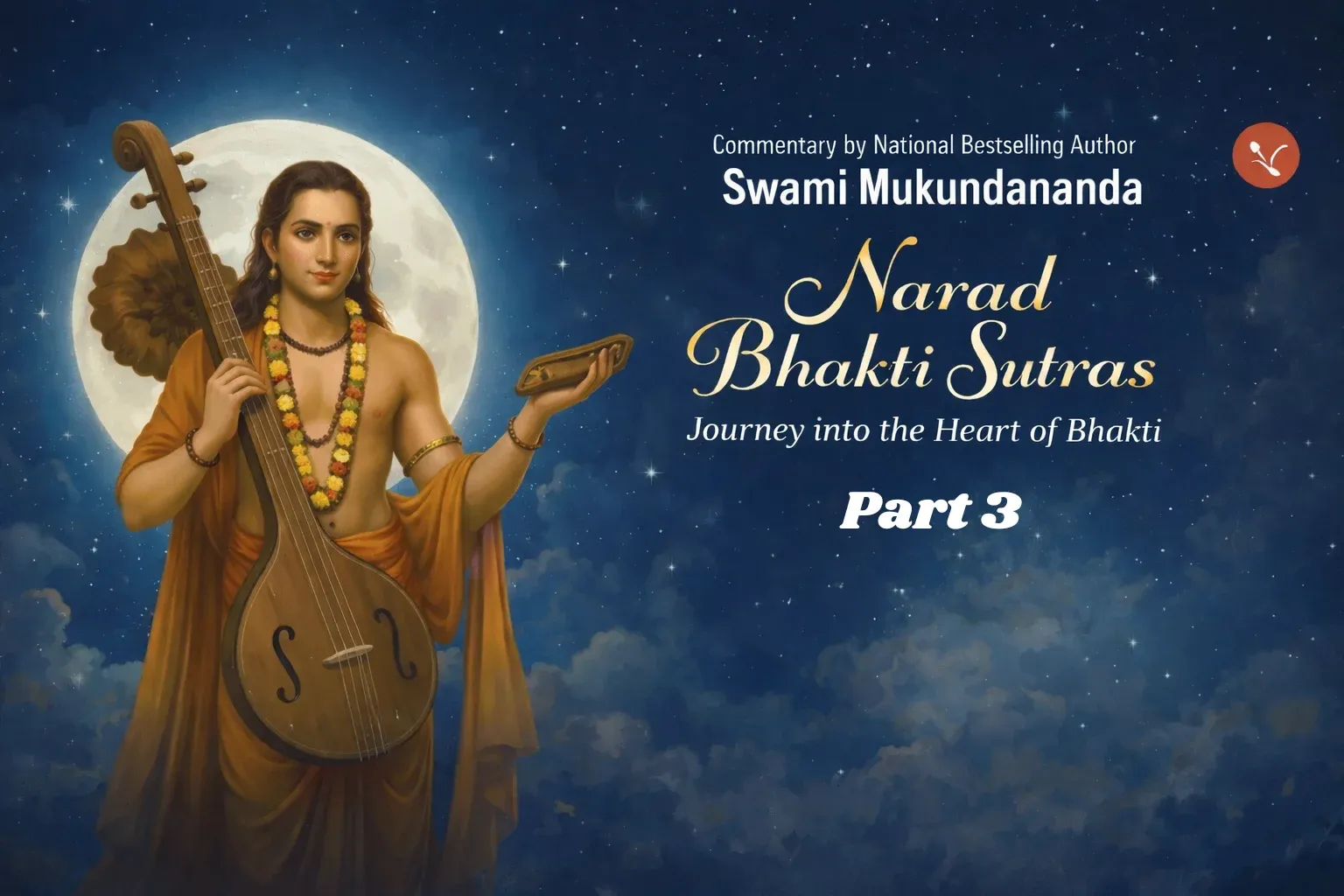
Narad Bhakti Sutra - Part 3
The real calamity is never what life takes from you. The real calamity is the moment your heart forgets God.
— Swami Mukundananda Ji
I. The Film That Never Stops Playing
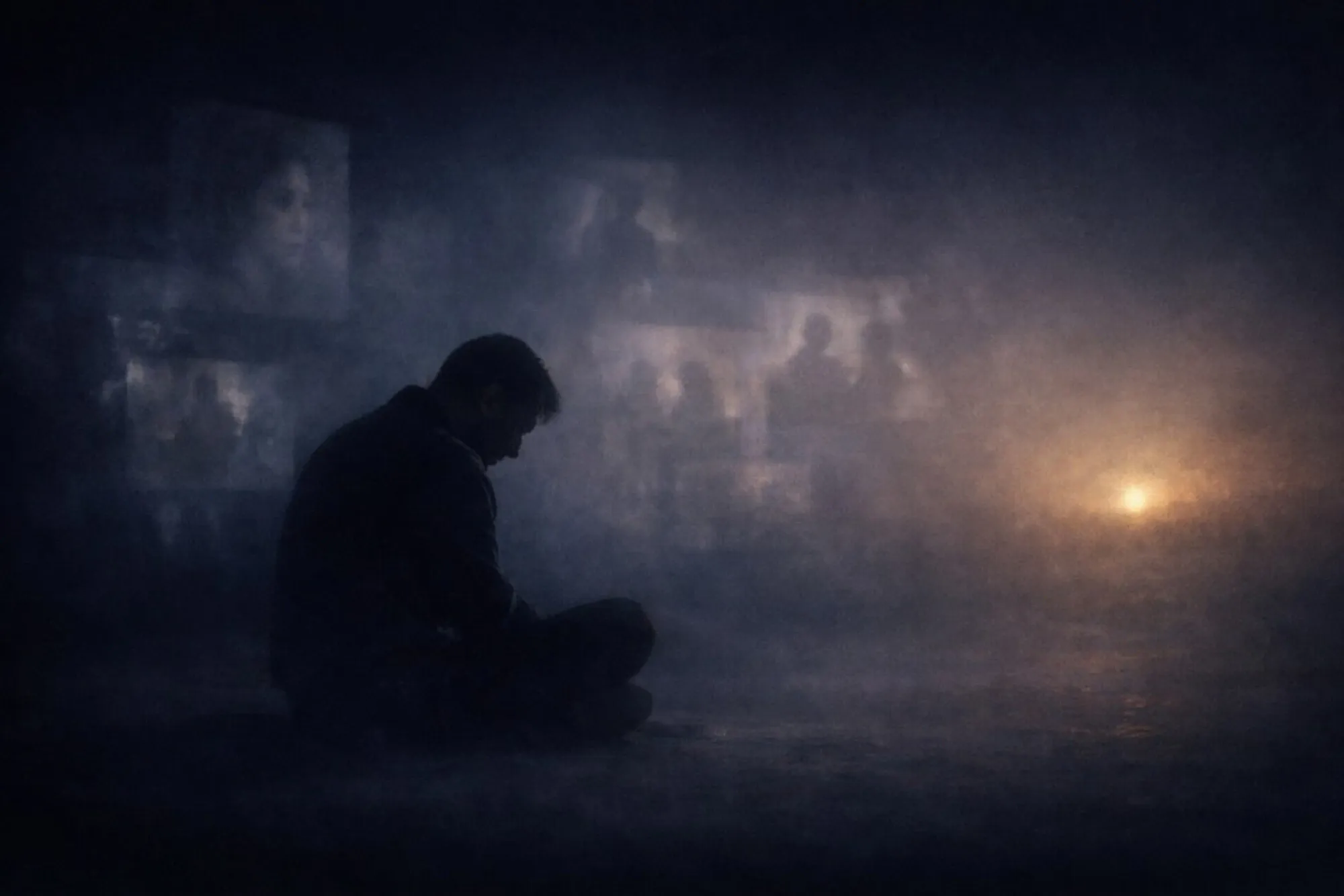
Close your eyes for a moment.
There is a film playing in your mind right now. It has been playing quietly for days. For months. Perhaps for years. You did not consciously choose it. You did not press record. And yet it runs anyway — in the quiet moments between tasks, in the silence before sleep, in the sudden ambush of an idle afternoon when you thought you were finally free of it.
You know the scene. The words that were said or the words that were never said but should have been. The moment the door closed. The day the news arrived. The morning you woke up and understood that something you had counted on was simply gone. And every single time it reaches that specific moment, the chest tightens. The stomach turns. The body responds as if it is happening right now. As if the wound is fresh.
Nothing is going right in my life.
Have you felt that today? The way it does not arrive loudly but settles quietly like dust over everything. Removing color from the future. Making the space between where you are and where you wanted to be feel not like distance but like verdict.
This is not weakness. This is a human mind doing something it was never taught not to do. The more exhausted you become, the more faithfully the mind returns to that same shrine — that place in the past where the wound lives — believing that if it visits enough times, something will finally be resolved. The shrine gives no blessings. Only the same wound, freshly reopened, every single time you arrive.
Here is what Swami Mukundananda Ji, illuminating the Narad Bhakti Sutras with the precision of a surgeon and the love of a father, places before us — not as philosophy, not as consolation, but as a diagnosis so precise that when it lands it changes everything:
That event is over.
Whatever it was — the argument, the betrayal, the loss, the failure, the door that closed — it happened somewhere in the past and it is finished. It no longer exists anywhere in the universe. The air of that room has long since moved on.
And yet in your mind it is happening right now. Two years ago, this happened. Three years ago, that happened. And the mind returns with the faithfulness of a pilgrim returning to a shrine except this shrine does not give blessings. Swami Mukundananda Ji's diagnosis is this precise, this gentle, and this liberating all at once: you are not suffering from the past. The past cannot hurt you. It is over. What you are suffering from is a film of the past that you are running in the projector of your own mind right now and calling it reality.
You are the projectionist. You are the one keeping the hurt alive. Not because you want to suffer. But because no one ever showed you how to turn the projector off.
And there is a cost to this that cuts far deeper than the pain itself — one that most people never name clearly. Every moment the mind spends inside the film is a moment stolen from the only place where anything real can happen. The place where God can be met. The place where the life you are still living is quietly waiting for you to arrive.
This is what Swami Mukundananda's teaching through the Narad Bhakti Sutras has come to offer you.
The Narad Bhakti Sutras — the ancient scripture of divine love that illumines this entire teaching — speak directly to this moment:
Sutra 61: Lokahanaau cinta na karya niveditAtma-loka-vedatvat
"Devotees should not worry about worldly losses since they have already surrendered themselves, their worldly matters, and Vedic deeds to God."
This is the sutra the entire teaching lives inside. Not that losses do not come. They come. But the soul that has genuinely surrendered discovers that what it truly is cannot be taken by anything the world brings. The film runs. The chisel falls. And beneath it all steady, present, unmoved — is the Lord's hand.
Swami Mukundananda Ji's teaching through the Narad Bhakti Sutras does not offer consolation for this. It offers something more demanding and more alive. It begins with a story so simple it almost conceals what it carries.
II. The Instagram Disciple and the One Word That Contains Everything
The mind replays the film because it believes, somewhere beneath language, that if it examines every angle with sufficient precision, it will finally resolve what happened. But the past cannot be resolved. It can only be replayed. And every replay deepens the groove. The body does not know the difference between something happening now and something vividly remembered. The chest tightens on cue. Not because the past is present. Because the projector is running.
Swami Mukundananda Ji brings us a story that is, in its gentle humor, a mirror held up to our entire generation.
A disciple — sincere, earnest, perpetually sorrowful — went to his Guru with one urgent request: how do I get free of this lamentation that has taken up permanent residence inside me? He had built, brick by brick, a mansion of grief and had begun to mistake it for a home.
The Guru said: Come. Let us study the Bhagavad Gita together for three months.
The disciple flinched. Guruji, can the process not be shortened?
The Guru, with the patience of someone who has answered this question ten thousand times: Very well. Twenty days. The eighteenth chapter.
The disciple hesitated again and here, recognize yourself, because this disciple is every one of us. Guruji, he said finally, I should tell you honestly. I am one of those Instagram types.
The Guru smiled. Then take just one verse. The sixty-sixth of the eighteenth chapter.
Could it even be shorter? Something that arrives complete in a single breath?
And the Guru said the thing that holds the entire palace of the Gita's wisdom in a single room: Then take just one quarter of that verse. One word. One movement.
Surrender.
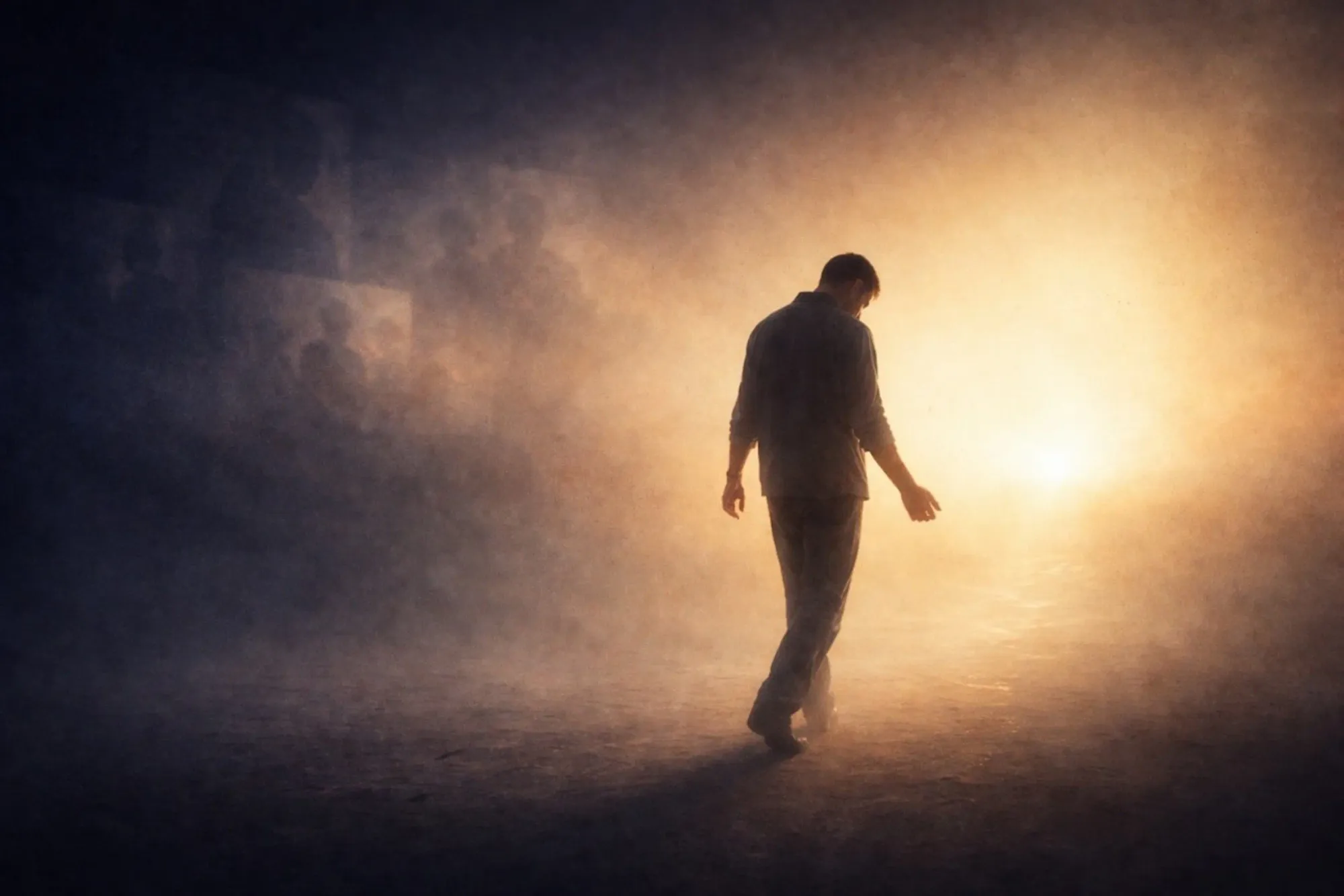
This story is not only charming, it is a precise portrait of how the modern mind approaches suffering. Seeking relief without confronting the source. The Guru's gift is not the shortcut the disciple was asking for. It is the truth about why there is no shortcut. Because the real answer was never long. It was only demanding.
And it must be done not once but constantly, moment to moment. The present moment always requires a fresh turning. Every moment spent in the film of the past is a moment away from God. Not because God is far. Because you are not here. And here is the only place He can be found.
III. What God Says to Every Mind Trapped in Its Own Story
On the greatest battlefield in the history of the world, a warrior put down his bow and began to talk.
Arjun's grief was real and deep and entirely understandable. The people across the battlefield were not strangers — they were teachers, uncles, cousins, the entire architecture of his relational world. He looked at all of it with the full clarity of a great mind and the full feeling of a sensitive heart, and he collapsed. His arguments were intelligent. His grief was articulate. His film was very convincingly produced.
Shree Krishna listened to every word with complete attention. And then said:
The Supreme Lord said: While you speak words of wisdom, you are mourning for that which is not worthy of grief. The wise lament neither for the living nor for the dead.
— Bhagavad Gita 2.11
Do not let this sound harsh. It is the most loving thing a true teacher can say to a student who is suffering beautifully inside a story. Your intelligence is real. Your pain is real. But you are using your intelligence to construct an elaborate, philosophically sophisticated monument to your own suffering — and that monument, however magnificently built, is a prison.
Swami Mukundananda Ji shows us how Shree Krishna returns to this again and again throughout the Gita. He is thorough because the ego's attachment to its own film is thorough — it does not stop at a single invitation. It needs the truth offered from every angle, through every door, until one of them finally opens.
Underneath all the cosmic architecture and the philosophical precision, the invitation is always the same: turn around. Stop running the film. Come to Me. I am here. I have always been here. I was here before the film started and I will be here after it ends.
IV. Two Words That Carry the Weight of Everything
Abandon all varieties of dharmas and simply surrender unto Me alone. I shall liberate you from all sinful reactions; do not fear.
— Bhagavad Gita 18.66
Ma shuchah.
Do not grieve.
Two words in Sanskrit. Standing at the very end of a poem of seven hundred verses like a hand placed gently, without drama, on a shoulder in the dark.
The promise here is unconditional. Not — I will deliver you if you perform correctly. Aham tvam mokshayishyami. I shall deliver you. Full stop. The delivering is not a reward for worthiness. It is a response to the single gesture of turning. When the soul turns toward God, God moves toward the soul. This is the law of Bhakti, as reliable as gravity, as certain as dawn following the darkest hour.
One quarter of this verse. One word. Surrender. It was not a shortcut at all. It was the whole path, compressed to its living essence.
Surrender does not mean collapse. It does not mean giving up on your responsibilities or pretending the difficulty is not real. It means something more precise: you bring your full effort, but you release the outcome. You face life completely, but you do not carry it alone. You feel the pain honestly, but you place it at His feet rather than replay it in the projector. And sometimes, in the most difficult moments, surrender looks exactly like this:
My Lord... I do not understand this. But I trust You.
That is enough. It has always been enough. The projector does not need to be forced off. It turns off in the moment of that turning. Surrender is the off switch. Not a destination to reach — a direction to face. And the facing can begin right now.
V. The Marble and the Sculptor — Understanding God's Plan Through Every Difficulty
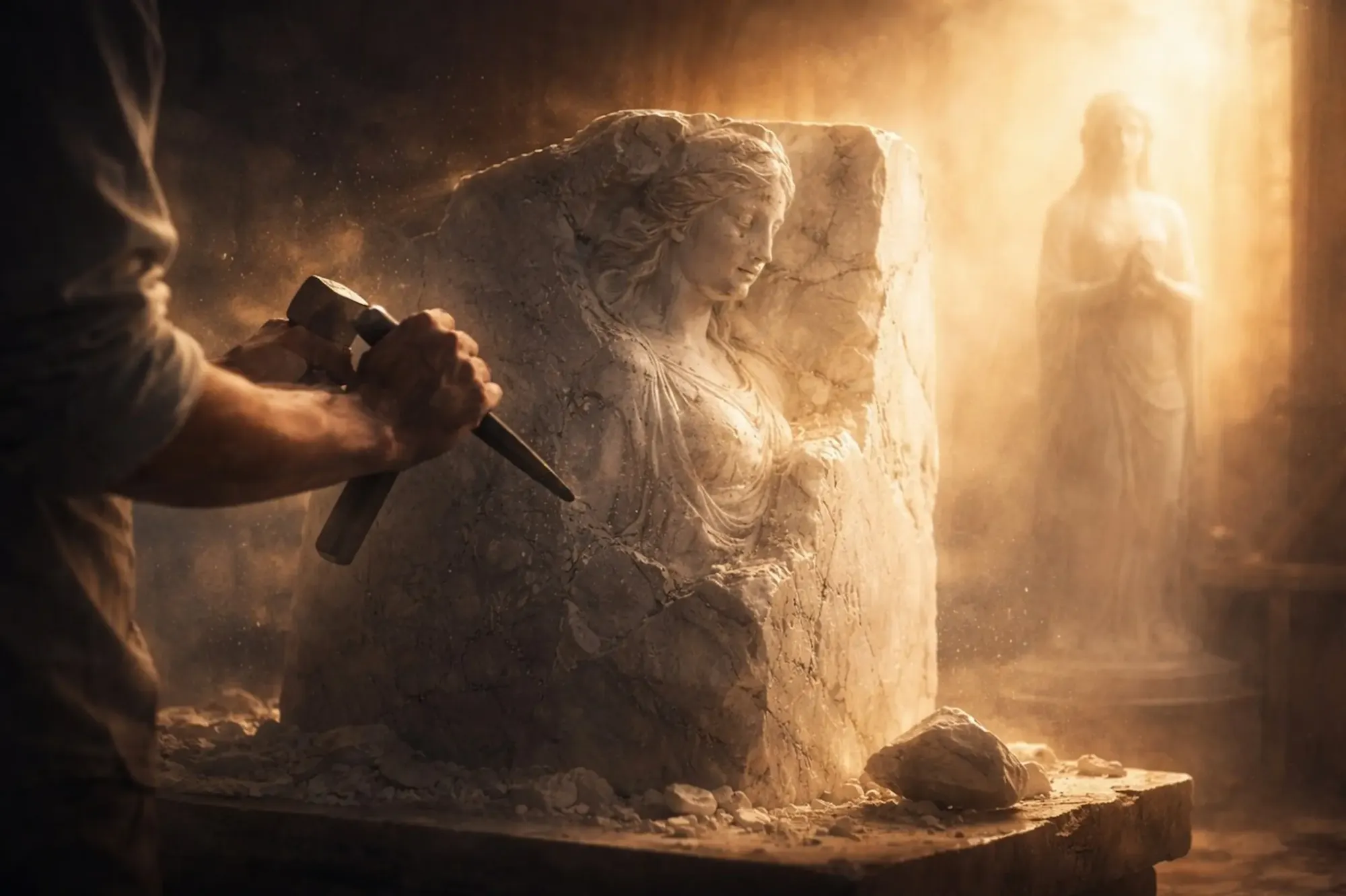
In a sculptor's workshop, the light comes in sideways through small high windows, and the air carries the particular mineral patience of stone that has been waiting a long time to become what it was always meant to be.
Two blocks of marble arrived on the same day. Same quarry. Same truck. Same rough unpolished surface. Identical in every way that could be measured or seen.
The sculptor looked at them the way only a sculptor looks at stone — not at what they were, but at what they contained. He picked up his chisel and began.
The first blow struck. Then another. Chips flew. Fine dust rose in the slanted light. The sculptor was not gentle — he was precise. And precision in the making of a masterpiece requires force.
Anyone who has sat inside a sustained season of real difficulty knows precisely what this feels like from the inside. The chisel is cold. The blows are accurate. And the precision makes it worse, not better, because it does not feel random. It feels targeted. It feels personal. Alongside the pain of the blow, the mind generates its own second film: this is wrong. This should not be happening. Why me.
The first marble gave way to that film. Pain without meaning is unbearable, and the first marble could not find any meaning in what was happening to it. It shattered in the wrong places, refused the shape being coaxed from it with such careful attention. And the sculptor set it aside. And walked to the second marble.
The second marble felt the same blows. The chisel was identical, the force the same, the removal equally total and unannounced. But somewhere in the second marble there lived a different understanding. Not that the pain was welcome. Only this: hands this purposeful - do not work without vision. Something is being made here. I cannot see it yet. But the one holding this chisel has already seen it.
I will endure. Not because pain is good. But because I trust the hands.
Years later, in a great museum, visitors moved through the halls with lowered voices and slowed steps — the particular hush that falls over people in the presence of beauty that has no explanation. They stopped before a marble statue of such luminous, unreasonable beauty that even the most distracted visitor went quiet.
One of the floor tiles was the first marble.
One day the tile spoke to the statue in whatever language stone uses when it finally has enough silence to form a question: Brother, we came from the same quarry. The same truck. The same day. How did we become such entirely different things?
The statue replied with the simplicity of someone who has nothing left to prove:
You remember — when he first lifted the chisel, he began with you. But every time the blow fell, you resisted. You could not bear it. You gave way in the wrong places. And so, he set you aside. When he put you down, he picked me up. I knew what the chisel cost. I bore it because I trusted the hands that held it. I knew they could already see who I was becoming.
Let that settle. Do not move past it too quickly.
Swami Mukundananda Ji places this story before us not as comfort but as revelation. God is the sculptor. Every soul is marble. The masterpiece He sees in each of us — the divine potential He has loved in us since before we drew our first breath — is the reason the chisel keeps falling. Not in punishment. Not in indifference. In the fierce, patient, refusing-to-abandon love of a creator who will not leave his greatest work unfinished.
God has a plan. He is working on it right now, through this very difficulty, with this very chisel, on this very stone. The difficulty pressing on you is not evidence that the plan has been abandoned. It is evidence that the plan is active. The masterpiece does not expire. The vision does not fade. He will not abandon the work and He will not abandon you.
The only question this teaching quietly places before us is this: how long do we want to remain the floor tile?
VI. How Do You Know God Loves You When Everything Feels Wrong?
There is a question that arrives not from intellectual curiosity but from genuine, exhausted, three-in-the-morning need. From a faith that is not absent but tired. From a heart that has not stopped believing but has stopped feeling the believing.
How do I know God loves me, when everything around me seems to say otherwise?
Swami Mukundananda Ji does not reach first for scripture. He points to the world itself. To the miracle proceeding, uninterrupted and entirely unannounced, in this very body, while the film runs and the chest is tight and the mind circles its familiar wound.
Look at a single human cell. Within its microscopic boundary, thousands of simultaneous chemical operations are being conducted right now with a precision that the most advanced technology ever built cannot fully replicate. It reads instructions encoded in a language of four letters containing more organized information than any library ever assembled. It repairs its own damage. It maintains the exact conditions of its own existence with a fidelity so extraordinary that scientists who devote entire careers to studying it reach, again and again, for the word miracle — because no other word is honest enough.
Thirty-seven trillion of them in your body. Right now. While you carry your worry. While the film runs. While you wonder whether you have been forgotten. They are working not because you instructed them, not because your faith was strong enough this morning. They are working because the intelligence that designed them has not paused its sustaining of them for a single second of your entire life.
His miracle is there in every atom of creation. That God who has so much intelligence to create such a universe — there should be no doubt that He has infinite love for His little parts as well. Just as you love your children, God loves us. And He has a plan.
He is working on it right now. The difficulty pressing on you is not evidence that the plan has been abandoned. It is evidence that the plan is active. The chisel is still falling — which means the sculptor has not walked away from the stone. Which means you have not been forgotten.
The film says you have been forgotten. The thirty-seven trillion cells working in your body right now say otherwise.
VII. The Moment the Projector Turns Off
The film is not the past hurting you. The film is you — right now, in this present moment — keeping the past alive in the only place it can still exist: the projector of your own mind. The past itself is over. It no longer exists anywhere in the universe. What exists is the film you are choosing, breath by breath, to keep running.
And the projector has an off switch.
It is called surrender. It is called choosing — right now, quietly, without drama, without waiting for the difficulty to resolve first — to remember God rather than replay the film. Renewed in this breath and then the next and then the one after that.
The saints made this choice. Not once. Every day. Every ordinary moment. And here is what is easy to miss about them: they were not spared the chisel. The great devotees of history did not live soft, undisturbed lives from which they dispensed wisdom about suffering they had never known. They were exiled. They lost children. They were betrayed by those they loved. They endured illness, poverty, humiliation, and grief of a depth most of us will never be asked to carry. The chisel fell on them as it falls on everyone. What was different was not the blow. It was what they brought to the blow. They changed the question the mind asked of difficulty. They looked at the same universe we live in and saw not a place of random suffering but a workshop — and themselves not as victims of the chisel but as marble in the hands of a sculptor who has already seen the face inside the stone and will not rest until it is revealed.
You are that marble. Not the floor tile. The block the sculptor chose and has not set down. The chisel is still falling because the masterpiece is still being made. He has never once — in all the blows struck across the entire length of your life — lost sight of it.
Turn off the projector.
Be here.
Remember God now.
Not last year. Not tomorrow.
Now.
The chisel falls because the sculptor loves you and love never abandons its masterpiece.

Key Takeaways
The film is not the past — it is a present choice. Whatever happened is finished. It no longer exists anywhere in the universe. What exists is the film you are choosing, breath by breath, to keep running in your own mind. The past cannot hurt you. Only the projector can.
Surrender is a direction, not a destination. It is not something you accomplished once and now possess. Last year's surrender does not carry today. The present moment always requires a fresh turning — a new, quiet choosing of God over the film. That turning can begin in this breath.
The chisel falls because the sculptor loves the stone. Every difficulty is not random suffering. It is the precise work of a creator who has already seen the masterpiece inside you and will not rest until it is revealed. The question to bring to hardship is not why is this happening to me, but what is this making of me.
God's love is structural, not occasional. Thirty-seven trillion cells in your body are being sustained right now, without pause, without condition. The intelligence that holds that miracle together has not forgotten the heart it is keeping alive. You have not been abandoned. The plan is active.
There is never failure — only success or learning. If the effort produced the desired result: move forward. If it did not: information received, the next attempt beginning from a wiser place. The stumble is not the story. It is one line in a story being written by a sculptor who already knows the shape of the ending.
Living it — one complete daily rhythm: Before the phone each morning, give five minutes to surrender. During the day, when the film begins, change the question from why to what. In any difficult moment, look at your hand and let the miracle of what is being sustained there remind you that you have not been forgotten. Before sleep, bring one wound the second question rather than the first. Not why is this happening to me. But what is this making of me.
May every blow of the chisel be felt for what it truly is — the touch of the sculptor who has never stopped loving the stone.
🌟 Final Call to Action
👉 For more life-changing teachings, subscribe to the official YouTube channels:
👉 Watch the complete Narad Bhakti Sutra series on the Bhagavad Gita Krishna Bhakti Channel:
Buy the "Narad Bhakti Sutras" by Swami Mukundananda
Now that we’ve explored the divine wisdom of the Narad Bhakti Sutras, it’s time to take the next step on your spiritual journey. To deepen your understanding of the Narad Bhakti Sutras, we highly recommend Swami Mukundananda’s commentary, which beautifully unpacks each mantra providing a clear and practical guide for modern seekers.
Order the Book: Swami Mukundananda’s Commentary
Unlock the deeper wisdom of the Narad Bhakti Sutras with this insightful commentary by Swami Mukundananda. Perfect for modern seekers who wish to explore the divine teachings in greater depth.
Order the Book Now (India)Order the Book Now (USA)
If this teaching reached something in you — share it with one person who needs it today.
FAQ
1. Is this teaching asking me to suppress grief to pretend the pain is not real?
No. Feel the pain fully — that is not what the teaching asks you to stop. What it asks you to stop is the endless replay of the film. Grief that is felt, acknowledged, and brought to God is not lamentation. Lamentation is grief that has stopped moving and started circling — that has built a permanent address in the past. Feel the blow. Do not build a home inside it.
2. What does surrender look like in a practical, ordinary day?
Bring your full effort to every situation, then release the outcome to God. This is not passivity — it is the most active spiritual practice available. Practically: five minutes of prayer before the phone each morning. One question changed from why to what when the film begins. One wound reframed before sleep. Surrender is not a destination you reach once. It is a return you make in this breath, and then the next.
3. How do I know that what I am going through is purposeful and not simply random suffering?
Look at a single cell in your body — one of thirty-seven trillion working right now without your instruction. The God who sustains that level of intelligence and care in every atom of creation is not indifferent to you. The difficulty is not evidence that the plan has been abandoned. It is evidence that the plan is active. The chisel is still falling — which means you have not been forgotten.
4. Are difficulties really part of God’s plan, or just random suffering?
From the lens of Bhakti, nothing is random. Every difficulty is a form of divine shaping—like a sculptor chiseling marble. The Bhagavad Gita explains that challenges are opportunities for inner growth and purification, preparing the soul for higher realization.
5. How do I feel God’s presence when everything seems to go wrong?
Start by noticing what is still being sustained—your breath, your body, your life. Even in difficulty, divine grace is continuously operating. Turning your awareness toward God, even for a few moments daily, begins to shift your experience from isolation to connection.