

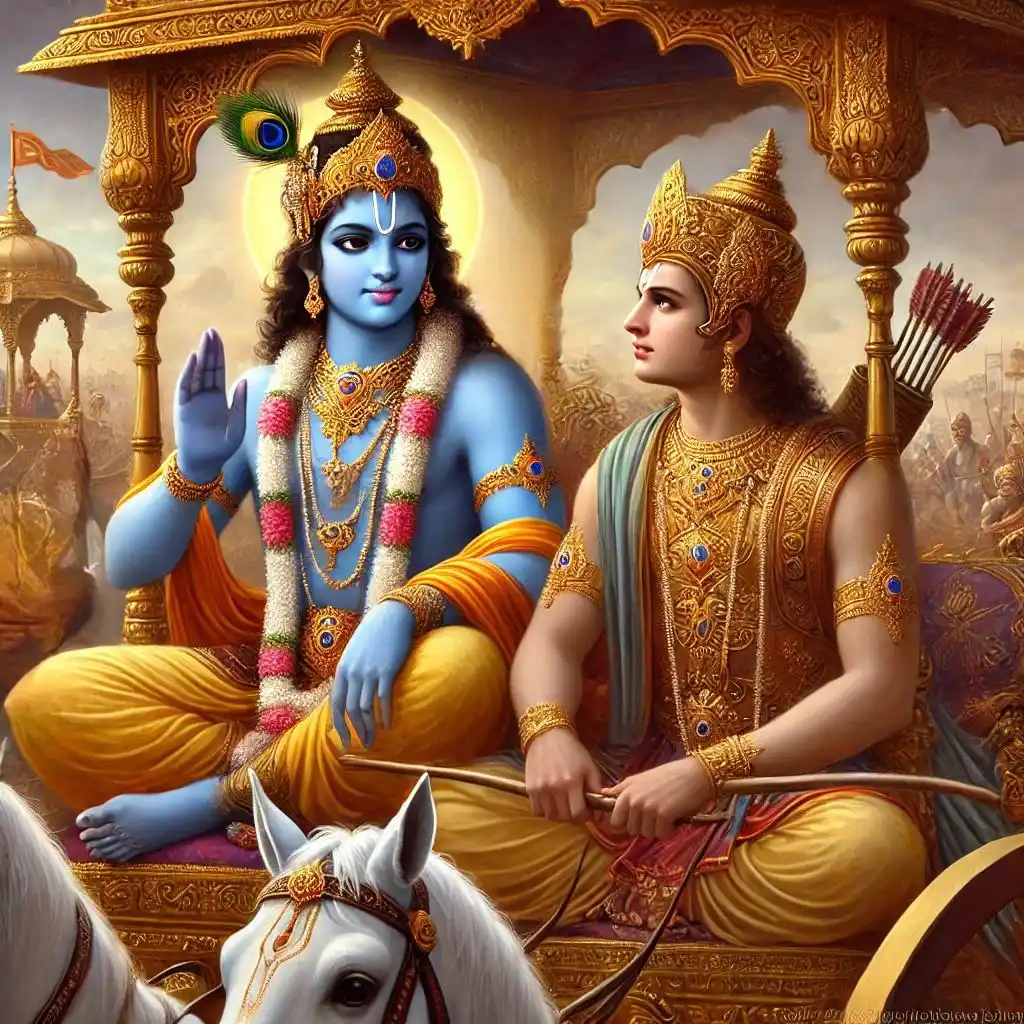
Most people misunderstand detachment. To many, the word sounds cold, distant, and unmotivated. They assume that if one becomes detached, life will lose color; ambitions will fade; and the desire to excel will disappear. The Bhagavad Gita stands firmly against this misconception. In reality, detachment is not the death of motivation but the purification of it.
Arjun—confused, overwhelmed, and emotionally shattered on the battlefield of Kurukshetra—was not asked by Shree Krishna to walk away from life. He was taught how to engage with life more powerfully by rising above attachment and acting with clarity, purpose, and devotion. Detachment didn’t weaken him; it refined him. It didn’t empty him; it elevated him. It didn’t make him passive; it made him unstoppable.
Before hearing the Gita, Arjun was a capable warrior, but bound by fear, grief, and confusion.
After hearing the Gita, Arjun was still a warrior—but now the most inspired, courageous, and determined version of himself.
His motivation was not killed.
It was transformed.

Understanding Attachment Through the Lens of the Bhagavad Gita
Attachment, in the spiritual sense, doesn’t mean affection or care. It means emotional dependence—the belief that our peace, happiness, and identity hinge on a particular result, person, possession, or outcome. Once this dependence forms, our judgment becomes clouded.
The Bhagavad Gita describes this progression with extraordinary psychological clarity:
“dhyayato vishayan pumsah sangas teshupajayate
sangat sanjayate kamah kamat krodho ’bhijayate” (BG 2.62)
“While contemplating on the objects of the senses, one develops attachment to them. Attachment leads to desire, and from desire arises anger.”
krodhad bhavati sammohah sammohat smriti-vibhramah
smriti-bhranshad buddhi-nasho buddhi-nashat pranashyati” (BG 2.63)
“Anger leads to clouding of judgment, which results in bewilderment of memory. When memory is bewildered, the intellect gets destroyed; and when the intellect is destroyed, one is ruined.”
Shree Krishna then explains that anger leads to delusion, delusion to loss of memory, the loss of memory destroys the intellect, and the destroyed intellect causes one’s downfall.
In simple terms:
Attachment → Emotional Chaos → Loss of Clarity → Wrong Decisions
This chain is not ancient philosophy—it’s human psychology. To see how attachment clouds decision-making, we need only look at the story of Guru Dronacharya.
When Attachment Overpowers Wisdom: The Fall of Dronacharya
During the Mahabharata war, on the tenth day, after Bhishma fell, Dronacharya took command of the Kaurava army. As a military genius and the guru of both sides, his presence on the battlefield began heavily favoring the Kauravas.
In desperation, Yudhishthir asked Shree Krishna,
“How can we defeat a warrior like Gurudev Dronacharya?”
Shree Krishna’s reply revealed the guru’s vulnerability:
“You must ask him directly.”
When Yudhishthir approached him respectfully, Dronacharya stated:
“As long as I hold weapons, I am invincible.
But if I hear that my son Ashwatthama has died, I will lose the will to fight.”
This confession revealed the depth of his attachment. Despite his unmatched intellect, wisdom, and discipline, his emotional dependence on his son overshadowed all else.
A plan was formed to declare the death of an elephant named Ashwatthama. Yudhishthir, who refused to lie, announced:
“Ashwatthama is dead…”
and softly added,
“…the elephant.”
Shree Krishna blew his conch at that exact moment, muting the second part.
Dronacharya heard only what his heart feared most.
His world shattered. His strength dissolved.
His weapons slipped from his hand.

In that moment, the greatest guru was defeated not by force, but by attachment.
This story is not about deception—it is about the human mind. It teaches us that no matter how knowledgeable or capable we are, attachment clouds judgment.
Attachment to Results: The Modern Obstacle to Excellence
Attachment doesn’t only apply to people. It can apply to results, achievements, recognition, or performance.
When our happiness becomes tied to success, we create enormous pressure inside the mind.
A striking modern example is the case of Mark Emmons, one of the finest American rifle shooters. His career highlights the subtle but destructive effect of being overly attached to results.
2004 Olympics
He was far ahead of the field. Victory seemed guaranteed. Yet in the last shot, under immense pressure, he hit the wrong target—something almost unthinkable for a shooter of his caliber.
2008 Olympics
Again, he led the event. Again, at the final moment, anxiety overwhelmed him, and he misfired.
2012 Olympics
After psychological counseling and years of preparation, he returned stronger. He performed brilliantly throughout the event. But once again, the attachment to victory caused a slip, and he lost the medal.
The issue was not skill.
It was pressure created by attachment.
This is exactly why Shree Krishna advises:
“karmany-evadhikaras te ma phaleshu kadachana
ma karma-phala-hetur bhur ma te sango ’stvakarmani” (BG 2.47)
“You have a right to perform your prescribed duties, but you are not entitled to the fruits of your actions. Never consider yourself to be the cause of the results of your activities, nor be attached to inaction.”
When we obsess over results, we paralyze ourselves.
When we focus on doing our best and leave the result to God, excellence flows naturally.
Mastery Lies in Process: The Formula One Lesson
Lewis Hamilton, the most decorated Formula One driver in history, is another example. His career demonstrates that true success lies not in the moment of victory but in the process that precedes it.
Think about the scale of his commitment:
- Over 15 years of championship racing
- 23 races per year
- Each race lasting around 2.5 hours
- Daily training of 5–6 hours
- Endless practice sessions, endurance conditioning, and strategic planning
If he stood on the podium 190 times, and each podium ceremony lasted 10 minutes, that’s roughly 1,900 minutes—barely 32 hours of celebration in an entire career.
But the process—the real work—spanned tens of thousands of hours.
Hamilton’s career embodies the Gita’s teaching:
“buddhi-yukto jahatiha ubhe sukrita-dushkrite
tasmad yogaya yujyasva yogah karmasu kaushalam” (BG 2.50)
“One who prudently practices the science of work without attachment can get rid of both good and bad reactions in this life itself. Therefore, strive for Yog, which is the art of working skillfully (in proper consciousness).”
When your mind is free from pressure, your performance elevates naturally.
How Can Anyone Stay Motivated Without Attachment?
This is the central question most people ask.
They believe that letting go of attachment means letting go of motivation.
But Shree Krishna clarifies the difference between lower motivation and higher inspiration.
Lower motivation comes from:
- Ego
- Insecurity
- Fear of failure
- Desire for praise
- Emotional pressure
- Comparison with others
Higher inspiration comes from:
- Duty
- Dharma
- Devotion
- Service
- Excellence
- Love for God
Shree Krishna transforms Arjun’s motivation in the Gita:
Before the Gita, Arjun thought:
“I will fight for my honor.”
After the Gita, Arjun understood:
“I will fight for the sake of righteousness, as an offering to God.”
The battlefield remained the same.
The opponent remained the same.
The challenge remained the same.
Only Arjun’s inner posture changed.
And that changed everything.
Rani Ahilyabai Holkar: Leadership Rooted in Detachment
Spiritual detachment is not theoretical. It has been lived by great leaders throughout history. One of the most luminous examples is Rani Ahilyabai Holkar, whose reign over the Malwa kingdom is celebrated as a golden age.
When both her husband and son died, she was consumed by grief. She considered committing sati. But her father-in-law convinced her that her duty to the kingdom was greater.
She chose service over sorrow.
Duty over despair.
Devotion over attachment.
Over the next decades, she:
- Rebuilt the sacred Kashi Vishwanath Temple
- Built and restored hundreds of temples across India
- Established dharamshalas for pilgrims
- Supported arts, crafts, and social welfare
- Ruled with fairness, compassion, and humility
Despite being a queen, she lived simply, prayed sincerely, and always credited God for her achievements.
Her life proves the Gita’s message:
Detachment is not withdrawal from the world.
It is engagement with higher purpose.
The Sweet Balance of Contentment and Aspiration
Sanatana Dharma offers a beautiful dual principle:
Be content in worldly matters.
- Be satisfied in food.
- Be satisfied in wealth.
- Be satisfied in relationships.
Excessive craving leads to restlessness.
Be discontent in spiritual matters.
- Always study more scriptures.
- Always serve more selflessly.
- Always chant more sincerely.
This is the perfect balance:
Contentment outside. Aspiration inside.
Final Thoughts: Detachment as the Gateway to Inspired Living

Detachment is not an escape from action—it is the elevation of action. It removes the emotional noise that distorts judgment and replaces it with spiritual clarity and strength. The Bhagavad Gita does not ask us to run away from our duties. It teaches us how to perform them without anxiety, without ego, and without fear.
Arjun did not renounce the battlefield.
He renounced his confusion.
He did not renounce his bow.
He renounced his inner turmoil.
Once he dropped attachment, he became fully available to divine guidance—and that is when he performed his best work.
This is the transformation available to every one of us:
- When we drop attachment, we gain clarity.
- When we drop ego, we gain excellence.
- When we drop anxiety, we gain energy.
- When we drop expectations, we gain joy.
Whether we look at the fall of Dronacharya, the struggles of Mark Emmons, the discipline of Lewis Hamilton, or the devotion of Rani Ahilyabai, the message remains unchanged and universal:
Attachment binds. Detachment liberates.
When we stop chasing results and start offering our actions to God, work becomes worship. Inspiration flows effortlessly. Success becomes a natural byproduct, not a source of pressure.
In the end, Shree Krishna gives humanity one of its most powerful teachings:
"Do your duty wholeheartedly. Offer the results to Me. And remain peaceful."
This is not the death of motivation.
This is the birth of divine inspiration—
the kind that lasts, the kind that uplifts, the kind that sets the soul free.
Call to Action
If these teachings uplifted your heart, take one more step toward inner mastery. Make the Bhagavad Gita your daily companion. Read one verse each day, reflect on Shree Krishna’s guidance, and offer your actions to the Divine. When work becomes worship, life becomes peaceful, purposeful, and powerful.
Join our spiritual community, attend satsangs, and immerse yourself in the transformative wisdom shared by Swami Mukundananda. Let’s walk this journey together—one inspired, detached, God-centered action at a time.
References
- Watch Video:
#1 Mindset to UNLOCK Peak Performance — Shree Krishna’s Forgotten Success Rule | Swami Mukundananda
- Bhagavad Gita – The Song of God (commentary by Swami Mukundananda)
- Srimad Bhagavatam and Mahabharata narratives of Dronacharya
FAQs
1. Does detachment mean not caring about anything?
No. Detachment means avoiding emotional dependence on outcomes. You still care, but from a place of clarity and inner steadiness rather than fear or expectation.
2. How can I be detached and still stay motivated?
By shifting your motivation from ego-driven goals to higher, divine, and duty-centered goals—exactly as Shree Krishna guided Arjun. When your purpose is higher, inspiration becomes stronger.
3. Why does attachment cloud our judgment?
Attachment creates anxiety, fear of loss, and emotional turbulence. This weakens the intellect. The Gita explains that a disturbed mind cannot think clearly or act wisely.
4. What is the Bhagavad Gita’s formula for stress-free success?
Perform your duty with full effort, but leave the results to God. This reduces pressure, increases focus, and leads to better performance.
5. Is detachment practical in modern life?
Absolutely. Athletes, leaders, and professionals perform best when they focus on the process, not the result. Modern psychology and the Gita teach the same principle.
6. How did Rani Ahilyabai practice detachment?
Despite personal tragedies, she ruled with humility, devotion, and a sense of service—not for personal glory, but for dharma, God, and her people. Her detachment fueled her greatness.