


Mother's Day is more than just flowers and gifts; it is a sacred remembrance of the unconditional love a mother embodies. It is a time of deep emotion, heartfelt reflection, and sincere gratitude.
As we pause to reflect, let us immerse ourselves in the timeless narratives that illuminate the essence of motherhood. From the tender confessions of Shree Krishna about Mother Yashoda, the boundless compassion of Mother Sita, to the gentle lap of divinity that guides us to our Supreme Father—each story reveals the depths of motherly affection. Together, they remind us that such love transcends the boundaries of the material world. May each word draw you closer to Her who cradles us all.
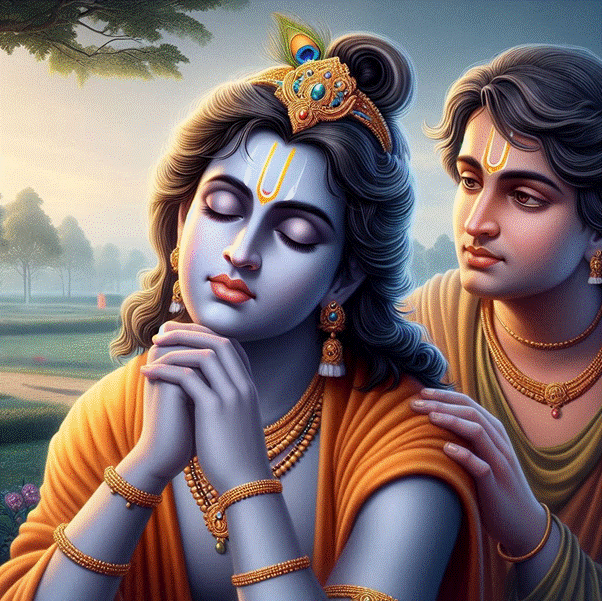
Shree Krishna’s Tender Confessions
In the pages of the Shrimad Bhagavatam, a moment of deep love and longing unfold. It is when Shree Krishna entrusts His friend Uddhav to deliver a heartfelt message on His behalf to His Mother Yashoda in Vrindavan. Behind Krishna’s playful pranks and heroic feats lies the tender heart of a son. Thus, it is not a message wrapped in ornate words, but a cascade of emotions—soaked in sweet memories of a mother’s love.
Shree Krishna says, "Tumro lal kiyo palagan, charan kamal sirnaya uddham"
“Bow your head at Mother Yashoda’s feet and tell her, ‘Your Lala sends his obeisance.’”
This is Krishna’s way of offering reverence to His mother from afar. Hearing these words, Uddhav replies, “This will surely melt her heart. But she will want to know more—what else did her Lala say.”
Krishna continues, "Yadapi madhupuri sakala rajasukha, asana basana mahutaya uddham..." "Tadbhi bhava vatsalya heenasava, bhiko parata lathaya uddham"
“I have everything in Mathura—the comforts of a king, majestic attire, sumptuous food, and royal luxuries. But all of this feels insipid and tasteless, because it lacks the warmth of motherly affection. In Mathura, no one rebukes me like you did, no one says, ‘Drink your milk, Lala, or I will beat you!’”
Now in Mathura, the young cowherd Krishna had become a king surrounded by splendor. All He heard was flattery—“Mathuradheesh ki jai ho!” Yet what He truly yearned for is that love-filled reprimand that only a mother could give.
Amused, Uddhav remarks, "Garaiya, you are cunning. You know just how to tug at a mother's heart." But he points out the inevitable question Yashoda would ask, "If my Lala misses me so much, why does He not return? After all, Vrindavan is just a short distance from Mathura.”
Krishna expresses His dilemma, "Vesha pilaya, kuchlaya pootana, Gai mukti padh paya uddham"
He recalls the demoness Pootana, who attempted to poison Him by disguising herself as a wet nurse. Yet, upon drinking her poisoned milk, He also drank her life air, granting her a place in Golok (His divine abode).
"If I gave even her, who sought to kill me, a place in my eternal abode, what do I give to my mother, who lovingly fed me? If I offer her the same reward, will that be justice? Will not the world ask: how can the hand that offered poison and the hand that offered love receive the same fate?”
He further confesses,
“I have nothing higher than my divine abode to give. So, I am eternally indebted to my mother. There is no way to repay that love. That is why I have not returned. Like a debtor who flees to earn, hoping one day to repay, I remain in Mathura." Uddhav, deeply moved by this confession, promises to deliver the message. This poignant episode reminds us that even the all-powerful God is humbled before a mother’s love.
Shree Krishna is the Supreme Almighty and Eternal Father of all the souls. Yet in His divine pastimes, He becomes Yashoda’s child, revealing the purity and power of a mother’s affection.
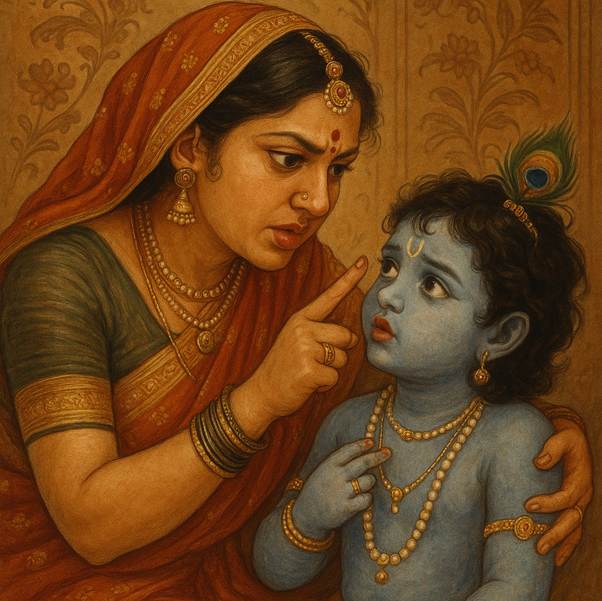
The Spirit of a Mother
As we ponder over Shree Krishna's heartfelt message, we are led to reflect on our own mothers.
A mother wakes before dawn, sleeps after all have rested, gives up dreams so we may fulfill ours. Her lap is our first school, where her stories become our first scriptures, and her touch, a healing balm. She teaches us not just how to walk but how to live. We offer our deepest gratitude for her tireless love. Thank you, mother, for being the silent force behind every success, the steady voice in every failure, and the unfailing light in our darkest hours.
Yet, beyond the physical realm, there is another mother who has nurtured us through countless lifetimes—the Divine Mother. Just as our earthly mother beckons us to take our first steps, the Divine Mother calls us to rise in consciousness. Her love is deeper than the ocean, more enduring than time. She has been waiting patiently for lifetimes, watching us chase the fleeting pleasures of the world. She hopes that one day we will turn our gaze inward, towards Her. And when we do, we will find Her waiting with open arms, ready to embrace us.
The Divine Mother is revered in various forms—Radha, Sita, Durga, Parvati, Lakshmi. And yet, many still ask: Who is Radha? Who is Sita beside Ram? Who is Lakshmi beside Narayan? Such questions, arising from limited vision, miss the eternal truth: They are not mere consorts. They are the Yogmaya Shakti personified—the divine energy of God.
Just as fire is not separate from its heat and light, God, the energetic (Shaktimaan) is not separate from his energy (Shakti). Radha is not different from Krishna. Sita is not apart from Ram. Lakshmi is one with Narayan. Parvati is one with Shiv. So, when we envision the Divine Couple, we do not see man and woman, but two divine forces—eternally intertwined, inseparable parts of the whole. Together, They represent the masculine and feminine dimensions of the Divine.
Boundless Compassion of Mother Sita
In the world, the mother often stands higher in stature as compared to the father due to her unmatched sacrifice. Her love is profound, surpassing mere understanding and reason. In the spiritual realm too, the maternal aspect—the ability to forgive, sacrifice, nurture, elevate—earns the Divine Mother a place of supreme reverence, even above the Divine Father.
The story below beautifully reveals the nature of the Divine Mother.
Once, as Bhagavan Ram was adorning Sita with a garland, Jayant (the son of Devraj Indra) happened to witness the scene. Seeing this, a seed of doubt arose in his mind: "How can Ram be God if he engages in such an ordinary act?" Clouded by arrogance, Jayant began to question Ram's divinity and decided to put Ram to test. He disguised himself as a crow and pecked at Sita’s feet. Sita, though in pain, tolerated it with quiet endurance. But for Ram, the pain of His beloved was unbearable. He released an arrow that relentlessly pursued Jayant.
Overwhelmed with fear, Jayant returned to his original form and frantically sought refuge in different corners of the universe. But the arrow kept chasing him. Desperate, he ran to Sage Narad, who inquired about his distress. Jayant replied, "I pecked at Mother Sita’s feet. I am repenting now but I don’t know how to make amends.” Narad ji was moved by Jayant’s plight and advised him to seek forgiveness from Ram Himself. Jayant fell at Ram's feet, pleading for mercy. However, Ram declared, “Your sin is unforgivable.”
Just then, Sita intervened and said to Ram, "Maharaj, Jayant is under the sway of Maya (material energy) and as long as one remains in this illusion, the defects of Maya will persist. Is there anyone who is not subject to sin while in the material world? Why then, should we judge him harshly for his mistake? Please, forgive him."
Moved by Sita’s words, Ram relented. He allowed Jayant to bear the mark of his error—not as punishment, but as a blessing. The arrow struck one of Jayant's eyes, symbolically opening his spiritual vision. Now, Jayant could see the divine truth: Ram is the Supreme Lord, and Sita—His Yogmaya Shakti.
Thus, in Her act of forgiveness, Sita's infinite mercy shone forth, exemplifying the Divine Mother's nature. She does not judge by one’s actions but recognizes the soul’s potential for transformation. She looks beyond faults, at the innate divinity within, uplifting even the fallen and drawing them closer to God.

The Gentle Lap of Divinity
Similarly, in the context of Radha and Krishna the scriptures state,
Srī kṛṣhṇo jagataṁ tāto jagan-mātā tu rādhikā, Satagunā mātā vaṁyā pūjya garasī rādhike.
Shree Krishna, the Supreme Lord, is the Father of the universe who sustains the entire cosmos. Whereas Radha is the Mother, the nurturing force of the universe. She is a hundred times superior to Shree Krishna, in Her virtues of compassion, selflessness, unconditional love, mercy etc. In the presence of the Divine Mother, even the most grievous sins are forgiven.
In that sense, She is the embodiment of divine grace. Moreover, Her grace is the gateway to the embrace of our Supreme Father. She nurtures the devotion within us until we are ready to stand before Him. Even in the world, it is through the mother that a child first comes to know the father.
Consider this example.
A young boy’s father left for a foreign land when he was just four. When the father, finally returned after 15 years, the boy rushed to the station in excitement. But as the train pulled in, he stood confused, unable to recognize his father among the crowd. It was his mother who gently pointed and said, “Look, that is your father.”
Likewise, it is the Divine Mother who helps us recognize and reach the Divine Father. When we chant "Radhey Radhey," we invoke not just a name but a prayer: "Radhey Radhey, Shyam se mila de."
O Divine Mother, if ever you get a chance, please speak our case to our Supreme Father. With your recommendation, fallen souls like us, may be accepted. Let your compassion dissolve our ego, your grace cleanse the impurities of our hearts, and your boundless love unite us with Shree Krishna. On this Mother's Day, with folded hands and humbled hearts, we offer our obeisances to You. O Radha Rani, embodiment of the highest devotion, bless us with even a single drop of your divine love for Shree Krishna. Lead us by the hand, steady our faltering steps, and guide us to His lotus feet.
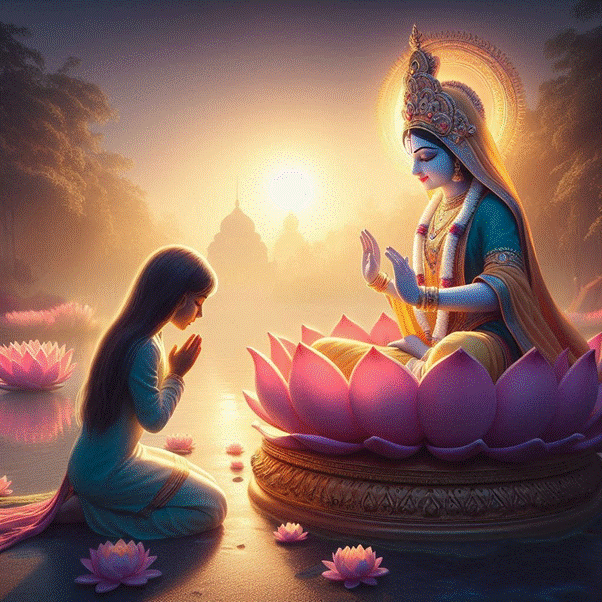
Conclusion
Even Shree Krishna, God incarnate, yearned deeply for His mother’s love, underscoring the profound stature of motherhood. This Mother’s Day, let us bow with humility—before our earthly mothers who shaped our lives, and before our Eternal Mother, who shapes our soul's journey. Let us honor our earthly mothers and awaken to the grace of the ever-compassionate Divine Mother—who lovingly leads to our Supreme Father. And let this not be just a day of celebration, but a turning point—a renewed commitment to walk the path of divine love, guided by our Eternal Mother’s hand that never lets go.
Resources
● Mother's Love | Heart Touching Mother's Day Special | Happy Mother's Day | 2018
● Ramanavami | Rama Katha | Secrets of Ramayana | Part 2 | 2018
Call to Action
• Discover a wellspring of inspiration and inner peace—subscribe to the Swami Mukundananda YouTube Channel for uplifting discourses.
• Step into a space of serenity and self-discovery—join the West Coast Spiritual Retreat with Swami Mukundananda (May 24–26) for three days of soul-enriching wisdom, yoga, meditation, and kirtans. Special sessions for kids and youth included.