

Introduction: Why Do We Feel Lost?
It’s a feeling most of us know all too well. One moment, life seems to be going in a direction—then suddenly, we hit a crossroad, a detour, or a dead end. We look around for guidance, hoping someone else has it all figured out. But as Swami Mukundananda beautifully puts it, “This guy must be knowing the way—but the other guy is equally lost as you are.”
If you've ever felt directionless, overwhelmed, or uncertain about your life’s purpose, the ancient wisdom of the Bhagavad Gita offers powerful clarity. This spiritual guidebook doesn't just answer "what should I do?"—it shows us how to think and where to place our inner compass.
Lesson 1: Control the Heart with the Head

In our journey through life, emotions often run the show. We make decisions based on fear, desire, anger, or attachment. The Bhagavad Gita tells us that to reach a higher, meaningful destination, we must lead with our intellect, not just our impulses.
“You have to learn to control your heart with your head.”
This doesn’t mean becoming cold or emotionless. It means using discernment—keeping your vision focused on the long-term, the eternal, and the soul’s evolution rather than temporary highs or emotional outbursts.
Swamiji shares a humorous story of a man yelling at an airline clerk in frustration. The clerk remains completely calm. Why? Because he knows he’s sending the man’s luggage to Cancun while the man is headed to New York.
The takeaway? You can huff and puff all you want—but the final destination isn’t in your hands unless your inner compass is aligned.
Lesson 2: Your Attachments Determine Your Destination

The Gita emphasizes a profound truth: Wherever your mind is attached at the time of death, that is where you shall go.
This isn't just about the afterlife. It’s about how our attachments shape our reality—our choices, our happiness, our identity.
If you attach yourself to material things, you remain in the material realm. If you attach your heart to celestial beings, you’ll reach only that height—not beyond. But if you connect to the Supreme—God, the Infinite, the Eternal—you transcend.
"The water can only rise to the height of the reservoir."
If your inner reservoir is shallow, your potential stays limited. But if your attachment is to the Supreme Source, there's no limit to where your spirit can soar.
Lesson 3: False Guidance Leads Nowhere

In a world buzzing with influencers, gurus, and advice-givers, it’s easy to follow people who seem to have the answers. But as the story of the two lost hikers reminds us—we often take comfort in the presence of someone just as lost.
So many seek guidance from people who themselves have no clear path. The Gita warns us: Be mindful of whom or what you worship. If you follow someone who doesn’t know the way, you may end up circling the forest of confusion.
Instead, seek guidance from those truly connected to the divine source—the Supreme and His realized representatives.
Lesson 4: The Taxi Driver and the Terminal Journey
One of the most touching moments shared by Swamiji is the story of a New York taxi driver and his final passenger for the night: an elderly woman headed to hospice.
She wasn’t in a rush—she wanted to drive through the streets of her memories. The ballroom where she once danced, the apartment she shared with her husband, the restaurant where she worked. It was a bittersweet journey through attachment.
The driver refused to take money from her, moved by the poignancy of her last ride.
As touching as it is, the story reveals a deeper truth:
In her final moments, her mind was still attached to worldly memories—not the divine.
And so, despite the emotion, she remained tethered to the material realm.
Lesson 5: The Monkey Mind and the Trap of Peanuts
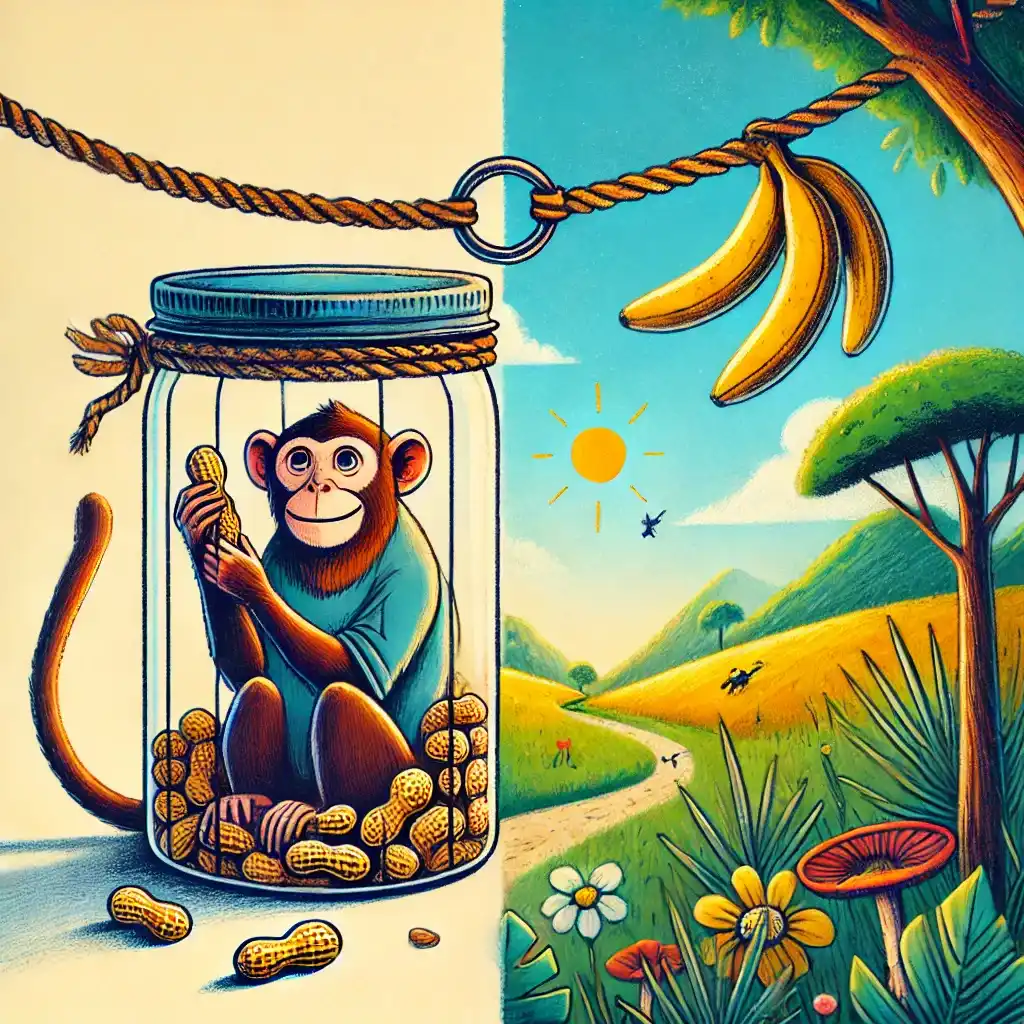
Why do we stay stuck in places that don’t serve us?
Swamiji likens it to a monkey trap. Hunters place peanuts inside a narrow-neck bottle. The monkey sticks its hand in, grabs the peanuts, and finds it can’t pull the closed fist back out. But it refuses to let go. The attachment keeps it trapped—and eventually captured.
We do the same.
We hold on to grudges, outdated dreams, toxic relationships, limiting beliefs—our own versions of peanuts. All it takes is a moment of courage to let go. But we cling, thinking, what if I need this?
“All of us have this little monkey in our head… preventing us from greater things that are available in the realm of God.”
The moment you let go of lower attachments, you rise.
Lesson 6: Choose Your Attachments with Awareness

So, what should we do with our heart’s clinging nature?
Don’t suppress it—redirect it.
The mind will attach. That’s its nature. The question is, what are you letting it cling to? Temporary desires—or eternal truth?
Bhagavad Gita’s central teaching is not about detachment from everything. It’s about detachment from the false and attachment to the real.
Worship the Supreme. Reflect on divine values. Remember the higher purpose of life. Serve selflessly. Align with dharma. These are not mere philosophies—they are lifelines for a soul that wants to stop feeling lost and start feeling whole.
Final Thoughts: From Lost to Liberated
You are not lost. You are being rerouted.
That deep confusion, that longing for something more, is not a weakness—it’s the soul’s GPS trying to recalibratetoward its true home.
In a noisy world that worships success, fame, and fleeting pleasures, the Bhagavad Gita whispers something bold and eternal:
“Wherever your mind is at the time of death, that shall be your next destination.”
So what will you choose? Temporary attachments? Or timeless truth?
The monkey inside you can drop the peanuts. The driver in you can reroute the journey. The heart in you can attach to something far greater.
Let your journey begin—not in confusion, but in consciousness.
Reflection Questions:
· What are the “peanuts” you’re currently holding onto?
· Where is your mind most attached—and is that bringing peace?
· Who or what are you letting guide your life?
· If today were your last ride, what memories or attachments would surface?
Resources
FEELING LOST in Life? WATCH THIS | Most Important Teaching of Bhagavad Gita | Swami Mukundananda
Mukundananda, S. (2020). The Science of Mind Management, Westland Publications: Chennai, India.