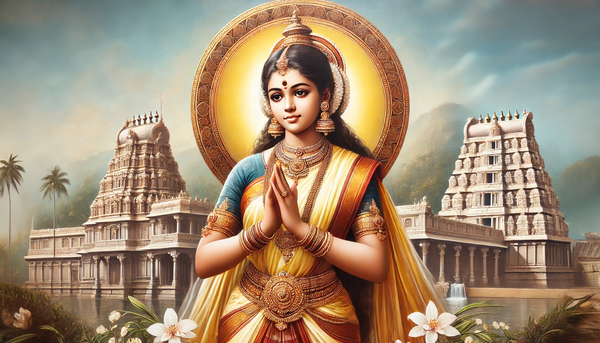


The Sacred Wedding of Goda Devi and Lord Ranganatha: Love Manifested
This is not merely history. It is an invitation to experience devotion as Andal lived it.
Entering the Sacred City of Srirangam
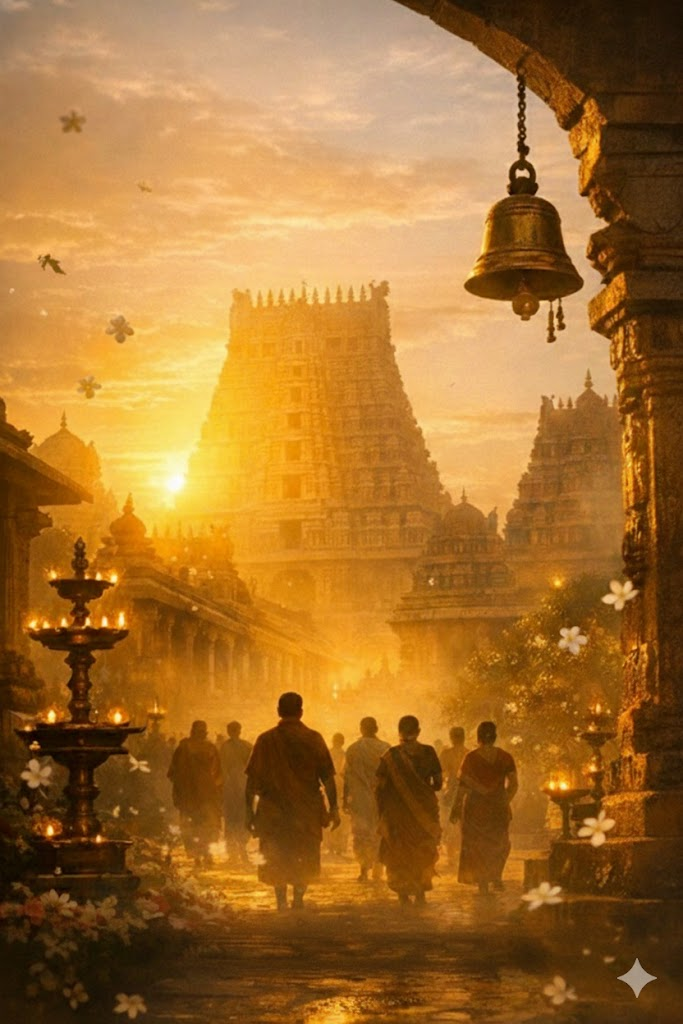
Imagine walking through the golden gates of Srirangam, as dawn pauses in reverence. The city glows—not with sunlight alone, but with something softer, deeper, alive. Jasmine and Tulasi perfume the air, carried gently by the breath of the Kaveri. Sandalwood smoke curls upward, as if even the wind has learned how to pray.
Lamps flicker in the Ranga Vilasa Mandapam like a thousand attentive flames, each one leaning forward, eager to witness what is about to unfold. Bells ring softly, threading sound into silence, vibrating through the chest and drawing the heartbeat into sacred rhythm. Every step feels sacred. Every heartbeat feels slower, fuller, aware.
This is not an ordinary day. This is the day love walks toward its fulfillment.
The sacred city awakens as the heart rises to devotion—Goda Devi Kalyanam, the eternal union of soul and Supreme. It is a moment felt before it is seen, inhaled before it is spoken, tasted before it is named. Every sense is drawn, magnet-like, into the sacred heart of the city, into the love about to bloom.
The Divine Bride and Beloved
She appears—radiant, luminous, draped in silks that catch the light like dawn touching the earth for the first time. Garlands rest upon her as offerings, not ornaments. Her eyes carry a longing refined by lifetimes, a love ripened through waiting, singing, surrendering. Each step she takes feels like a verse offered without sound.
And there He waits—Lord Ranganatha, reclining in eternal stillness, vast yet intimate. The Beloved who measures worth not by form or ritual, but by the love that dares to give itself completely. The One who listens when longing speaks.
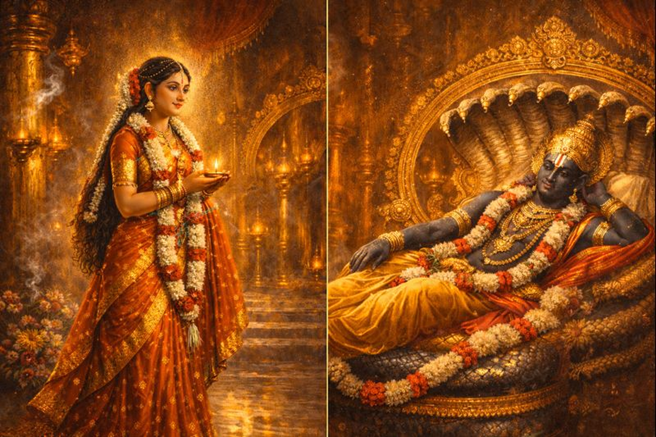
This is the moment where yearning is answered, where devotion becomes destiny, where love itself finds a resting place.
Welcome to Goda Devi Kalyanam 2026—a sacred union where the soul meets the Divine, and the heart remembers why it was created to love.
A Divine Arrival: A Child in the Garden of Devotion
A miracle in Srivilliputhur: Andal’s birth heralds devotion incarnate.
Long before the Kalyanam, Andal’s life was already a living hymn. Her very existence unfolded as a love story written by the Divine—quietly, gently, unmistakably.
Goda Devi is revered as an incarnation of Bhumi Devi—the Earth herself offering love in human form.
In the sacred town of Srivilliputhur lived a devoted servant of the Lord named Vishnuchitta. His world revolved around a single sacred act: gathering fresh flowers each day for the Lord’s altar.
Vishnuchitta discovered a radiant baby girl beneath a Tulasi plant. He lifted her with trembling hands, his heart certain before his mind could reason. This child had been sent by the Divine. He named her Kodai, meaning ‘garland.’ She also came to be lovingly known as Goda, meaning ‘the one given by the Earth.’
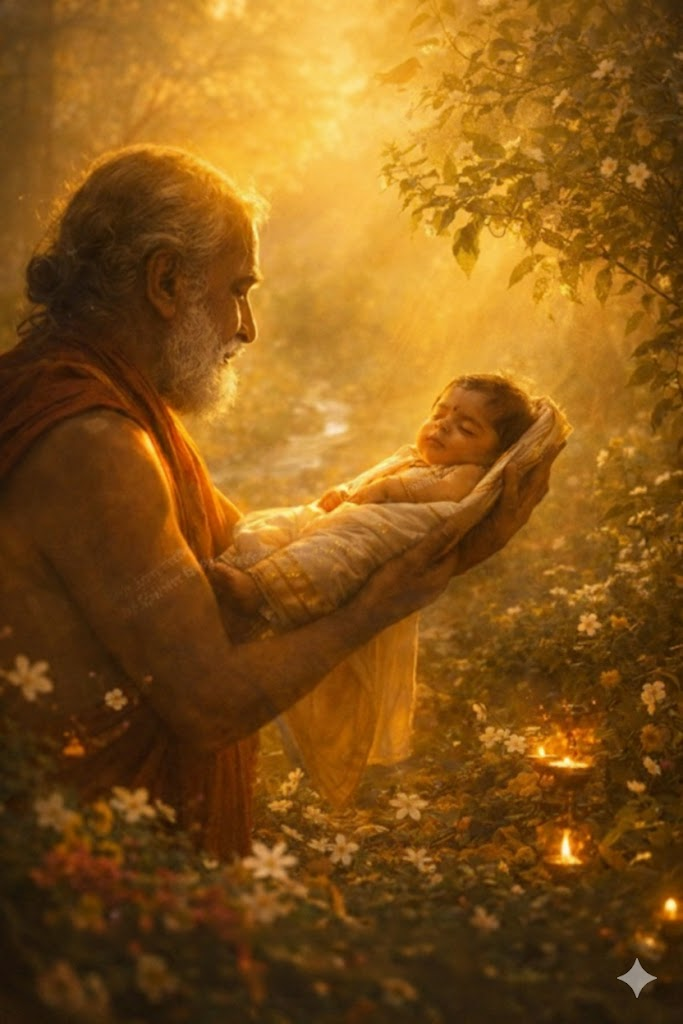
What makes her story extraordinary is the lineage into which she arrived. Vishnuchitta himself—later revered as Periyalvar—was the eleventh of the twelve Alvars. Andal, his daughter, became the twelfth Alvar and the only female Alvar. A father and daughter, both saints, both vessels of divine love. Two Alvars in one family—an occurrence unmatched in the annals of devotion—revealing a household chosen for rare intimacy with the Lord.
A Childhood Steeped in Love for the Divine
Goda grew up surrounded by stories of the Beloved Lord—His beauty, His playfulness, His compassion, His mischief, His promises. But unlike other children who listened and admired, Goda listened and belonged. Each story did not merely enter her mind; it became a living world within her heart.
She followed her father into the garden, observing closely as he gathered flowers and wove garlands with reverence. To her, the flowers were gestures of love—soft carriers of emotion. She observed how petals were chosen, how threads held them together, how devotion took form through touch.
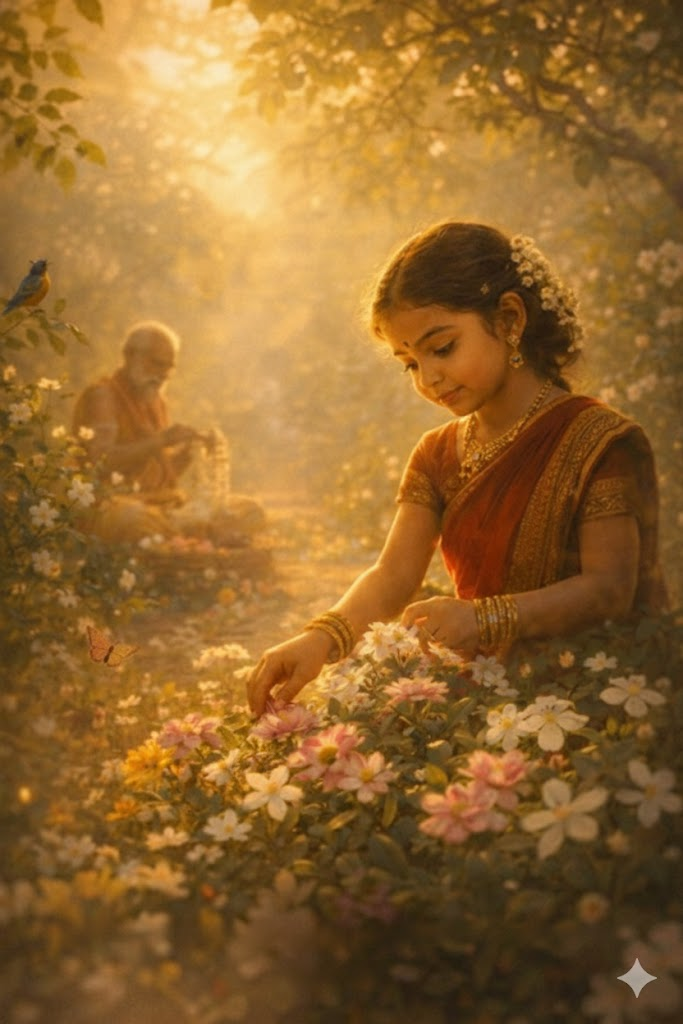
Her devotion was not discipline or duty, but intimacy. She gathered the flowers herself, breathed in their fragrance, spoke to them, and imagined how they would rest upon the Lord’s chest. She breathed devotion as naturally as one breathes air. From her earliest days, her eyes carried a depth far beyond her years. Her heart leaned instinctively toward the Lord. She did not learn devotion; she remembered it.
Her love was intense, exclusive, and complete. The Lord was not one among many pursuits; He was the center of her universe. She did not approach Him as a philosopher or ascetic or ritual-bound devotee—but as one who longed to belong entirely.
She saw herself as a gopi.
Her city as Vrindavan.
Her heart as the Lord’s dwelling.
Her mind as a pure instrument of longing.
The Garland Story: When Love Redefined Worship
As Goda grew, she began helping her father prepare garlands. Yet her way of loving did not remain at a distance. Her heart moved instinctively toward closeness.
One day, guided by a quiet inner impulse, she lifted a finished garland and placed it around her own neck. Standing in front of a mirror, she gazed softly—not in vanity, but in wonder.
She was not admiring herself. She was imagining how He might see her.
Her heart asked a question, only love dares to ask: Would this please Him? Would this offering, touched by my longing, be worthy of the One I belong to?
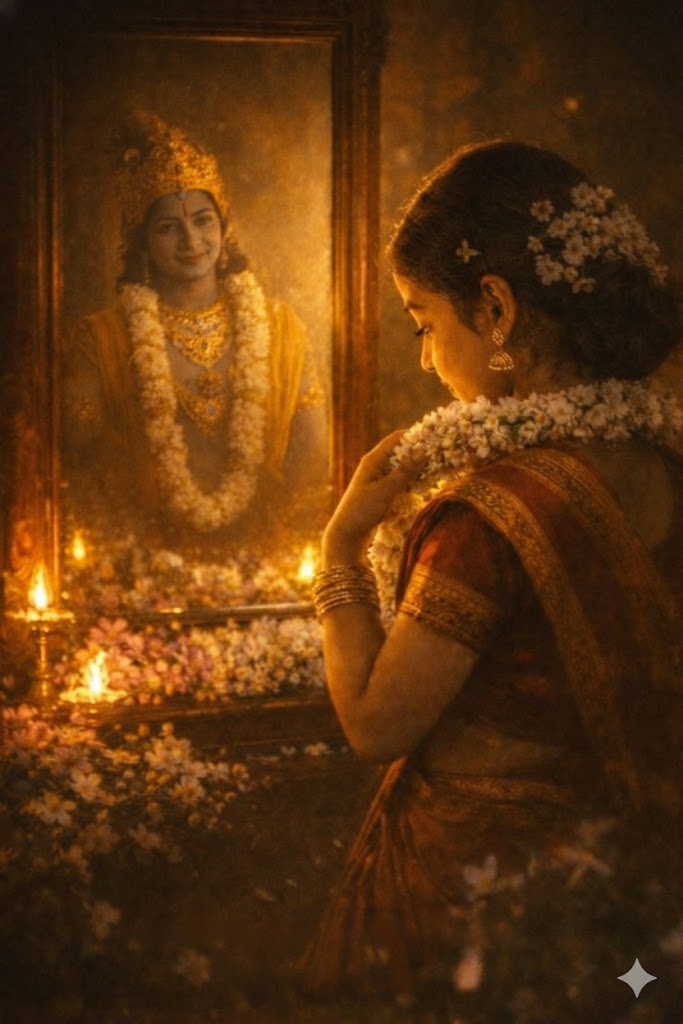
The mirror became more than glass. It became a meeting place—where the lover imagined herself through the eyes of the Beloved. Worship became closeness to Lord. Not purity of rules, but purity of feeling.
She looked into the mirror with love, and the Lord looked back wearing her offering.
When Vishnuchitta discovered what had happened, confusion and sorrow followed. The garlands—now believed to be ritually unfit—were set aside. His pain did not arise from anger, but from fear: fear that something sacred had been violated. The old order trembled, unable to understand the language of a child’s love.
That night, the Lord Himself came.
In dream-light and grace, He appeared before Vishnuchitta. With a smile that dissolved all doubt, He spoke—not as a distant deity, but with intimate tenderness—addressing him as father-in-law. Then He revealed His will:
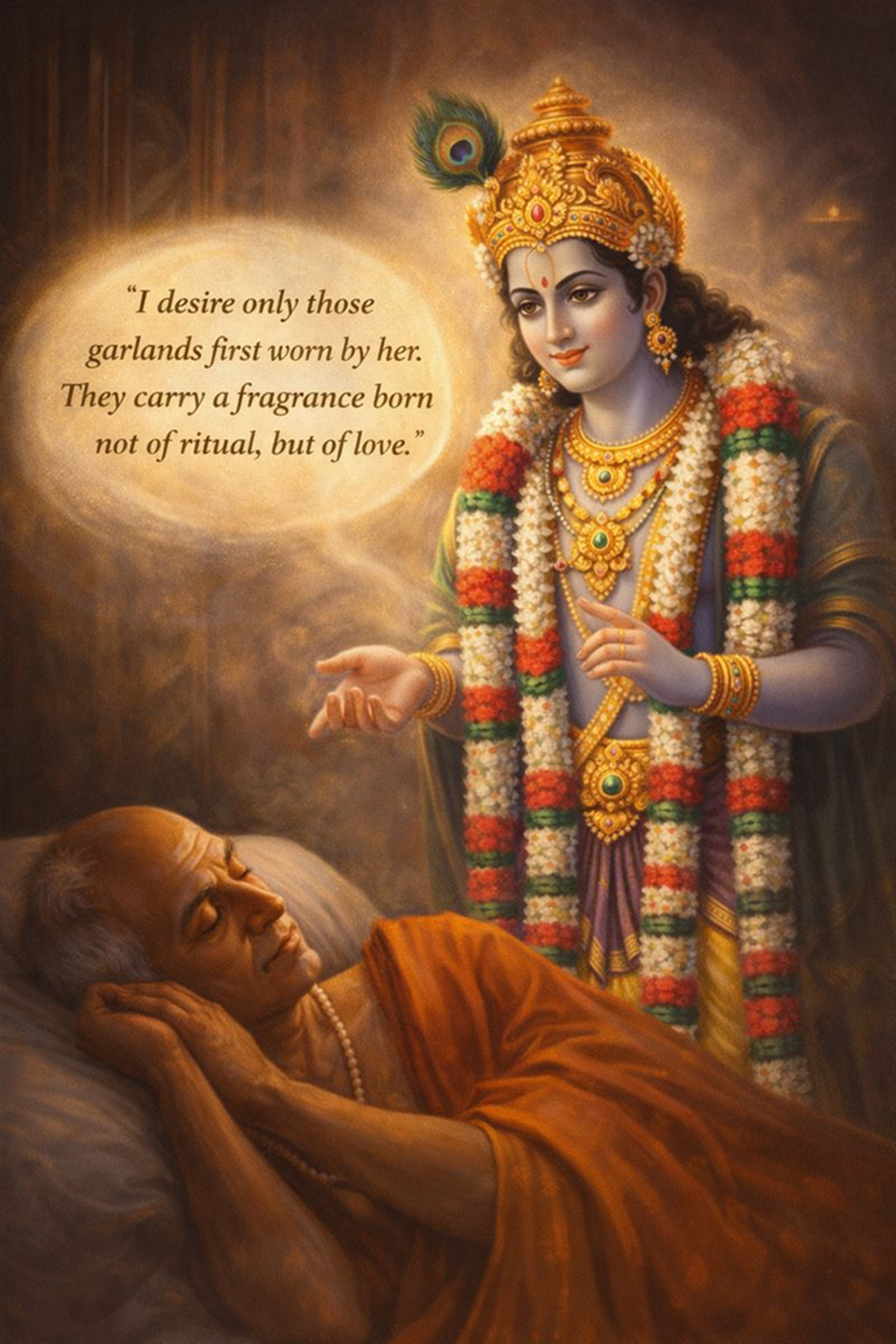
In that moment, devotion was forever transformed. What appeared improper became most precious. What appeared transgressive became the highest offering. Love was crowned above rule. Intimacy above form. The Lord Himself declared that He wished to be approached not through fear or formality, but through affection that dares to come close.
From that day onward, Goda was known as Chūḍikodutta Nācciyār—she who first wore the garland and then offered it. Her simple, innocent gesture rewrote the grammar of worship. Devotion was no longer something performed for God, but something shared with Him.
Through her, a profound truth quietly revealed itself:
- The Divine does not stand distant, counting correctness.
- He leans toward love.
- He yields to intimacy.
- He allows Himself to be conquered by the heart.
Her story continues to whisper across time to every seeker:
Offer not what is flawless, offer what is yours. Bring your heart first. Let love go before rule. And know this: the Beloved recognizes His own in the language of longing.
Video: 🎥 Watch: Can A Mirror Reflect God | Andal Story Part 1 | Saints | Swami Mukundanandaji #shorts
When love dares to step forward, even a mirror becomes sacred.
The Katyayani Vrat: A Sacred Vow of Longing and Awakening
During the sacred month of Dhanurmasam, Goda embraced the ancient Katyayani Vrat, inspired by the gopis of Vrindavan. She walked the same inward path of surrender to attain Krishna as her eternal Beloved.
This was not a prayer for blessings. It was a declaration of the soul: I am Yours alone.
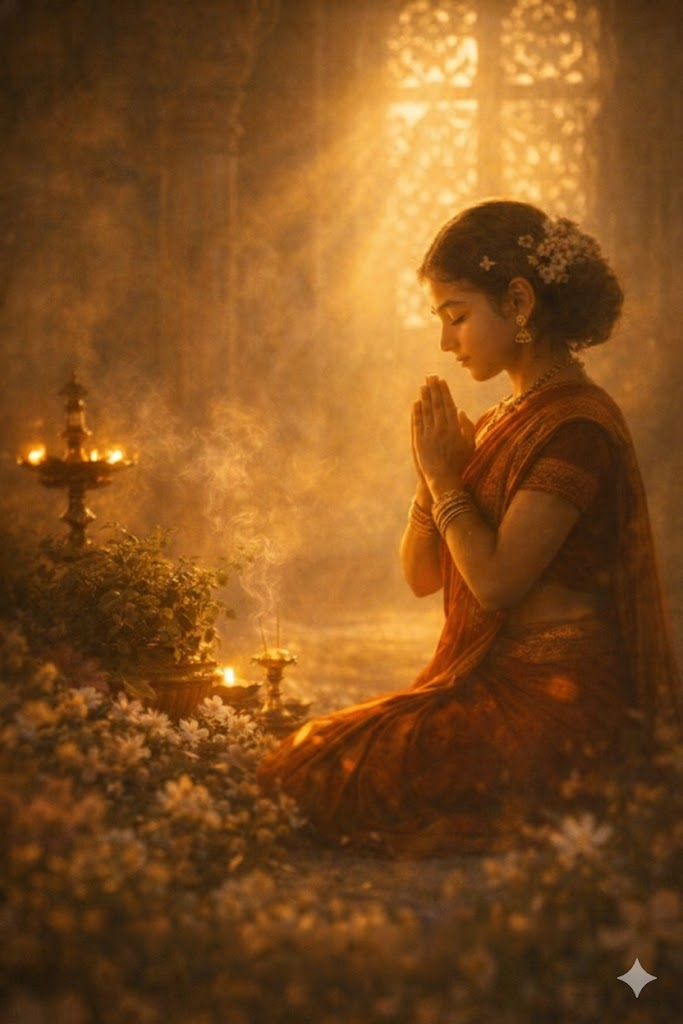
She rose before dawn, stepping into devotion with joy rather than effort. Her vows were not confined to form; they were lived in every breath, every action, every offering. Companions joined her, and what began as a solitary resolve became a shared awakening.
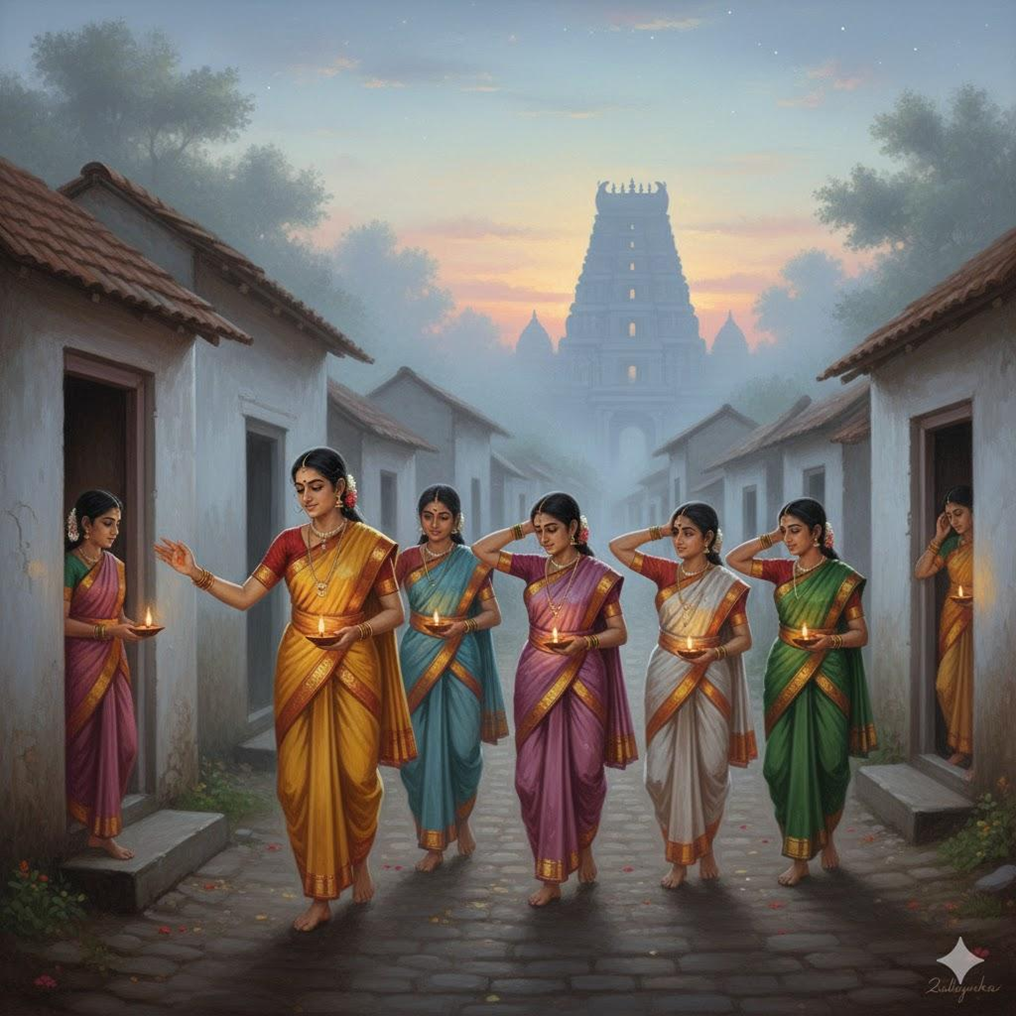
From discipline, longing unfolded. From restraint, surrender ripened. The heart slowly learned how to wait, how to ache, how to offer itself without condition.
From this lived devotion flowed the thirty verses of the Tiruppavai—not as composed poetry, but as love given shape. Verse by verse, dawn by dawn, the soul learned to walk toward the Divine. These were not teachings written for others; they were confessions sung from within. Each verse a step. Each step a yielding. Each yielding a movement toward union.
Thirty Steps of Love: The Tiruppavai
During the winter days of Margazhi, Goda offered thirty verses to the Lord—each one a knock at the door of the Divine. Sometimes gentle. Sometimes urgent. Sometimes playful. Sometimes aching.
As the verses unfold, the mood deepens. The soul learns humility, recognizing its dependence on grace. Through silent waiting, it develops patience. It learns courage—asking not for reward, but for closeness. And finally, it learns surrender—placing everything at the Lord’s feet.
These verses do not speak about God. They speak to Him. They assume relationship. They assume belonging. They assume that love has the right to speak boldly.
By the final verses, the seeker stands emptied of pride and full of longing, asking for nothing except eternal connection. The journey that began as a vow ends as a plea for grace. This is why the Tiruppavai is not merely recited—it is lived, one dawn at a time.
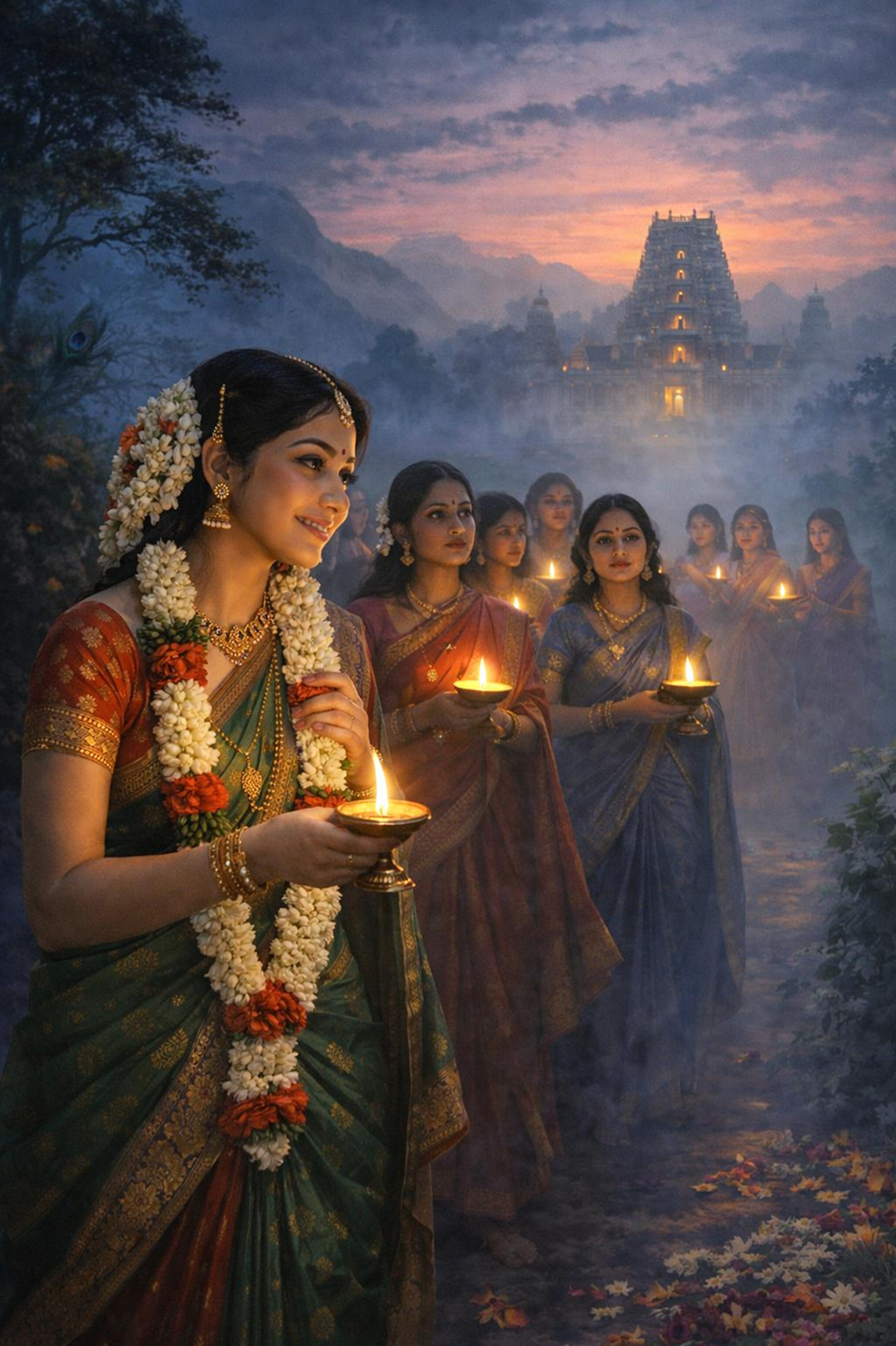
Stepwise Journey Through the Tiruppavai
The thirty verses of the Tiruppavai are more than poetry—they are a living path of devotion, unfolding as a step-by-step journey of the soul toward the Beloved. Each set of verses carries its own mood, teaching, and bhav, guiding the devotee from awakening to union with God.
Verses 1–5: Awakening the soul from sleep into devotion
These opening verses act as a spiritual alarm, stirring the soul from the slumber of habit and routine. Andal calls her companions to rise before dawn, awakening alertness, curiosity, and joy rather than mere duty. The heart is gently invited into devotion, sensing that life holds a love beyond the world of tasks and routines. Here, the soul becomes aware of the Beloved who waits not for performance, but for attention, recognition, and longing.
Verses 6–15: Training the heart through discipline and longing
Now awake, the heart is taught the discipline of desire. Andal shows that devotion requires patience, focus, and the courage to wait. Longing becomes a skill, cultivated gently but persistently. These verses guide the soul to transform everyday life into sacred practice—where even the act of waiting, the repetition of attention, the mindful offering of small deeds, becomes a form of worship. Devotion grows not from comfort, but from the conscious stretching of love toward the Divine.
Verses 16–20: Approaching the Beloved with intimacy
With longing matured, the heart moves closer to the Divine. The mood softens into playful, tender intimacy—love no longer cautious, but daring and fearless. The devotee imagines the Beloved seeing, responding, and delighting in the heart itself. Devotion is now not only about giving, but about daring to belong, to be seen, to exist fully in the presence of God. It is the sweetness of closeness, the joy of relationship, and the gentle courage of love.
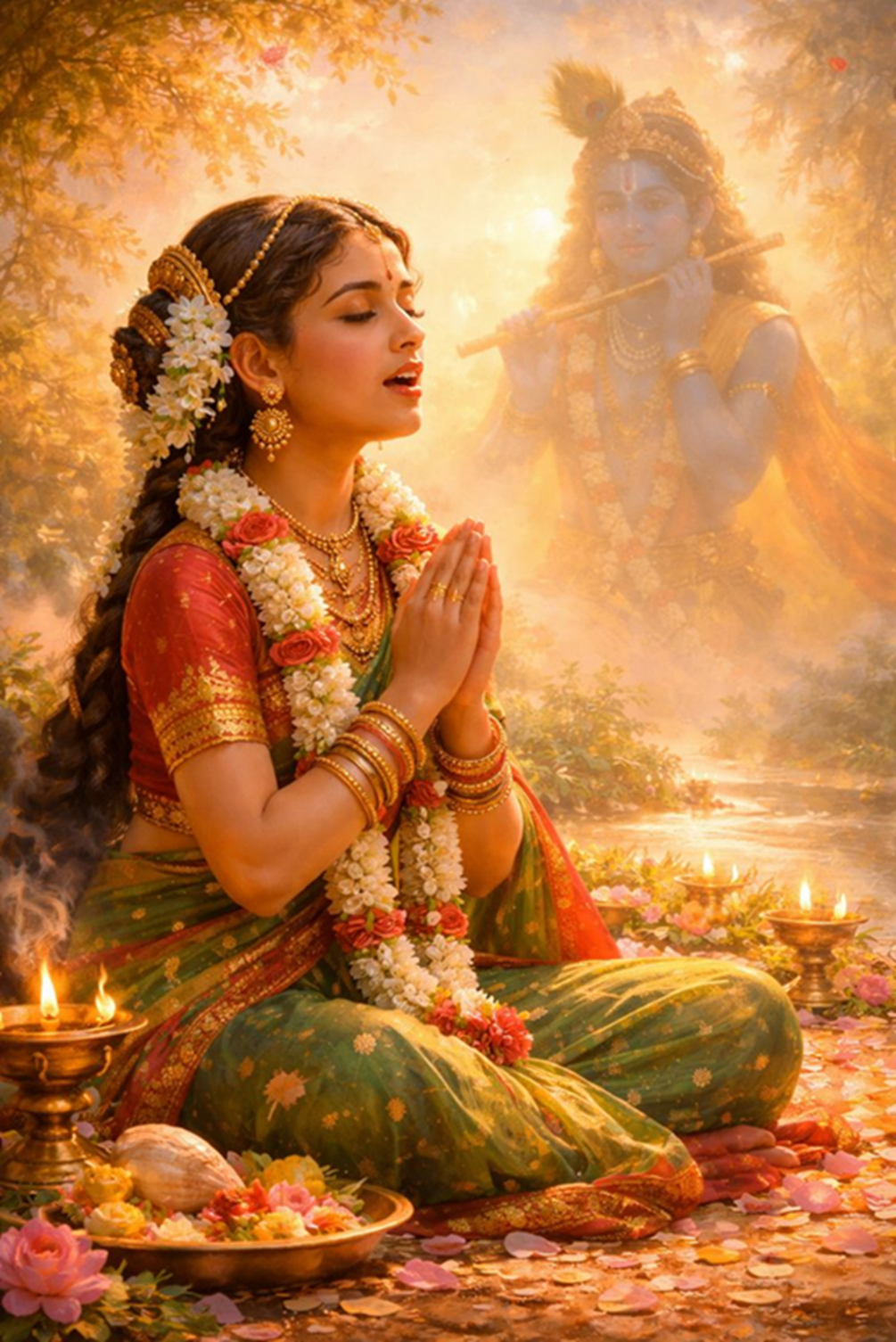
Verses 21–25: Total surrender
At this stage, the soul is ready to let go completely. Andal’s words teach the heart to release pride, control, and expectation. Surrender here is not weakness; it is a quiet intensity, the offering of everything without asking for reward or assurance. Devotion becomes full and unbroken. To surrender is to give the self entirely, trusting that such giving is not loss, but the ultimate fulfillment of love’s deepest longing.
Verses 26–30: Union and assurance through grace
The final verses bring the culmination: divine union. Longing meets acceptance, devotion is recognized and welcomed, and grace flows effortlessly. The soul experiences the assurance that a heart completely surrendered cannot be refused. Andal’s poetry becomes a living embrace—the seeker is seen, cherished, and held by the Beloved. Every offering, every breath, every step finds its home in divine love. The journey that began with awakening ends in quiet ecstasy, a sweet union that transcends time, form, and self.
When Longing Becomes Fire: Nachiyar Tirumozhi
If the Tiruppavai is the soul learning to walk toward God, the Nachiyar Tirumozhi is the soul unable to live without Him.
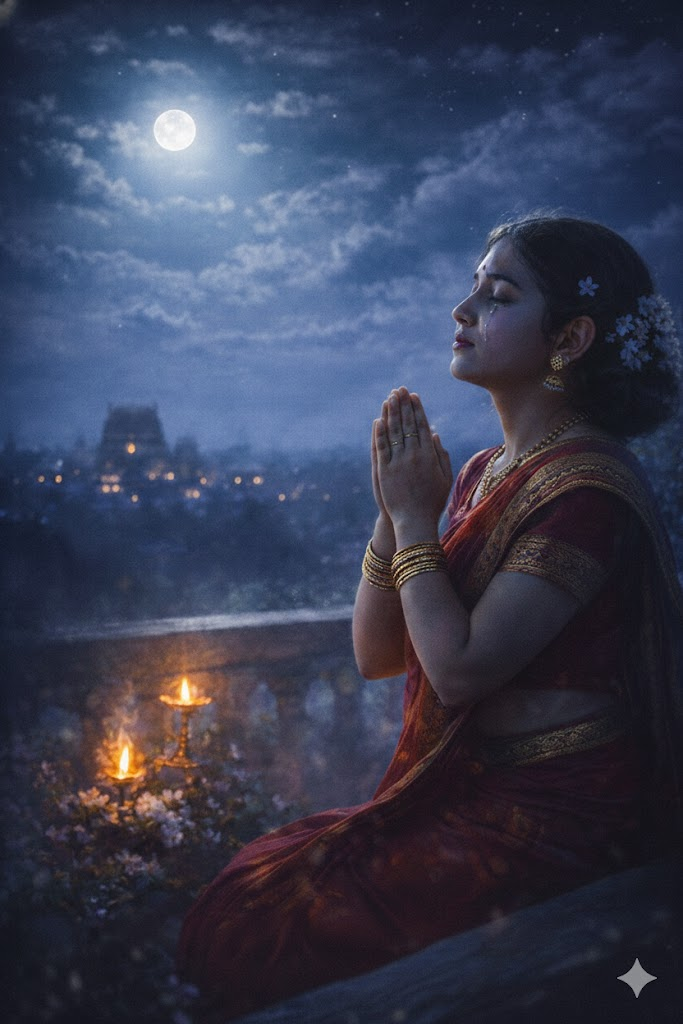
Here, longing intensifies. Separation becomes unbearable. Goda no longer speaks as one practicing devotion; she speaks as one already claimed by love, yet aching in absence. Her words burn, plead, tremble, and sometimes even dare to question.
Goda speaks with fearless honesty, sending messages through the moon, the clouds, the breeze. She imagines wedding rituals. She envisions the moment of meeting. She adorns herself not for display, but in anticipation. Every ornament becomes hope. Every ritual is a rehearsal. Every breath waits.
Here, separation itself becomes sacred—a fire that purifies desire until nothing remains but love.
Through this fire, Goda reveals a profound truth: longing for God is not weakness. It is strength refined by surrender. It is the courage to ache honestly, to love fully, and to trust completely.
The Divine Acceptance
As Goda’s love intensified, her body grew fragile. Every breath carried one longing, one name, one certainty. No earthly bond could contain her heart. She belonged elsewhere—where love had always been pointing.
The Lord Himself responded. He appeared in visions to the temple’s head priest and to her father, not as a distant deity, but as the Beloved answering love. He expressed His desire to accept Goda as His own. He instructed that she be escorted to Srirangam with royal splendor, marking the completion of Dhanurmasam and the offering of the thirty verses of the Tiruppavai.
What had been sung in longing would now be answered in grace. Love had been received.
The Sacred Wedding: A Union Beyond Time
With each step toward Srirangam, Andal’s love leads her closer to the Lord, her longing transforming into divine embrace.

Imagine the procession beginning from Srivilliputhur—her birthplace, her first garden of devotion—moving toward Srirangam, the eternal resting place of her Beloved. Goda Devi is escorted with royal honor. She walks slowly, her heart trembling yet steady, her eyes reflecting temple lamps and the devotion of countless onlookers. Chants rise and ripple through the air—“Alvar Sevai, Andal Tirukalyanam”—as devotees witness a truth older than time: love surpasses effort, and surrender transcends ritual.
She is not merely a bride. She is surrender embodied.
Inside the Ranga Vilasa Mandapam, the wedding unfolds amid sacred chants, ceremonial music, and cascading flowers. Every mantra vibrates with intimacy. Every ritual mirrors the soul’s journey toward its eternal home. The garlands once worn by her in longing now rest upon both the Lord and His bride—offerings that have completed their circle.
She does not merely marry. She merges. The veil between human and Divine dissolves. Time loosens its hold. Ego disappears. Only love remains—vast, complete, unbroken. This is the essence of Goda Devi Kalyanam.
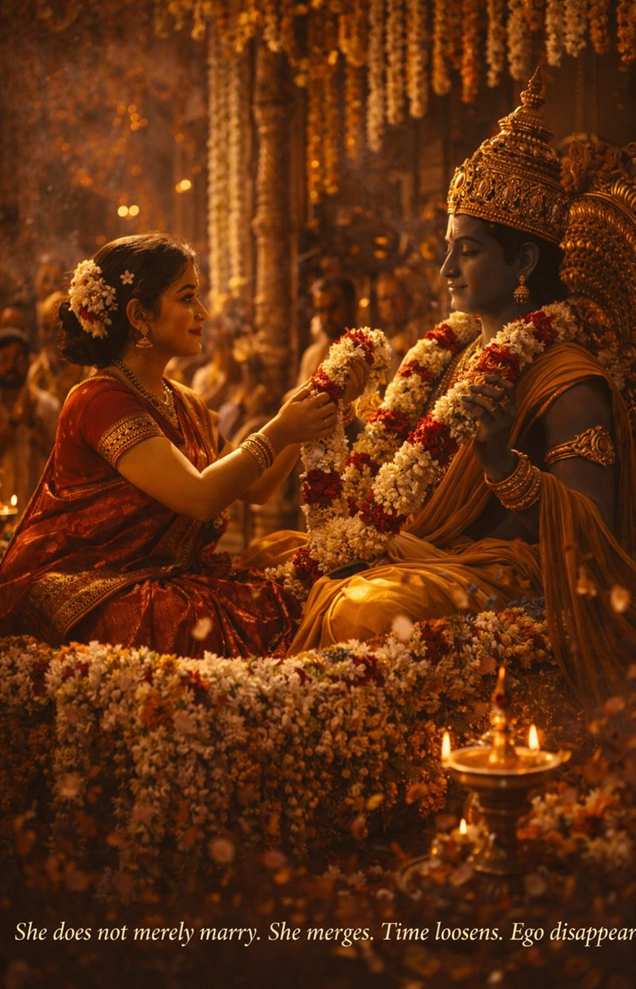
From that sacred moment, she is known as Andal—She who rules over the Lord. A title born not of power, but of love so complete that even the Supreme bends toward it.
Each year, this union is celebrated not merely as ritual remembrance, but as a living affirmation: when love is pure, the Divine does not resist. He receives it fully.
Goda Devi Kalyanam at JK Yog: A Living Practice of Love
At JK Yog, Goda Devi Kalyanam on January 14, 2026 is observed as a living practice of devotion, reflecting Swami Mukundanandaji’s emphasis on a personal, loving relationship with God.
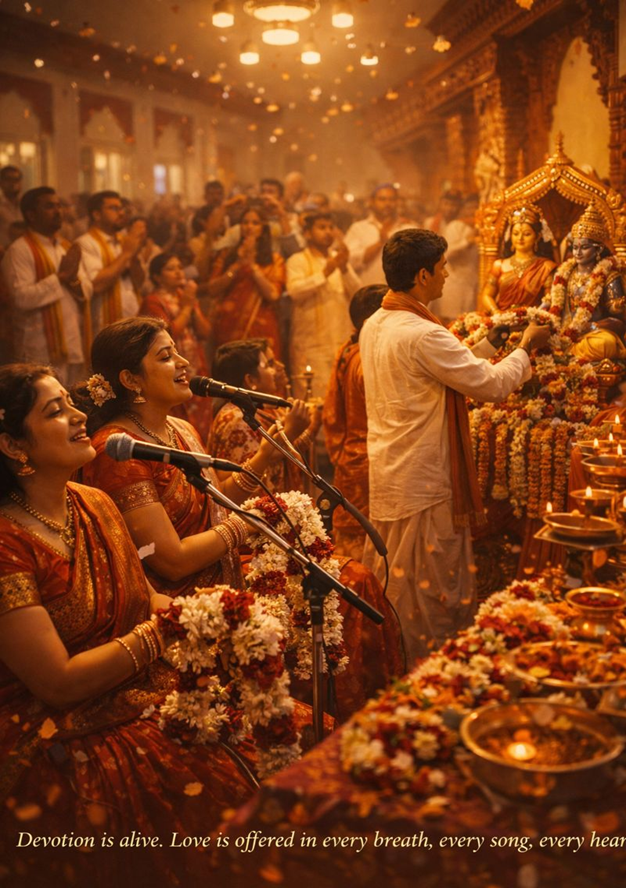
Celebrations during Dhanurmasam typically include:
- Early morning Tiruppavai chanting, accompanied by inner meanings and reflections
- Devotional discourses centered on surrender, longing, and divine grace
- Kirtans and bhajans soaked in the mood of love and union
- Special satsangs on Goda Devi Kalyanam, reflecting the soul’s journey toward God
- Encouragement to offer one’s mind, emotions, and daily actions as garlands, just as Goda Devi did
On the day of Kalyanam:
- Goda Devi and Lord Ranganatha are adorned as bride and groom
- Sacred wedding rituals and devotional kirtans unfold
- Processions reenact her journey toward the Beloved
- Sweet prasadam—especially payasam and butter-based offerings—symbolizes sweetness and surrender
Through all of this, one truth is quietly lived: God responds to love, not formality.
Walking the Path of Love — An Ending That Remains
Some moments in sacred history do not belong to time. They breathe still. They wait still. They continue to call.
Goda Devi Kalyāṇam is one such moment. It is not the memory of a wedding. It is the soul remembering why it was born.
Andal did not seek God as an idea. She sought Him as life itself—not as philosophy to be understood, but as the Beloved without whom breath felt incomplete.
In our time, Swami Mukundanandaji speaks of tridhā bhakti—a devotion that listens, remembers, and lives the Lord: hearing His names, chanting His glories, letting remembrance seep into every corner of life.
Andal lived this path. She listened with hunger. Every name of Nārāyaṇa entered her like rain upon parched earth. This was śravaṇa.
She remembered—not as repetition, but as longing. The Lord walked her streets, filled her dreams, colored her solitude. This was smaraṇa.
And then she dissolved—not in thought, but in identity. There was no Andal waiting for God. There was only God, waiting to be loved. This was nididhyāsana.
This is tridhā bhakti—no longer a method, but necessity. Andal could not live without Him. She did not approach God carefully. She did not negotiate devotion. She did not ask what was appropriate, safe, or respectable. She wanted Him.
Not heaven. Not liberation. Not virtue.
Him alone.
So, this Goda Devi Kalyāṇam is not a celebration to attend. It is a mirror held before the soul:
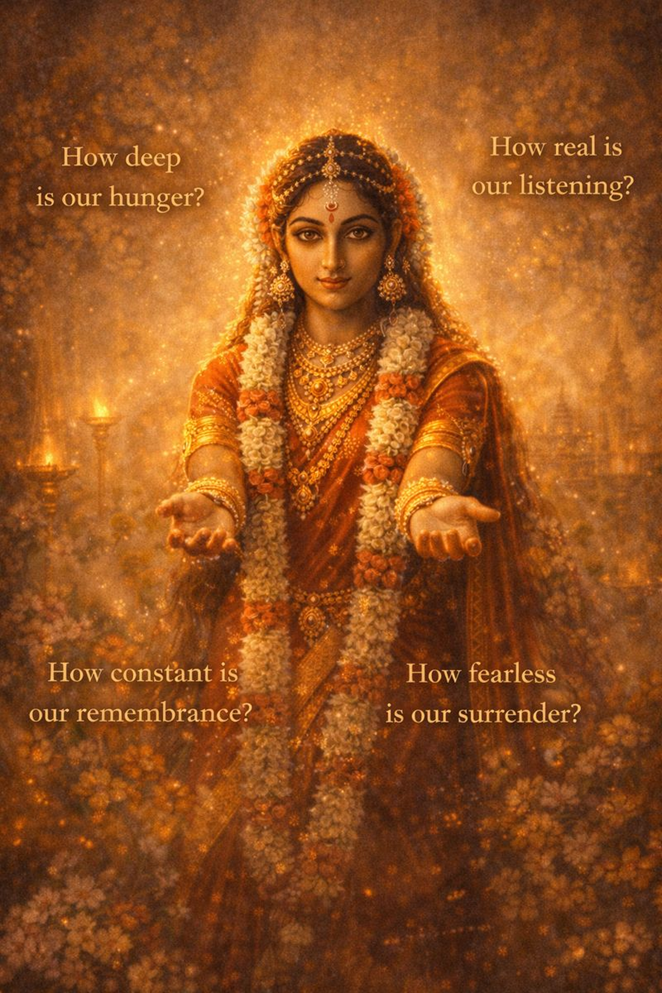
Because bhakti is not proven by words. It is revealed by thirst.
And perhaps this is the final grace Andal gives us—not answers, but a longing so sharp that once awakened, it cannot be forgotten.
Just as Andal made her world Vrindavan, may our inner lives, too, become a place where the Beloved feels irresistibly at home.
Devotional Call to Action
- 🎥 Video: The Love that Will Melt Shree Krishna’s Heart | Swami Mukundanandaji on Andal’s love for Krishna — a devotional discourse that brings her early longing to life.
The Story of Andal highlights the immense power of Bhakti and how pure love melts Shree Krishna's heart and enslaves him under the sway of selfless devotion.
🌸 Join the Divine Celebration: Goda Devi Kalyanam 2026 🌸
Date: Sunday, January 18th, 2026
Time: 9:00 AM – 12:30 PM
Event: Goda Devi and Sree Ranganatha Swami Divine Wedding Ceremony
Location: Radha Krishna Temple, Dallas
Step into a sacred experience where devotion comes alive. Witness the eternal union of Goddess Goda Devi and Lord Sree Ranganatha Swami in a celebration filled with grandeur, rituals, and love.
Highlights of the day:
- Traditional Kalyanam (Divine Wedding) rituals
- Bhakti-filled chanting and devotional music
- Immersive spiritual atmosphere reflecting centuries of love and devotion
- Concluding with Mahaprasad Seva
✨ Experience the heart of devotion, see love embodied, and let your own longing for the Divine awaken.
For full event details and registration, visit: Goda Devi Kalyanam at Radha Krishna Temple, Dallas
FAQs: Goda Devi Kalyanam
1. What is Goda Devi Kalyanam and why is it celebrated?
It celebrates the divine wedding of Andal (Goda Devi) and Lord Ranganatha, symbolizing the soul’s eternal union with the Beloved. It inspires devotees to cultivate selfless surrender in their hearts.
2. Who was Goda Devi (Andal)?
Andal, also called Goda Devi, was a young saint from Tamil Nadu who composed the Tiruppavai and Nachiyar Tirumozhi. Her life exemplifies deep love, unwavering devotion, and complete surrender to the Divine.
3. What is the significance of the Tiruppavai during this festival?
The Tiruppavai is recited during Margazhi (Dhanurmasam). Each verse is an offering of love, devotion, and longing for the Divine, guiding devotees toward spiritual awakening and union.
4. How can I participate in Goda Devi Kalyanam celebrations?
By singing Andal’s hymns, offering flowers and garlands, visiting temples, or reflecting on the divine love story at home. Emphasis is on heartfelt devotion rather than rituals alone.
5. Why is Goda Devi’s story considered timeless?
Her story transcends time because it is the living expression of love for God. Her longing, purity, and surrender continue to inspire devotees to experience devotion as a vibrant, personal relationship with the Divine.