

Some gatherings entertain us, some educate us, and a rare few transform the way we understand ourselves and our purpose in life. The 2026 JKYog Spiritual Retreat and Family Camp was one such transformative gathering.
Held at the Radha Krishna Temple of Dallas in the divine presence of Swami Mukundananda, the weeklong retreat brought together spiritual seekers, families, children, youth, seniors, volunteers, and devotees from across the country. From July 4 to July 10, 2026, participants stepped away from their everyday routines and entered an uplifting environment filled with spiritual wisdom, devotion, meditation, cultural celebrations, recreation, seva, and meaningful community bonding.
The official highlights video, A Week of Devotion and Joy, beautifully captures the spirit of the camp. It presents unforgettable moments of prayer, laughter, learning, singing, service, and interaction with Swamiji. More than a collection of programs, the retreat became a shared spiritual journey in which participants learned together, prayed together, served together, and discovered the joy of living with a higher purpose.
An Auspicious Beginning with Sri Venkateswara Swamy Prana Pratishtha

The Family Camp began on an exceptionally sacred note as its opening coincided with the historic Sri Venkateswara Swamy Prana Pratishtha Mahotsavam at the Radha Krishna Temple of Dallas.
The ceremony was graced by the presence of HH Chinna Jeeyar Swamiji and Swami Mukundananda, making the beginning of the retreat deeply meaningful for the entire community. Vedic rituals, devotional chanting, sacred offerings, and the presence of revered spiritual leaders created an atmosphere of profound reverence.
The Prana Pratishtha represented far more than the installation of a divine form. It marked the establishment of a sacred place where generations of devotees could come for darshan, prayer, worship, seva, and spiritual renewal.
Through the consecrated deity, the unlimited and all-pervading Lord becomes accessible to the human mind in a form that devotees can lovingly behold, worship, and serve. The arrival of Sri Venkateswara Swamy therefore filled the temple community with immense gratitude and joy.
It also brought a renewed sense of responsibility. A temple is sustained not only by its structure and rituals, but also by the devotion, discipline, service, and spiritual commitment of its community. The ceremony invited devotees to deepen their connection with God and participate actively in preserving the temple as a center of spiritual inspiration.
Beginning the retreat with such a sacred celebration elevated the hearts of all participants and set the tone for the days that followed.
Entering a Sacred Rhythm of Life

Modern life often moves at an exhausting pace. Days become filled with responsibilities, deadlines, digital distractions, and constant mental activity. Even when people wish to pray or reflect, the mind may remain occupied with unfinished work and personal concerns.
The Family Camp offered a refreshing alternative.
For seven days, participants followed a rhythm centered on spiritual growth. Mornings began with prayer, sadhana, Radha Govind Geet chanting, kirtans, meditation, and scriptural wisdom. The days continued with lectures, interactive sessions, age-specific activities, devotional celebrations, cultural programs, seva, shared meals, and meaningful interaction with Swamiji.
This structure helped participants recognize how strongly the surrounding environment influences the mind. When the day begins with prayer instead of notifications, the mind develops a different direction. When conversations focus on spiritual wisdom rather than complaints and worries, one’s inner state gradually becomes calmer. When time is shared with people seeking similar ideals, spiritual effort feels more natural and joyful.
The retreat showed that spirituality does not require withdrawing permanently from family life or worldly responsibilities. Instead, it offers a wiser way of approaching them. By placing devotion, discipline, gratitude, and self-reflection at the center, daily life can become more peaceful, meaningful, and purposeful.
The Timeless Wisdom of the Kathopanishad

A central highlight of the retreat was Swami Mukundananda’s profound discourse series on the Kathopanishad.
The Kathopanishad presents the inspiring dialogue between Nachiketa, a sincere young seeker, and Yamraj, the Lord of Death. Through their conversation, the scripture explores some of the deepest questions of human existence.
Who am I?
What is the nature of the soul?
What happens after death?
Why do material pleasures fail to provide lasting satisfaction?
What is the ultimate purpose of human life?
How can a person attain liberation and eternal bliss?
Nachiketa’s story is powerful because he refuses to accept superficial answers. Although young in age, he displays remarkable courage, clarity, determination, and spiritual maturity.
When Yamraj offers him wealth, long life, power, pleasures, and worldly comforts, Nachiketa remains unmoved. He understands that all material enjoyments are temporary. He does not allow attractive distractions to divert him from his search for eternal knowledge.
One of the most important teachings of the Kathopanishad is the distinction between shreya and preya.
Shreya refers to what is ultimately beneficial, while preya refers to what is immediately pleasant. This teaching remains deeply relevant today. Every person repeatedly chooses between temporary comfort and long-term growth.
Sleeping longer may feel pleasant, while waking early for spiritual practice may be beneficial. Reacting in anger may provide momentary satisfaction, while responding with patience protects relationships. Endless entertainment may please the senses, while meditation and scriptural study strengthen the mind and intellect.
Swamiji encouraged participants to examine these choices honestly. Spiritual progress does not depend only on what one knows. It depends on what one repeatedly chooses.
Nachiketa’s example also demonstrated the importance of having clarity about one’s goal. He knew what he wanted and refused to exchange the highest truth for temporary pleasures.
This call reflected the spirit of the retreat. Participants were encouraged to awaken from the belief that material accomplishments alone can satisfy the soul. They were reminded of the precious opportunity offered by human life and the importance of seeking guidance from a true spiritual teacher.
Through Swamiji’s explanations, the teachings of the Kathopanishad became practical and relevant. The discourses addressed not only the nature of death and liberation, but also the way people manage desires, respond to challenges, make decisions, and pursue spiritual growth in everyday life.
Divine Teachings of Jagadguru Shri Kripalu Ji Maharaj

The retreat was further enriched by video lectures from Jagadguru Shri Kripalu Ji Maharaj.
Maharajji’s divine words brought participants closer to the essence of bhakti and reminded them of the supreme purpose of human life. His teachings emphasize that every soul naturally seeks happiness because the soul is an eternal part of God, who is the ocean of unlimited bliss.
However, the mind often searches for infinite happiness in finite material objects. This creates a cycle of desire, temporary satisfaction, disappointment, and renewed desire.
Maharajji’s teachings direct seekers toward loving devotion to God and Guru. They emphasize purification of the mind, consistent remembrance of God, sincere spiritual practice, and the cultivation of selfless love.
For devotees at the camp, listening to Maharajji was not simply a philosophical exercise. It was an opportunity to receive divine guidance and reconnect with the spiritual foundation of the JKYog tradition.
His teachings beautifully complemented the Kathopanishad discourses. The Kathopanishad offered deep insight into the soul and its eternal goal, while Maharajji’s teachings explained how that goal can be pursued through bhakti, surrender, and loving remembrance.
These sessions encouraged participants to look beyond external achievements and examine their inner growth.
Were they becoming more humble, peaceful, compassionate, disciplined, and devoted?
Were their spiritual practices genuinely transforming their thoughts and behavior?
Such reflection helped keep the retreat focused not only on inspiration, but also on meaningful spiritual transformation.
Kirtans That Filled the Temple with Divine Bliss
Throughout the camp, blissful kirtans filled the Radha Krishna Temple with devotional energy.
Morning sadhana, evening programs, prayers, and celebrations offered participants repeated opportunities to chant the divine names and absorb their minds in God.
There is a unique power in collective chanting. A person may arrive with worries, fatigue, or mental distractions, but when hundreds of voices unite in the divine name, the heart gradually begins to soften. Individual concerns feel smaller, and the mind becomes more receptive to spiritual sentiments.
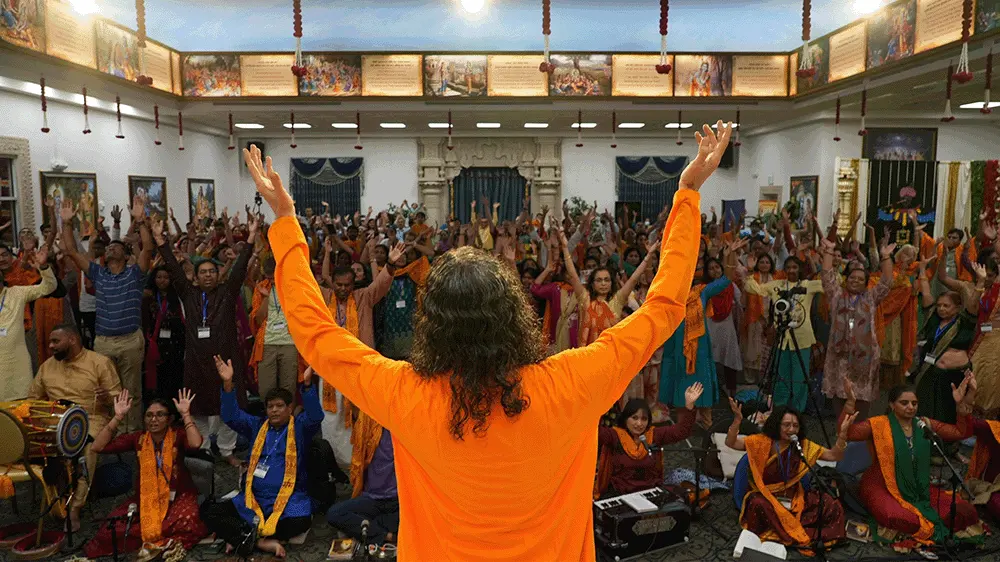
Kirtan also allowed participants to express devotion beyond words and intellectual understanding. Some sang with enthusiasm, while others closed their eyes and meditated. Children clapped joyfully, youth participated with energy, and elders offered their prayers with quiet absorption.
The chanting of Radha Govind Geet with Swamiji became a cherished part of the morning routine. It gave participants the opportunity to begin the day by remembering the names, forms, qualities, and divine pastimes of Radha and Krishna.
As the week progressed, the kirtans helped create a shared devotional consciousness. Participants were not merely attending programs. Through their singing and remembrance, they were contributing to an atmosphere of bhakti that uplifted everyone.
Roopdhyan Meditation and the Art of Directing the Mind
Roopdhyan meditation formed another important part of the retreat.
Through this practice, participants were encouraged to lovingly contemplate the divine form, names, qualities, pastimes, and presence of God and Guru.
The mind cannot remain without thought. When it is not deliberately engaged in uplifting contemplation, it naturally returns to worldly concerns, memories, fears, and desires.
Roopdhyan offers a positive way of directing the mind. Rather than merely attempting to suppress unwanted thoughts, the seeker lovingly replaces worldly impressions with divine ones.
Participants experienced Roopdhyan both in the temple and during the outdoor picnic. Meditation in the peaceful surroundings of nature brought an added sense of openness and stillness. The beauty of the environment reminded devotees of God’s creation, while Swamiji’s guidance helped them turn inward.
This practice also connected closely with the teachings of the Kathopanishad. The senses naturally move outward toward objects of the world, while spiritual realization requires the seeker to develop inner awareness and discipline.
The retreat helped participants understand that meditation is not merely a one-time emotional experience. It is a practice that gradually transforms the mind. Every sincere effort creates a positive spiritual impression. With regular practice, attachment to God increases and dependence on worldly stimulation decreases.
Celebrations of Love and Devotion


The camp included several beautiful devotional celebrations that allowed participants to experience different expressions of bhakti
The camp included several beautiful devotional celebrations that allowed participants to experience different expressions of bhakti.
Shri Maharajji’s Palki Yatra
One of the most joyful events was Shri Maharajji’s Palki Yatra with Swamiji.
As Maharajji’s beautifully decorated palki moved through the temple, devotees sang kirtans, offered flowers, danced, and joined the procession with heartfelt devotion.
The Palki Yatra became an expression of gratitude to Jagadguru Shri Kripalu Ji Maharaj. It reminded participants that gratitude to the Guru is expressed not only through words, but also through remembrance, obedience to the teachings, service to the mission, and sincere efforts to transform one’s life.
Children, youth, adults, and seniors participated together. The atmosphere was festive and deeply spiritual at the same time. Devotees celebrated because their hearts were filled with love and gratitude.
Radha Krishna Abhishek
During the Radha Krishna Abhishek, participants offered their love and reverence as the divine forms were ceremonially bathed and worshipped.
Abhishek symbolizes the bathing of the heart in devotion. Every sacred offering becomes an expression of love and surrender. As devotees witnessed the ceremony, they were encouraged to offer not only physical substances, but also their minds, attachments, desires, and aspirations at the feet of God.
Radha Krishna Jhoolan Leela
The Radha Krishna Jhoolan Leela brought participants into the sweet devotional mood of Vrindavan.
Radha and Krishna were lovingly seated upon a beautifully decorated swing, and devotees experienced the joy of serving the Divine Couple in an intimate and affectionate way.
These celebrations helped participants move beyond formal worship and develop a personal relationship with God. Radha and Krishna were lovingly served, adorned, remembered, and invited into the heart.
Philosophy clarifies the intellect, while devotional celebration nourishes and softens the heart. The retreat offered both dimensions in abundance.
Shri Krishna Leela and Cultural Expressions
The cultural programs brought creativity, devotion, and joyful entertainment into the retreat.
Shri Krishna Leela presentations, bhajans, dances, poetry, sher-shayari, fusion songs, and other performances gave participants opportunities to offer their talents at the feet of God and Guru.
The stage became more than a place for performance. It became a platform for devotional expression.
Children portrayed divine characters. Youth communicated spiritual values through creative formats. Adults expressed gratitude through music, poetry, dance, and drama.
These presentations helped families recognize that spirituality is not limited to lectures, rituals, and meditation. Music can become worship. Dance can become prayer. Drama can communicate timeless values. Poetry can awaken devotion.
For children and youth, preparing for these programs also developed confidence, discipline, communication, cooperation, and teamwork. Their efforts gained a higher meaning because they were presented as offerings rather than merely as entertainment.
The cultural events added laughter and beauty to the retreat while keeping the consciousness connected to devotion.
A Joyful Picnic with Swamiji


Away from the formal setting of the lecture hall, participants enjoyed Swamiji’s company through games, music, meditation, food, and joyful interaction
One of the most heartwarming highlights of the Family Camp was the picnic with Swami Mukundananda.
Away from the formal setting of the lecture hall, participants enjoyed Swamiji’s company through games, music, meditation, food, and joyful interaction.
Swamiji played ball and cricket with devotees, creating moments of laughter and happiness. Children, youth, adults, and seniors participated together, experiencing the warmth of a close spiritual family.
The picnic included devotional singing and Roopdhyan meditation in the community park. Participants expressed their love through songs dedicated to Radha Krishna and Guru bhakti.
This combination of recreation and spiritual practice demonstrated that spirituality does not make life dull or restrictive. When the mind remains connected to God, even simple activities can become wholesome, joyful, and uplifting.
Watermelon, refreshing green mango juice, and delicious food added to the festive mood. Yet the greatest joy came from togetherness. Families relaxed, devotees formed new friendships, and participants created treasured memories in Swamiji’s presence.
Personal Guidance and Questions with Swamiji
The retreat also provided valuable opportunities for participants to seek personal guidance from Swami Mukundananda.
Along with his structured lectures, Swamiji interacted with devotees during dedicated question-and-answer sessions, breaks, and shared meals.
Participants asked about challenges that spiritual seekers commonly face:
How can the mind be controlled?
How can devotion remain steady during difficult circumstances?
How should parents transmit spiritual values to their children?
How can one balance career, family, health, and sadhana?
How can anger, fear, ego, jealousy, and attachment be overcome?
Swamiji’s responses connected timeless Vedic wisdom with modern situations. Participants learned that spirituality is not separate from family life, professional responsibilities, or relationships. Spiritual wisdom enables people to fulfill these responsibilities with greater balance, compassion, discipline, patience, and clarity.
These interactions helped devotees apply general spiritual principles to their individual circumstances. A teaching heard during a lecture became more personal when Swamiji explained how it related to a specific struggle or decision.
For many participants, even a brief conversation or a few encouraging words became one of the most treasured memories of the retreat.
Children and Youth Growing in Values

The Family Camp was thoughtfully designed for participants of different ages.
Parallel tracks included Bal-Mukund programs for children and personality development activities for youth. These sessions combined value-based education, stories, shloka learning, meditation, leadership development, communication skills, practical applications of Swamiji’s teachings, and service-oriented thinking.
Children learned spiritual values through engaging activities rather than abstract instruction alone. Stories, crafts, games, music, and performances made the lessons memorable and enjoyable.
Youth explored topics related to identity, purpose, relationships, careers, leadership, discipline, and spiritual values. They were encouraged to understand success not only as personal achievement, but also as the responsible use of their abilities in service to society and God.
One of the greatest strengths of the retreat was that entire families could grow spiritually together. Parents did not have to leave their children behind to attend spiritual programs. Children and youth received age-appropriate instruction, while adults participated in deeper scriptural and devotional sessions.
At meals and family activities, generations reunited and shared their experiences. Children saw their parents attending lectures, serving, chanting, and meditating. Parents saw their children joyfully engaging with spiritual culture.
This created a living form of value education in which spiritual principles were not only taught, but also demonstrated.
Seva: The Invisible Strength Behind the Retreat
Behind every lecture, meal, decoration, ritual, cultural presentation, and activity stood the dedication of volunteers.
Volunteers served in registration, hospitality, food preparation, meal distribution, transportation, children’s programs, technical support, communications, decorations, crowd management, cleaning, and many other areas.
Much of this seva happened quietly and without public recognition.
Seva transforms ordinary work into spiritual practice. The outer task may appear simple, but when it is performed for the pleasure of God and Guru, it purifies the heart.
Serving food, arranging shoes, guiding a visitor, cleaning a space, assisting a child, or resolving a technical issue can all become offerings of devotion.
The retreat gave volunteers opportunities to practice patience, humility, flexibility, responsibility, and teamwork. Unexpected needs sometimes arose, plans had to be adjusted, and long days required endurance.
Through these situations, volunteers learned to place the comfort and needs of others above their own convenience.
The smooth and joyful experience enjoyed by participants was therefore the visible result of countless invisible acts of love.
The camp reminded everyone that a spiritual community is strengthened by every person who willingly offers time, energy, and skills in a spirit of selfless service.
Carrying the Transformation Home
As the retreat came to a close, participants carried home much more than photographs and pleasant memories.
They carried spiritual questions, practical teachings, renewed inspiration, stronger relationships, and a deeper longing to improve their lives.
The Kathopanishad had encouraged them to choose shreya over preya. Maharajji’s teachings had inspired loving remembrance of God. Kirtans had awakened devotion. Roopdhyan had offered a method for directing the mind. Seva had cultivated humility. Cultural celebrations had connected creativity with worship. Personal guidance from Swamiji had strengthened faith and clarity.
The Kathopanishad describes the culmination of the spiritual journey:
“When all the desires that dwell in the heart fall away, then the mortal becomes immortal.”
The retreat did not suggest that transformation would happen instantly. Instead, it encouraged participants to take sincere and consistent steps.
A family might begin praying together each day. A seeker might establish a regular meditation practice. A young participant might reduce distractions and become more disciplined. A devotee might commit to regular seva, satsang, or scriptural study.
The inspiration received during a retreat remains alive when it is converted into daily habits. Without consistent practice, even a powerful experience may gradually become a distant memory. With practice, however, one week of spiritual immersion can influence an entire lifetime.
A Spiritual Family United by a Higher Purpose

The 2026 JKYog Spiritual Retreat and Family Camp demonstrated what becomes possible when people gather around a shared spiritual aspiration.
For seven unforgettable days, the Radha Krishna Temple of Dallas became a home for wisdom, devotion, celebration, learning, friendship, and selfless service.
The retreat showed that spirituality does not make life narrower. It makes life richer. It brings depth to learning, purity to relationships, purpose to work, sacredness to service, and lasting joy to the heart.
Although the programs concluded and families returned to their homes, the impact of the retreat continued through the inner resolutions formed, the relationships strengthened, the devotion awakened, and the lives inspired to move closer to God.
The call of the Kathopanishad remained alive within every sincere heart:
Arise. Awake. Choose what is truly beneficial. Seek the eternal beyond the temporary. Walk the spiritual path with faith, courage, devotion, and perseverance.
The Family Camp may have lasted seven days, but the journey it inspired has only begun.
Call To Action: Experience the Next JKYog Family Camp
Let the inspiration of the 2026 retreat become the beginning of your own spiritual journey.
Watch the official highlights video to relive the unforgettable moments of Kathopanishad wisdom, blissful kirtans, devotional celebrations, seva, family activities, and joyful time with Swami Mukundananda.
Stay connected with JKYog and the Radha Krishna Temple of Dallas to receive updates about upcoming spiritual retreats, lecture series, devotional celebrations, family programs, and seva opportunities.
Join us at the next JKYog Spiritual Retreat and Family Camp and experience a transformative journey of wisdom, devotion, and togetherness with your family.

Frequently Asked Questions
1. What was the JKYog Spiritual Retreat and Family Camp 2026?
It was a weeklong spiritual retreat featuring scriptural discourses, meditation, kirtans, cultural programs, devotional celebrations, seva, and activities for participants of all ages.
2. Who led the main spiritual sessions?
Swami Mukundananda led the principal discourse series and guided participants through the timeless teachings of the Kathopanishad.
3. Were there programs for children and youth?
Yes. Children and youth participated in age-appropriate value education, creative activities, leadership sessions, meditation, cultural programs, and devotional learning.
4. What made the 2026 Family Camp special?
Its unique combination of Kathopanishad wisdom, devotional celebrations, personal interaction with Swamiji, family activities, cultural offerings, and volunteer seva made it a deeply enriching experience.
5. How can I watch the retreat highlights?
The official 2026 Family Camp highlights video is available on the JKYog YouTube channel.