

There is one full moon each year that shines with a light unlike any other. Rising over the sacred month of Ashadh, it does not choose who deserves its light. It simply shines, and all beneath it is illuminated.
Guru Kripa is like that: not knowledge imparted, but Divine Compassion reaching the soul through the God-realized Guru. It does not wait until we are worthy. It descends because God's love refuses to leave the soul in darkness forever.
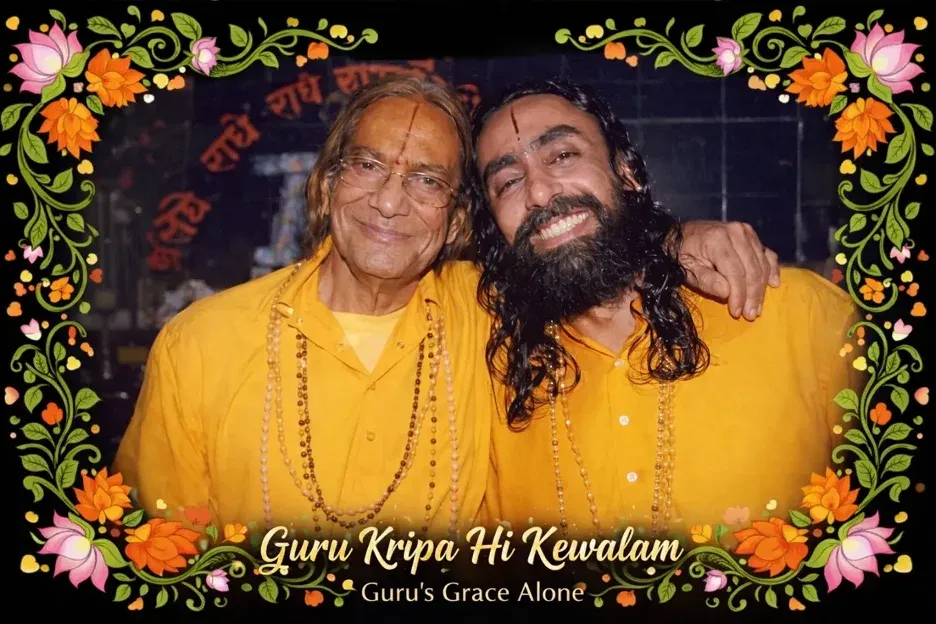
Guru Purnima, observed on this full moon, has traditionally been celebrated as Vyasa Purnima, honoring Sage Veda Vyasa. Over time, it has also become the day devotee’s express gratitude to the spiritual master through whom that grace flows.
In 2026, Guru Purnima falls on Wednesday, July 29.
Among all the scriptures of Sanatan Dharma, the Bhagavad Gita offers some of the clearest teachings on the Guru. Though the word guru appears only sparingly, the entire dialogue between Shree Krishna and Arjun reveals the sacred relationship between master and disciple.
Through the timeless wisdom of the Bhagavad Gita, illumined by Swami Mukundananda in the lineage of Jagadguru Shri Kripaluji Maharaj, let us explore four lessons on the Guru: lessons that carry the soul from intellectual understanding into loving surrender, and awaken its journey toward Divine Love.
Lesson One: The Journey Begins When We Become a Disciple

कार्पण्यदोषोपहतस्वभाव:
पृच्छामि त्वां धर्मसम्मूढचेता: ।
यच्छ्रेय: स्यान्निश्चितं ब्रूहि तन्मे
शिष्यस्तेऽहं शाधि मां त्वां प्रपन्नम् ॥ 7॥
kārpaṇya-doṣhopahata-svabhāvaḥ
pṛichchhāmi tvāṁ dharma-sammūḍha-chetāḥ
yach-chhreyaḥ syānniśhchitaṁ brūhi tanme
śhiṣhyaste ’haṁ śhādhi māṁ tvāṁ prapannam
BG 2.7: I am confused about my duty, and am besieged with anxiety and faintheartedness. I am Your disciple, and am surrendered to You. Please instruct me for certain what is best for me.
The Bhagavad Gita does not truly begin when Shree Krishna starts speaking. It begins when Arjun becomes capable of listening.
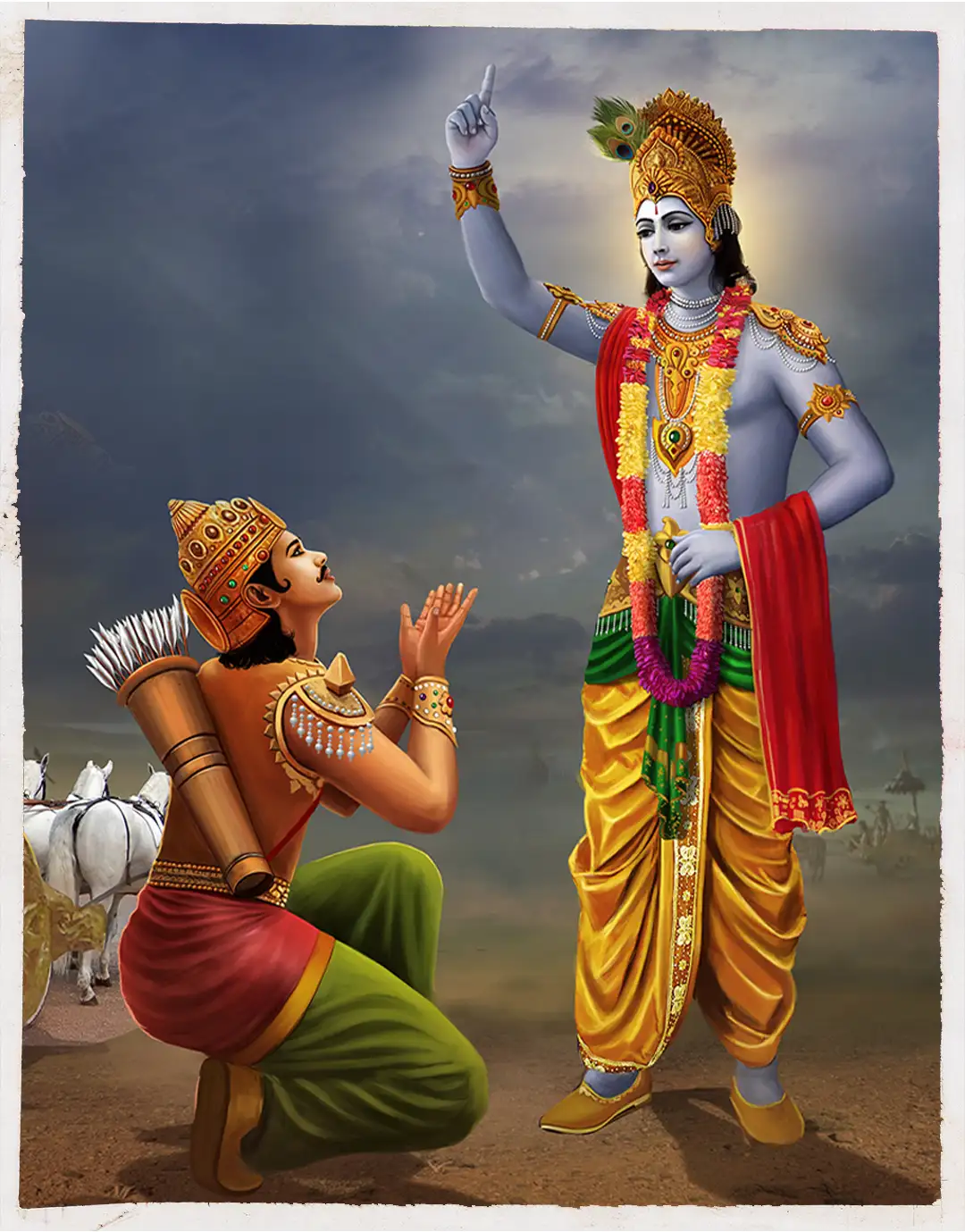
Standing between two armies, Arjun is overwhelmed by grief and confusion. His famous Gandiva bow slips from his hands as he sinks into despair. Until this moment, Krishna had been his beloved friend and charioteer, Arjun answering every counsel with another argument, his intellect straining to solve a problem beyond intellect's reach.
Then everything changed. Recognizing the limits of his own understanding, Arjun laid aside the pride of self-reliance and surrendered to Shree Krishna.
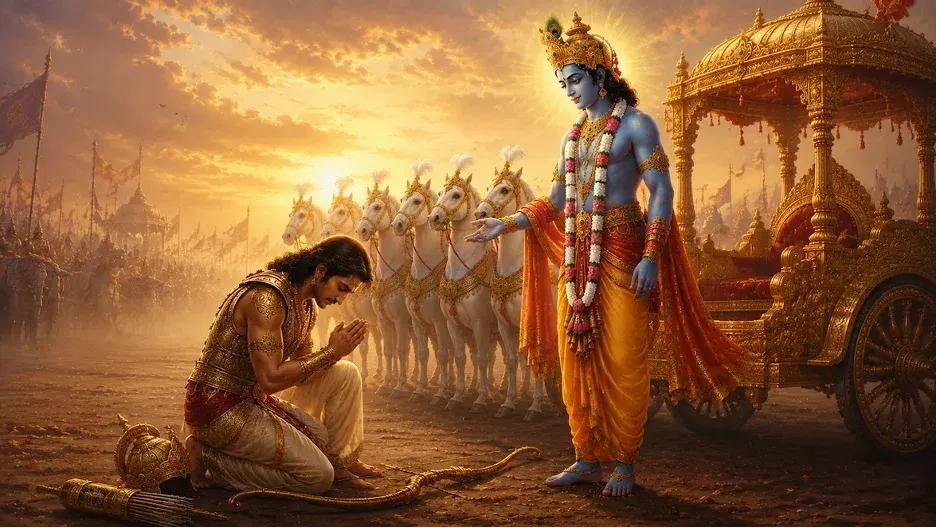
This verse marks the true beginning of Arjun’s transformation in the Bhagavad Gita.
Swami Mukundananda explains that spiritual transformation did not begin because Arjun grew more intelligent, but because he accepted Krishna as his Guru. Friendship gave way to discipleship, and argument gave way to surrender. This is the Gita's first lesson on the Guru: the path to realization begins with humility.
The Guru does not remove ignorance from a heart that insists it already knows. As long as we trust our own opinions as sufficient, we leave little room for God's higher wisdom to enter. Humility is not weakness; it is the doorway through which grace is received.
Swami Mukundananda often points to a remarkable truth: though Shree Krishna is the Supreme Lord and the original Guru of the universe, He accepted Sage Sandipani Muni as His own Guru during His earthly pastimes. He had nothing to learn, yet He joyfully demonstrated the discipline of a disciple, teaching that no soul is beyond the guidance of a genuine spiritual master.
In the devotional lineage of Jagadguru Shri Kripaluji Maharaj, this verse is not remembered only as history. It becomes the disciple's daily prayer: I cannot cross this ocean by my own strength. Please guide me.
Arjun's first victory at Kurukshetra was therefore not over the Kauravas, but over his own ego. The Guru never draws attention to himself; he lovingly directs every heart toward God. That is the Bhagavad Gita's first lesson: discipleship begins where ego ends.
Lesson Two: How to Approach the Guru
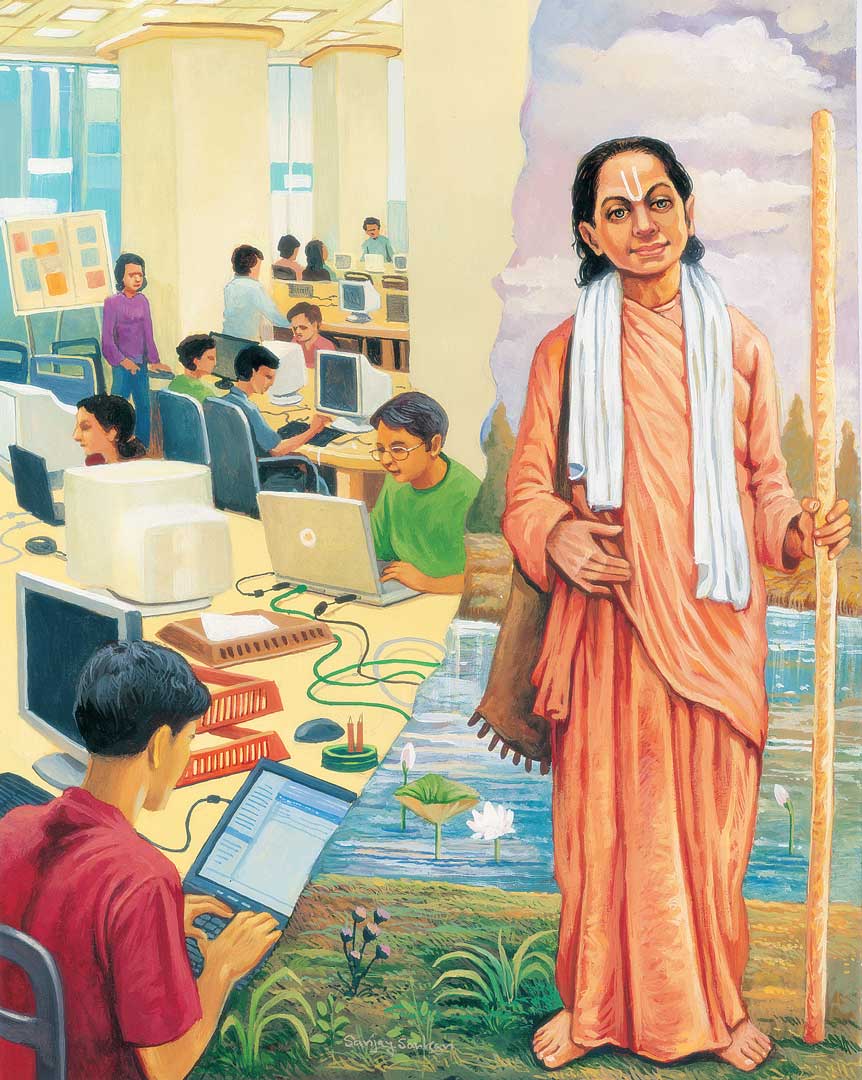
तद्विद्धि प्रणिपातेन परिप्रश्नेन सेवया ।
उपदेक्ष्यन्ति ते ज्ञानं ज्ञानिनस्तत्त्वदर्शिन: ॥ 34॥
tad viddhi praṇipātena paripraśhnena sevayā
upadekṣhyanti te jñānaṁ jñāninas tattva-darśhinaḥ
BG 4.34: Learn the Truth by approaching a spiritual master. Inquire from him with reverence and render service unto him. Such an enlightened Saint can impart knowledge unto you because he has seen the Truth.
Having accepted Arjun as His disciple, Shree Krishna next reveals how every sincere seeker should approach a God-realized Guru: not through intellectual brilliance, but through the right attitude of the heart.
Swami Mukundananda explains that this verse is far more than spiritual etiquette. It reveals the inner qualities of an ideal disciple: pranipat, pariprashna, and seva.
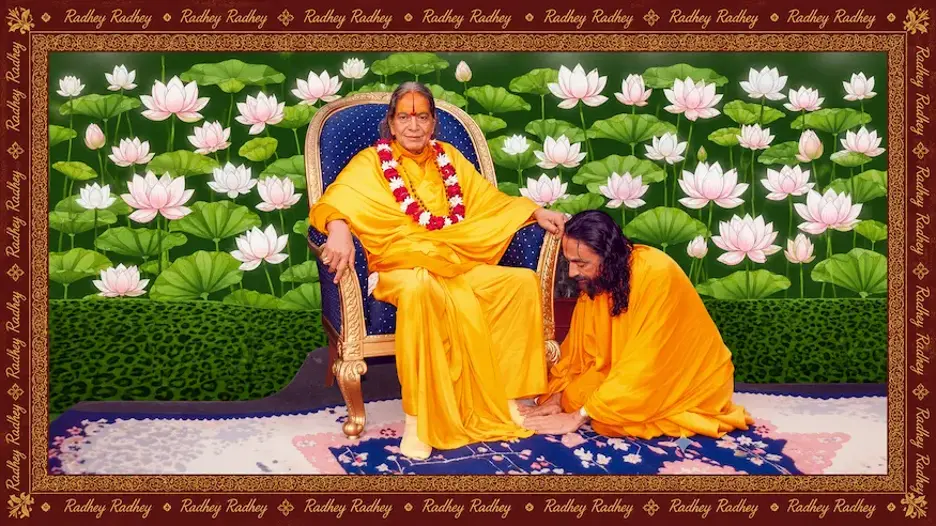
Pranipat: Humility That Opens the Heart
Pranipat means to bow down, but the Gita points to something deeper than an external gesture: the surrender of ego. Anyone can bend the body while the mind still insists, “I already know.” True pranipat begins when that inner resistance softens, and the disciple approaches not to confirm personal beliefs but to be transformed by higher wisdom. Swami Mukundananda reminds seekers that humility is not thinking less of ourselves; it is thinking more of God's wisdom than our own. Humility does not earn grace, for grace can never be purchased, it simply removes the barriers that prevent us from receiving what the Guru longs to give.
Pariprashna: Inquiry Born of a Desire to Grow
Shree Krishna does not ask Arjun to suppress his questions; He teaches him how to ask. Pariprashna is sincere inquiry, not debate but a genuine thirst to understand. Swami Mukundananda explains that faith in Sanatan Dharma is never blind, it matures through reflection and a sincere desire to understand God's teachings more deeply. In the Kripalu Bhakti tradition, such inquiry becomes sweeter still: questions arise not to increase knowledge but from a heart longing to love God more, so that understanding blossoms into loving remembrance of Radha-Krishna.
Seva: Love Expressed Through Action
The third instruction is seva, loving service, measured not by size but by devotion. Swami Mukundananda teaches that seva offered to please God and Guru purifies the heart far more quickly than action motivated by ego. Whether one sings a bhajan, cleans the temple floor, or serves through one's talents, every action becomes sacred when offered with the prayer: May this bring joy to my Guru, and through my Guru's pleasure, to Radha-Krishna. Such service gradually transforms duty into devotion, and devotion into love.
The Guru Awakens What Was Always Meant to Bloom
Swami Mukundananda beautifully explains, following the teachings of Jagadguru Shri Kripaluji Maharaj, that Divine Love cannot be manufactured by human effort alone. Sadhana prepares the heart, but God's grace causes devotion to blossom. The scriptures are like seeds; sadhana prepares the soil; the Guru lovingly nurtures the seed by connecting the disciple to God's grace. The Guru's greatest joy, in every one of these acts, is to unite the disciple with Radha Krishna.
That is why Bhagavad Gita 4.34 remains one of the most treasured verses for every spiritual aspirant. The Bhagavad Gita's second lesson on the Guru is this: spiritual wisdom is received through humility, inquiry, and service.
Lesson Three: Faith Opens the Heart to Divine Wisdom
श्रद्धावान् लभते ज्ञानं तत्पर: संयतेन्द्रिय: ।
ज्ञानं लब्ध्वा परां शान्तिमचिरेणाधिगच्छति ॥ 39॥
śhraddhāvānllabhate jñānaṁ tat-paraḥ sanyatendriyaḥ
jñānaṁ labdhvā parāṁ śhāntim achireṇādhigachchhati
BG 4.39: Those whose faith is deep and who have practiced controlling their mind and senses attain divine knowledge. Through such transcendental knowledge, they quickly attain everlasting supreme peace.
Swami Mukundananda explains that shraddha, faith, is the soil in which the Guru's teaching takes root. A disciple may bow with humility, ask sincere questions, and offer loving service, yet without faith the teaching passes through the mind without ever settling into the heart.
This is not blind faith. Swamiji explains that shraddha in the Gita is a reasoned, living trust that grows through direct experience of the Guru's wisdom, the way a small lamp brightens a room once lit and given time to burn steadily.
Along with faith, Shree Krishna mentions samyatendriya, mastery over the senses. A restless mind, pulled in many directions, cannot hold the Guru's teaching steadily enough for it to bear fruit. Faith opens the heart; steadiness of mind allows what has been received to remain and mature.
In the Kripalu Bhakti tradition, this steady faith finds its most natural expression in a single, quiet question the disciple learns to ask before every thought, word, and action: Will my Guru be pleased?
This is Guru Prasannata, the pleasure of the Guru, and it becomes the disciple's living compass. Every kirtan sung, every line of scripture studied, every act of seva offered is measured by this one standard. When the Guru is pleased, Radha is pleased, and through Her pleasure, the disciple draws nearer to Shree Krishna Himself.
Faith is what allows the fruit of Lesson Two to ripen, and prepares the heart for the final and most complete teaching of the Bhagavad Gita. The Bhagavad Gita's third lesson on the Guru is this: faith allows the Guru's teachings to transform the heart.
Lesson Four: Complete Surrender Is the Highest Teaching
सर्वधर्मान्परित्यज्य मामेकं शरणं व्रज ।
अहं त्वां सर्वपापेभ्यो मोक्षयिष्यामि मा शुच: ॥ 66॥
sarva-dharmān parityajya mām ekaṁ śharaṇaṁ vraja
ahaṁ tvāṁ sarva-pāpebhyo mokṣhayiṣhyāmi mā śhuchaḥ
BG 18.66: Abandon all varieties of dharmas and simply surrender unto Me alone. I shall liberate you from all sinful reactions; do not fear.
After revealing the paths of Karma Yoga, Jnana Yoga, Dhyana Yoga, and Bhakti Yoga across eighteen chapters, Shree Krishna concludes the Bhagavad Gita with His most confidential instruction: Complete surrender unto Him.
This is the summit of the Bhagavad Gita.

Swami Mukundananda explains that surrender does not mean abandoning responsibility or becoming passive. It means lovingly offering our body, mind, intellect, and heart to God, while relinquishing the false belief that we are independent controllers of our lives. This surrender is not forced, it blossoms naturally as faith in God and Guru deepens.
Throughout the Gita, Shree Krishna patiently transforms Arjun's consciousness. The warrior who began overwhelmed by grief now stands with clarity and unwavering trust. His circumstances have not changed, but his heart has, the Guru has removed the ignorance that obscured his vision.
The Guru never asks the disciple to become dependent on a personality. Rather, the Guru teaches the disciple how to become completely dependent on God.
Swami Mukundananda beautifully describes the Guru as a compassionate guide who takes the seeker's hand and gently places it into the hand of Radha Krishna. His greatest joy is not that the disciple remains attached to him personally, but that the disciple develops an ever-deepening relationship with God.
In the lineage of Jagadguru Shri Kripaluji Maharaj, surrender reaches its fullest expression in loving devotion. Every thought, prayer, and act of seva gradually becomes an offering of love, and the heart begins to ask a different question: not, “How can God improve my life?” but, “How may my life bring joy to God?”
The Bhagavad Gita's final lesson on the Guru is this: the Guru ultimately leads every disciple to complete surrender to God.
And what happens to the soul that surrenders in this way? Shree Krishna answers this Himself:

तेषां सततयुक्तानां भजतां प्रीतिपूर्वकम् ।
ददामि बुद्धियोगं तं येन मामुपयान्ति ते ॥ 10॥
teṣhāṁ satata-yuktānāṁ bhajatāṁ prīti-pūrvakam
dadāmi buddhi-yogaṁ taṁ yena mām upayānti te
BG 10.10: To those whose minds are always united with Me in loving devotion, I give the divine knowledge by which they can attain Me.
Swami Mukundananda often turns to this verse to show where the path of Guru and surrender ultimately leads. The Guru guides the disciple to surrender; surrender opens the heart to grace; and that grace is Shree Krishna Himself, reaching in from within to guide the devotee home. The Guru is the beloved medium, but Shree Krishna is always the one walking beside the disciple at every step.
The Guru's Greatest Gift: Divine Love
The Bhagavad Gita teaches that the Guru removes ignorance and leads the disciple toward surrender. Swami Mukundananda explains that the Guru's work does not end there. As the disciple continues to practice under the Guru's guidance, knowledge gradually ripens into devotion, devotion deepens into loving remembrance of God, and by Divine Grace the heart awakens to Prem, pure love for Radha-Krishna. This is the highest gift of the Guru: not merely information, but inner transformation.
Swami Mukundananda beautifully explains that Divine Love cannot be manufactured by human effort. Our spiritual practices prepare the heart to receive God's grace, but love itself is ultimately God's gift. The God-realized Guru becomes the compassionate instrument through whom that grace reaches the sincere seeker, yet the source of that grace always remains Shree Krishna Himself, who lovingly works through His realized saints for the upliftment of souls.
As Divine Grace works within the heart, the Holy Name becomes joyful remembrance, prayer becomes loving conversation, and seva becomes a privilege rather than an obligation. The disciple discovers that the goal of spiritual life is not simply freedom from sorrow but loving union with God, reaching, in the Kripalu Bhakti tradition, its highest expression in wholehearted devotion to Radha-Krishna.
This is the Guru's greatest gift. Not merely information. Not merely inspiration, but a heart awakened to Divine Love.
A Final Reflection
The disciple often believes he is walking toward the Guru. The Bhagavad Gita gently reveals another truth.
Long before Arjun surrendered at Kurukshetra, Shree Krishna had already been walking beside him, waiting only for the moment his disciple was ready to listen.
Perhaps that is the deepest meaning of Guru Purnima. It is not the celebration of our flawed search for God. It is the celebration of God's unwavering, compassionate search for us, reaching us through the Guru He so lovingly sends. The Guru's greatest joy is to unite the disciple with Radha Krishna, and it is toward that union that every teaching, every blessing, and every act of grace ultimately leads.
So come with folded hands. Come with an open heart. Come with whatever faith and longing you possess. The rest belongs to God's grace, lovingly given through the Guru.
May this Guru Purnima become not merely the day we honored the Guru, but the day we truly became disciples.
Call To Action: Living the Bhagavad Gita's Teachings on Guru Purnima
The Bhagavad Gita teaches many truths about life, duty, and devotion. Yet woven through its eighteen chapters is one more timeless message: no soul walks the spiritual path alone.
Arjun did not overcome his confusion through intelligence alone. He first became a disciple. Shree Krishna then taught him how to approach the Guru, with humility, inquiry, and service; showed him that faith allows this teaching to take root; and finally revealed that the highest perfection of spiritual life is complete surrender to God.
These are not merely Arjun's lessons. They are our lessons. Every one of us stands somewhere on the battlefield of Kurukshetra, wrestling with fear, attachment, and the restless demands of the mind. Like Arjun, we discover that our own understanding is not enough to guide us through life's deepest challenges.
Guru Purnima is an invitation to renew our discipleship: to bow with greater humility, to inquire with greater sincerity, to serve with greater love, to trust with greater faith, and above all, to deepen our surrender to Shree Krishna.
On this sacred day, let us offer heartfelt gratitude to the God-realized saints who dedicate their lives to guiding souls toward God. Through the Guru's compassionate guidance, may our study become wisdom, our seva become devotion, and our devotion blossom into Divine Love that draws us ever closer to Radha-Krishna.
This Guru Purnima, let us not simply celebrate the Guru. Let us strive to live the Bhagavad Gita's timeless lessons on the Guru, every day of our lives.
Frequently Asked Questions
Q1. Why is Guru Purnima considered so sacred?
Guru Purnima falls on the full moon of Ashadh and honors the spiritual master who removes the darkness (gu) of ignorance and reveals the light (ru) of the Divine. Traditionally celebrated as Vyasa Purnima to honor Sage Veda Vyasa, it is also the day devotees express gratitude for the God-realized Guru through whom Divine Grace flows into their lives. In 2026, Guru Purnima falls on Wednesday, July 29.
Q2. What does the Bhagavad Gita teach about approaching the Guru?
In Bhagavad Gita 4.34, Shree Krishna teaches that spiritual wisdom is received through pranipat (humble surrender of ego), pariprashna (sincere inquiry born of genuine longing), and seva (loving service). Swami Mukundananda's commentary explains that these are not rituals of courtesy but the very qualities of heart that allow the Guru's grace to take root.
Q3. Why does the Bhagavad Gita emphasize faith in Bhagavad Gita 4.39?
Shree Krishna teaches that the person of steady faith, shraddhavan, attains divine wisdom. Swami Mukundananda explains that faith is what allows the Guru's teaching to remain in the heart long enough to mature into realization. Without shraddha, even sincere effort fails to bear lasting fruit.