


Inspired by the Teachings of Swami Mukundananda
The Search for Peace in Modern Chaos
In today’s fast-paced world, stress has become a constant companion. From relentless deadlines and financial pressures to social expectations and digital overload, the human mind is perpetually engaged, rarely at rest. While external circumstances continue to evolve, the internal struggle for peace remains timeless.
Ancient wisdom traditions have long addressed this dilemma. Among contemporary spiritual teachers, Swami Mukundananda presents a deeply practical and accessible approach to achieving inner peace, one that does not require escaping the world, but rather transforming our relationship with it.
His teachings emphasize that peace is not something to be found externally; it is cultivated within. By aligning our thoughts, emotions, and actions with higher spiritual principles, we can remain calm even amidst turbulence.
This blog explores how to find lasting peace using these timeless teachings, adapted for the modern world.
Understanding Stress: The Root Cause
Before seeking peace, it is essential to understand stress. Stress arises not merely from external situations, but from how we perceive and react to them.
According to spiritual psychology, stress originates from:
- Attachment to outcomes
- Desire for control
- Fear of loss or failure
- Comparison with others
- Identification with the ego
When the mind becomes entangled in these patterns, it loses its natural equilibrium.
Swami Mukundananda teaches that the mind is like a powerful instrument. If left uncontrolled, it becomes our greatest enemy; when mastered, it becomes our greatest ally.
The Inner Shift: From External to Internal
One of the most transformative ideas is shifting focus from external control to internal mastery.
We often believe peace will come when:
- Our career stabilizes
- Relationships improve
- Financial goals are met
- Life becomes predictable
However, even after achieving these, peace often remains elusive. Why is this? This occurs because the mind continues to generate new desires and anxieties.
True peace arises when we:
- Accept uncertainty
- Let go of excessive expectations
- Develop inner resilience
This shift, from changing the world to transforming the self, is the foundation of spiritual peace.
The Role of the Mind: Friend or Enemy
The mind constantly generates thoughts, some uplifting, others disturbing. Left unchecked, it can amplify stress.
Key principles include:
1. Awareness of Thoughts
Observe your thoughts without immediately reacting. Awareness creates distance between you and your mental patterns. Swami Mukundananda calls this "Sakshi Bhav" just observing the thoughts.
2. Thought Discipline
Replace negative thoughts with constructive ones. This is not suppression, but conscious redirection.
3. Emotional Regulation
Understand that emotions are temporary waves. Do not let them define your identity.Keep practicing steps 1 and 2 anytime a negative thought appears, then it will become a habit.
By training the mind, we reduce its tendency to create unnecessary stress.

Detachment: The Secret to Freedom
Detachment does not mean indifference or withdrawal. It means engaging fully in life without becoming emotionally dependent on outcomes.
In practical terms:
- Do your best, but release anxiety about results
- Care deeply, but avoid emotional dependency
- Participate actively, but maintain inner balance
This approach allows you to remain peaceful regardless of success or failure.
Detachment transforms action from a source of stress into a path of growth.
The Power of Purpose
A major source of stress is lack of clarity about life’s purpose. When actions are driven solely by external rewards, dissatisfaction is inevitable.
Swami Mukundananda emphasizes aligning life with a higher purpose, of loving and serving God.
When actions are:
- Driven by meaning rather than ego
- Focused on contribution rather than comparison
- Rooted in values rather than validation
Stress naturally diminishes.
Purpose acts as an anchor, stabilizing the mind amidst life’s uncertainties.
Meditation: The Gateway to Inner Calm
Meditation is a powerful tool for cultivating peace. It trains the mind to remain centered and reduces its tendency to wander into anxiety.
Benefits of Meditation:
- Reduces mental clutter
- Enhances emotional stability
- Improves focus
- Promotes inner clarity
Simple Practice:
- Sit comfortably in a quiet place
- Focus on your breath or a mantra (While inhaling, you can chant "Radhey," while exhaling you can chant "Shyam")
- Gently bring the mind back when it wanders
- Practice consistently
Even a few minutes daily can significantly reduce stress.

Devotion and Spiritual Connection
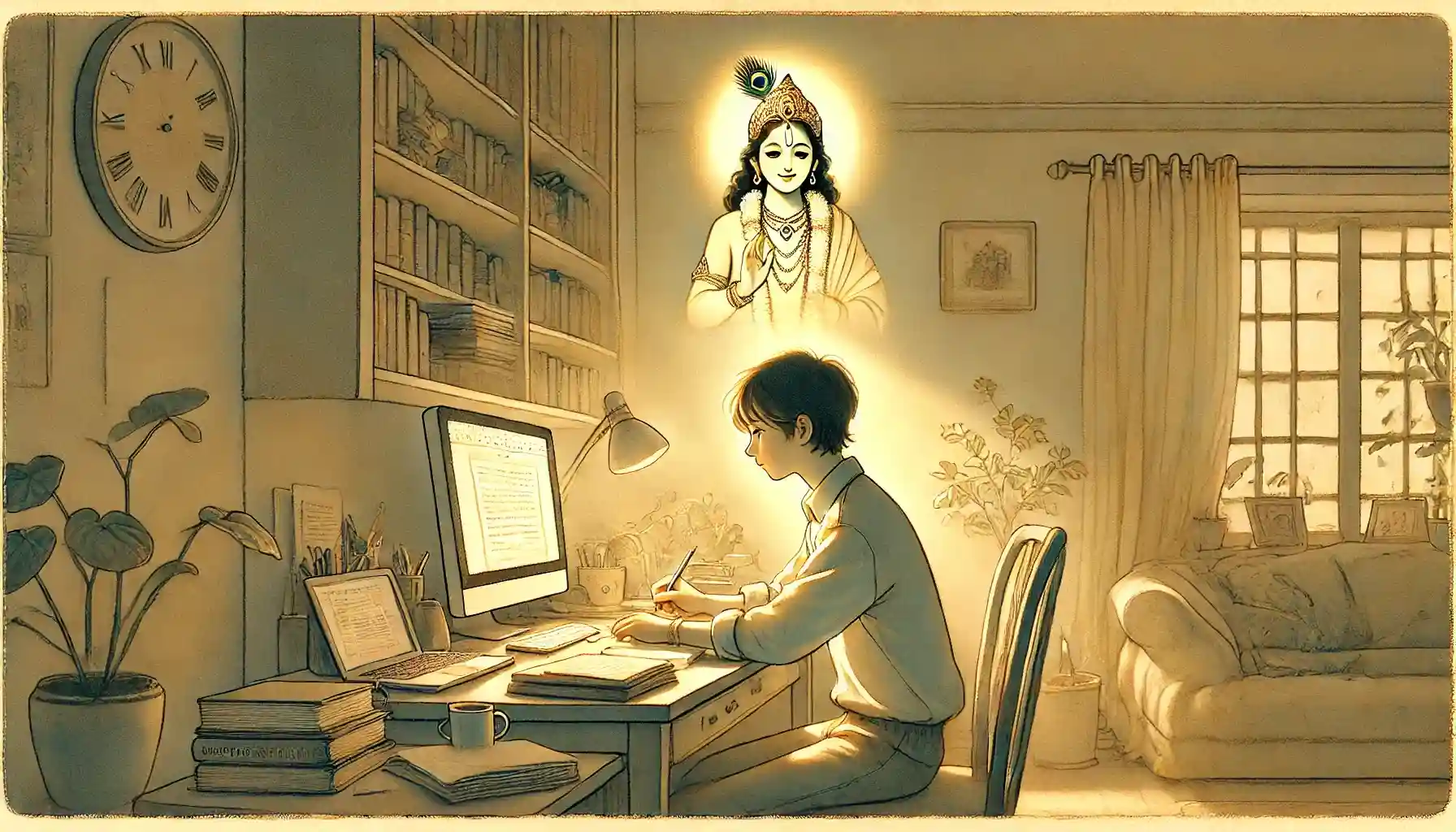
Another key teaching is the importance of devotion. Connecting with a higher power provides emotional strength and inner security.
In a stressful world, reliance solely on personal abilities can feel overwhelming. Devotion shifts the burden:
- From “I must control everything”
- To “I will do my best and trust the higher plan”
This surrender is not weakness; it is a source of immense strength.
It allows the heart to experience peace even when circumstances are uncertain.
Managing Desires and Expectations
Uncontrolled desires are a major cause of stress. The mind constantly seeks more more success, more recognition, more comfort.
This creates a cycle:
Desire → Effort → Anxiety → Temporary Satisfaction → New Desire
Breaking this cycle requires:
- Contentment with what you have
- Gratitude for present blessings
- Moderation in desires
When expectations are reduced, peace increases.
The Importance of Selfless Service
Serving others is a powerful antidote to stress.
When we are absorbed in our own problems, stress intensifies. But when we help others:
- Perspective shifts
- Ego diminishes
- Compassion grows
Service connects us to something larger than ourselves.
It brings fulfillment that material achievements cannot provide.
Acceptance: Embracing Reality
Resistance to reality is a major source of suffering.
We often struggle against:
- Unchangeable situations
- Past events
- Other people’s behavior
Acceptance does not mean passivity. It means:
- Acknowledging what is
- Responding wisely
- Letting go of unnecessary resistance
When we stop fighting reality, the mind relaxes.
The Balance Between Effort and Surrender
Life requires both effort and surrender.
- Effort ensures growth
- Surrender ensures peace
Too much effort without surrender leads to stress.
Too much surrender without effort leads to stagnation.
The balance lies in:
- Giving your best
- Accepting the outcome
This harmony creates inner stability.
Building Daily Habits for Peace
Peace is not achieved in a single moment; it is cultivated through consistent practice.
Daily Practices:
- Morning reflection or meditation
- Gratitude journaling
- Mindful breathing
- Limiting negative inputs (news, social media)
- Spending time in silence
Small habits create profound change over time.
Overcoming Anxiety About the Future
Fear of the future is a major contributor to stress.
The mind imagines worst-case scenarios, creating unnecessary anxiety.
To overcome this:
- Focus on the present moment
- Trust the process of life
- Prepare, but do not obsess
The future is shaped by present actions, not present worries.
Relationships and Emotional Balance
Relationships can be a source of both joy and stress.
Peaceful relationships require:
- Understanding rather than judgment
- Communication rather than assumption
- Acceptance rather than control
Let go of the need to change others. Focus on improving your own responses.
This creates harmony and reduces emotional turbulence.
The Role of Discipline
Discipline is essential for inner peace.
Without discipline:
- The mind becomes restless
- Habits become destructive
- Stress increases
With discipline:
- Thoughts become organized
- Actions become purposeful
- Life becomes balanced
Discipline is not restriction; it is liberation from chaos.
The Hidden Barrier to Peace: Understanding and Transcending the Ego
One of the most subtle yet powerful obstacles to inner peace is the ego. Unlike obvious stressors such as workload or financial pressure, the ego operates quietly beneath the surface, influencing our thoughts, emotions, and reactions in ways we often fail to recognize.
To truly find peace in a stressful world, it is essential to understand the role of the ego and learn how to rise above its limiting tendencies.
What Is the Ego?
The ego is the false sense of identity that we construct around:
- Our achievements
- Our roles (career, family, status)
- Our opinions and beliefs
- Our need for recognition and validation
It creates the idea of “I” and “mine,” leading us to define ourselves by external labels.
While the ego is necessary for functioning in the world, over-identification with it leads to inner conflict and stress.
How the Ego Creates Stress
The ego thrives on comparison, control, and validation. This leads to several stress-inducing patterns:
1. Constant Comparison
The ego measures self-worth by comparing with others. This creates insecurity, jealousy, and dissatisfaction.
2. Fear of Judgment
A strong ego is highly sensitive to how others perceive us. This leads to anxiety and overthinking.
3. Need for Control
The ego wants everything to go according to its expectations. When reality differs, frustration arises.
4. Resistance to Criticism
Even constructive feedback can feel like a personal attack, creating emotional turbulence.
5. Attachment to Identity
When we define ourselves too rigidly (e.g., “I must always succeed”), any deviation causes stress.
These patterns operate subconsciously, making stress feel unavoidable.
The Ego and Emotional Reactivity
Have you ever noticed how quickly emotions arise in certain situations?
- Anger when disrespected
- Hurt when ignored
- Pride when praised
- Anxiety when uncertain
These reactions are often driven by the ego’s need to protect its identity.
The stronger the ego, the stronger the emotional swings.
Peace becomes difficult because the mind is constantly reacting rather than observing.
Shifting from Ego to Higher Awareness
True peace begins when we shift from ego-centered thinking to a higher perspective.
This involves recognizing:
- “I am not my thoughts”
- “I am not my roles”
- “I am not defined by others’ opinions”
Instead, we begin to see ourselves as a deeper, more stable consciousness beyond temporary identities. We start identifying ourselves as tiny parts of the Supreme instead.
This shift reduces emotional volatility and creates inner stability.
Practicing Humility: A Powerful Antidote
Humility is one of the most effective ways to weaken the ego.
It does not mean thinking less of yourself—it means thinking of yourself less.
Practical ways to cultivate humility:
- Acknowledge that there is always more to learn
- Accept mistakes without self-judgment
- Appreciate others’ strengths without comparison
- Be open to feedback
Humility dissolves the ego’s rigidity, making the mind more peaceful and flexible.
Letting Go of the Need for Validation
Much of our stress comes from seeking approval:
- Wanting recognition at work
- Expecting appreciation in relationships
- Seeking validation on social media
While appreciation feels good, dependence on it creates instability.
Inner peace grows when we:
- Do the right thing regardless of recognition
- Find satisfaction in effort rather than praise
- Build self-worth from within
This reduces emotional dependence on external opinions.
The Practice of Witness Consciousness
One of the most powerful techniques taught in spiritual traditions is becoming a “witness” of the mind.
Instead of reacting immediately, you observe:
- Thoughts as passing events
- Emotions as temporary experiences
- Situations as neutral occurrences
- You start recognizing the gap between you (the soul) and your thoughts and circumstances
For example:
Instead of thinking, “I am angry,” shift to:
“I notice anger arising within my body and mind.”
This subtle change creates distance between you and the emotion.
Over time, this practice:
- Reduces impulsive reactions
- Enhances clarity
- Promotes calmness
It transforms you from being controlled by the mind to being aware of it.
Redefining Success Beyond the Ego
The ego defines success in external terms:
- Wealth
- Status
- Recognition
However, these are unstable sources of happiness.
A more peaceful definition of success includes:
- Inner calmness
- Emotional balance
- Consistency of values
- Spiritual growth
Swami Mukundananda describes the true success to be good, to do good, and to feel good.
When success is redefined internally, stress reduces significantly.
You no longer feel pressured to constantly prove yourself.
Handling Criticism Without Losing Peace
Criticism often triggers the ego, leading to defensiveness or hurt.
To respond peacefully:
- Pause before reacting
- Separate the feedback from your identity
- Evaluate objectively
- Accept what is useful to improve, ignore what is not
This approach turns criticism into growth rather than stress.
Ego in Relationships
Many conflicts arise not from the situation itself, but from ego clashes:
- Wanting to be right
- Refusing to apologize
- Expecting others to change first
Letting go of ego in relationships means:
- Prioritizing harmony over winning
- Listening with empathy
- Being willing to compromise
This creates deeper and more peaceful connections.
The Freedom of Letting Go
As the ego loosens its grip, a profound sense of freedom emerges.
You begin to experience:
- Less emotional reactivity
- Greater acceptance of situations
- Reduced need for control
- Increased inner calm
Life becomes lighter because you are no longer carrying the burden of constant self-assertion.
Integrating Ego Awareness into Daily Life
You don’t need to withdraw from life to transcend the ego. Instead, use everyday situations as practice:
- When praised → remain balanced
- When criticized → stay composed
- When challenged → respond thoughtfully
- When successful → stay grounded
Each moment becomes an opportunity for growth.
Final Reflection on the Ego
The ego is not an enemy to be destroyed but a tendency to be understood and refined.
By becoming aware of its patterns and gradually loosening its hold, you create space for deeper peace.
In a stressful world, mastering the ego is like removing the root cause of many internal disturbances.
When the ego quiets down, the mind naturally becomes still, and in that stillness, peace is found.
Gratitude: The Simplest Path to Peace
Gratitude shifts focus from what is lacking to what is present.
When practiced regularly, it:
- Reduces dissatisfaction
- Enhances happiness
- Promotes contentment
Make it a habit to acknowledge:
- Small blessings
- Everyday comforts
- Support from others
Gratitude transforms perception, and perception shapes experience.
Key Takeaways
- Peace is an internal state, not dependent on external conditions
- Stress arises from attachment, expectations, and lack of control over the mind
- Training the mind through awareness and discipline is essential
- Detachment allows engagement without anxiety
- Meditation and devotion are powerful tools for inner calm
- Purpose-driven living reduces stress and enhances fulfillment
- Acceptance and surrender create emotional stability
- Daily habits play a crucial role in sustaining peace
FAQ Section
1. Can I find peace without leaving my current lifestyle?
Yes. Peace is not about changing your external life but transforming your internal state. You can practice these principles in any environment.
2. How long does it take to experience inner peace?
It varies. Some benefits are immediate, especially from practices like meditation. Deeper transformation occurs gradually with consistent effort.
3. Is detachment the same as not caring?
No. Detachment means caring without becoming emotionally dependent on outcomes. It allows you to act with clarity and balance.
4. What if my mind keeps wandering during meditation?
This is natural. The practice is to gently bring it back. Over time, the mind becomes more stable.
5. How do I deal with overwhelming stress in the moment?
Pause, take deep breaths, and shift focus to the present. Remind yourself that the situation is temporary and manageable.
Call to Action
If you found these insights valuable and wish to deepen your understanding of spiritual wisdom for modern life, consider exploring more teachings by Swami Mukundananda.
Subscribe to his YouTube channel for practical guidance on meditation, stress management, and living a purpose-driven life. Regular exposure to uplifting knowledge can significantly transform your mindset and help you cultivate lasting peace.
Conclusion
In a world that constantly demands more from us, finding peace may seem like a distant goal. Yet, as these teachings reveal, peace is not something we need to chase, it is something we need to uncover within ourselves.
By training the mind, moderating desires, embracing purpose, and cultivating spiritual connection, we can navigate life with calmness and clarity.
The world may remain stressful, but your inner world does not have to be.
Peace begins the moment you choose it.
Further Reading
 JKYog Team