

There are moments in life when the noise of the world grows so loud that even our own thoughts seem distant. Deadlines, expectations, desires, and disappointments weave together into a constant hum. In such times, the ancient wisdom of devotion—simple, profound, and deeply human—becomes not just relevant, but necessary. This is where the timeless figure of Devarishi Narada enters our consciousness, not merely as a mythological character, but as a guide for modern living.

Narad Jayanti 2026 falls on Saturday, May 2, 2026. It celebrates the birth of Devarishi Narada, the divine sage and ultimate devotee of Lord Vishnu, known for his wisdom, knowledge, and selfless devotion. But beyond rituals and remembrance, this sacred day offers something deeper: a blueprint for inner peace, resilience, and divine connection.
Drawing from the teachings of saints like Swami Mukundananda and the timeless guidance of the Narad Bhakti Sutras, this blog explores the profound lessons Narada offers us—lessons that are strikingly relevant in 2026 and beyond.
Before we explore the individual lessons Narada offers, it’s important to understand his deeper role—not just as a sage, but as a cosmic guide shaping spiritual destinies.
Narad as the Cosmic Guide
Narada does not simply appear in stories—he appears at turning points. When confusion peaks, when ego clouds judgment, or when devotion is about to awaken, Narada arrives. His guidance is not always comfortable, but it is always transformative.
“In a modern context…” this idea becomes strikingly relevant. Today, guidance often comes in the form of quick advice, shortcuts, or validation. But Narada represents something deeper—guidance that challenges, refines, and elevates.
Narada does not impose transformation; he awakens it. His presence often appears at moments of confusion, pain, or moral crossroads. Rather than offering easy answers, he redirects individuals toward deeper truth and self-realization.
Swami Mukundananda beautifully explains that a true guide does not remove challenges but equips us to transcend them. Narada embodies this principle perfectly. He doesn’t shield devotees from difficulty—he shows them how to use those very difficulties as stepping stones toward divine connection.
In a modern context, Narada’s role reminds us that guidance is not always comfortable. Sometimes, the most meaningful insights come when our assumptions are challenged. The “cosmic guide” is not someone who tells us what we want to hear—but what we need to hear to evolve.
The Unwavering "Narayana" Chant: Lessons in Perpetual Remembrance
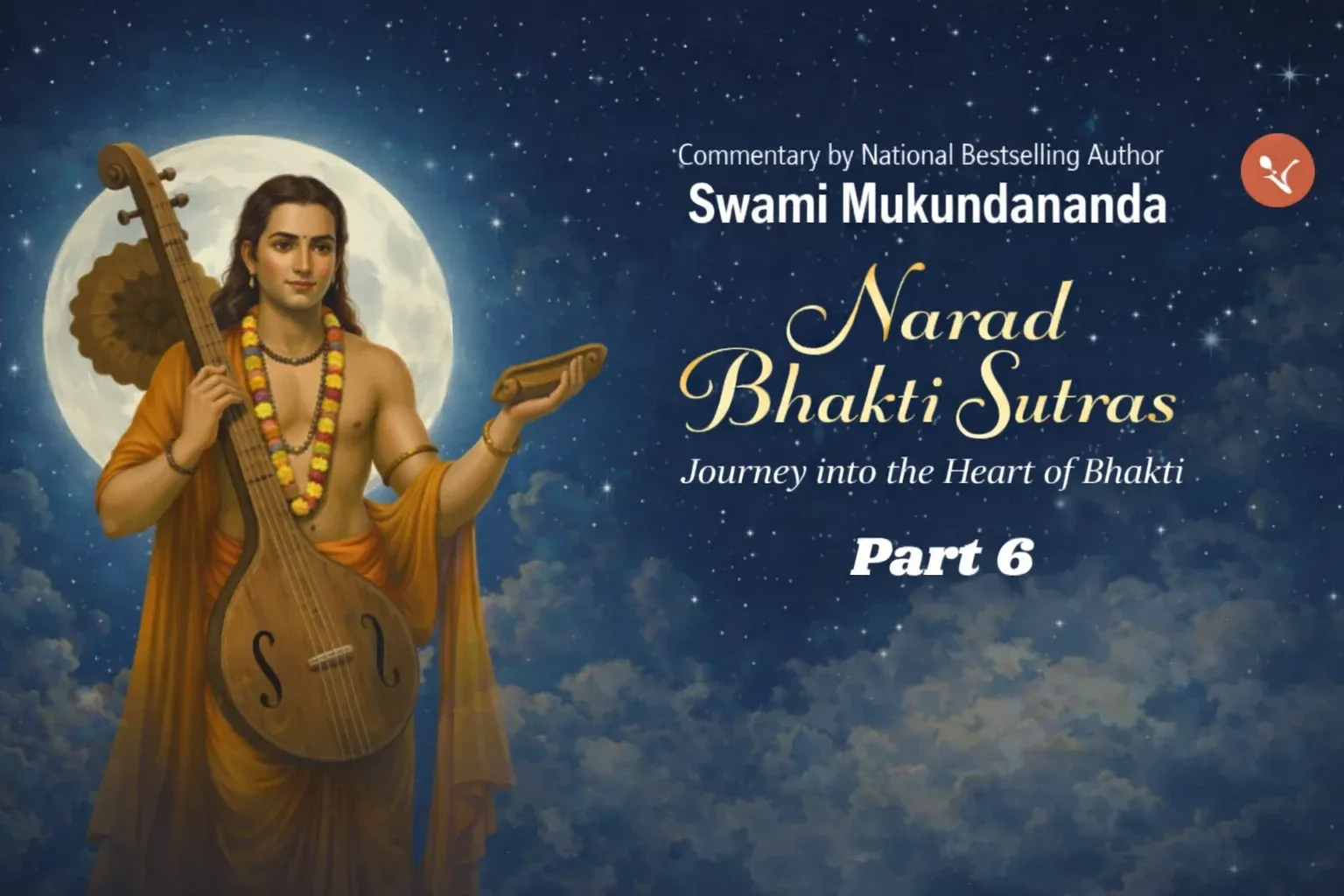
Narada is often depicted with his veena, traveling across realms while chanting “Narayana, Narayana.” At first glance, it may seem like mere repetition. But this chant represents something far more powerful: a mind anchored in the divine.
Narada’s constant chant—“Narayana, Narayana”—symbolizes a mind anchored in the divine.
“Building on this idea…” devotion is not about rituals alone—it is about remembrance amidst action.
This truth is beautifully expressed in the Bhagavad Gita, Chapter 8, Verse 7 (8.7).
Full Verse:
तस्मात्सर्वेषु कालेषु मामनुस्मर युध्य च |
मय्यर्पितमनोबुद्धिर्मामेवैष्यस्यसंशयम् || 7||
tasmāt sarveṣhu kāleṣhu mām anusmara yudhya cha
mayyarpita-mano-buddhir mām evaiṣhyasyasanśhayam
Therefore, always remember Me and also do your duty of fighting the war. With mind and intellect surrendered to Me, you will definitely attain Me; of this, there is no doubt.
This verse perfectly reflects Narada’s teaching: stay connected to the divine, even in the midst of life’s responsibilities.
In our modern lives, distraction is the default state. Social media notifications, endless scrolling, and the constant need for validation pull us away from inner stillness. Narada’s example challenges us to ask: what occupies our mind when we are not consciously thinking?
Swami Mukundananda often emphasizes that remembrance of God is not about renouncing the world but transforming how we live in it. He explains that when the mind repeatedly turns toward the divine, it gradually sheds anxiety and develops resilience.
The lesson here is subtle yet transformative: devotion is not confined to temples or rituals. It is a continuous inner dialogue. Whether working, commuting, or resting, the mind can gently return to a higher anchor.
Imagine replacing worry loops with divine remembrance. Over time, this shift changes not just thoughts, but emotional responses. The “Narayana” chant becomes a metaphor for cultivating a steady, peaceful awareness amidst chaos.
Transcending Ego: Learning True Humility from the "Oil Pot" Story

One of the most insightful stories associated with Narada is the famous “oil pot test.” Narada once believed himself to be the greatest devotee. To teach him humility, Lord Vishnu asked him to carry a pot filled to the brim with oil around the world without spilling a drop.
Narada completed the task successfully. But when asked how many times he remembered God during the journey, he admitted that it was none. His focus was entirely on the oil.
Then Vishnu pointed to a farmer who remembered Him even while managing countless responsibilities.
“This becomes even clearer when we look at…” the role of humility in spiritual growth. Narada’s realization shows that ego can quietly enter even devotion, distancing us from true connection.
As the Bhagavad Gita teaches:13.8
अमानित्वमदम्भित्वमहिंसा क्षान्तिरार्जवम् |
आचार्योपासनं शौचं स्थैर्यमात्मविनिग्रह: || 8||
amānitvam adambhitvam ahinsā kṣhāntir ārjavam
āchāryopāsanaṁ śhauchaṁ sthairyam ātma-vinigrahaḥ
Meaning: Humility, absence of pride, non-violence, tolerance, and simplicity are the foundation of true wisdom.
This verse beautifully reinforces that true devotion begins not with pride, but with surrender and humility.
This story is profoundly relevant today. We often equate devotion with outward expressions such as rituals, chanting, or displays of spirituality. But Narada’s lesson reminds us that true devotion lies in inner remembrance, even while fulfilling duties.Swami Mukundananda highlights that ego is the biggest barrier to devotion. The moment we think “I am devoted,” the ego quietly takes center stage.
Humility, therefore, is not weakness, it is clarity. It is the understanding that devotion is not about comparison, but connection.
In a world obsessed with achievements and recognition, the oil pot story gently redirects us inward. It asks: can we stay connected to the divine while navigating responsibilities?
Satsang and Service: The Power of Associating with Devotees
Narada’s life is deeply intertwined with satsang, which is the company of spiritually elevated souls. In fact, his transformation began in his previous life through association with sages.
This principle holds immense relevance even today. Our environment shapes our mindset. The people we spend time with influence our values, habits, and emotional states.
Swami Mukundananda ji often stresses that satsang acts like a mirror, because it reflects our higher potential. In the presence of positive, spiritually inclined individuals, our own aspirations rise.
But satsang is not limited to physical gatherings. In today’s digital age, it can include listening to discourses, reading scriptures, or engaging with uplifting content.
Equally important is service. Narada is not a passive devotee; he actively serves by guiding, teaching, and uplifting others. Devotion, therefore, is not inward isolation; it is outward expression.
When we combine satsang with service, something remarkable happens. The mind becomes less self-centered and more expansive. Problems shrink, perspective grows, and life gains meaning beyond personal gain.
The power of satsang is not theoretical—it has shaped some of the greatest devotees in history, often through the guidance of Narada himself.
The Guru of Great Devotees: Analyzing Narad's Role in Guiding Figures like Dhruv, Prahlad, and Valmiki

Narada’s greatness is perhaps best understood through the lives he transformed. His guidance shaped some of the most celebrated devotees in spiritual history, each from vastly different circumstances.
Take Dhruva, a young prince hurt by rejection and injustice. When Dhruva sought revenge and recognition, it was Narada who redirected his pain into devotion. Instead of fueling anger, Narada taught him meditation on Lord Vishnu. The result? Dhruva attained not only divine vision but eternal significance as the Dhruv star.
Then there is Prahlada, who learned devotion even before birth through Narada’s teachings to his mother. Despite facing extreme adversity from his father, Prahlada’s unwavering faith became a symbol of fearless devotion.
Perhaps the most striking transformation is that of Valmiki. Once a bandit, Valmiki’s life changed when Narada asked him a simple yet piercing question: would his family share the consequences of his sins? This moment of reflection shattered his ignorance and set him on the path of intense penance, eventually leading him to compose the Ramayana.What connects these stories is Narada’s ability to see potential where others see limitation. He meets each individual where they are, whether a child, a persecuted devotee, or a misguided adult, and offers guidance tailored to their state of mind.
Swami Mukundananda emphasizes that a true guru doesn’t give identical advice to everyone; he gives relevant advice. Narada’s genius lies in this adaptability.
For us today, this teaches a powerful lesson: transformation does not require perfect conditions. With the right guidance and sincere effort, even the most difficult circumstances can become catalysts for spiritual growth.
Ahaituki Bhakti: Devotion Without Motive (Insights from Narad Bhakti Sutras)
“In a modern context… devotion is not about escaping the world, but finding stillness within it.”

One of Narada’s greatest teachings is ahaituki bhakti—devotion without expectation.
“Building on this idea…” devotion becomes pure when it is free from conditions.
As stated in th:Shrimad Bhagavatam Canto 1, Chapter 2, Verse 6 (1.2.6).
स वै पुंसां परो धर्मो यतो भक्तिरधोक्षजे।
अहैतुकी अप्रतिहता ययाऽत्मा सुप्रसीदति॥
sa vai puṁsāṁ paro dharmo yato bhaktir adhokṣaje
ahaitukī apratihatā yayātmā suprasīdati
Meaning: The highest form of devotion is unconditional and uninterrupted, bringing complete inner satisfaction.
This teaching frees us from transactional spirituality and leads us toward true peace.
Most of our actions are driven by outcomes. We pray for success, health, relationships, or solutions. While there is nothing inherently wrong with this, Narada points toward a higher form of devotion—loving God for the sake of love itself.
Swami Mukundananda explains that conditional devotion creates emotional dependency. When desires are fulfilled, faith strengthens; when they are not, doubt arises.
But unconditional devotion frees us from this cycle. It brings stability. It transforms devotion from a transaction into a relationship.
In 2026, where uncertainty continues to shape personal and global realities, this teaching becomes especially powerful. Ahaituki bhakti offers a way to remain grounded regardless of external outcomes.
It invites us to shift from “What can I get?” to “How can I connect?”
The Divine Messenger: Spreading Love and Knowledge, Not Just News
Narada is often portrayed as a messenger, traveling between worlds, carrying information. But his role is frequently misunderstood.
He does not spread gossip; he spreads transformation.
At times, his words create conflict—but always with a higher purpose: to awaken truth and restore balance. His communication is rooted in compassion and wisdom.
In today’s era of instant communication, this lesson is incredibly relevant. Information spreads faster than ever, but not all of it uplifts.
Narada’s example encourages mindful communication. Before sharing something, we can ask: does this bring clarity, harmony, or growth?
Swami Mukundananda teaches that speech is a powerful tool. Used wisely, it can inspire; used carelessly, it can harm.
Being a “modern-day Narada” means becoming a messenger of positivity. It means using words to heal, guide, and uplift—not divide.
While Narada’s role as a messenger is timeless, its relevance becomes even more striking in today’s era of constant communication.
Divine Communication with Purpose: Using Narad's Example to Communicate with Truth, Purpose, and Compassion in a Digital Age
“Building on this idea… communication becomes powerful when it flows from a place of inner stillness and compassion.”

In an era dominated by tweets, reels, and instant messaging, communication has never been faster or more fragile. Words can travel across the world in seconds, but their impact often lacks depth and responsibility.
Narada, often seen as a communicator moving between realms, offers a timeless model for meaningful communication.
At first glance, his role might seem controversial. He appears to “carry news” that sometimes creates tension. But a closer look reveals a deeper truth: his communication is always purposeful. It is never driven by ego, gossip, or personal gain—it serves dharma, the greater good.
Swami Mukundananda teaches that speech should pass through three filters: truth, kindness, and necessity. Narada’s words consistently align with these principles. Even when his messages create temporary discomfort, they ultimately lead to clarity, growth, or divine intervention.
In today’s digital landscape, this lesson is crucial. Before posting, sharing, or commenting, we can pause and ask:
- Is this true?
- Is this helpful?
- Is this necessary?
Narada’s example encourages us to move from impulsive expression to intentional communication. Instead of amplifying noise, we can contribute meaning. Instead of reacting emotionally, we can respond thoughtfully.
Being mindful communicators doesn’t mean staying silent, it means speaking with awareness. It means recognizing that words are not just expressions; they are actions with consequences.
In this sense, embodying Narada’s communication style in 2026 means becoming a source of clarity in a world of confusion.
From Humble Beginnings: The Story of Narada’s Previous Life
Narada was not always a divine sage. In his previous life, he was the son of a maidservant who served sages during the monsoon season. Through humble service and exposure to spiritual wisdom, his heart transformed.
This story is deeply empowering. It reminds us that spiritual greatness is not determined by birth, status, or privilege.
Transformation begins with small steps such as listening, serving, reflecting.
Swami Mukundananda often shares that spiritual evolution is accessible to everyone. What matters is sincerity, not circumstance.
Narada’s journey shows that even a single lifetime, guided by the right influences, can lead to profound awakening.
In a world that often emphasizes external success, this story shifts focus inward. It highlights that true growth is about consciousness, not credentials.
Forbearance and Faith: Finding Calm Amidst Worldly Chaos
Narada’s life was not free from challenges. He encountered criticism, misunderstanding, and difficult situations. Yet, he remained calm and devoted.
This quality—forbearance—is increasingly rare today. We live in an age of instant reactions. Patience is often replaced by impulsiveness.
Swami Mukundananda teaches that forbearance is a form of inner strength. It is the ability to remain steady despite external disturbances.
Narada’s example shows that faith is not tested in comfort, but in adversity.
When things go wrong, do we lose connection, or deepen it?
Practicing forbearance does not mean suppressing emotions. It means observing them without losing balance. It means trusting that every situation has a higher purpose.
In 2026, where uncertainty continues to shape our lives, this lesson is invaluable. Calm is not found outside, it is cultivated within.
As the Bhagavad Gita reminds us :chapter 18 verse 66
सर्वधर्मान्परित्यज्य मामेकं शरणं व्रज |
अहं त्वां सर्वपापेभ्यो मोक्षयिष्यामि मा शुच: || 66||
sarva-dharmān parityajya mām ekaṁ śharaṇaṁ vraja
ahaṁ tvāṁ sarva-pāpebhyo mokṣhayiṣhyāmi mā śhuchaḥ
Meaning: Abandon all varieties of dharmas and simply surrender unto Me alone. I shall liberate you from all sinful reactions; do not fear.
“In a modern context…” this surrender is not weakness, it is your greatest strength.
As we celebrate Narad Jayanti 2026, may we carry forward these lessons of humility, balance, devotion, and purpose.
Narada’s 2026 Message: Balancing Material Duties with Divine Connection
Perhaps the most relevant lesson Narada offers today is balance.
We often assume that spirituality requires withdrawal from worldly responsibilities. But Narada’s life tells a different story because he is constantly active, engaged, and involved.
The oil pot story reinforces this truth: devotion is not about abandoning duties but performing them with awareness.
Swami Mukundananda emphasizes that life is not about choosing between material and spiritual paths. It is about integrating them.
Work can become worship. Relationships can become expressions of compassion. Challenges can become opportunities for growth.
Narada’s message for 2026 is clear: you do not need to escape the world to find peace. You need to transform your relationship with it.
Balance is not a static state, it is a dynamic practice. It requires intention, reflection, and consistency.
Beyond individual lessons and interactions, Narada’s presence has shaped entire cosmic events, revealing a deeper dimension of his role.
Messenger of Dharma: Understanding How Narad’s "Mischief" or Interventions Were Often Necessary Precursors to Divine Events like the Ramayana
Narada is sometimes playfully described as a “mischief-maker.” He appears in situations that escalate tensions, reveal hidden truths, or set major events into motion. But labeling his actions as mere mischief misses their deeper significance.
Narada is a messenger of dharma: cosmic order and righteousness.
His interventions often act as catalysts for divine events. For instance, his influence is intricately connected to the unfolding of the Ramayana, one of the greatest spiritual narratives in history.
By provoking certain situations or revealing truths at the right moment, Narada ensures that events align with a higher purpose. What may appear disruptive in the short term often leads to harmony in the long run.
Swami Mukundananda explains that life’s challenges are not random, they are often divinely orchestrated opportunities for growth. Narada’s actions symbolize this principle. He reminds us that not everything uncomfortable is harmful; sometimes, discomfort is the doorway to transformation.
In our own lives, we may encounter situations that feel chaotic or unfair. But Narada’s role invites us to look deeper. Could these moments be guiding us toward something greater?
This perspective doesn’t eliminate difficulty but it changes how we relate to it. Instead of resisting every disruption, we can learn to trust the process.
Narada’s “mischief” is not about creating chaos, it is about revealing truth. It is about aligning individuals and events with a larger divine plan.
Key Takeaways: What Narada Teaches Us for 2026
As we reflect on Narad Jayanti 2026, the life and wisdom of Devarishi Narada offer more than inspiration—they provide practical guidance for living with clarity, balance, and devotion in a fast-paced world.
“Building on this idea…” here are the most important lessons to carry forward:
1. Devotion is a Daily Practice, Not a Ritual
Narada’s constant remembrance of Lord Vishnu reminds us that devotion is not limited to temples or specific times. It is about where our mind returns throughout the day.
2. True Humility Comes from Awareness, Not Achievement
“This becomes even clearer when we look at…” the oil pot story—no matter how spiritually advanced we think we are, ego can quietly take over. Real devotion begins when humility deepens.
3. The Right Company Shapes Your Inner World
“Taking this further…” satsang (uplifting association) influences our thoughts, decisions, and growth. Surrounding ourselves with positivity accelerates both personal and spiritual development.
4. Transformation is Always Possible
From guiding Valmiki to inspiring Dhruva and Prahlada, Narada shows that no starting point limits spiritual progress.
5. Communicate with Purpose and Compassion
“In a modern context…” every message we share—online or offline—has an impact. Like Narada, we can choose to use our words to uplift, guide, and bring clarity instead of confusion.
6. Challenges May Carry a Higher Purpose
Narada’s role in shaping events like the Ramayana teaches us that not every disruption is negative. Sometimes, it is a step toward growth and alignment with dharma.
7. Balance is the Key to Modern Spirituality
“Building on this idea…” we don’t need to leave the world to find peace. As emphasized by Swami Mukundananda, true spirituality lies in balancing responsibilities with inner connection.
8. Devotion Without Expectation Brings True Peace
“This becomes even clearer when we look at…” the teaching of ahaituki bhakti—loving the divine without expecting rewards creates emotional stability and lasting fulfillment.
Final Thought
Narada’s teachings are not meant to stay in scriptures—they are meant to be lived.
“In a modern context…” even small shifts such as mindful thoughts, kind words, moments of remembrance, can transform the way we experience life.
The takeaway is simple yet powerful:
Stay connected, stay humble, and let devotion guide your journey.
Conclusion
Across these roles: cosmic guide, guru, communicator, and messenger, Narada emerges as a deeply relevant figure for modern life.
He teaches us how to guide and be guided, how to speak and listen, how to act and reflect. Most importantly, he shows that devotion is not passive, it is dynamic, intelligent, and deeply engaged with the world.
As we reflect on these lessons during Narad Jayanti 2026, we are invited to ask ourselves:
- Can we guide others with compassion and wisdom?
- Can we remain open to guidance, even when it challenges us?
- Can we communicate with purpose in a distracted world?
- Can we trust that life’s disruptions may carry deeper meaning?
In exploring these questions, we don’t just learn about Narada—we begin to embody his teachings.
And perhaps, in small yet meaningful ways, we too can become instruments of clarity, connection, and devotion in the lives we touch.Rediscovering Devotion in a Modern World
Call To Action
Narad Jayanti is not just a celebration of a divine sage—it is an invitation.
An invitation to pause. To reflect. To reconnect.
In a world that often prioritizes speed over stillness and success over serenity, Narada’s teachings offer a refreshing perspective. They remind us that true fulfillment lies not in accumulation, but in connection.
As May 2, 2026 approaches, the question is not how elaborately we celebrate—but how deeply we absorb these lessons.
Can we remember the divine amidst our routines?
Can we let go of ego and embrace humility?
Can we serve, uplift, and communicate with compassion?
Can we remember the divine amidst our routines?
Can we let go of ego and embrace humility?
Can we serve, uplift, and communicate with compassion?
Can we love without expectation?
If even a few of these answers begin to shift, Narad Jayanti has fulfilled its purpose.
And perhaps, like Narada himself, we too can walk through the world—not burdened by it, but uplifted within it—softly echoing a timeless truth:
Narayana… Narayana…
Narad Jayanti 2026 is more than a date on the calendar—it’s an opportunity to realign your life with purpose, peace, and devotion.
Frequently Asked Questions (FAQs)
1. What is the significance of Narad Jayanti 2026?
Narad Jayanti 2026, celebrated on May 2, honors the birth of Devarishi Narada, one of the greatest devotees of Lord Vishnu. The day is significant because it reminds us of the power of devotion (bhakti), humility, and divine remembrance in everyday life. It is not just a ritualistic celebration but an opportunity to reflect on how we can integrate spiritual awareness into our daily routines.
2. What are the key lessons we can learn from Narada’s life?
Narada’s life offers several timeless lessons:
- Constant remembrance of God (like the “Narayana” chant)
- Practicing humility and letting go of ego
- The importance of satsang (good association)
- Selfless devotion without expectations (ahaituki bhakti)
- Using communication to uplift and guide others
These teachings, also emphasized in the Narad Bhakti Sutras, remain deeply relevant even in modern life.
3. Why is Narada sometimes seen as a “mischief-maker”?
Narada is often misunderstood because his actions sometimes create temporary conflict. However, his interventions always serve a higher purpose—restoring balance and aligning events with dharma. As seen in stories connected to the Ramayana, his “mischief” often acts as a catalyst for divine outcomes and spiritual growth.
4. How can we apply Narada’s teachings in today’s digital world?
“In a modern context…” Narada’s teachings are more relevant than ever:
- Practice mindful communication on social media
- Share meaningful and uplifting content
- Avoid spreading negativity or misinformation
- Stay spiritually grounded despite digital distractions
Following the insights of Swami Mukundananda, we can turn everyday interactions into opportunities for growth and connection.
5. Do we need to renounce worldly life to follow the path of devotion?
No, Narada’s teachings clearly show that devotion does not require renunciation. The famous oil pot story highlights that true devotion lies in remembering God while performing daily responsibilities. You can balance work, relationships, and spirituality by maintaining inner awareness and intention.
Further Reading
To deepen your understanding of devotion and the teachings of Devarishi Narada, explore these insightful blogs
1. Narad Bhakti Sutras: A Timeless Guide to Devotion
👉 Narad Bhakti Sutras Explained
- A comprehensive explanation of the 84 sutras and their relevance today
 JKYog Team
 JKYog Team