

The Divine Bridge of Absolute Faith: When Belief Becomes Reality

What if the river before you is not meant to stop you, but to reveal whether your faith is real?
Faith is one of the most commonly used words in spirituality, yet one of the least understood. We often say, “I have faith in God.” We say, “I believe everything happens by God’s grace.” We say, “God will protect me.” But when life places a river in front of us, when the boat is not available, when logic says there is no way forward, does that faith remain alive?
In the spiritual journey, the ultimate realization of the Divine is often obscured by the complexities of the human intellect. The knowledge of God is infinite, but what is fundamentally required to navigate this vast spiritual expanse is true, unwavering faith. When faith becomes real, it acts as a divine bridge, turning the impossible into the possible and transforming mechanical spiritual practices into miracles of divine grace.
This is the profound question raised by Swami Mukundananda “When Faith in God Becomes Real… Even the Impossible Happens.” The message is simple but deeply transformative: faith is not merely a comforting thought. Real faith is a spiritual force. When faith becomes living, steady, and surrendered, even what appears impossible begins to bend before divine grace.
The path to knowing God is not merely about accumulating facts or collecting spiritual information. It is about allowing true knowledge to awaken deep faith within the heart. Such faith leads to surrender, attracts divine grace, and ultimately results in true spiritual realization. The central idea is that many people claim to have faith, but true faith is revealed only when the mind, intellect, and heart stand together in trust.
This teaching connects beautifully with Narad Bhakti Sutra 78:
Narad Bhakti Sutra 78
अहिंसासत्यशौचदयास्तिक्यादिचारित्र्याणि
परिपालनीयानि ॥ ७८ ॥
ahinsāsatyashauchadayāstikyadi-chāritrāni
paripālanīyāni
ahinsā—nonviolence; satya—truth; shaucha—cleanliness;
dayā—compassion; āstikyadi—faith; chāritrāni—virtues;
paripālanīyāni—should be practised.
Continue practising virtues, such as non-violence,
truthfulness, cleanliness, compassion, and faith in the
Vedic scriptures.
In this sutra, Sage Narad places faith, or āstikya, alongside virtues like truthfulness, purity, compassion, and nonviolence. This shows that faith is not merely a belief in the mind, but a quality of character that must be protected, practiced, and lived. Real faith becomes visible in how we think, speak, act, serve, respond to difficulties, and trust the words of God, Guru, and scripture. It is this living faith that becomes the bridge between human limitation and divine possibility
Bhagavad Gita 4.39: Faith Leads to Divine Knowledge
श्रद्धावान् लभते ज्ञानं तत्पर: संयतेन्द्रिय: |
ज्ञानं लब्ध्वा परां शान्तिमचिरेणाधिगच्छति || 39||
śhraddhāvānllabhate jñānaṁ tat-paraḥ sanyatendriyaḥ
jñānaṁ labdhvā parāṁ śhāntim achireṇādhigachchhati
BG 4.39: Those whose faith is deep and who have practiced controlling their mind and senses attain divine knowledge. Through such transcendental knowledge, they quickly attain everlasting supreme peace.
This verse reverses a common modern assumption. Many people think, “First I will know everything, then I will have faith.” But the Gita says that faith itself is necessary to receive higher knowledge. Spiritual truths are not always visible to the senses or immediately provable by the intellect. Faith allows us to walk the path long enough for realization to dawn.
Swami Mukundananda ji explains that not all spiritual truths can be verified at the beginning of the journey. Faith helps us accept what we do not yet understand, provided that faith is placed in a true Guru and authentic scriptures. His commentary also cautions that blind faith is not desirable; one should first use the intellect to ensure that the Guru is genuine and the teachings align with the Vedic scriptures.
This is a balanced and practical view. Faith is not the rejection of intelligence. It is the purification of intelligence. First, the intellect examines. Then, having found authenticity, it learns to surrender.
The disciple in the story below did not have complicated philosophical reasoning. His mind was simple. He heard the Guru’s instruction and accepted it. Most of us, however, have complicated minds. We have doubts, fears, past experiences, and intellectual resistance. For such seekers, scripture becomes essential. The Shastras gradually train the intellect until it becomes humble enough to trust divine wisdom.
Faith and knowledge are therefore not enemies. True knowledge produces faith, and true faith opens the heart to deeper knowledge.
The Miracle of Simple Faith: Crossing the Waters of Life
The profound power of true faith is beautifully illustrated through the story of a devoted disciple whose life revolved around one simple purpose: to serve his Guru
This spirit of service reflects Narad Bhakti Sutra 19:
Narad Bhakti Sutra 19
नारदस्तु तदर्पिताखिलाचारता तद्विस्मरणे
परमव्याकुलतेति ॥ १९ ॥
nāradastu tadarpitākhilachāratā tadvismaraṇe
paramavyākulateti
Meaning:
According to Sage Narad, bhakti means offering all one’s actions to God and feeling deep restlessness or anguish when one forgets Him.
This sutra shows that devotion is not limited to prayer, chanting, or worship alone. Every action can become bhakti when it is offered to God with love
The disciple’s daily act of bringing milk was not an ordinary duty. It was Guru-seva, an offering made with love, humility, and devotion. Because his action was rooted in service rather than ego, his faith became a channel for divine grace.

Every morning, this disciple would bring milk for his Guruji’s worship. Yet despite his sincerity, he often arrived late.
When his Guru asked the reason for his delay, the disciple humbly explained his difficulty. To reach the temple, he had to cross a river,and the first boatman was not available until later in the morning. Because of this, reaching by 7:00 AM seemed impossible.
Hearing this, Guruji offered him a deep spiritual truth. He said that by the power of God’s name, people are able to cross the vast ocean of life and death. If the divine name can carry the soul across the endless ocean of material existence, then why could it not carry him across a small river?
The disciple had a pure and uncomplicated heart. He did not argue, analyze, or doubt. He accepted his Guru’s words completely. The very next morning, with absolute faith, he began chanting the holy name, “Ram Ram,” and stepped directly onto the water.
Miraculously, his foot did not sink.
Still chanting “Ram Ram,” he placed one foot after another and walked across the surface of the river. What had seemed impossible through ordinary means became possible through the power of faith, the name of God, and trust in the Guru’s words.
From that day onward, the disciple crossed the river on foot every morning. He was sustained not merely by the sound of the divine name, but by the unshakable faith with which he chanted it. His devotion was simple, his intention was pure, and his trust was complete.
Narad Bhakti Sutra 10
अन्याश्रयाणां त्यागोऽनन्यता ॥ १० ॥
Transliteration:
anyāśrayāṇāṁ tyāgo ’nanyatā
Meaning:
Single-minded devotion means giving up all other shelters and taking refuge in God alone.
This sutra shows that real faith becomes complete dependence on God. The disciple crossing the river did not depend on the boatman, the timing, or his own cleverness. His only shelter was the divine name and the words of his Guru. When faith becomes this exclusive and undivided, it turns into surrender, and divine grace begins to work beyond the limits of human logic.
The Pitfall of Doubt: The Mechanics of the Mind
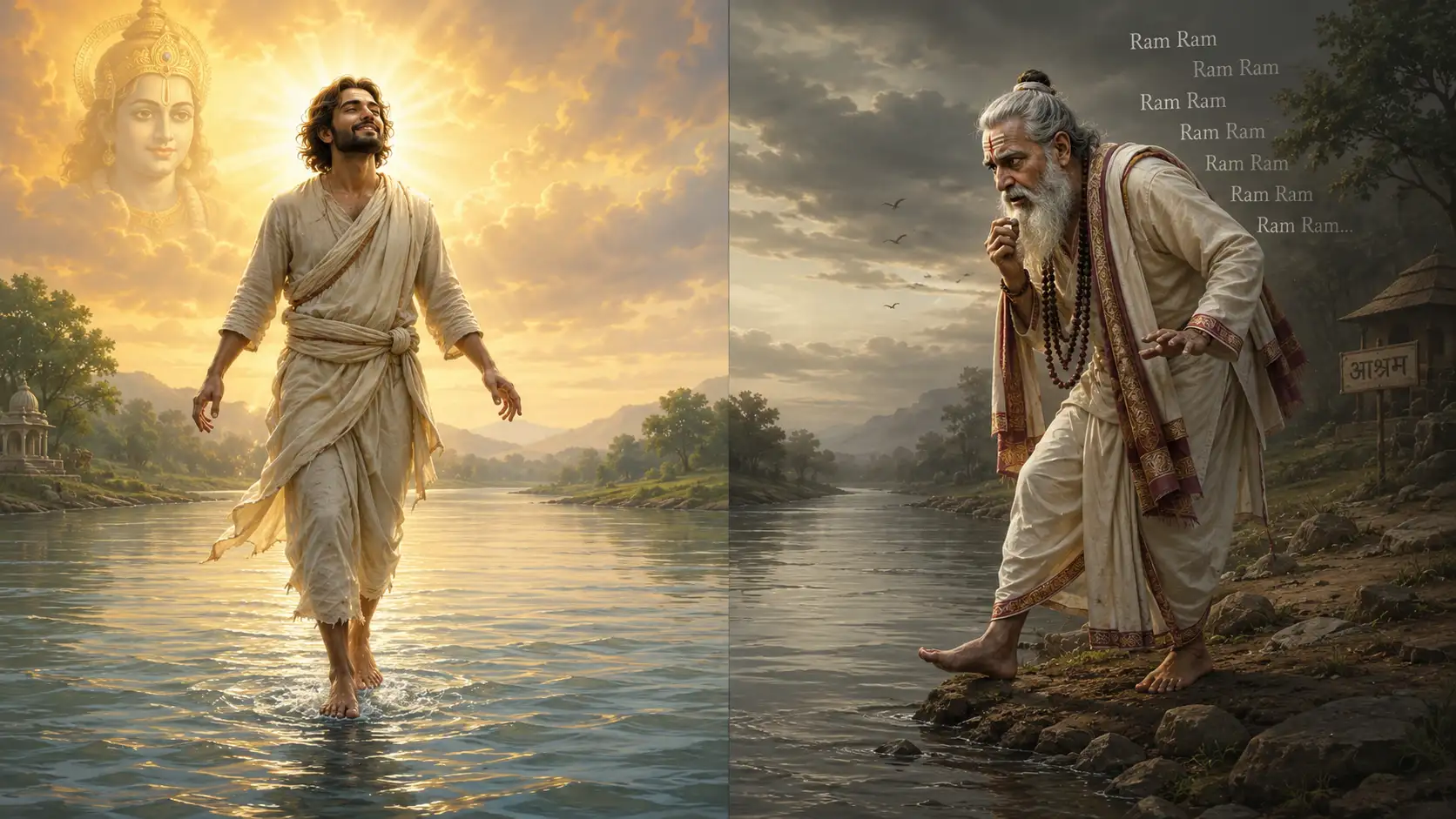
The stark contrast between genuine faith and mechanical spiritual practice becomes apparent when Guruji discovers the disciple’s daily miracle. Astonished that the disciple is actually crossing the river on foot, Guruji decides to try it himself.
However, his approach is very different. The disciple had stepped onto the water with simple, complete trust. Guruji, on the other hand, approaches the river pensively and hesitantly. He chants “Ram Ram,” but his mind is filled with doubt. His lips repeat the divine name, but his heart is not resting in its power.
As he steps into the water, he continues chanting, “Ram Ram, Ram Ram,” but instead of walking on the surface, he immediately sinks and begins splashing helplessly.
Seeing this, the disciple understands what has happened. He gently points out that although Guruji is taking the divine name of Ram, he is also thrashing in the water because he does not truly believe that the name will support him.
The lesson is profound. It was not the mere mechanical repetition of God’s name that carried the disciple across the river. It was the absolute, unwavering faith within that remembrance. The mantra is divine, but the heart must become receptive to its divinity. Naam-jap, prayer, kirtan, and worship are not empty rituals; they are channels of grace. But for grace to flow, the practitioner must bring sincerity, humility, and trust.
Many seekers struggle at this very point. We chant, but we worry. We pray, but secretly believe nothing will change. We bow before God, but the intellect keeps whispering, “What if this does not work?” Outwardly, we perform devotion; inwardly, we remain dependent on our own calculations.
Swami Mukundananda’s teaching reminds us that spiritual practice becomes powerful only when faith enters it. Without faith, even the holiest practice can become dry and mechanical. With faith, even the simple repetition of God’s name can become a bridge across impossible circumstances.
The Spectrum of Intellect: Why We Struggle with Belief
Why is it that a seemingly ordinary disciple can walk on water while an experienced Guru sinks? The answer lies in the relationship between faith, knowledge, and the complexity of the human intellect. These two elements, faith and knowledge, are the absolute keys and the very essence of spiritual progress.
Human beings exist on a wide spectrum of intellect. On one end are those whose minds are simple, pure, and uncomplicated. When a spiritual master points to something and says, “This is God,” they accept it instantly, without demanding extensive philosophical proof. The story of Dhanna Jat is a beautiful example of this kind of simple faith. When he was told that something was God, he accepted it as God with complete sincerity.
However, most of us do not possess this natural simplicity. We have complicated our minds and overdeveloped our analytical intellects to such an extent that we no longer have that effortless, childlike faith. Our heads are filled with doubts, conditions, arguments, and questions. Because of this, we must rely on the Shastras, the scriptures, to slowly build our understanding.
Through careful study and reflection, the scriptures help us remove our intellectual barriers. They guide us step by step until we eventually arrive at the same place where the simple-hearted devotee began: complete faith in God, Guru, and the divine path.
This spiritual paradox is beautifully reflected in the Biblical teaching that one must become like a little child to enter the kingdom of God. The great sage Vedavyasa expressed a similar truth. He explained that two kinds of people can cross the ocean of material existence with ease: those who are extremely simple and obey the Guru without overthinking, and those who are spiritually brilliant enough to transcend the limitations of the intellect altogether.
It is those of us in the middle, neither completely simple nor fully realized, who struggle the most. Burdened by a complicated intellect, we require the steady guidance of scripture, satsang, and spiritual practice to cultivate true faith. In this way, knowledge becomes the bridge that leads the restless intellect back to the simplicity of the heart.
Defining True Shraddha: What Real Faith Looks Like

To understand how faith truly operates, we must first understand what Shraddha, or faith, looks like in practice. It is easy to say, “I have faith in God,” or “I trust my Guru,” but real faith is tested when the instruction goes against the comfort, logic, or expectations of the mind.
When asked about the true meaning of Shraddha, Jagadguru Shree Kripaluji Maharaj gave a striking and uncompromising definition, he explained that true Shraddha means that if the Guru were to tell a disciple, “Go out from the gate and never come back,” the disciple would quietly obey. The disciple’s inner conviction would be so firm that he would think, “If my Guru has said this, it must be for my highest good.”
This kind of faith is not ordinary belief. It is complete trust in the Guru’s wisdom, compassion, and divine intention. The disciple does not measure the Guru’s instruction by the limited scale of personal likes and dislikes. He does not argue, question, or doubt the Guru’s motive. He accepts that the Guru sees what he cannot see and knows what is ultimately beneficial for his soul.
Maharajji often illustrated this through the example of Valmiki. Before becoming the great sage who composed the Ramayan, Valmiki was given a simple instruction by his Guru: chant “Mara, Mara.” He did not question, “Why should I chant this?” He did not ask, “For how long should I continue?” He did not demand an explanation of the result. He simply accepted the instruction and began chanting with faith.
Because of his obedience and sincerity, “Mara, Mara” gradually became “Rama, Rama,” and through the power of the divine name and the grace of the Guru, Valmiki was transformed into a great saint. His example shows that real Shraddha does not always need to understand everything in the beginning. It trusts, follows, and allows grace to work.
At the same time, this level of absolute surrender may seem daunting. Spiritual masters understand human weakness. Kripaluji Maharaj explained that in the beginning of the spiritual journey, no disciple possesses such perfect Shraddha. The Guru knows this very well. He watches the disciple just as a father watches a child learning to walk. The child stands, takes a few steps, falls, rises again, and slowly learns balance.
Similarly, spiritual faith is not a switch that is turned on in one moment. It grows gradually through practice, patience, satsang, reflection, obedience, and divine grace. The seeker may doubt, fall, struggle, and rise again. But with continued effort and the blessings of God and Guru, Shraddha becomes stronger.
True faith, therefore, is not merely emotional inspiration. It is the growing conviction that the path shown by God, Guru, and scripture is for our ultimate welfare. As this conviction deepens, the heart becomes more surrendered, the intellect becomes more humble, and devotion begins to blossom.
The Triad of Spiritual Evolution: Faith, Surrender, and Devotion
Swamiji explains that in the journey of spiritual growth, faith does not stand alone. It is part of a divine triad consisting of Shraddha (Faith), Sharanagati (Surrender), and Bhakti (Devotion). These three elements are deeply intertwined and always grow together in direct proportion to one another. Our capacity for Sharanagati (surrender) will only ever be as deep as our level of faith. If our faith is weak, our ability to surrenderyour ego and desires to the divine will be equally weak. Consequently, our Bhakti (devotion) will only ever expand to the extent of our surrender. It is a continuous, self-reinforcing cycle: as we progress on our spiritual path, our faith naturally keeps growing. As our Shraddha grows, our Sharanagati deepens, and as your surrender deepens, our Bhakti automatically blossoms
Saint Kabir’s Ladder of Spiritual Progression
The ultimate purpose of all spiritual seeking and scriptural study is to develop this faith. True knowledge is exclusively that which results in faith. The mystic Saint Kabir perfectly mapped out this progression of spiritual evolution, highlighting the limits of mere intellectual pursuit. Kabir explained that:
- "पढ़ने की हद समझ है" (The end of reading is understanding): The ultimate goal of consuming scriptures and texts is not just to read words, but to achieve samajh (true understanding) of the concepts.
- "समझन की हद ज्ञान" (The end of understanding is knowledge): Once deep understanding is achieved, it transforms into internalized gyan (spiritual knowledge).
- "ज्ञान की हद हरि नाम है" (The end of knowledge is faith in the name of God): This is the critical turning point. The ultimate destination of all spiritual knowledge is not intellectual superiority, but the cultivation of absolute faith in the divine name.
- "प्रेम नाम हद जान" (The end of taking the name of God is Prem): Ultimately, the highest peak of taking the Lord's name with pure faith is the manifestation of Prem (divine, unconditional love).
Without faith, the entire ladder collapses. As the teachings suggest, faith is the critical linchpin that connects knowledge to divine love
The Fragility of Faith: The Curiosity That Drowns

Since faith is so crucial, the spiritual path requires vigilance, for it can easily be weakened by the treacherous pitfalls of doubt and intellectual curiosity.. The fragility of Shraddha is illustrated by the story of another disciple who frequently needed to cross a river. Seeking a permanent solution, he asked his Guru for something that would continually help him cross the waters. The Guru wrote something down, sealed it inside a small casket attached to a ring, and gave it to the disciple. Instructed to wear it and go, the disciple began walking across the water, sustained by the powerful faith that his Guru had given him a profound magical object. However, halfway across the river, the disciple's analytical mind began to churn. Curiosity got the better of him, and he wondered, "What has my Guru actually given me?". Unable to resist, he opened the casket right there on the water. Inside, he found merely a simple piece of paper. Unfolding it, he saw that only the name of God, "Ram," was written on it.In that crucial moment, his intellect scoffed at the simplicity of the divine. He thought, "Oh, that's all?". The very second that doubt entered his mind, his faith was completely finished, and he immediately sank down into the water. The object had not lost its power; rather, the disciple had severed his own connection to that power by replacing faith with skeptical curiosity
The Escaping Faith: The Box in the Himalayas
A similar tragedy of lost faith occurred in the foothills of the Himalayas, where a third disciple resided in his Guru's ashram. In this remote location, where electricity often failed to reach, the nights became incredibly dark. One such dark night, the Guru handed the disciple a closed box and instructed him to deliver it to a fellow monk at an ashram three miles away. The Guru gave one strict condition: "Don't open it. Just take it there" .Armed with his Guru's instruction, the disciple set off into the night. As he walked, he noticed that the box was making a rustling noise indicating that something alive was moving inside. The Guru had deliberately not told him what the box contained, leaving the disciple astonished and increasingly curious as the noises continued .As he journeyed through the dark, the noise gnawed at his mind until his curiosity completely overpowered his obedience. Disobeying his Guru's direct command, he opened the box. Instantly, whatever was inside leaped out and vanished into the darkness of the night. Defeated, the disciple returned to the ashram and asked his Guru what had been in the box, explaining that it had jumped away. The Guru offered a heartbreakingly profound revelation: "I gave you Shraddha (faith), and in one leap it has flown away"
How to Develop Real Faith
For most seekers, faith does not become perfect overnight. It must be cultivated. Narad Bhakti Sutra 78 uses the word paripālanīyāni, meaning these qualities should be maintained, protected, or cultivated. Faith is like a sacred flame. It must be guarded from the winds of doubt, ego, negative association, and mechanical practice.
Here are some practical ways to develop real faith:
First, study scripture regularly. Bhagavad Gita 4.39 shows that faith and knowledge are connected. The more we understand God’s nature, the more our faith becomes stable.
Second, keep satsang. Association shapes conviction. When we hear from saints, devotees, and authentic teachers, faith becomes nourished.
Third, practice remembrance of God’s name with attention. The disciple crossed the river by chanting “Ram Ram,” but it was not casual chanting. His heart was fully present.
Fourth, observe God’s grace in your own life. Many times, God has protected, guided, and corrected us, but we forget. Gratitude strengthens faith.
Fifth, obey small instructions. Faith grows when we practice surrender in daily life. If we cannot surrender small preferences, it is difficult to surrender big fears.
Sixth, cultivate the virtues of Sutra 78. Be truthful. Be compassionate. Keep the heart pure. Avoid hurting others. Faith grows in a clean inner environment.
Finally, pray for faith. Even faith is a gift of grace. We can sincerely ask, “O Lord, please help me trust You. Please remove my doubts. Please let my knowledge become devotion.”
When Faith Becomes Real
So when does faith become real?
Faith becomes real when God’s word becomes more important than the mind’s fear.
Faith becomes real when the Guru’s instruction becomes more trustworthy than our ego’s calculation.
Faith becomes real when chanting is not only on the lips but in the heart.
Faith becomes real when we continue devotion even when life does not go according to our plan.
Faith becomes real when knowledge leads to surrender, and surrender opens the door to grace.

The disciple crossing the river is a symbol of every soul’s journey. Each of us stands before some river: fear, doubt, grief, failure, attachment, insecurity, or confusion. The boat of worldly support may not arrive on time. Logic may say, “You cannot cross.” But the Guru and scriptures say, “Take God’s name. Trust Him. Walk.”
The question is: will we stand on the bank analyzing forever, or will we step forward with faith?
Narad Bhakti Sutra 78 reminds us that faith must be cultivated as part of devotional character. The Bhagavad Gita teaches that faith leads to knowledge, surrender leads to liberation, and exclusive devotion draws God’s personal care. Swami Mukundananda’s message brings these truths alive through simple stories that pierce the heart.
Real faith is not weakness. It is the soul’s strength. It is not ignorance. It is knowledge ripened into trust. It is not passivity. It is courageous surrender. It is not superstition. It is the confidence that God, Guru, and scriptures reveal a truth higher than the limited intellect can grasp.
When faith becomes real, we may not always walk on physical water. But we will cross the deeper waters of fear, doubt, ego, and material bondage. We will discover that the impossible was never impossible for God. It was only impossible for the mind that had not yet learned to trust.
And when the heart finally says, “God, I am Yours,” grace begins to carry us.
Conclusion: The Simple Path to Grace
These narratives weave together to form a cohesive and powerful truth about the spiritual journey. The human mind craves infinite knowledge, but the actual knowledge of God is boundless and infinite. Attempting to grasp God purely through the intellect is a futile endeavor that only leads to splashing helplessly in the waters of material existence.What is genuinely required is not infinite data, but infinite faith. The only true knowledge that will ever come handy to a spiritual seeker is the specific kind of knowledge that successfully evokes faith.The formula for spiritual success, therefore, is beautifully plain and simple: true knowledge evokes pure faith. From this sturdy foundation of faith arises the capacity to completely surrender (Sharanagati) one's ego and doubts to the divine will. By achieving this state of profound surrender, the soul becomes an open vessel ready to receive God's grace. And it is solely through this divine grace that we can finally, truly come to know God.Faith, therefore, is not a sign of intellectual weakness, but the ultimate spiritual strength. It is the divine bridge that carries us over the turbulent waters of life, protecting us from the depths of our own doubts, and delivering us safely into the loving embrace of the divine
Key Takeaways
- Faith is more than belief.
Real faith is not merely saying, “I believe in God.” It becomes real when it shapes our thoughts, actions, choices, and responses to life’s challenges. - Narad Bhakti Sutra 78 teaches that faith is a virtue.
Sage Narad places faith alongside truthfulness, purity, compassion, and nonviolence. This shows that faith must be protected, practiced, and lived as part of one’s character. - True faith transforms spiritual practice.
Chanting, prayer, kirtan, and worship become powerful when they are filled with sincerity, humility, and trust. Without faith, even sacred practices can become mechanical. - The disciple crossed the river through living faith.
He did not depend on logic, fear, or the boatman. His only shelter was the name of God and the words of his Guru. - Narad Bhakti Sutra 10 teaches exclusive surrender.
Real devotion means giving up all other shelters and taking refuge in God alone. When faith becomes undivided, it turns into surrender. - Narad Bhakti Sutra 19 shows that faith must express itself through seva.
The disciple’s miracle happened not for display or ego, but because he wanted to serve his Guru. Faith joined with service becomes a channel for divine grace. - The Bhagavad Gita confirms that faith leads to knowledge and peace.
In Bhagavad Gita 4.39, Shree Krishna teaches that a faithful and sincere seeker attains divine knowledge and supreme peace. - Faith, surrender, and devotion grow together.
As faith deepens, surrender becomes stronger. As surrender deepens, devotion blossoms. - Doubt weakens faith.
Overthinking, restless curiosity, and lack of trust can break the inner connection through which grace flows. - When faith becomes real, divine grace makes the impossible possible.
The greatest miracle is not merely walking on water, but crossing the deeper rivers of fear, doubt, ego, and material bondage through trust in God, Guru, and scripture.
🌟 Final Call to Action
👉 For more life-changing teachings, subscribe to the official YouTube channels:
👉 Watch the complete Narad Bhakti Sutra series on the Bhagavad Gita Krishna Bhakti Channel:
Buy the "Narad Bhakti Sutras" by Swami Mukundananda
Now that we’ve explored the divine wisdom of the Narad Bhakti Sutras, it’s time to take the next step on your spiritual journey. To deepen your understanding of the Narad Bhakti Sutras, we highly recommend Swami Mukundananda’s commentary, which beautifully unpacks each mantra providing a clear and practical guide for modern seekers.
Order the Book: Swami Mukundananda’s Commentary
Unlock the deeper wisdom of the Narad Bhakti Sutras with this insightful commentary by Swami Mukundananda. Perfect for modern seekers who wish to explore the divine teachings in greater depth.

Order the Book Now (India)Order the Book Now (USA)
FAQs
1. What does it mean for faith in God to become real?
Faith becomes real when it moves beyond words and begins to shape our thoughts, actions, and responses to life. It is not merely saying, “I believe in God,” but trusting God, Guru, and scripture even when the mind is filled with doubt or the situation seems impossible.
2. How does Narad Bhakti Sutra 78 connect with real faith?
Narad Bhakti Sutra 78 teaches that virtues such as nonviolence, truthfulness, purity, compassion, and faith should be cultivated. By placing faith alongside these qualities, Sage Narad shows that faith is not just a feeling. It is a character quality that must be practiced and lived.
3. Why did the disciple cross the river while Guruji sank?
The disciple crossed the river because he chanted God’s name with complete faith and trust in his Guru’s words. Guruji repeated the same name, but with hesitation and doubt. The story shows that spiritual practice becomes powerful when it is filled with living faith, not when it is done mechanically.
4. What is the connection between faith and surrender?
Faith is the foundation of surrender. When we truly trust God, we become willing to depend on Him and accept His will. Narad Bhakti Sutra 10 teaches that real devotion means giving up all other shelters and taking refuge in God alone.
5. How can we develop stronger faith in daily life?
Faith grows through satsang, scripture study, chanting God’s name, seva, prayer, reflection, and remembering God’s grace. It also grows when we practice trusting God in small daily situations. Over time, faith deepens into surrender, and surrender blossoms into devotion.
Continue Your Bhakti Journey
If this reflection inspired you, read these related blogs to go deeper into faith, surrender, and loving remembrance of Krishna.
 JKYog Team
 JKYog Team
 JKYog Team