
On New Year’s Day, a man walked into the gym for his usual workout. To his surprise, he found it teeming with people—treadmills occupied, weights piled high, barely any space to move. Curious, he asked the owner about the rush. With a knowing smile, the owner replied, “Don’t worry, sir. By mid-January, most will have dropped out.” The anecdote is amusing yet telling.
Each year, countless people resolve to improve themselves, yet enthusiasm alone seldom translates into lasting change. True transformation calls for an inner drive—steady and sustained over time. This ethos underpins JKYog’s year-round programs, designed to foster clarity of thought, resilience of spirit, and a life of equanimity. One such gathering was the Bhakti Yog Sadhana Shivir with Swami Mukundananda, in late December at the JKYog Ashram in Cuttack, India. Far from austere, the retreat was lively and engaging, marking both a meaningful close to the year and an inspired beginning to the next.
Auspicious Beginnings
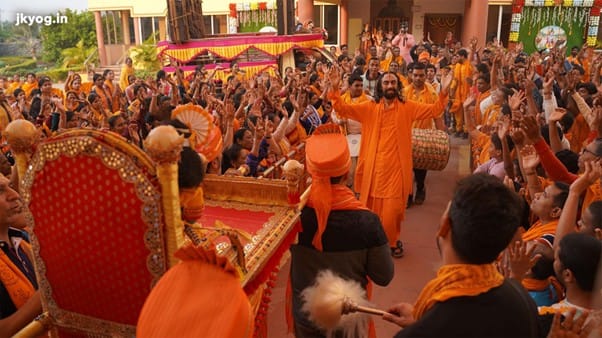
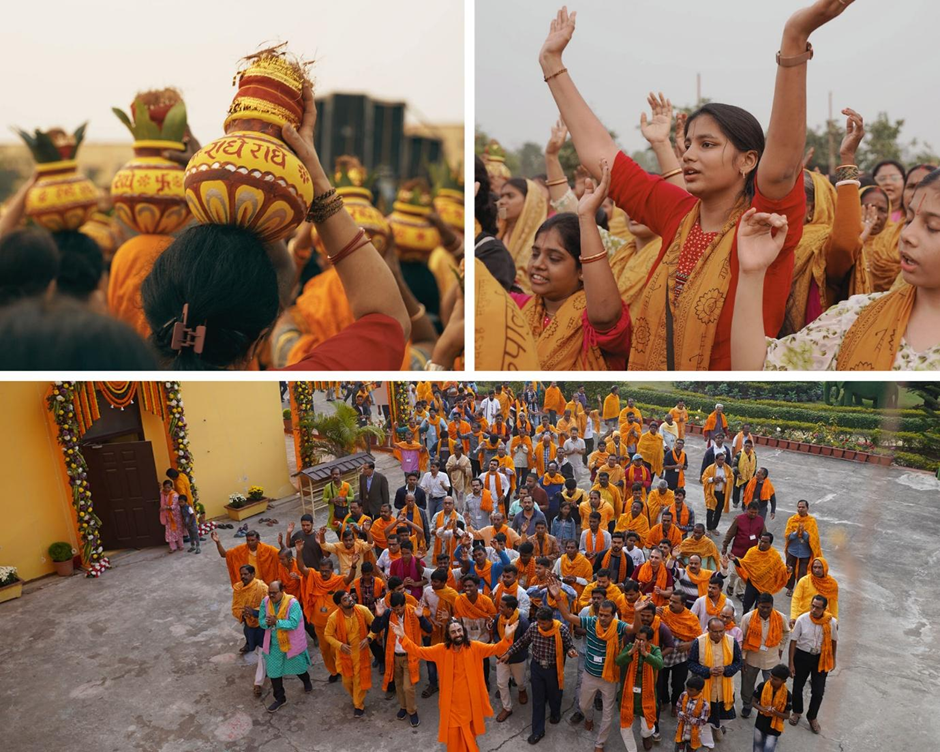
Thousands of aspirants buzzing with excitement flocked to the JKYog Bhakti Ashram for a week-long spiritual odyssey. Volunteers bustled with zeal, readying the space as a serene haven. At mid-day, the retreat commenced with Guru Vandana, flowing into kirtans that reverberated with divine rhythm. Swami Mukundananda ji then welcomed all with chocolate prasad, a tender blessing cloaked in sweetness. With folded hands, participants bowed before merging into the collective tide of Hari Naam chanting.
The retreat bore a special theme—the Shreemad Bhagavatam, revered as the crown jewel of the scriptures. Sage Ved Vyas likens the Vedas to a Kalpavriksh, the wish-fulfilling tree, and the Bhagavatam to its ripened fruit. Thus, from cosmic truths to the Lord’s most intimate pastimes, the Bhagavatam distils the most ambrosial essence of Vedic wisdom. Swamiji’s guidance through this treasured granth shone as a rare benison for this era.
Rooted in Revelation
Day One began with a grand Kalash Yatra through the hallowed paths of Jagadguru Kripalu University campus. Amid vibrant bhajans and kirtans, devotees clad in bright yellow carried kalash borne reverently on their heads, each filled with sanctified Mahanadi water inscribed with Radhey Radhey. These were later placed in the Sadhana Hall, where the seven-day Shreemad Bhagavat katha unfolded. Swamiji explained that, touched by the words of the Bhagavatam, this water would become kathāmrit-mayī (infused with the nectar of the holy text) and lovingly distributed after the final discourse.
The evening unfurled with the aarti of Shreemad Bhagavat Mahapuran, followed by Swamiji’s inaugural lecture, illuminating both the katha and its rahasya. Just as pilgrims grow receptive upon hearing of a sacred site’s glory, Swamiji began with the Bhagavatam’s mahatmya, preparing the audience to partake of its nectar. Swamiji explained how sincere listening to this katha enriches spiritual understanding, loosens worldly attachments, and stirs love for the Divine. He reminded all that this treasure has been cherished and passed down by Rishis and Munis for the welfare of humanity. Drawing parallels with Egyptian and Greek reflections on creation, he unveiled perennial Vedic truths of the Supreme Creator. As twilight fell, chants of Hari Bol echoed through the hall, hearts united in devotion, bringing Day One to an uplifting close.
Mornings of Gyan, Bhaav, and Sadhana
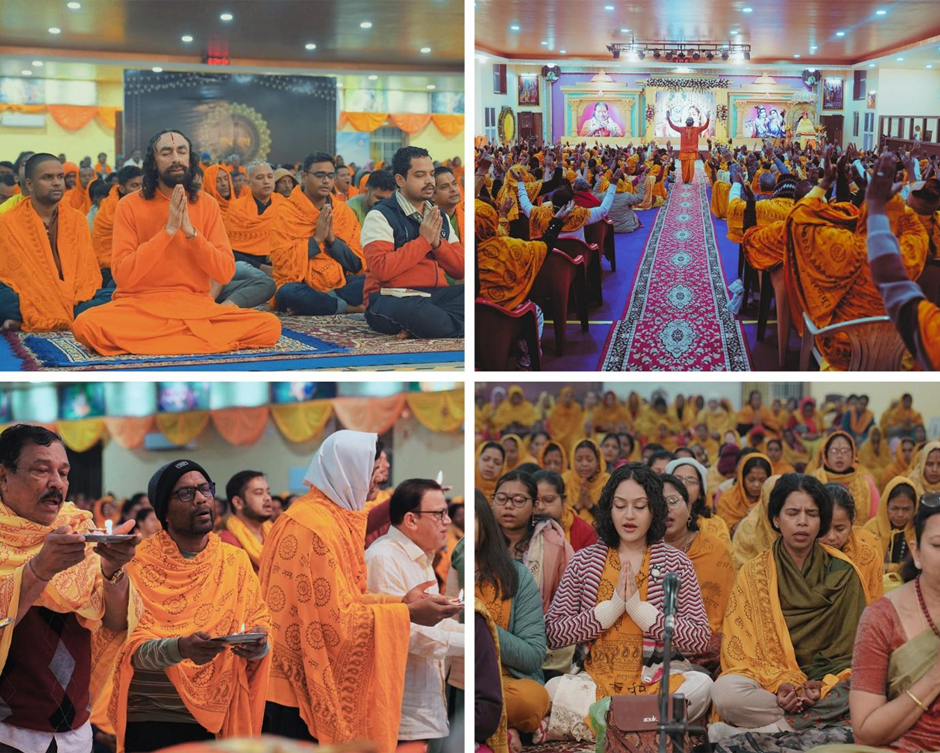
Each day began in Brahmuhurt with Divyavachanamrit (divine words) from Shree Kripalu ji Maharaj bestowing guidance that was profound yet practical. Among his teachings, was the call to maintain constant awareness of Hari and Guru, not limited to sadhana hours but woven into every action of daily life. He stressed the purification of the mind, for it is through the mind alone that devotion is cultivated and deepened. At rare and blessed moments, Shree Maharajji sang his exquisitely sweet verses on the divine pastimes of Radha-Krishna, leaving the audience steeped in bhakti ras.
The morning prayer set a heartfelt tone—a soul’s plea to the Lord of the universe to accept this flawed being and make him His own. A soulful aarti followed with flower-petal thalis raised in reverence to glorify the Lord. Then came the Radha Govind Geet, mellifluous verses shimmering with wisdom. One such verse urged surrender to the Guru, entrusting the wavering mind to Him on the path of devotion.
गुरु के प्रपन्न हो जा, गोविंद राधे!
मन-रूपी डोरी, गुरुवर को थमा दे! ~ Verse 60
The early morning session rose to its crescendo with kirtans from Maharajji’s principal composition, Prem Ras Madira. “Darshan Dena Nand Dulare” painted Shree Krishna’s divine form—His peacock feather, flute, tilak, and enchanting eyes—expressing the soul’s deep yearning for His darshan before this fleeting human life slips away. Each kirtan carried its own sentiment from longing to surrender, humility, and joy, yet all drew the devotees closer to God’s embrace.
Discourses by Swami Mukundananda
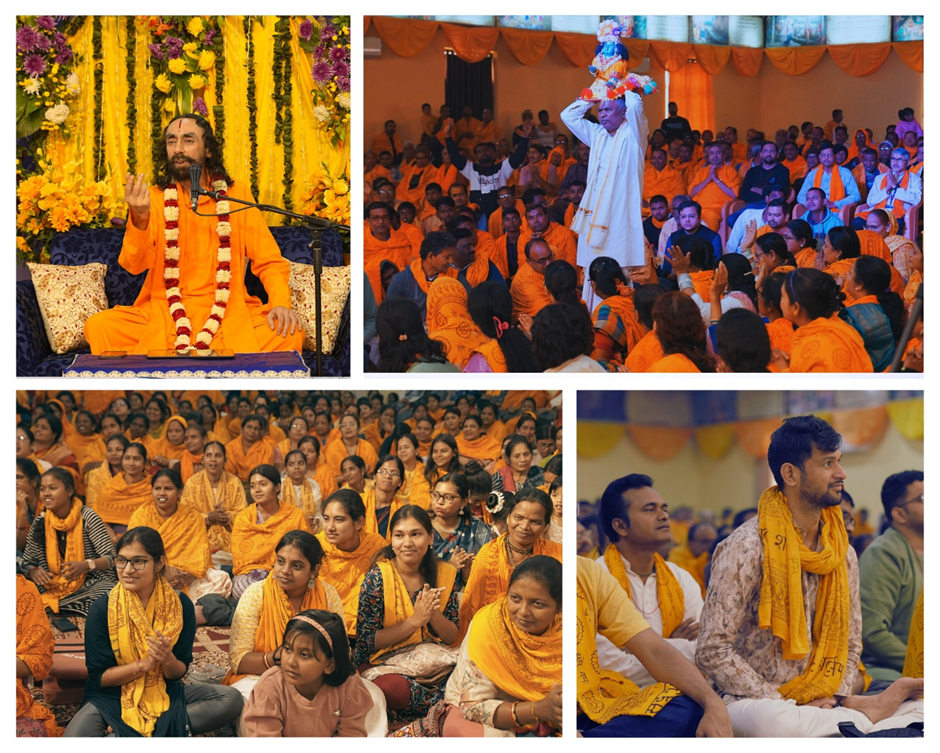
Throughout the retreat, Swamiji expounded on the Shreemad Bhagavatam katha with insightful morning and evening sessions. Beginning with Tattva Gyan, he emphasized its defining principle of kaitav-rahit dharma—a path free from deception. To illustrate, he shared a light-hearted tale: a man sought a boon from Brahmaji that every three wishes he asked would be granted. He wished first for wealth, then for a happy family, and finally that each future request yield three more boons. This, Swamiji explained, is kaitav (desire disguised as devotion). While dharma may appear in many forms—action, discipline, ritual, or ethics—the Bhagavatam transcends all conditional paths, presenting nishkam bhakti: pure, selfless devotion offered solely for the happiness of the Lord.
As the katha unfolded, Swamiji narrated how King Parikshit, upon learning of his impending death, entered into a sublime dialogue with Shukadev Ji Maharaj. In the context of Parikshit’s question on freedom from sin, Swamiji recounted the story of Ajamil, clarifying that merely uttering God’s name is not a passport to evade Maya. Only when one’s mind is bathed in divine thoughts, does one rise above the frailties of the material realm. Such inner purification is nurtured through bhakti and disciplined sadhana. This truth was further illumined through the story of Bharat Muni and his attachment to a deer. Swamiji explained how even subtle worldly chintan can deflect the mind from its spiritual course, reminding all that vigilance over the inner landscape is vital at every step of the journey.
Sweet Pastimes of the Lord
By Day Four, the katha carried devotees into the tender currents of Shree Krishna’s pastimes. Then came an unexpected moment: as Swamiji narrated Krishna’s birth, the leela was enacted in real-time. Kansa’s prison cell was recreated and was inundated with radiance as the Divine Child appeared. Suddenly, Swamiji exclaimed, “Look, Vasudev is coming with Shree Krishna.” Turning back, devotees beheld the scene of Vasudev carrying Bal Gopal towards Braj. The distant calls of peacocks deepened the immersion, and tears flowed as devotees silently welcomed their Lord. When Swamiji described the joy of Nandotsav, toys showered down, audience rose to dance, and the hall brimmed with childlike bliss.
With profound sensitivity, Swamiji spoke of Devaki’s anguish, the fate of her newborns, Kansa’s cruelty, and Putna’s deliverance. He highlighted that Kansa, out of fear, saw Krishna everywhere, and Putna approached Him with intent to kill—yet both attained God’s Abode. What then to say of devotees who love Him selflessly? Such is the power of pure love, which makes Bhagavan bhaktavashya, willingly beholden by their devotion.
The katha then moved through Govardhan Dharan and Cheer Haran, revealing how complete surrender draws divine grace, while reliance on worldly crutches dilutes exclusive devotion. From there, it transitioned into the soulful emotions of Krishna’s remembrance of the gopis and Brajwasis, leading into the Uddhav–Gopi Samvad. Overwhelmed by their bhaav, Uddhav prayed for a single boon: to be born as a blade of grass in Braj, so he might receive the dust of their feet. The session left devotees absorbed in Krishna’s many-sided beauty—His sweetness and strength, compassion and courage—kindling the flame of devotion in every heart.
Seva Opportunities & Parikrama
Seva is the lifeblood of every spiritual path, and the retreat abounded with opportunities for devotees to serve in manifold ways.
Abhishek of Jagadguruttam Shree Kripalu ji Maharaj
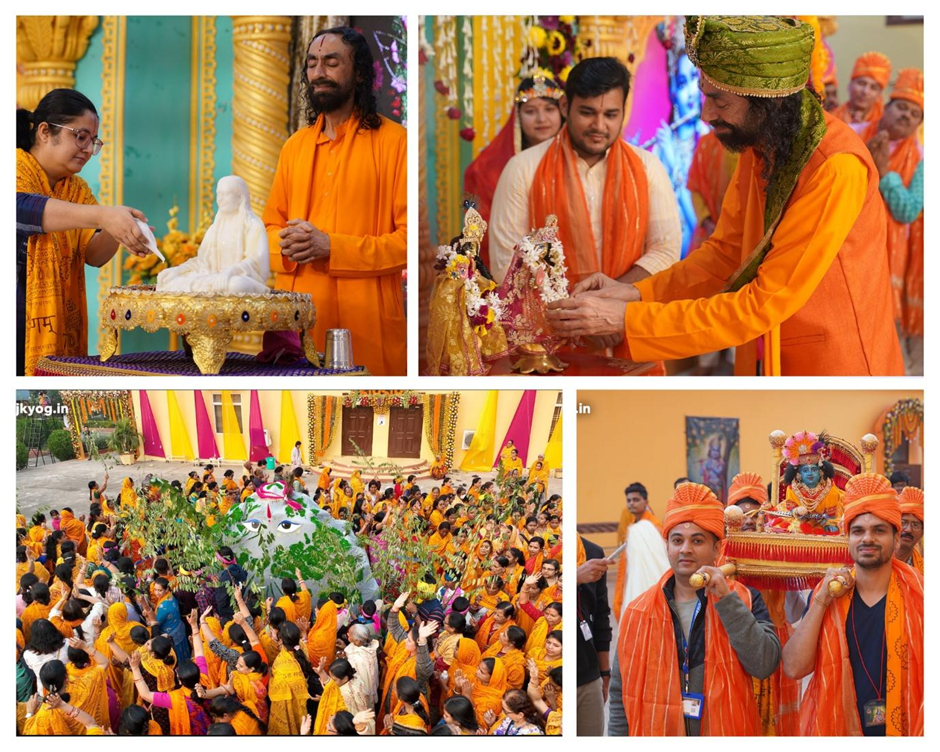
The Panchamrit Abhishek of Shree Maharajji’s vigraha was performed amidst the resonant chanting of Guru bhajans. One particularly moving hymn—“Gurudev daya karke mujhko apna lena”—expressed an ardent cry for Guru’s grace. The Guru is the indispensable bridge between Bhagavan and the soul, guiding them steadily towards their ultimate spiritual goal. This seva, conducted in Swamiji’s presence, reaffirmed the Guru’s sacred role in leading seekers to God-realization.
Bal Gopal Abhishek
Each event was seamlessly interlaced so that Swamiji’s discourses found living expression in corresponding sevas and parikramas, offering devotees a holistic experience of bhakti. Aligned with the narration of Shree Krishna’s Janm Leela, little Lala’s Abhishek was performed. Devotees stepped forward one by one, pouring their affection onto the baby form of Shree Krishna, lovingly bathing Him with milk, curd, ghee, honey, and sugar. The parikrama that followed brimmed with childlike ecstasy. Bal Gopal was carried in a palki while Swamiji led the kirtan “Nand ke anand bhayo, Jai Kanhaiya Lal ki.” The sentiment was palpable; Bal Gopal had come to spread happiness, and every heart felt it.
Celebration of Giriraj Govardhan
Following Swamiji’s discourse on the Govardhan Leela, the atmosphere naturally blossomed into the seva of Giriraj Govardhan. Devotees lovingly created the form of Giriraj Parvat, instantly drawing all eyes. Fruits, juices, ladoos, and countless delicacies were offered in a grand Annakut. As kirtans praising Giriraj resounded, joy permeated the space. Swamiji himself began to dance, embodying the delight of offering to Govardhan Ji—none other than Bhagavan Krishna Himself. The parikrama around the campus recalled how the Brajwasis once found shelter beneath Govardhan Parvat, while the presence of children evoked the innocence of Krishna’s sakhas, exuding a Braj-like charm.
Shree Krishna–Rukmini Vivah
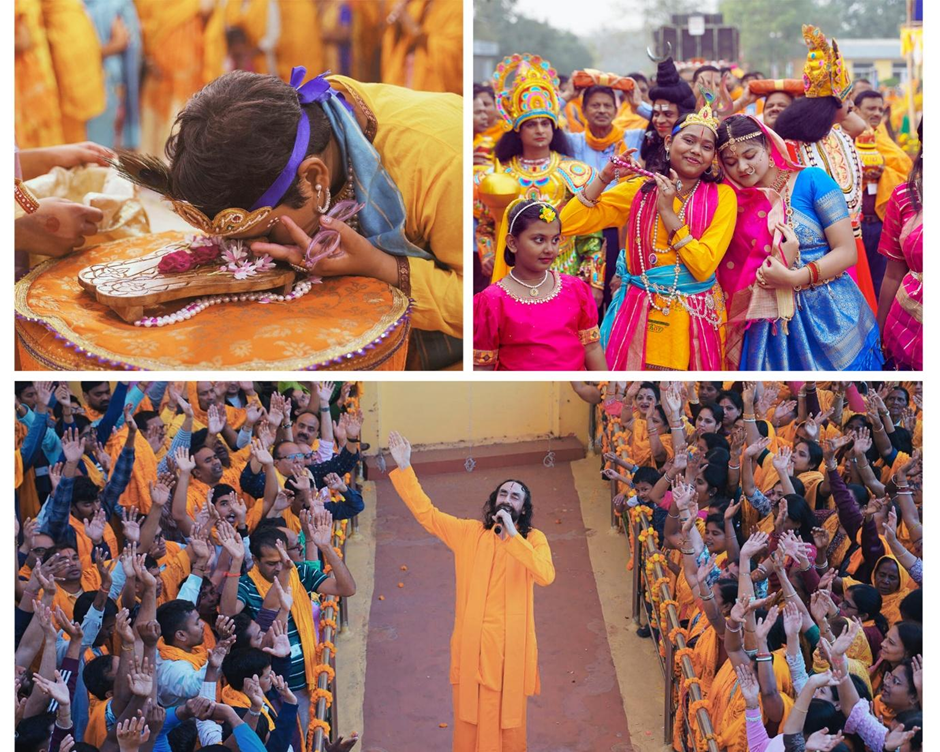
Day Six witnessed the celebration of Shree Krishna–Rukmini Vivah. The stage transformed into a resplendent mandap, adorned with fresh blooms and accompanied by soft wedding melodies. There, the deities of Shree Krishna and Rukmini Ji were ceremonially enthroned, graced with jewels and fragrant garlands. Participants, some dressed as baratis, others as members of the bride’s side, stepped forward to shower petals upon the Divine Couple, and in a sweet gesture, even received wedding gifts!
A jubilant parikrama followed, accompanied by the kirtan “Aaj Dulha bane hain Nandlaal.” In a playful moment, Swamiji ran ahead, laughing, with devotees joyously following Him. In that instant, age and formality dissolved, reminding all that bhakti flourishes in childlike simplicity and trust.
Evenings of Expression and Joy
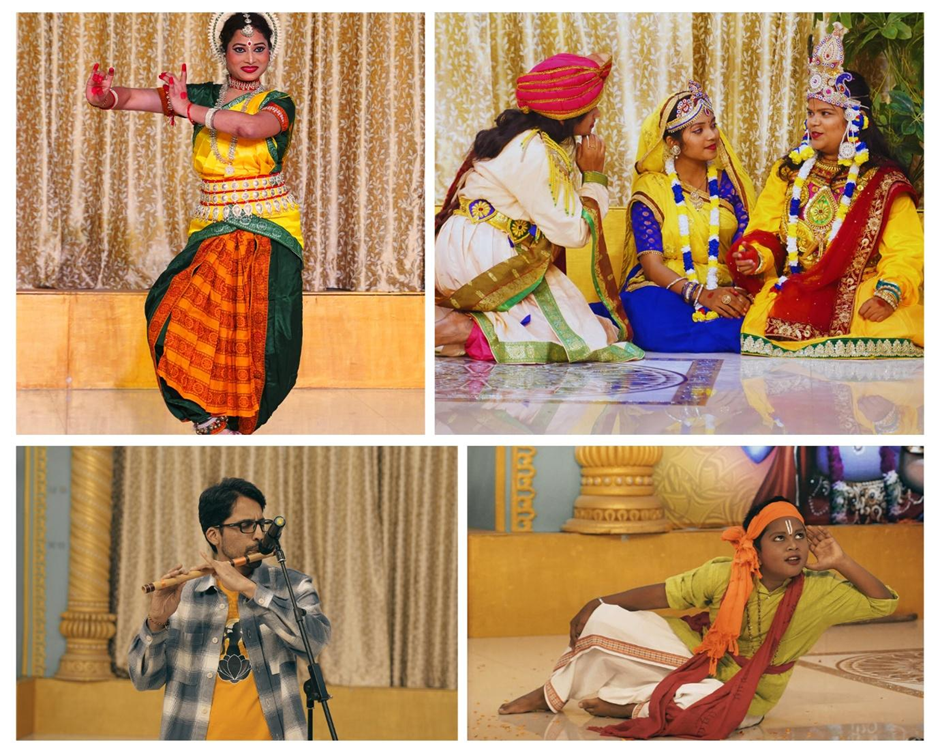
Each evening unfurled a Mehfil, where devotees offered their art as service to God and Guru. From drama, music, poetry, dance, to shloka recitation, every performance flowed from earnest devotion. A special highlight was the enactment of the Uddhav–Gopi Samvad, performed with such unfeigned sentiments that it felt as though the leela was unfolding before one’s eyes, echoing the teachings heard earlier in the day. Each night culminated in an exuberant Hari Bol dance. Running, leaping, and chanting together, devotees of all ages joined in with unrestrained joy. The sadhana hall throbbed with collective fervor, dissolving all barriers and inhibitions in the rhythm of bhakti. The day ended on a sweet note as Swamiji distributed chocolates, leaving smiles on every face.
Final Thoughts
The new year often begins with intention, but what truly matters is what endures once life regains its pace. Over seven days, this retreat offered far more than inspiration—it shaped understanding and inner discipline through knowledge, sadhana, seva, and lived devotion. Immersed in the Shreemad Bhagavatam and guided by Swami Mukundananda, seekers learned to carry remembrance of God and Guru into daily life. Time seemed to pass effortlessly, yet what remained was clarity of direction and steadiness of purpose. Such gatherings are not an escape from responsibility, but a preparation to return to it with a reoriented mindset. What better way to close a year and step into a new one than with a fulfilling festival of the soul!
Call to Action
Attend the Upcoming Life Transformation Program with Swami Mukundananda.
📍 Kolkata: 16–18 Jan 2026
📍 Guwahati: 19–20 Jan 2026
📍 Chennai: 21–23 Jan 2026
📍 Kochi: 24–25 Jan 2026
Highlights
✨Enlightening live discourses by Swamiji
✨Soulful kirtans and guided Roopdhyan meditation
✨Q&A sessions, morning walks, book signings
FAQs
1. What spiritual practices are included in the retreat?
The retreat includes a variety of spiritual practices such as early morning prayers, discourses on the Shreemad Bhagavatam, Hari Naam chanting, kirtans, and meditation. Participants also engage in seva (selfless service) and parikramas (circumambulations), creating an environment of devotion and discipline that cultivates spiritual growth.
2. How does Swami Mukundananda's guidance benefit attendees?
Swami Mukundananda's teachings focus on cultivating steady devotion, spiritual discipline, and practical wisdom drawn from the Shreemad Bhagavatam. His insightful discourses guide attendees to understand the essence of Vedic wisdom, deepen their love for the Divine, and integrate spiritual practices into daily life for lasting transformation.
3. What is the role of seva in the retreat?
Seva, or selfless service, is a cornerstone of the retreat, allowing participants to express their devotion through practical actions. From performing the Panchamrit Abhishek of Shree Kripalu ji Maharaj to participating in the joyful celebrations of Shree Krishna's pastimes, seva enables devotees to actively engage in the spiritual process and strengthen their connection with God and Guru.
4. How does the retreat inspire lasting transformation for the New Year?
Unlike fleeting New Year resolutions, the retreat offers a deep, transformative experience by fostering clarity of thought, resilience, and devotion. Through knowledge, sadhana, and seva, participants leave with a renewed sense of purpose, ready to embrace their daily lives with an enlightened perspective and a steady connection to the Divine.