

From the Editor’s Desk
Sincere seekers often abandon their spiritual journey when faced with inconvenience, discomfort, or temptation. It is because the pursuit of temporary pleasures and the instinctual urge to escape pain frequently weaken intention, distort core values, and redirect emotional attachment away from long-term inner growth that satiates the soul.
Drawing from a powerful story narrated by Swami Mukundananda ji and the Vedic knowledge (i.e., tattva jnana) He teaches, this issue of JKYog’s E-Journal, Samarpan, explores how subtle distractions quietly derail spiritual progress. Additionally, it offers tools to practice a devotional yet practical framework for staying the course and guarding against seemingly harmless detours that become permanent exits.
Vedic Wisdom & Application
Challenge of the Month
Stay the Course: Guarding the Spiritual Journey from Subtle Distractions
Reflection Questions
- Why Do Sincere Seekers Drift from the Path?
- Why Do Temporary Pleasure and Escape from Pain Derail Us?
- How Can We Redirect Attachment Toward the Supreme?
- What Does It Truly Mean to Stay the Course?

Most spiritual journeys do not end in dramatic rebellion. They fade quietly.
A seeker begins with enthusiasm. There is joy in chanting, eagerness in the study of scriptures, sincerity in seva, and gratitude for the Guru’s guidance. The path feels luminous. Yet as life unfolds, challenges arise, responsibilities increase, and fatigue overpowers the seeker. The seeker’s intention softens when competing opportunities present themselves, comfort beckons, and recognition flatters the ego. It is then that the sharpness of what was once central becomes peripheral, and the seeker gets derailed from the spiritual goal and path itself.
In a mind-blowing discourse, Swamiji narrated a simple but penetrating story. A monk was sent by his Guru to preach in a distant land. After a year of dedicated service, he requested his Guru to send one more disciple to support his effort. Surprisingly, the Guru sent five disciples. As the group journeyed through villages, each village presented new circumstances and attractions. Distracted by contextual situations that appealed to their preferences and unsurfaced weaknesses, one by one, four of the five disciples chose to drop out before completing the journey. By the time the destination was reached, only one disciple stood beside the monk. [Watch Swamiji's video in Gems of Wisdom for the story.]

The four monks who dropped off were not immoral, nor did they reject their Guru. They simply allowed their resolve to dissolve in the face of opportunity. At first, what seemed insignificant and harmless led them off the spiritual path to become a permanent exit.
This story reflects a universal truth. As Swamiji beautifully said, “A road journey is measured in miles, but the spiritual journey is measured in choices.” When the going becomes difficult, or when pleasure presents itself unannounced, the real test begins. It is in these moments that the direction of one’s inner life is determined.
Let us understand why this happens and how to prevent it by reflecting deeply on the subtle mechanics of distraction.
Why Do Sincere Seekers Drift from the Path?
Spiritual decline rarely begins with disbelief. It begins with misalignment. The heart subtly shifts its center of gravity. What once felt non-negotiable becomes flexible. What was peripheral becomes primary. The monks did not reject their Guru’s instruction outright; they recalibrated their priorities in response to circumstances. Each diversion revealed a specific vulnerability. When examined closely, their story becomes a mirror for our own. Here are some ways that distract spiritual aspirants from their journey:
1. Wealth and Comfort:
The first monk encountered a respectable opportunity. A temple priesthood offered stability, income, and dignity. Nothing about it was immoral. In fact, it appeared spiritually legitimate. Yet the original mission required movement, uncertainty, and sacrifice. Comfort promised relief from that strain.

This is how attachment to security operates. It persuades us that stability is synonymous with alignment. Over time, the desire for predictability can quietly overpower the call to growth. When preservation of comfort becomes more important than obedience to purpose, the drift quietly solidifies.
2. Power and Royal Prestige:
The second monk faced an even more dazzling alternative. A kingdom, a princess, and succession to the throne promised influence and admiration. The offer appealed not to survival, but to significance. This shows that prestige carries a unique subtlety. It convinces us that expanded authority equals expanded impact. Influence can inflate identity. When status begins to define self-worth, devotion becomes secondary. The longing to be important eclipses the longing to be loyal.

3. Romantic Attachment:
The third monk’s diversion emerged through affection. A moment of compassion evolved into emotional attachment. His decision was not impulsive lust but bonding over a few hours of companionship. The learning is that attachment to temporary relationships often feels tender and justified. Human connection is natural and sacred. Yet when emotional dependence redirects spiritual focus, priorities are inverted. The heart begins to revolve around proximity and approval rather than transcendence. What begins as empathy can turn into entanglement.

4. Ego and Righteous Anger:
The fourth monk believed he was defending the truth. Challenged by an atheist, he felt compelled to respond. His motive appeared noble. Yet beneath the surface lay material provocation, as the ego rarely presents itself as pride. It disguises itself as righteousness. The desire to win, to prove, to correct, can masquerade as devotion. When agitation replaces equanimity, it signals that identity has become entangled with being right. The mission is forgotten while the argument becomes central.

Each monk’s derailment was different, yet the underlying pattern was the same. External circumstances did not overpower them; internal inclinations redirected them. Wealth appealed to the need for security. Prestige appealed to the sense of self-importance. Relationship appealed to a need for belonging, and debate appealed to the ego.
Shree Krishna provided Arjun with a deep insight into the functioning of the material mind:
ध्यायतो विषयान्पुंस: सङ्गस्तेषूपजायते |
सङ्गात्सञ्जायते काम: कामात्क्रोधोऽभिजायते || 62||
dhyayato vishayan pumsah sangas teshupajayate
sangat sanjayate kamah kamat krodho ’bhijayate
While contemplating on the objects of the senses, one develops attachment to them. Attachment leads to desire, and from desire arises anger (Bhagavad Gita, 2.62).
This and the following verses explain the psychological chain that leads to spiritual downfall. When an innocuous thought lingers, the mind contemplates it repeatedly and attachment forms. When attachment solidifies, judgment bends.
The Bhagavad Gita’s analysis invites uncomfortable introspection. What occupies our contemplation? What narratives do we replay? What do we secretly admire? Even before actions change, contemplation reveals direction.
Why Do Temporary Pleasure and Escape from Pain Derail Us?
The soul longs for happiness as naturally as the body longs for nourishment. This longing is not a sign of weakness but evidence of our divine origin. Yet when that longing is misdirected, it becomes the very force that unsettles our resolve. The challenge is not that we desire joy, but that we often seek it in forms that provide immediate pleasure rather than enduring, soothing, or sanctifying happiness. It begins with contemplation.
1. The Craving for Immediate Gratification
Spiritual growth unfolds gradually. Its rewards are subtle, internal, and cumulative. In contrast, sensual pleasures deliver quick stimulation. The mind, conditioned by repeated access to such pleasures, begins to favor what produces immediate sensation, albeit low, over higher levels of happiness that require patience. This is why, to a novice seeker, spiritual practices such as meditation, seva, and scriptural study can sometimes feel less compelling than worldly entertainment or indulgence. The fruits of sadhana mature slowly, whereas the nervous system is wired to respond to instant reward. Without vigilant awareness, the preference for immediacy weakens long-term aspiration.
2. The Desire for Emotional Comfort
When spiritual practice exposes inner restlessness or unaddressed propensities, discomfort surfaces. Inner growth requires confrontation with one’s own limitations. Rather than facing the discomfort that painfully challenges the ego, the mind seeks refuge in distraction that provides emotional comfort. At such times, temporary pleasures become like anesthesia. The need for social validation, consumption of worldly goods, busyness, or even excessive religious activity can serve as an escape from internal confrontation. The seekers may not consciously reject transformation but simply postpone it in favor of emotional relief.
3. The Fear of Uncertainty and Loss
Genuine progress often requires relinquishment of previous identities that loosen attachments. Such renunciation makes outcomes uncertain and unpredictable due to uncharted territory. For many, this vulnerability triggers deep anxiety, making temporary pleasure more comforting. It reassures the ego that nothing essential is changing. In this way, indulgence becomes a mechanism of control. It keeps life predictable. Yet spiritual evolution demands surrender, not control. When fear governs decision-making, we cling to what is known, even if it limits us.
Consider the transformation of Viktor Frankl. Imprisoned in Nazi concentration camps under extreme deprivation, he observed that those who survived psychologically were not those who escaped pain, for escape was impossible. They were those who anchored themselves in meaning beyond immediate suffering. His mind was oriented toward a higher purpose, so pain did not disappear, but lost its power to define identity.
4. The Habit of Sensory Identification
Over lifetimes, our consciousness has been habituated to identifying pleasure with sensory experiences. Even when intellectually convinced of a higher truth, the deeper layers of the mind revert to old conditioned patterns of contentment with the status quo. Especially during moments of fatigue or emotional strain, the mind instinctively reaches outward rather than inward or upward. It confuses stimulation with fulfillment. This is why the Saints emphasize disciplined redirection rather than mere suppression. Transformation requires retraining attention itself.

When all these different tendencies converge, temporary pleasure appears rational. Escape feels justified. The mind constructs narratives that legitimize detours. Each indulgence subtly reinforces identification with the fleeting sense of calm. Spiritual decline occurs when relief from discomfort becomes more urgent than alignment with a higher purpose. The deeper question, then, is not why pleasure attracts us but in our belief that lasting bliss lies elsewhere. If the conviction of divine joy is faint, worldly substitutes will gain power.
How Can We Redirect Attachment Toward the Supreme?
If the longing for happiness is intrinsic to the soul, then the solution cannot lie in suppression but in elevation. The mind is not designed to remain empty. It must attach, love, contemplate, and dwell somewhere. The question is not whether our mind will attach to something, but to what and when. Shree Krishna, therefore, does not instruct Arjun to extinguish desire. He invites him to sanctify it by directing it toward its rightful object through deliberate inner reorientation in these ways:
1. Cultivating Higher Vision
Lasting transformation begins with inner conviction. As long as worldly enjoyment appears substantial and divine joy appears theoretical, the mind will gravitate toward what seems tangible. Here is where the life of the saints strengthens spiritual perception. When the intellect repeatedly contemplates that God/Guru is the infinite reservoir of bliss, the seeker gradually redirects inner attraction. This shift in vision weakens the enchantment of temporary attraction. Divine attachment then starts to purify the mind.
2. Rehearsing Divine Remembrance
Saints and scriptures repeatedly emphasize remembrance of all things Divine as a central discipline. Just as repeated contemplation of sense objects strengthens worldly desire, repeated remembrance of the Lord strengthens divine attachment. Under a true Guru’s guidance, the practice of daily sadhana and conscious offering of actions will train the mind to return to the Supreme. Such rehearsals establish new neural patterns that sustain over time. These impressions, then, will form a new default pattern due to new neural pathways.
3. Transforming Desire Rather Than Denying It
Desire itself is not the adversary. It is misdirection that creates bondage. The same intensity that seeks recognition can seek divine approval. The same longing for companionship can seek intimacy with God in any of the four bhavs (i.e., Dasya, Sakhya, Vatsalya, and Madhurya) that fill the heart with the sweet and sublime Prem Ras. When desire is spiritualized, it becomes propulsion rather than obstruction.
4. Anchoring the Heart Through Grace and Guidance
While effort is essential, transformation is not achieved by effort alone. Association with a God-realized Guru, sincere seekers, and authentic teachings stabilizes intention. Guidance refines discrimination, and grace strengthens resolve.

What Does It Truly Mean to Stay the Course?
To stay the course is not merely to avoid wrongdoing; it is to remain aligned with one’s highest intention despite changing circumstances. Life will offer comfort, recognition, emotional connection, and provocation. What determines their impact upon us is the firmness of one’s sankalp.
1. Guarding the Original Sankalp (Intention):
Every genuine spiritual beginning is marked by a moment of clarity. A seeker recognizes a higher calling and makes a resolve. Over time, that resolve can fade beneath routine and responsibility. Staying the course requires revisiting that original sankalp. Through reflection on the Guru’s words, teachings, and prayer, the seeker consciously renews the intention to attain God.
2. Making Decisions in Light of the Ultimate Goal:
Swamiji beautifully says that each decision either reinforces or weakens alignment with the ultimate aim. When confronted with alternatives, the question becomes simple yet profound: Does this move me closer to the Divine, or does it merely soothe the heart in the present moment? Such discrimination makes life purposeful.
3. Persevering Through Inner Weather:
Spiritual life includes seasons of inspiration and seasons of dryness. There are moments when devotion feels effortless, and moments when it feels mechanical. Staying the course means continuing practice regardless of emotional climate. The lone monk who reached the destination did not necessarily feel greater enthusiasm than the others. He simply maintained focus on his Guru’s instruction and the goal.
4. Measuring Progress by Faithfulness, Not Sensation:
Modern culture equates growth with visible results and emotional highs. Spiritual maturation, however, often unfolds quietly. Reduced agitation, increased humility, deeper patience, and steadier remembrance are subtle indicators of advancement. When seekers measure themselves by sensation, discouragement easily arises. When they measure themselves by faithfulness, resilience develops.

In the end, staying the course is not an act of grim endurance. When the heart is convinced that the Supreme Lord is the true destination, distractions lose their authority. The journey continues not because it is easy, but because it is true.

Tools for Your Personal Growth
Here is a practical tool you can use to identify and prevent distractors that could derail you and send you on another journey without your awareness. Use this tool to reflect and keep yourself from falling off the spiritual journey.
A downloadable tracking sheet is available for you to use.
Gems of Wisdom from Swamiji
Here are a few YouTube video titles with related links and books where Swamiji has described situations that can potentially distract one from the spiritual path.
Watch this Video for Swamiji's Story on the Five Monks
- Shree Krishna’s ULTIMATE Plan for You – God’s Purpose Behind Your Sufferings
- The Way to Train your Mind to Stay Inspired - Top 1% Successful People do this
- Mukundananda, S. (2025). Bhagavad Gita for Everyday Living: Selected Verses with Key Takeaways. Rupa Publications Pvt Ltd: New Delhi, India.
- Mukundananda, S. (2025). Ishavasya Upanishad. Rupa Publications Pvt Ltd: New Delhi, India.
- Mukundananda, S. (2024). Nourish Your Soul: Inspirations from and Lives of Great Saints. Rupa Publications Pvt Ltd: New Delhi, India.
- Mukundananda, S. (2023). The Art & Science of Happiness, Penguin Random House India: GuruGram, India.
- Mukundananda, S. (2022). The Power of Thoughts, Penguin Random House: Gurugram, India.

Hold Your Breath! Check out Upcoming Events
We are delighted to share an extremely devotional event with you and all spiritual aspirants who wish to "Stay the Course" and protect themselves from being derailed from the spiritual path.
JKYog’s Bhakti Kirtan Retreat with Swamiji – April 17 to 19, 2026
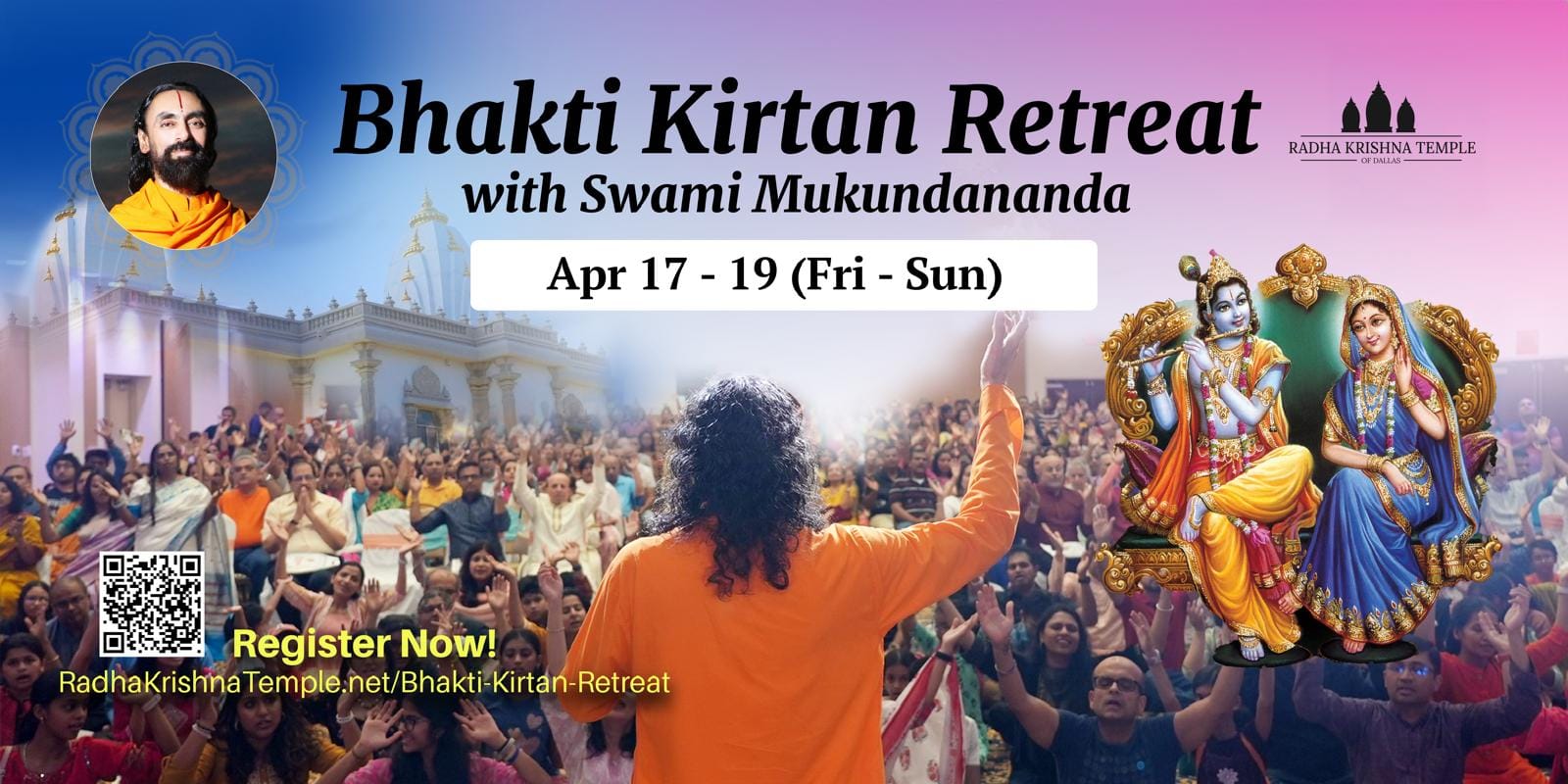
Experience the transformative power of devotion at our 3-Day Bhakti Kirtan Retreat with Swamiji at the exquisitely beautiful Radha Krishna Temple of Dallas (Allen), the official US Headquarters of JKYog.
In the current age of Kaliyug, Kirtan is hailed by Vedic scriptures as the most potent tool for purifying the heart and awakening divine love. This retreat offers a rare sanctuary from the noise of modern life, inviting you to:
- Find Inner Peace: Immerse yourself in a serene environment designed for spiritual rejuvenation.
- Engage the Mind: Discover a vibrant blend of music, chanting, and contemplation that keeps your practice fresh and focused.
- Deepen Your Wisdom: Meditate on sacred lyrics that serve as portals to divine knowledge and self-discovery.
- Experience Bliss: Be transported by Swamiji’s melodious chants and Pad Vyakhyas that move us beyond the material world into a realm of spiritual elevation.
Don’t miss this opportunity to soak in the divine atmosphere and elevate your soul through the highest form of Sadhana.
Register Now! Details: https://www.radhakrishnatemple.net/bhakti-kirtan-retreat
JKYog Transforming Communities
Here, we share evidence of amazing activities about the programs and initiatives of JKYog that are instrumental in transforming the lives of people. Today, we share an invaluable resource:
Bhagavad Gita Online: Explore Timeless Wisdom with Swami Mukundananda

In this chaotic and fast-paced world, finding a reliable source of inner peace and conceptual clarity is a rare gift. The Bhagavad Gita – The Song of God, a masterpiece of spiritual wisdom, remains one of the most profound guides for navigating the complexities of everyday modern life. To make this timeless knowledge accessible to everyone, Swamiji has created a comprehensive digital sanctuary that has been a reliable guide for spiritual seekers. It is a complete digital resource featuring all 700 verses, with an easy-to-understand commentary that is directly relatable to modern life.
Here is what makes this resource so unique:
- Simple Insights: Swamiji breaks down complex philosophy into practical "life hacks" for the mind.
- Language Choice: You can read it in any of the six Indian languages (i.e., Hindi, Telugu, Odia, Gujarati, Tamil, and English), making the teachings feel much more personal.
- Daily Inspiration: You can sign up for free to get the "Verse of the Day" delivered to your email or WhatsApp.
It is a powerful way to start your morning with a clear head and a positive heart. Instead of scrolling through the news, you can start with a timeless truth that puts everything into perspective.

JKYog’s Bhagavad Gita Krishna Bhakti App

The Ask Swamiji feature within the Bhagavad Gita Krishna Bhakti App revolutionizes spiritual support by providing instant, AI-driven guidance based on Swamiji’s teachings and sacred Vedic scriptures. By bridging the gap between traditional mentorship and modern accessibility, it allows seekers to receive personalized, scriptural perspectives on complex life issues such as the purpose of life, karm, ethics, our relationship with God, etc., at any moment.
This tool ensures that authentic wisdom from the Vedic Scriptures is always available, offering users a constant sense of spiritual companionship and direction. Here is a sample of a question asked by a user and the response to the question.
Question: A true Guru already knows what's in the minds and hearts of disciples. What then is the best way to express gratitude to the divine Guru?
Answer: The best way to express gratitude to the divine Guru is through sincere devotion and selfless service. When we develop a deep reverence for the Guru and humbly surrender ourselves to their guidance, it pleases the Guru. By following their teachings and putting them into practice in our daily lives, we show our gratitude for the spiritual knowledge and blessings they have bestowed upon us. Additionally, we can express our gratitude through acts of kindness, helping others, and spreading the Guru's teachings to benefit more souls.
If you have not already downloaded the app, do it now!
Download the App: https://www.jkyog.org/radha-krishna-bhakti-app