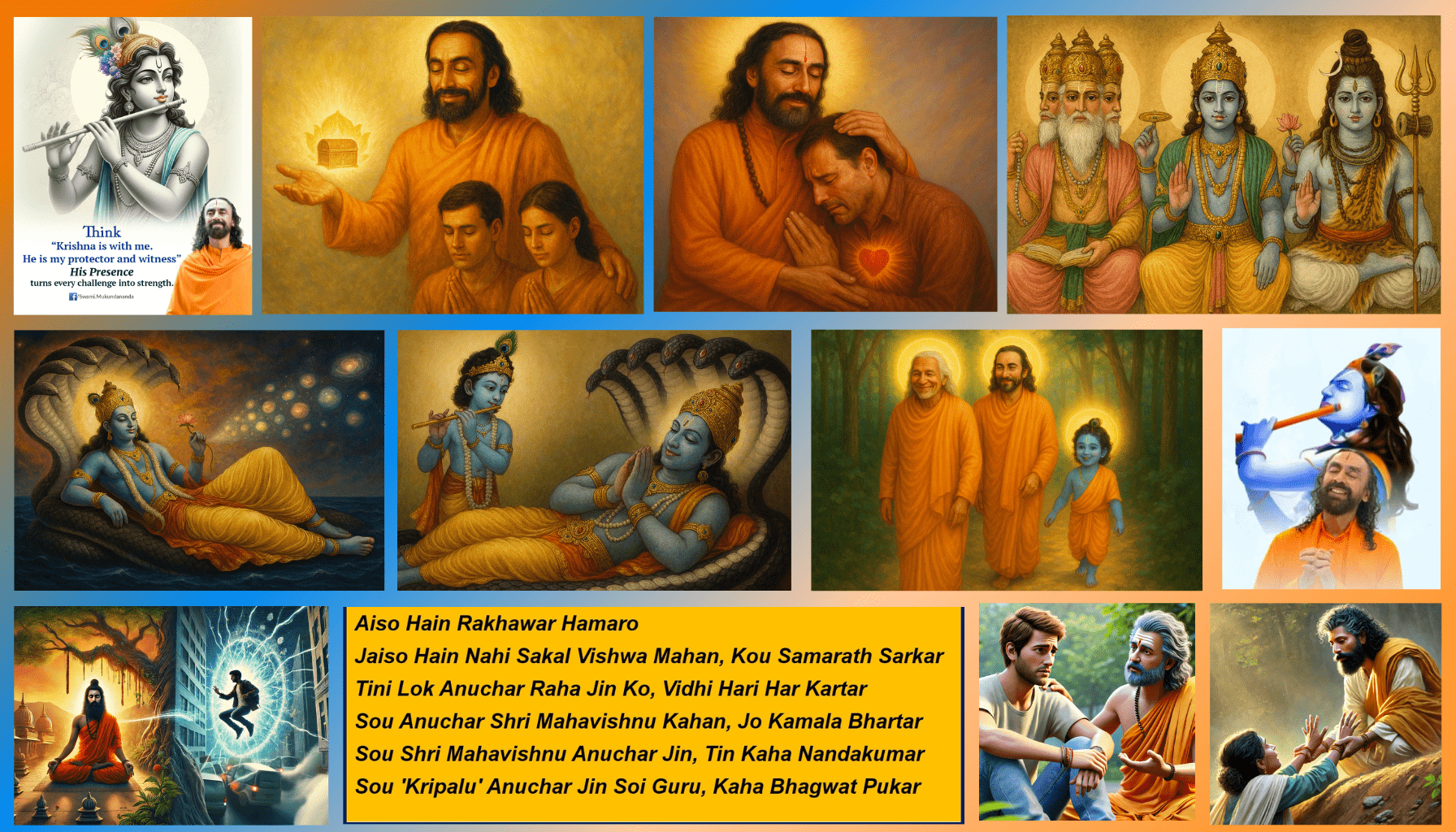
The spiritual journey is illuminated most powerfully by the grace of a true Guru. In every age, scriptures declare that the soul cannot attain God by its own efforts alone, but requires the grace of a Divine Spiritual Master. Jagadguru Shree Kripalu ji Maharaj composed a profound kirtan, “Aiso Hain Rakhavar Hamaro” that elucidates the indescribable virtues of a true Guru, surpassing even the divine personalities worshipped by the masses. This central truth is revealed in this blog.
A Disclaimer
The divine nature of a true Guru is boundless and way beyond the comprehension or expression of an ordinary material soul. This blog translates the lyrics and offers a humble expression of devotion, reverence, and gratitude to a supremely Divine Guru whose graces are infinite and immeasurable.
Who Is The Guru or Spiritual Master?
From its opening verse, the disciple proudly declares the Guru as the supreme protector and guide, surpassing even the Divine personalities worshipped by the masses. Each subsequent verse further elevates the Guru's status, offering a breathtaking vision of the Guru’s divine position in relation to God Himself. Through these reflections, we contemplate the indispensable and incredible grace of the Guru on the spiritual path and acknowledge the transformative impact of Swami Mukundananda ji’s guidance to seekers around the world.
1. The Disciple’s Joyful Proclamation of the Guru’s Protection
Hamaro! Aiso Hain Rakhavar
A disciple proudly states, “Such is my Guru, my Protector!”
From the very first line, the disciple proclaims the supreme protection found in the Guru. A disciple’s pride in the Guru is not worldly – it is an overflowing of gratitude. The protector described here is not merely a guide or teacher but the soul’s eternal refuge.
The Guru protects disciples not only from worldly troubles that impede devotion, but from the greatest danger – lifetimes of spiritual ignorance. On the spiritual path, we experience all kinds of storms: doubts, past impressions, restlessness, and the ceaseless pulls of Maya. Left alone, the wandering soul feels puny and vulnerable. But in the care of a true Guru, one experiences an unshakeable sense of shelter. The disciple knows and believes that the Guru is the unfailing protector – protecting faith, integrity, purpose, and the budding love for God.
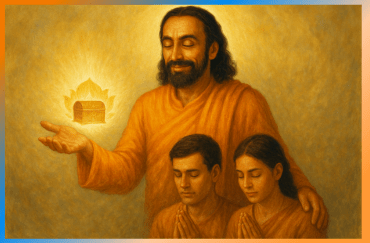
The fundamental premise is that the Guru and disciple are connected through a universal consciousness. The Guru, having taken complete responsibility for the disciple, preserves the spiritual assets that exist and provides what one lacks. This is explained by Shree Krishna to Arjun:
अनन्याश्चिन्तयन्तो मां ये जना: पर्युपासते |
तेषां नित्याभियुक्तानां योगक्षेमं वहाम्यहम् || 22||
ananyash chintayanto mam ye janah paryupasate
tesham nityabhiyuktanam yoga-kshemam vahamyaham
There are those who always think of Me and engage in exclusive devotion to Me. To them, whose minds are always absorbed in Me, I provide what they lack and preserve what they already possess (Bhagavad Gita 9.22).
2. The Incomparable Spiritual Authority of the Guru
Jaiso Hain Nahi Sakal Vishwa Mahan, Kou Samarath Sarkar
There is no one in this entire world who can equal Him in power and position.
This verse elevates the status of the Guru beyond any worldly measure. In spiritual terms, power and position do not refer to authority or dominance, but to the Guru’s capacity to transform a materially-conditioned and hardened heart, dissolve lifetimes of karmic burdens, awaken divine love within a soul, and connect the disciple to God Himself. No worldly force can alter the destiny of the soul like a supremely Divine Guru. This is no exaggeration but a scriptural truth. The Shvetashvatara Upanishad (6.23) states:
Only to those great souls who develop the highest devotion for God and equal devotion for the Guru, all the truths of the scriptures become revealed.
Additionally, the Mundak Upanishad (1.2.12) teaches that the truth of the Supreme Lord cannot be known unless one approaches a Shrotriya (i.e., possessor of knowledge of the scriptures) and Brahmanishtha (i.e., God-realized) Guru. The Bhagavad Gita (verse 4.34) also suggests that because the Guru has "seen the Truth" (i.e., is tattva-darshi), He can reconcile contradictory philosophical viewpoints found in various traditions.
This implies a stunning conclusion that without the true Guru, even scriptural knowledge remains veiled. The Guru’s grace operates at the level of the soul, not at the level of the intellect, and that magnitude of spiritual influence cannot be compared with anything else in this world.

3. The Divine Functions of Brahma, Vishnu, and Shiv
Tini Lok Anuchar Raha Jin Ko, Vidhi Hari Har Kartar
Everyone in the three worlds is subordinate to the creator Brahma, the maintainer Vishnu, and the annihilator Shiv.
Here, Shree Maharajji expands the disciple’s understanding: The mightiest cosmic powers – the personalities responsible for creation (i.e., Brahma ji), preservation (i.e., Lord Vishnu), and dissolution (i.e., Lord Shiv) govern the universe with divine authority. Yet even their roles are temporary, tied to the functioning of the cosmic cycle of creation and dissolution, whereas the Guru is the ultimate spiritual force, surpassing even the Divine Trinity.
The Shrimad Bhagavatam (2.6.32) clarifies that Brahma creates the material universe by Lord Vishnu’s grace; Lord Vishnu (i.e., Garbhodakashayi Vishnu) sustains, and Lord Shiv dissolves – all in service to the cosmic order.
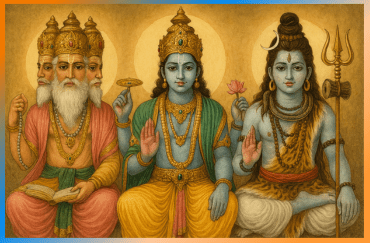
This kirtan verse reminds seekers of the vast spiritual hierarchy and the immense reverence one must hold for divine governance. But the kirtan also prepares the mind for an astonishing revelation that follows. It contextualizes the Guru’s role by first establishing the grandeur of the Trinity who rule the three worlds.
4. Mahavishnu: The Lord Beyond the Three Worlds
Sou Anuchar Shri Mahavishnu Kahan, Jo Kamala Bhartar
But they are servants of Mahavishnu, the Lord of Mahalakshmi.
According to the Vishnu Purana (1.22.53) and elaborated in the Vaishnav literature, Mahavishnu (i.e., Lord Karanodakashayi Vishnu) lies beyond the material cosmos, from whose breath innumerable universes emerge. Even the Trinity – Brahma, Garbhodakashayi Vishnu, and Shiv – are subordinate to this higher form of the Divine. Mahavishnu is the Lord of Mahalakshmi Devi, the embodiment of divine power and opulence. This establishes the scale of divinity – ascending beyond the personalities known to the material realm. Yet even this is not the summit. In devotion, every step upward prepares the heart to appreciate better the ultimate glory described next. This way, the disciple who glorifies the Guru gradually leads the listener upward through the hierarchy of divine authority.

5. Nandakumar as the Supreme Divine Personality
Sou Shri Mahavishnu Anuchar Jin, Tin Kaha Nandakumar
Mahavishnu Himself is the servant of Nandakumar.
In this line, the heart melts. The cosmic grandeur recedes into something intimate, tender, and infinitely sweeter than the Aishwarya bhav. Mahavishnu, the creator of infinite universes, bows down to Nandakumar (i.e., Shree Krishna, the Golok vihari and the Avatari Lord), the darling of Mother Yashoda, who is the Supreme Divine Personality. The Brahma Samhita (5.1) states that Shree Krishna is the original Supreme Personality (“kṛiṣṇas tu bhagavān svayam”), whom even Mahavishnu Bhagwan serves.
This verse reveals an essential truth of the path of bhakti: God’s highest form is not His external opulence or aishwaryata, but His divine sweetness, His loving personality, His charm, His playfulness, and His unconditional grace.

This is the form that the true Guru reveals to the true disciple. The Guru does not merely teach the knowledge of the scriptures; He grants access to the heart of Shree Radha Krishna, forever binding them in ecstatic divine love bliss. It is then that disciples experience the indescribable leelas or pastimes of God in His divine abode. This tender form of God revealed by the true Guru guides true disciples from awe and reverence alone to selfless loving devotion in His service.
6. The Guru’s Exalted Position as Honored by Shyamsundar
Sou 'Kripalu' Anuchar Jin Soi Guru, Kaha Bhagwat Pukar
The Shrimad Bhagavatam states that Shyamsundar Himself is the servant of the Guru. That is the position of my Protector!
This final verse is the pinnacle. It surpasses every single hierarchy revealed earlier. The line says that Shyamsundar, the same Shree Krishna whom even Mahavishnu serves, declares Himself to be the servant of the Divine Guru. Why? It is because the Guru is the embodiment of God’s grace in action. The Guru is the cause of the soul’s inner transformation and awakening. It is only the Guru who carries the lost soul toward God, step by step, with infinite love, patience, and compassion.
If God is the destination, the Sadguru is the bridge, the guide, the guardian, and the Divine Light. To honor the Guru is to honor God. Thus, Shree Kripaluji Maharaj teaches disciples to proudly proclaim the exalted position of the Divine Guru as the ultimate Witness and Protector of mayadheen souls.
The Shrimad Bhagavatam (10.80.34–35) establishes that Shree Krishna Himself honors and serves His Guru. He recounts with great humility how He, during His avatar kaal, served Sandipani Muni with complete dedication. Additionally, the Bhagavatam (11.17.27) also states:
आचारयम माम विजानीयान नाव मन्येत कारहिचीत
ना मारत्या बुद्धया सूयेत, सर्व देवमायो गुरुः
ācāryam māṁ vijānīyān nāvamanyeta karhicit |
na martyabuddhyāsūyeta sarvadevamayo guruḥ || 27 ||
Know the Guru to be Myself (God). Never think unfavorably about Him. Do not use your material mind to comprehend the Guru’s divine actions, for all the forms of God dwell within Him (Bhagavatam 11.17.27).
This verse does not elevate the Guru above God but states that God manifests through the Guru to guide the soul. They are the same entity. Thus, when the kirtan declares that Shyamsundar is “the servant of the Guru,” it reflects Shree Krishna’s own demonstration of honoring and serving His representative, the Divine Guru, who cleanses the impure hearts of souls to prepare them to meet God. The Supreme Entity, thus, models the ideal of Guru Bhakti for all seekers.
This is the astonishing spiritual truth the disciple celebrates: The Guru’s position is so exalted that even the Supreme Lord honors the Guru tattva or principle.
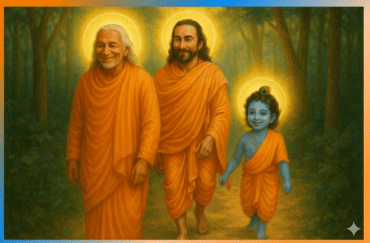
A Humble Expression of Gratitude
For countless seekers, Shree Swami Mukundananda ji’s life, exemplified by complete surrender to His Divine Guru, Jagadguru Shree Kripalu ji Maharaj, shines with tireless service, resolute discipline, and unwavering commitment to uplifting humanity.
As souls still bound by material limitations, we cannot fully assess the greatness of a true Guru, yet we unmistakably recognize His grace when it touches and transforms our lives. Such divine guardianship is something countless devotees have experienced through Swamiji’s constant encouragement, spiritual wisdom, and infinite compassion that inspires, uplifts, and instills hope. Devotees have testified to this form of protection that brings stability to their spiritual journey.
Extending far beyond individual encounters, millions across the globe have experienced an inner transformation through Swamiji's teachings, sadhana practices, books, and personal guidance. His kindness extends universally – to those who revere Him, to those who struggle to follow His instructions, and even to those who challenge Him. His patience is unfailing, His compassion is limitless, His mercy is causeless, His humility is rare and incomparable, and His love is unquestionably unconditional.
It is no surprise that countless seekers naturally gravitate toward Swamiji when searching for authentic spiritual guidance. His presence alone becomes the turning point that awakens or deepens faith, provides clarity of purpose, and builds the resolve to pursue higher goals in life. May this reflection deepen our reverence for the Divine Guru and inspire sincere dedication to the path He illuminates.
This sentiment aligns with the essence of Bhagavad Gita 4.34, which instructs seekers to approach a God-realized Guru with humility, pose questions to clarify doubts regarding scriptural knowledge, and serve the Guru's mission with loving devotion. The Guru then helps souls by revealing transcendental knowledge which is beyond the reach of our independent efforts.
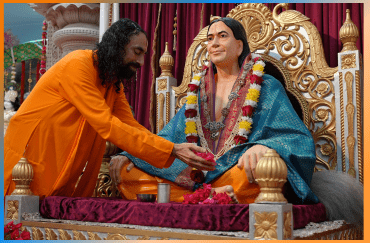
Call to Action
If these insights about the Guru Tattva touched your heart:
- Spend time daily in remembrance of our Guru’s teachings. A very special video by Swamiji is on how God protects us (Krishna Will PROTECT You if You Do This l Bhagavad Gita).
- Listen to or chant kirtans glorifying the Guru to develop devotional and loving sentiments of gratitude. Many others can be found on Swamiji's social media channels (see JKYog’s website).
- Join a satsang or program by Swamiji to experience His guidance. Become a member of SM Exclusive to directly connect with Swamiji. Details are available on JKYog’s Bhagavad Gita Krishna Bhakti App.
- Reflect on the presence of a divine Guru in life. How does the Guru transform us from within?
- Study scriptural references about the Guru’s divine role in our spiritual progress.
May the Guru’s divine grace guide every step of our journey toward God.
Resources
- Mukundananda, S. (2025). Bhagavad Gita for Everyday Living: Selected Verses with Key Takeaways. Rupa Publications Pvt Ltd: New Delhi, India.
- Mukundananda, S. (2025). Ishavasya Upanishad. Rupa Publications Pvt Ltd: New Delhi, India.
- Mukundananda, S. (2024). Spiritual Secrets from Hinduism: Essence of the Vedic Scriptures. Rupa Publications Pvt Ltd: New Delhi, India.