
EGO: Edging God Out
Human beings often struggle with inner conflict—feelings of insecurity, resentment, comparison, and dissatisfaction. Despite material progress and external achievements, many people experience a deep sense of unrest within. The ancient Vedic traditions of India explain that the root of this turmoil lies in a subtle but powerful illusion: the ego.
Ego: Edging God Out
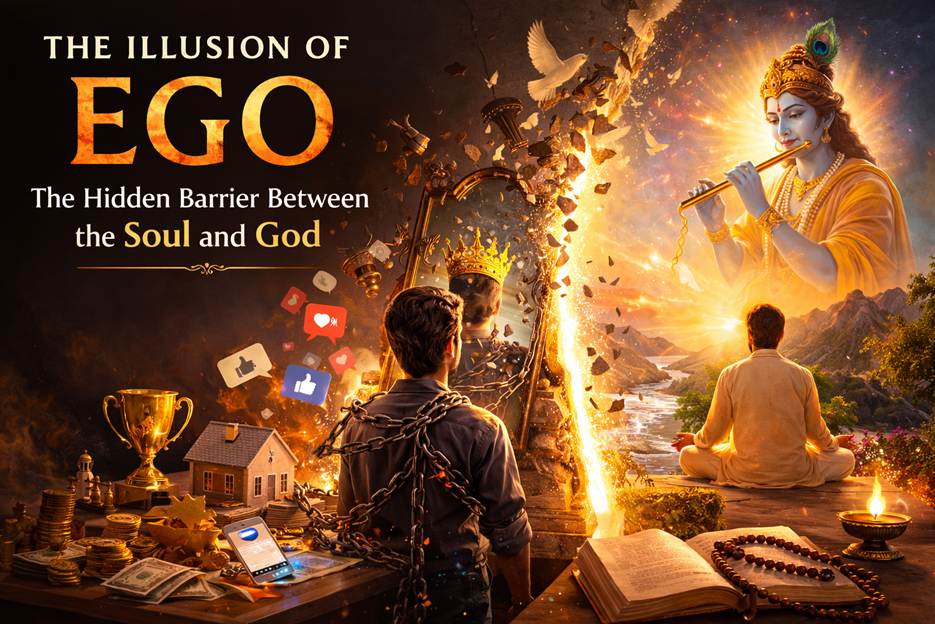
Ego, or pride, is the single greatest obstacle between the soul and God. The German philosopher Paul Deussen, a devoted student of the Upanishads, once remarked that the ego is like a cloud that hides God from our sight. When the cloud disappears, the brilliance of the divine becomes visible.
Swami Mukundananda offers an interesting acronym for understanding the word ‘ego’: Edging God Out. He explains that the ego arises with the forgetfulness of God and our relationship with Him. Consider a simple example.
At night, a firefly glows and may feel proud of its light. It might think, “Look how bright I am!” But when the sun rises, the firefly’s glow becomes insignificant. Its pride instantly disappears.
Similarly, when we forget God's greatness, we begin to feel proud of our tiny achievements. We build a small house and feel proud of it—forgetting that Brahma created the universe and Mahavishnu manifests countless universes. When we remember God’s greatness, our pride naturally melts away.
Understanding the nature of the ego, its manifestations, and the path to transcending it can transform our inner life. When we learn to see through this illusion and cultivate humbleness, we begin to experience peace, clarity, and a deeper connection with God.
What Is Ego? The Illusion of Misidentification
In spiritual philosophy, the ego is not merely arrogance or pride. Its deeper meaning is a false sense of identity. The scriptures describe it as asmita—the mistaken belief about who we truly are.
The Yoga Darshan of Maharshi Patanjali explains this concept beautifully in the aphorism: “Drik-darshana-shaktyor ekatmata iva asmita.”(Sutra 2.6).
It means that ego arises when we wrongly identify the seer (the soul) with the instruments of perception (body and mind). In other words, we mistake what we possess for who we are.
The ego expresses itself through the word “I.” But the question arises: What exactly is this “I”?
When a small child begins to develop awareness, they are still confused about their identity. If someone speaks about him by name, he may say, “Mohan is feeling hungry,” rather than “I am hungry.” The concept of “I” is still forming. As the child grows, he gradually identifies with different things: toys, body, thoughts, achievements, and more.
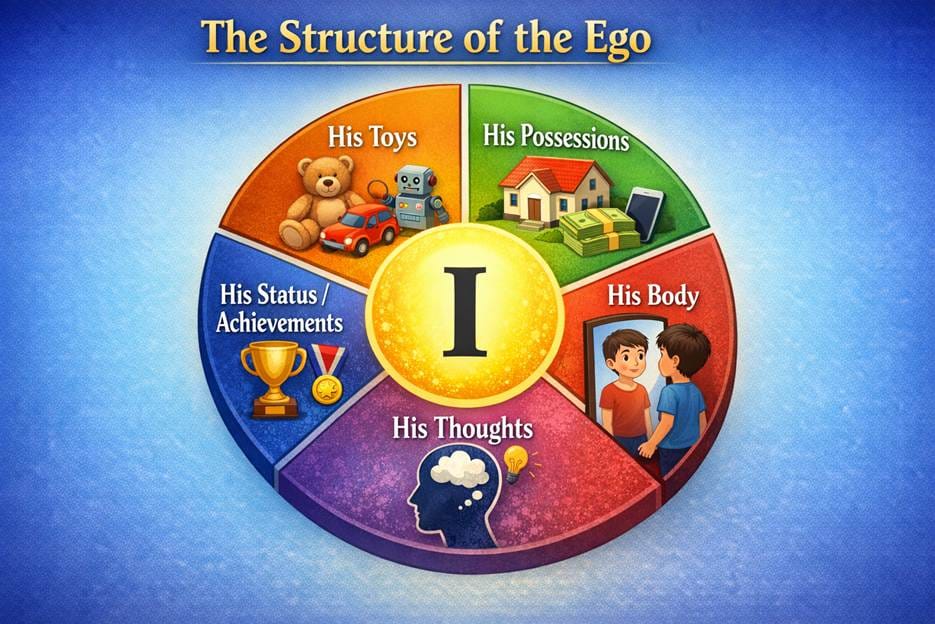
This process of identification is the structure of the ego.
For a child, the ego may identify with a toy. If someone breaks the toy, the child feels miserable—not because of physical need but because the toy has become an extension of his identity.
Later in life, the ego begins to identify with more sophisticated things: my car, my house, my profession, my social status, my opinions, my body, my emotions, and so on. But all these are merely external possessions or temporary attributes. The ego mistakenly declares: “This is me.”
Thus, the ego is simply making something that is not truly the self appear as the self.
Ego: The Prime Barrier Between the Soul and God
The soul is divine by nature. However, it is covered by layers of material identification—the body, mind, intellect, and ego. Among these coverings, the most deceptive is ego (ahankār). The ego makes the soul believe:
➔ “I am the body.”
➔ “I am the mind.”
➔ “I am the intellect.”
➔ “I am the doer.”
Because of this illusion, we begin to identify with temporary attributes—wealth, knowledge, position, beauty, or talent. Spiritual masters explain that the ego is the first defect to arise and the last to disappear. On the day the ego completely dissolves, divine realization dawns naturally.
Jagadguru Shri Kripaluji Maharaj explained this truth beautifully. God is called Deen Bandhu—the savior of the fallen. If God is the rescuer of the destitute, then why does He not immediately liberate all souls suffering in the world? The answer is startlingly simple: We have never accepted that we are fallen.
If someone tells us, “You are not very intelligent,” we feel offended. But if we claim to know everything, we contradict reality. Our ego refuses to accept our limitations. This pride becomes the barrier preventing divine grace from entering our hearts.
The Story of the Tongs, the Hand, and the Mind
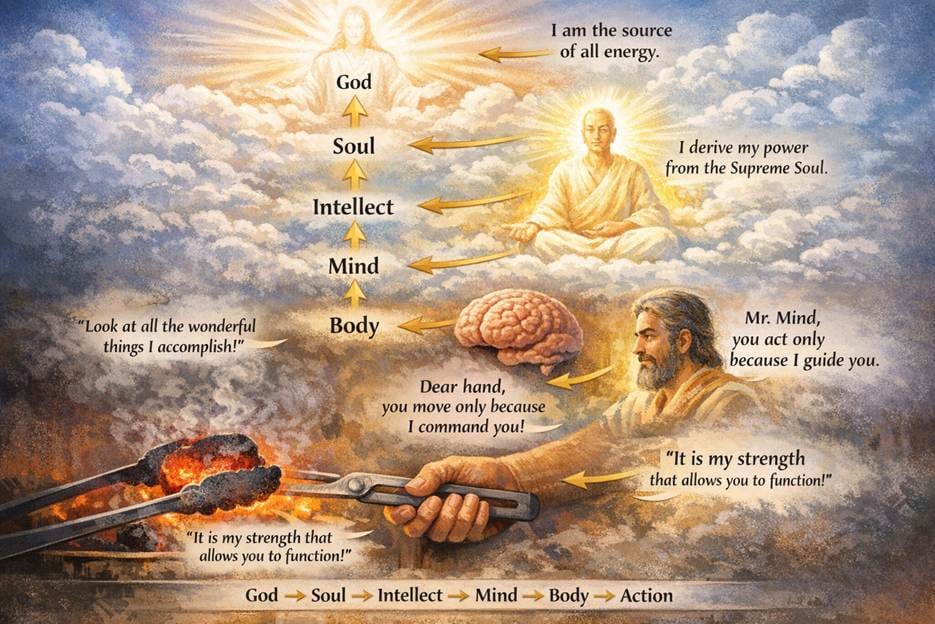
Swami Mukundananda explains ego through a simple yet insightful analogy from everyday life. Imagine the tongs used in the kitchen to hold burning coal. Suppose the tongs suddenly develop pride: “Look at all the wonderful things I accomplish!”
Immediately, the hand responds: “It is my strength that allows you to function. Without me holding you, you could do nothing.”
Now the hand becomes proud. Then the mind enters the conversation: “Dear hand, you move only because I command you. When I sleep, you remain motionless.”
The mind begins to boast. Then the intellect speaks: “Mr. Mind, you act only because I guide you. Without my discrimination, you would not even know how to use the tongs.”
Yet even the intellect is not independent. All these faculties derive their power from the soul. And the soul itself receives its energy from the Supreme Soul—God. Thus, the chain of power is clear:
God → Soul → Intellect → Mind → Body → Action
When we say, “I did this,” we forget the countless sources of energy that made our actions possible. This is the illusion of doership, the subtle ego that binds the soul.
Manifestations of Ego in Daily Life
The ego does not merely exist as a concept; it expresses itself through many behaviors. If we observe, we can detect its presence in our everyday interactions.
1. Complaining
One of the most common manifestations of the ego is complaining. The ego creates a narrative: “Life is unfair to me.” “People are not treating me properly.” “My boss is overlooking me.”
This mindset places the person in a position of moral superiority. The ego feels justified by declaring that everyone else is wrong. There is nothing wrong with calmly pointing out a mistake. But when emotion and bitterness are added, the ego takes control.
2. Resentment and Grievances
When complaints persist, they transform into resentment. Resentment feeds the ego by reinforcing the sense of separateness: “I am the one who has been wronged.” Over time, resentment becomes grievance—a repeated story about past injustice. A person keeps replaying the memory: “This happened to me.” “It was terrible.” “It was unfair.” This mental repetition fills the heart with bitterness. The saints often say that the day we eliminate the feeling “I am hurt,” the heart becomes pure.
3. Gossip
Another favorite pastime of the ego is gossip. Why does gossip feel so attractive? Because it lowers others to elevate oneself. When someone speaks about another person’s shortcomings, the ego quietly feels superior. But this habit pollutes the mind and damages relationships.
4. Fault-Finding
Closely related to gossip is the tendency to find faults in others. The ego wants to believe: “I am good, therefore others must be flawed.” Ironically, the faults we notice most intensely in others often reflect our own hidden tendencies. Saint Kabir wisely remarked that while searching for faults in others, we forget to examine our own.
5. Craving for Attention
The ego constantly seeks recognition. Children sometimes misbehave simply to attract their parents’ attention. Similarly, adults may pursue fame, status, or admiration. Even negative attention can satisfy the ego because it reinforces a sense of importance.
6. Victim Mentality
Another subtle manifestation of the ego is self-victimization. The ego declares: “Nobody understands me.” “Everyone is against me.” “My life is uniquely difficult.” This mindset strengthens the ego’s identity as a sufferer.
Even illness can become a form of ego identification. A person may unconsciously derive attention and sympathy from being perceived as a victim.

The Pride of the Gopis
Saint Kabir said:
Jab main tha tab Hari nahī̃, ab Hari haĩ main nāhī̃.
Prem galī ati sā̃karī, tāmẽ do na samāhī̃.
Tr. When the ego of “I” existed, God was not present.
Now that God is present, the ego has disappeared.
The lane of divine love is extremely narrow.
Two cannot walk through it together.
The couplet implies that either God resides in the heart, or the ego does. Both cannot remain simultaneously. This truth was dramatically demonstrated in the divine pastimes of Shri Krishna and the Gopis.
After many lifetimes of spiritual practice, the Gopis became eligible to participate in the Maharaas, the celestial dance with Krishna on the night of Sharad Purnima. Responding to the enchanting call of Krishna’s flute, they abandoned all worldly responsibilities and ran to Him.
Pleased by their devotion, Krishna began the divine dance. To increase their joy, He expanded Himself so that every Gopi had Krishna dancing beside her. It was the highest possible spiritual blessing—direct association with God.
But at that very moment, a subtle demon entered their hearts: the demon of pride. Some Gopis began thinking: “God is dancing with me. He is especially pleased with me.”
The moment the word “me” appeared, the focus shifted from Krishna to themselves. Instantly, Krishna disappeared.
The Gopis were devastated. Their pride had separated them from the very Lord they loved.
Even Radha, in a subtle divine play, briefly experienced a moment of pride. Krishna vanished again, teaching the profound lesson that even a moment of pride can separate us from divine grace.
The Buddha and the Power of Humility
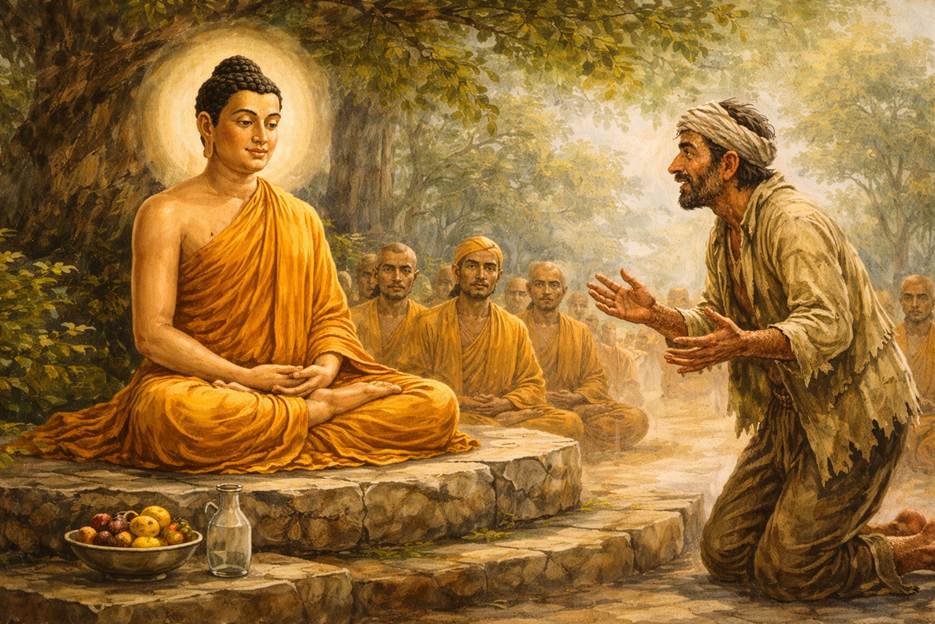
A remarkable story from the life of Gautama Buddha illustrates the power of humbleness. Once, a man approached the Buddha and began insulting him. For an entire hour, he hurled harsh words, accusations, and abuse. Buddha sat calmly, unaffected. Eventually, the man became exhausted.
Buddha turned to his disciples and said, “Give this man some water and food. He seems tired. Once he recovers his energy, he may continue.”
The man was stunned. “How can you remain unmoved after everything I said?” he asked.
Buddha replied with a simple question: “If someone offers you a gift and you refuse to accept it, with whom does the gift remain?”
“With the giver,” the man answered.
“Exactly,” said Buddha. “You offered me insults. I chose not to accept them. So they remain with you.”
This story reveals an extraordinary spiritual truth. Our reactions are not forced upon us by the world—they are choices. When ego dominates the mind, even a small criticism ignites anger. But when the ego dissolves, the heart remains peaceful.
Awakening Through Awareness
The first step toward overcoming the ego is awareness. When we begin to observe our thoughts and behaviors honestly, we start noticing the subtle workings of the ego. Retreat into isolation and ask yourself:
❓Am I blaming others for my problems?
❓Am I constantly complaining?
❓Do I crave attention and approval?
❓Do I hold onto resentment?
These patterns reveal the presence of the ego. Awareness of it weakens its grip. Just as recognizing a mirage removes its illusion, recognizing the ego begins dissolving it.
The Spiritual Solution: Understanding Our Relationship with God
Ultimately, the ego dissolves when we understand our true identity. We are not merely bodies, possessions, or thoughts. We are eternal souls, tiny parts of the Supreme. In comparison to the infinite greatness of God, what reason is there for the ego? Everything we possess—our intelligence, talents, wealth, and opportunities—comes from Him. Humility does not mean weakness or self-deprecation. Rather, it is a clear recognition of reality. When this understanding enters the intellect, a natural attitude of humbleness develops.
Instead of thinking: “I achieved this.” We begin thinking: “By God’s grace, this happened.” Instead of seeking recognition, we adopt the identity: “I am the servant of God.” This humble perspective dissolves the illusion of ego.

Affirmations for Cultivating Humbleness
Spiritual transformation requires constant practice. One powerful method is to repeat spiritual affirmations. Reflect on thoughts such as:
🌿“I am a humble servant of God.”
🌿“Everything I have is a gift from Him.”
🌿“My purpose is to serve, not to dominate.”
🌿“God’s wisdom guides every action in my life.”
These affirmations gradually reshape the mind and weaken ego-driven tendencies.
Conclusion: Empty the Vessel of Ego
The message is simple yet profound: If we wish to invite God into our hearts, we must first remove the occupant already sitting there—ego. When the heart becomes empty of pride, it becomes full of divine presence. And in that sacred humility, the soul discovers its greatest achievement: union with the Divine.
Call To Action
1. Follow this Meditation by Swami Mukundananda to practice the virtue of humbleness: Meditation to Feel Humbled - Guided Meditation by Swami Mukundananda
2. Subscribe to the Swami Mukundananda YouTube channel and find Practical Tips to Cultivate Humility: Achieving Anything in Life by Getting Rid of Your Ego - An Eye opening video by Swami Mukundananda
Resources
● https://www.youtube.com/watch?v=o18BrZa_FbI
● SMEx Session on Ego