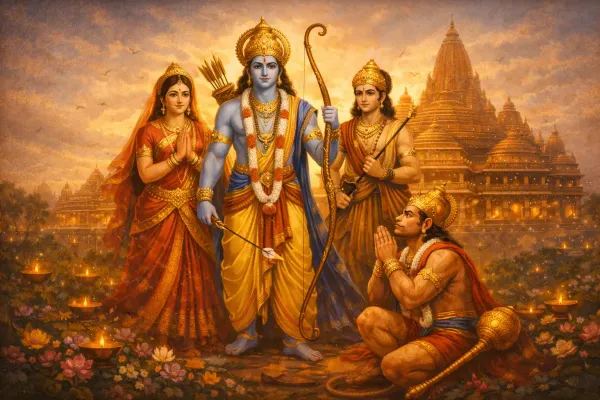

In an era defined by rapid technological growth, social transformation, and global connectivity, ancient traditions often face the challenge of staying relevant. Yet some celebrations transcend time, offering wisdom that continues to guide humanity through modern complexities. Ram Navami, the sacred festival commemorating the birth of Lord Rama, is one such timeless occasion.
Observed on the ninth day of the Hindu month of Chaitra, Ram Navami celebrates not only the birth of a divine figure but also the ideals of righteousness, compassion, and ethical leadership embodied by Lord Rama. Known as Maryada Purushottam—the perfect embodiment of moral conduct—Lord Rama’s life, as narrated in the Ramayana, continues to inspire millions across cultures and generations.
In today’s world of digital overload, ethical dilemmas, environmental crises, and social divisions, the principles represented by Ram Navami are more relevant than ever. This festival is not just a ritual observance but a powerful reminder of the values that can guide modern society toward harmony, integrity, and inner peace.
This blog explores the modern significance of Ram Navami, examining how its teachings apply to leadership, social unity, personal growth, and global cultural identity.
Ethical Leadership & Values

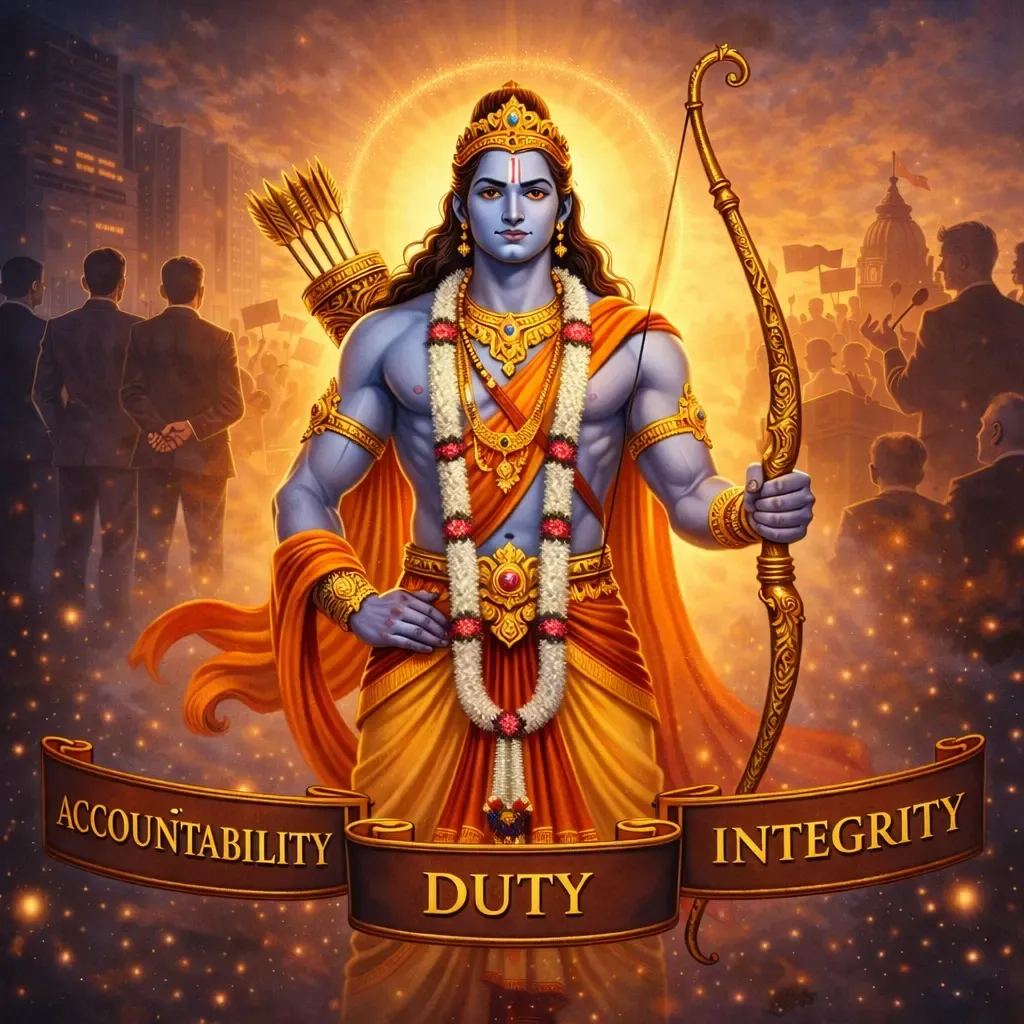
The Maryada Purushottam Blueprint: Applying Ancient Integrity to Modern Leadership
Leadership today is often measured by influence, wealth, or authority. However, Lord Rama’s life presents a different model—one based on integrity, accountability, and duty.
As Maryada Purushottam, Rama demonstrated that true leadership lies in putting dharma above personal gain. When faced with exile due to a promise made by his father, he accepted it without resentment, prioritizing moral responsibility over royal privilege. His life shows that ethical leadership means honoring commitments even when circumstances are unfavorable.
This principle resonates strongly with teachings from the Bhagavad Gita, where Lord Krishna advises Arjuna:
“You have a right to perform your prescribed duty, but you are not entitled to the fruits of action.”
(Bhagavad Gita 2.47)
This verse emphasizes nishkama karma, the practice of performing one’s duty without attachment to outcomes. Lord Rama exemplified this principle perfectly by fulfilling his responsibilities without seeking personal benefit.
In modern organizations and governments, ethical leadership is increasingly demanded by society. Corporate scandals, political corruption, and misuse of power highlight the urgent need for leaders who embody transparency and fairness.
Modern spiritual teacher Swami Mukundananda often explains in his discourses that true leadership begins with inner discipline.
He states:
“When leaders align their actions with dharma rather than ego, they inspire trust and create lasting impact.”
His teachings highlight that leadership rooted in spiritual values creates harmony both in organizations and society.
Lord Rama’s example teaches leaders to:
- Honor commitments even in difficult situations
- Lead through service rather than authority
- Uphold justice and fairness for all
Companies and institutions that integrate ethical leadership principles often enjoy stronger trust, loyalty, and long-term success. Ram Navami reminds us that the most powerful leadership style is rooted in character, not control
When leaders adopt these principles, they transform leadership from a pursuit of power into a path of service and responsibility.
Beyond Rituals: Internalizing Dharma in a Fast-Paced World

When individuals incorporate dharma into their lives, society naturally becomes more harmonious. Ram Navami serves as a reminder that spirituality is not limited to temples; it is practiced through everyday actions.
Many people celebrate Ram Navami through prayers, fasting, temple visits, and devotional songs. While rituals play an important role in cultural preservation, the deeper purpose of the festival lies in internalizing dharma—the path of righteousness.
Modern life is dominated by deadlines, digital distractions, and constant competition. In such an environment, ethical reflection often takes a backseat to productivity.
Ram Navami invites individuals to pause and reflect on their values.
The Bhagavad Gita provides guidance for living a balanced life amid chaos. Lord Krishna explains:
BG 2.48: Be steadfast in the performance of your duty, O Arjun, abandoning attachment to success and failure. Such equanimity is called Yog.
(Bhagavad Gita 2.48
This teaching reminds us that true fulfillment lies not in external achievements but in maintaining inner balance and integrity.
In his lectures on the Bhagavad Gita, Swami Mukundananda explains that stress often arises from excessive attachment to outcomes.
He shares an insightful reflection:
“Peace comes when we focus on our efforts rather than obsessing over results. When actions align with dharma, the mind becomes calm.”
This perspective encourages individuals to live spiritually even in the middle of busy professional lives.
Dharma in today’s context may include:
- Making ethical choices at work
- Practicing honesty in daily interactions
- Acting with compassion toward others
- Maintaining balance between ambition and responsibility
When individuals incorporate dharma into their lives, society naturally becomes more harmonious. Ram Navami serves as a reminder that spirituality is not limited to temples; it is practiced through everyday actions.
Truth in a “Post-Truth” Era: Why Lord Rama’s Commitment to Satya Matters Now
The modern world has entered what many scholars call the “post-truth era”, where misinformation spreads rapidly through digital platforms and social media.
In such times, Lord Rama’s unwavering commitment to satya (truth) becomes profoundly relevant.
Throughout the Ramayana, Rama chooses truth and righteousness even when it leads to personal suffering. His life illustrates that truth is not always convenient, but it is always necessary.
Today, truthfulness is vital in areas such as:
- Journalism and media integrity
- Transparent governance
- Responsible digital communication
- Honest business practices
Ram Navami encourages society to reclaim the value of truth in public discourse. Upholding truth builds trust, and trust forms the foundation of a stable and ethical civilization.
From Self to Society: Transitioning from Personal Ambition to Selfless Service
Modern culture often promotes individual achievement and personal success as the ultimate goals of life. However, the life of Lord Rama highlights the importance of selfless service and social responsibility.
Rama’s actions consistently demonstrate a commitment to the welfare of others—whether protecting sages in forests, forming alliances with diverse communities, or ensuring justice for his citizens.
The Bhagavad Gita reinforces this principle by encouraging individuals to act for the greater good:
BG 3.20-21: By performing their prescribed duties, King Janak and others attained perfection. You should also perform your duties to set an example for the good of the world. Whatever actions great persons perform, common people follow. Whatever standards they set, all the world pursues.
This verse underscores the influence of leadership by example.
Similarly, Swami Mukundananda teaches that service is the highest expression of spirituality. In his discourses he often explains:
“True success is not measured by what we accumulate, but by how much we contribute to the welfare of others.”
When individuals move beyond self-centered goals and work for collective well-being, society flourishes.
Ram Navami reminds us that true fulfillment comes not from personal ambition alone but from contributing to the greater good.
In modern contexts, this principle can inspire:
- Community service initiatives
- Ethical entrepreneurship
- Social responsibility programs
- Volunteerism and philanthropy
When individuals move beyond self-centered goals and work for collective well-being, society flourishes.
Contemporary Social Issues
Unity in Diversity: How Ram Navami Bridges Cultural and Religious Gaps

India and the global Hindu community represent extraordinary cultural diversity. Ram Navami celebrations reflect this richness, with traditions varying across regions, languages, and communities.
Despite these differences, the festival creates a powerful sense of unity.
In North India, devotees organize grand processions and temple celebrations. In South India, Ramayana recitations and classical music performances are common. Across the global diaspora—from the United States to Fiji and Mauritius—Ram Navami brings communities together in shared devotion.
This unity reflects a broader message: diversity is not a barrier but a strength.
At a time when social divisions and cultural conflicts are increasing worldwide, Ram Navami stands as a symbol of inclusivity and shared heritage.
The Environmental Guardian: Lord Rama’s Reverence for Nature and Modern Ecology
One of the lesser-discussed aspects of the Ramayana is its deep connection with nature.
Lord Rama’s journey through forests reveals a profound respect for the natural world. The epic portrays forests, rivers, mountains, and wildlife as sacred elements of life rather than mere resources.
Today, humanity faces major environmental challenges including climate change, deforestation, and biodiversity loss.
The ecological wisdom reflected in Rama’s story encourages:
- Respect for natural ecosystems
- Sustainable living practices
- Protection of wildlife and forests
- Recognition of humanity’s connection with nature
Ram Navami therefore serves as a reminder that environmental stewardship is not a modern invention—it is deeply rooted in ancient spiritual traditions.
Equality and Inclusion: Lessons from Rama’s Treatment of Sabari and the Vanaras
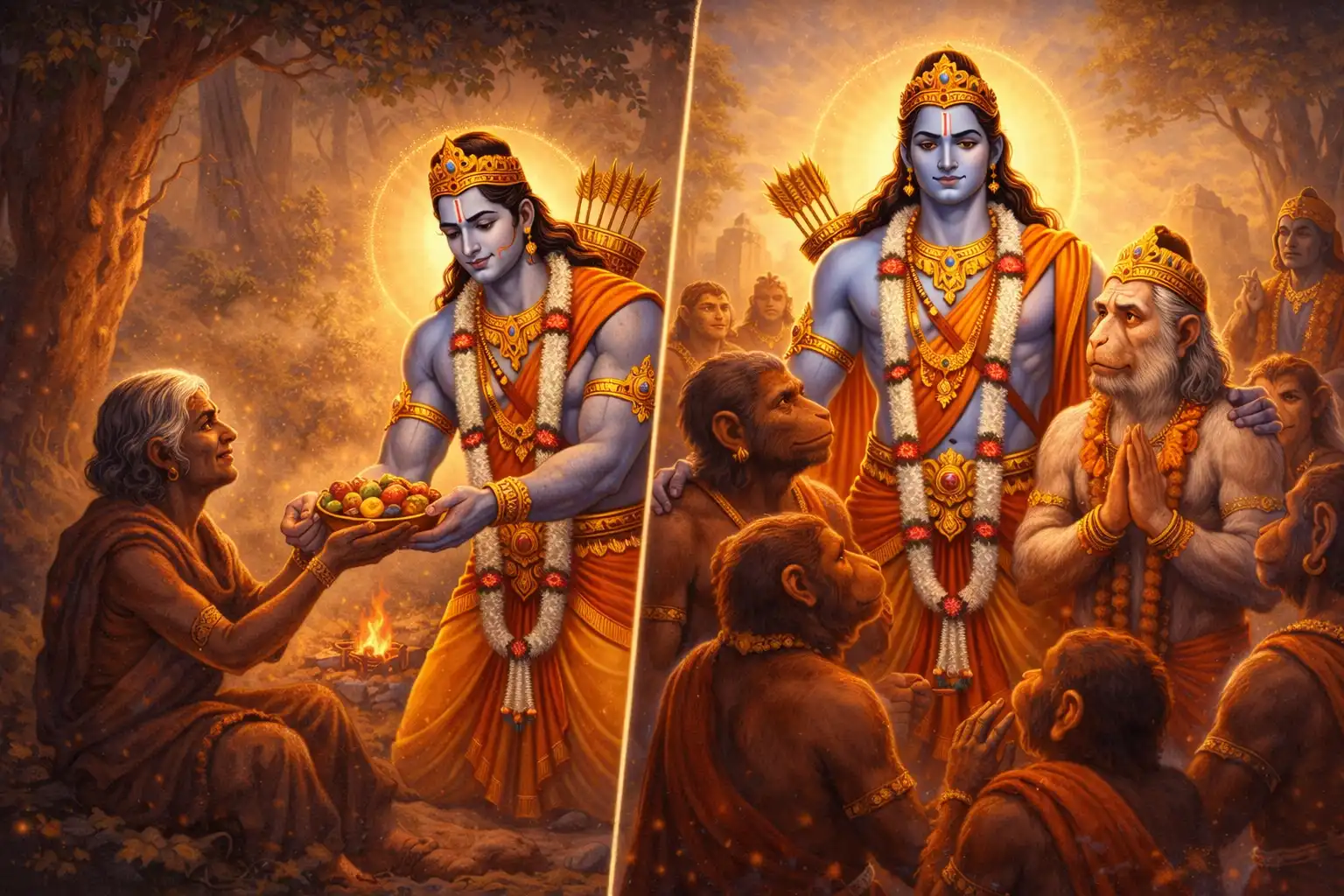
The Ramayana contains powerful lessons on equality and inclusion.
One of the most touching episodes involves Sabari, a humble devotee who offered fruits to Rama with deep devotion. Rama accepted her offering with gratitude, emphasizing that sincere devotion transcends social status.
Similarly, Rama formed strong alliances with the Vanaras (forest dwellers), treating them with respect and trust.
These stories highlight an important message: true greatness lies in recognizing the dignity of every individual.
In today’s world, where issues of social inequality and discrimination continue to persist, these teachings remain highly relevant.
Ram Navami encourages societies to promote:
- Social inclusivity
- Respect for marginalized communities
- Equal opportunities for all
Redefining Relationships: Modern Lessons on Family, Loyalty, and Mutual Respect
Modern life often places strain on relationships. Work pressures, mobility, and digital distractions can weaken family bonds.
The relationships portrayed in the Ramayana offer timeless guidance.
Rama’s devotion to his parents, Sita’s strength and loyalty, Lakshmana’s unwavering support, and Hanuman’s devotion exemplify trust, sacrifice, and respect.
These relationships remind us that strong societies are built on strong families and communities.
Ram Navami encourages individuals to nurture relationships through empathy, patience, and mutual respect.
Personal Growth & Wellness
The Digital Detox of Devotion: Finding Stillness Amidst the “Computerized Life”
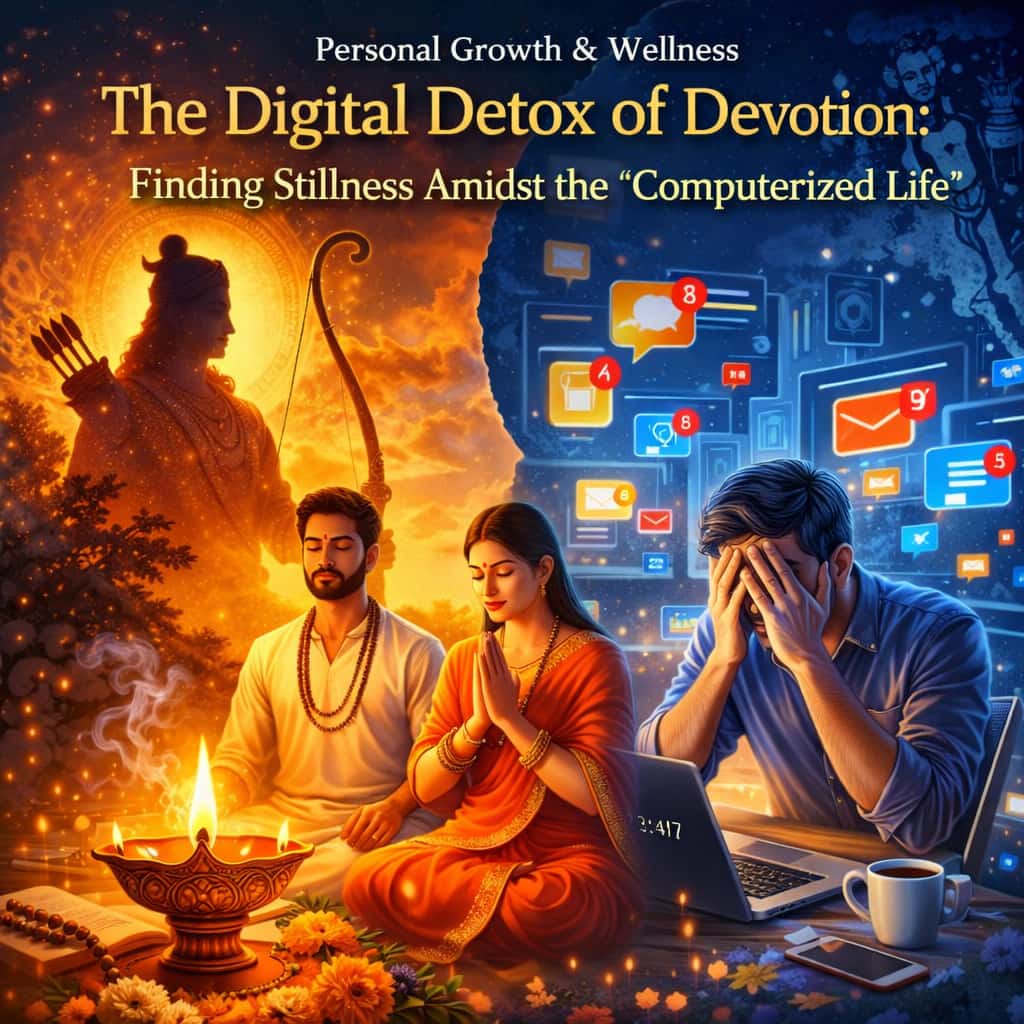
Modern society is deeply immersed in technology. Smartphones, social media, and constant connectivity often leave little space for quiet reflection.
Ram Navami offers an opportunity for digital detox and spiritual mindfulness.
Devotional practices such as chanting, meditation, and storytelling allow individuals to disconnect from digital noise and reconnect with inner peace.
Taking time away from screens—even briefly—can improve mental clarity, reduce stress, and enhance emotional well-being.
Emotional Resilience: Navigating Life’s “Exiles” with Grace and Fortitude
Lord Rama’s fourteen-year exile symbolizes the challenges and uncertainties that everyone faces in life.
Rather than reacting with bitterness, Rama accepted his circumstances with dignity and courage.
In modern psychology, resilience—the ability to adapt and recover from adversity—is considered a key trait for mental health.
Rama’s journey teaches that hardships can become opportunities for growth, strength, and self-discovery.
Cultivating the Inner Light: The Spiritual Psychology of “Ra-Ma”
Many spiritual traditions emphasize the power of sound and mantra.
The name “Rama” is often interpreted symbolically:
- “Ra” represents divine light or consciousness
- “Ma” represents inner peace and compassion
Chanting the name of Rama is believed to calm the mind, focus attention, and cultivate spiritual awareness.
Modern research on meditation supports the psychological benefits of mantra repetition, including reduced anxiety and improved emotional balance.
Stress Management through Dharma: Staying Steady When the World is Uncertain
Uncertainty has become a defining feature of modern life—economic fluctuations, global crises, and rapid technological change create continuous stress.
Ancient wisdom provides a powerful framework for maintaining stability.
In the Bhagavad Gita, Lord Krishna reassures seekers:
“The one who is steady in wisdom remains undisturbed by happiness or distress.”
(Bhagavad Gita 2.56)
This state of inner stability comes from understanding that life’s challenges are temporary.
Swami Mukundananda also explains that spiritual awareness helps individuals navigate adversity with resilience.
In one of his talks on managing life’s challenges, he states:
“Spiritual knowledge acts like a compass. When the world becomes uncertain, it guides us back to clarity and purpose.”
By applying these teachings, individuals can remain calm even in times of difficulty.
The concept of dharma provides a powerful framework for managing uncertainty.
When individuals focus on performing their duties with sincerity rather than obsessing over outcomes, stress naturally decreases.
Ram Navami encourages people to remain grounded in values even when circumstances are unpredictable
Cultural & Global Perspectives
Ram Rajya in the 21st Century: Is the Ideal State Still Possible?
Ram Rajya is often described as an ideal society characterized by justice, prosperity, and harmony.
While no society can perfectly replicate this vision, the principles behind Ram Rajya remain highly relevant.
A modern interpretation may include:
- Transparent governance
- Social justice and equality
- Economic fairness
- Environmental sustainability
Ram Navami invites leaders and citizens alike to strive toward a society where ethical governance and public welfare take precedence over power and profit.
The Global Diaspora: How Ram Navami Unites the World
The influence of Ram Navami extends far beyond India.
Across the global Hindu diaspora, the festival brings communities together through cultural programs, temple events, and charitable activities.
Countries such as Nepal, Indonesia, Mauritius, Trinidad, Fiji, the United States, and the United Kingdom celebrate Ram Navami with vibrant enthusiasm.
These celebrations help preserve cultural identity while fostering intercultural dialogue.
Ayodhya’s New Chapter: The Impact of the Ram Mandir on Modern Devotion

Ayodhya, the birthplace of Lord Rama, has long held profound spiritual significance.
Recent developments surrounding the construction of the Ram Mandir have renewed interest in the cultural and spiritual legacy of the Ramayana.
For many devotees, the temple represents not only religious devotion but also the revival of cultural heritage.
Ram Navami celebrations in Ayodhya now attract global attention, reflecting the continued relevance of Rama’s story in modern times.
Bridging the Gap: Teaching the Next Generation Timeless Values through Storytelling
One of the greatest challenges facing modern societies is ensuring that younger generations remain connected to cultural and ethical traditions.
Storytelling plays a powerful role in this process.
The Ramayana’s rich narratives—filled with adventure, moral dilemmas, and inspiring characters—offer an engaging way to teach values such as courage, compassion, and honesty.
Through books, theater, animation, and digital media, the story of Rama continues to reach new audiences.
Ram Navami provides an opportunity for families and educators to share these timeless stories with children, ensuring that ancient wisdom continues to guide future generations.
A Timeless Message for Modern Humanity
The teachings of Lord Rama, the wisdom of the Bhagavad Gita, and insights from Swami Mukundananda ultimately converge on a single truth: a meaningful life is built on dharma, selfless action, and inner discipline.
Ram Navami therefore becomes more than a religious celebration.
It becomes a powerful reminder that ancient spiritual wisdom continues to guide modern humanity toward ethical leadership, social harmony, and personal fulfillment.
Conclusion
Ram Navami is far more than a religious celebration. It is a reminder that timeless values can guide humanity through modern challenges.
From ethical leadership and social harmony to personal resilience and spiritual well-being, the teachings associated with Lord Rama offer insights that remain deeply relevant in today’s world.
As society continues to evolve, the principles of dharma, truth, compassion, and service will remain essential for building a more balanced and harmonious future.
By celebrating Ram Navami not only through rituals but through conscious action and reflection, individuals can bring the spirit of Lord Rama into everyday life.
In doing so, the festival becomes not just a remembrance of the past—but a living guide for the future.
CTA
🪔 Before You Go… A Small Invitation
Ram Navami is more than a festival—it’s a moment to pause, reflect, and reconnect with the values of truth, compassion, and dharma that Lord Rama represents.
So before you leave this page, take a moment and ask yourself:
✨ What is one action you can take today that reflects Lord Rama’s values?
Maybe it’s:
🌿 Choosing honesty even when it’s difficult
🤝 Helping someone without expecting anything in return
💛 Showing patience and kindness to family and friends
🙏 Taking a few quiet minutes for prayer or reflection
Even the smallest act of dharma can brighten someone’s day.
🎉 Celebrate Ram Navami with the Community
If you would like to experience the spirit of Ram Navami in a vibrant devotional atmosphere, we warmly invite you to join the celebrations at Radha Krishna Temple Dallas.
🪔 Ram Navami Celebration
📍 Radha Krishna Temple, Dallas
🙏 Experience bhajans, prayers, cultural programs, and community blessings.

.jpg)
✨ Frequently Asked Questions (FAQs) About Ram Navami
🌼 1. What is Ram Navami and why is it celebrated?
Ram Navami is a sacred Hindu festival that celebrates the birth of Lord Rama, the seventh incarnation of Lord Vishnu. Observed on the ninth day (Navami) of the Chaitra month, the festival symbolizes the victory of dharma (righteousness), truth, and virtue over evil. Devotees celebrate it with prayers, fasting, devotional songs, and readings from the Ramayana.
🕊️ 2. Why is Ram Navami important in modern times?
In today’s fast-changing world, the values represented by Lord Rama—truth, integrity, compassion, and ethical leadership—are more relevant than ever. Ram Navami reminds people to live with honesty, respect others, and make choices guided by moral responsibility.
🌍 3. How is Ram Navami celebrated around the world?
Ram Navami is celebrated globally by Hindu communities through temple visits, Ramayana recitations, fasting, devotional music (bhajans), and cultural processions. In countries such as India, Nepal, the United States, Fiji, and Mauritius, communities gather for spiritual programs and charity activities that strengthen cultural unity.
👑 4. What leadership lessons can we learn from Lord Rama?
Lord Rama is known as Maryada Purushottam, the ideal leader who upheld righteousness in every situation. His life teaches modern leaders to practice fairness, accountability, humility, and service to society, showing that true leadership is built on strong moral character.
🌿 5. How can we apply the teachings of Ram Navami in everyday life?
The teachings of Ram Navami can be practiced daily by:
- 🤝 Showing kindness and compassion to others
- 📖 Speaking the truth and acting with integrity
- 🌱 Respecting nature and living responsibly
- 👨👩👧👦 Strengthening family bonds and relationships
- 🙏 Performing duties with sincerity and humility
By following these values, individuals can bring the spirit of Lord Rama into modern life and contribute to a more harmonious society. ✨