

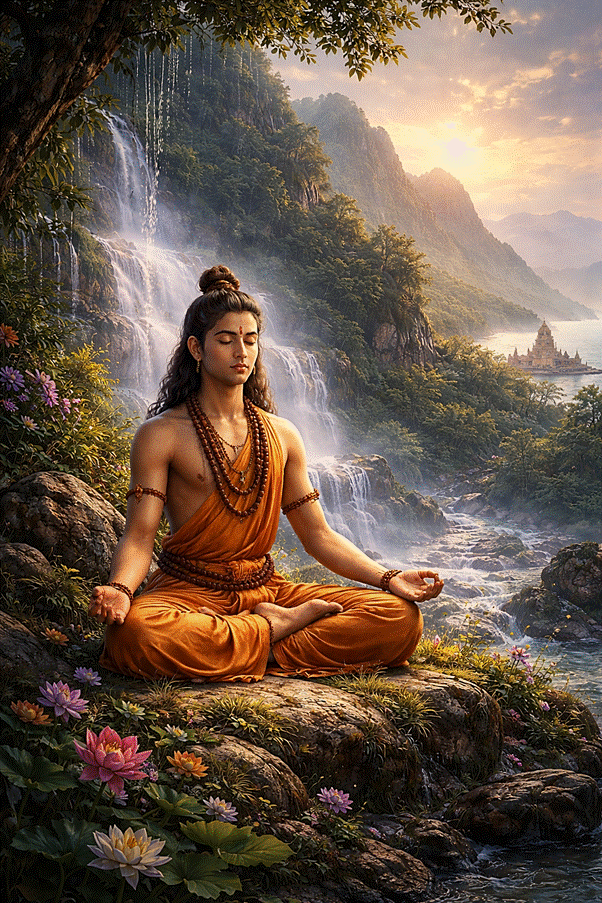
With the tale of Uttanapad, the first son of Swayambhuva Manu, brought to its close, the narrative turns to his second son—Priyavrat.
Born to spiritually exalted parents, Manu and Shatarupa, Priyavrat showed spiritual inclination from childhood. The glitter of worldly life held no allure for him. Indifferent to marriage and the demands of kingship, he withdrew to the serene heights of Gangamadan Parvat near Rameshwaram. There, he immersed himself in spiritual practice under the guidance of Sage Narad.
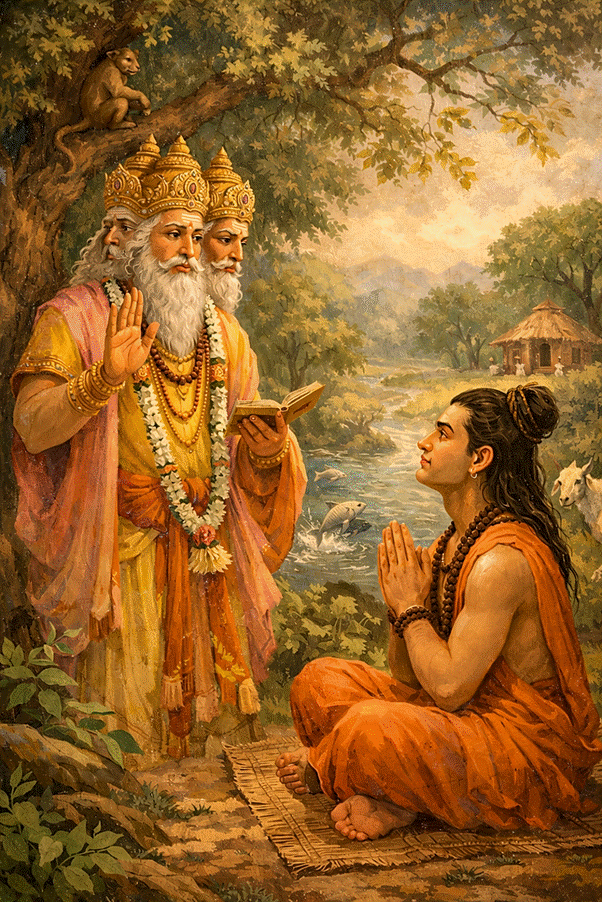
Meanwhile, Swayambhuva Manu grew concerned. As the progenitor of mankind, he bore the responsibility of ensuring the continuity of creation. For this, he needed Priyavrat to enter household life and extend the lineage. Yet his son’s resolve was unyielding. Perplexed, Manu sought counsel from his grandfather Brahma ji. “My son refuses to marry. If he will not beget progeny, how then shall creation proceed?”
The Legacy Continues
Recognizing the gravity of Manu’s dilemma, Brahmaji resolved to intervene. He approached Priyavrat and spoke words of wisdom. “Priyavrat, you are an elevated soul. For one such as you, spiritual attainment is not bound by external circumstances. God is not realized merely by retreating to the forest. If that were so, the monkeys would attain realization before anyone else. If bathing in holy rivers alone sufficed, then the fish would reach God first. If subsisting on leaves were the path to enlightenment, the goats would surpass every seeker. Know this: it is only through bhakti that God is truly realized.”
This eternal truth echoes in the Bhagavad Gita, where Shree Krishna declares:
भक्त्या मामभिजानाति यावान्यश्चास्मि तत्त्वत: ~ Verse 18.55
Only by loving devotion to Me does one come to know who I am in Truth.
In that moment, realization dawned upon Priyavrat. Obeying Brahma ji’s counsel, he entered household life, married, and embraced his royal duties. In time, he grew into a mighty and illustrious ruler. The Bhagavatam recounts how Priyavrat shaped the earth itself, creating its seven oceans and seven continents.
What is striking is that the sages spoke of this geography over five millennia ago—knowledge far ahead of its age. While much of the Western world still debated whether the earth was flat, the Vedic seers had already proclaimed it Bhugol (round in form) with oceans and continents mapped. Indeed, the very Sanskrit term for geography, Bhugol, reflects this ancient insight.
Eventually, following the tradition of vanaprastha ashram—the stage of life when one withdraws from worldly duties—he entrusted the kingdom to his son Nabhi and retired to the forest for spiritual practice. The scriptures prescribe that one enters vanaprastha at the age of fifty-one (ikyavan), and Priyavrat set an ideal example.
Birth of Rishabhdev
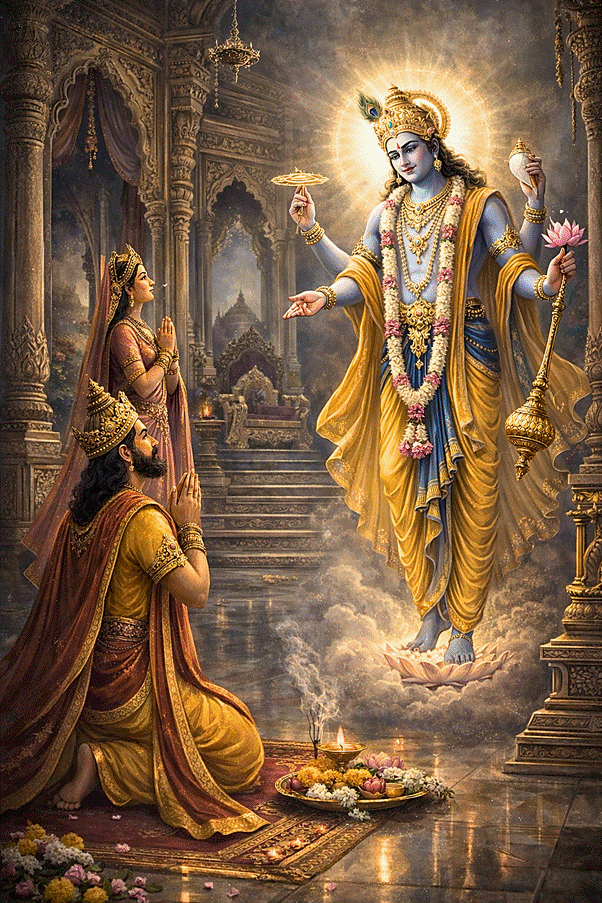
Nabhi then ascended the throne with queen Merudevi by his side. A righteous ruler, Nabhi governed the land so well that the region came to be known as Ajnabhavarsh, bearing his name. Yet amid prosperity, one sorrow weighed upon Nabhi and Merudevi: they remained childless. With deep devotion, they worshipped the Lord. And in time, the Supreme Almighty manifested before them, inviting them to ask for a boon. Nabhi prayed with humility: “O Lord, grant us a child who matches You in virtues and attributes.”
But who could ever be equal to the Supreme?
The Shwetashvatar Upaniṣhad declares:
न तत्समश्चाभ्यधिकश्च दृश्यते ~ (6.8) [v21]
“Nobody is equal to God, nor is anyone superior to Him.”
The Lord smiled gently, “The only way to fulfill your wish is I Myself shall come as your son.” Thus, in answer to their prayer, God incarnated once more. From the womb of Merudevi was born Rishabhdev—a divine avatar destined to guide humankind through His life and teachings.
After fulfilling their duties as parents, Nabhi and Merudevi retired to the forest, handing over the kingdom to their son. Rishabhdev at first ruled as king, guiding his many sons with profound wisdom. To them He said, “My dear children, the human form you have received is supremely rare. Its true purpose is not fulfilled by mere animalistic pursuits—eating, sleeping, mating, and defending. Even animals engage in these activities. If human life is spent only in these, its potential is squandered.”
One might argue, “I do more than that; I work in an office. I manage responsibilities.” But Rishabhdev’s point cuts deeper: Why do we work? If our efforts ultimately serve only to facilitate eating, sleeping, mating, and defending, then we have not truly risen above the animal plane. The sophistication of the activity does not alter its underlying purpose.
Rishabhdev, therefore, emphasized that human existence is meant for something higher. He further cautioned his sons that material entanglement begins with attraction between a man and woman. From this arises a binding knot that ensnares the soul in worldly attachments. As desires multiply, so do obligations, and the illusion of the material energy (maya) tightens its grip. Only the grace of the Guru can sever this Gordian knot and free the soul from bondage.
Having imparted this timeless teaching, Rishabhdev passed on the kingdom to his eldest son, Bharat, and withdrew into the forest. There, he embraced a life of austere renunciation. He relinquished all possessions, even clothing, and lived in complete detachment from worldly conventions.
It is from this aspect of His life that the Digambar tradition among the Jains draws its inspiration. Those who saw Him wandering unclad would often laugh or mock. Yet Rishabhdev remained unmoved, with His mind utterly absorbed in divine bliss.
Bharat’s Forest Encounter
With Rishabhdev’s renunciation, Bharat ascended the throne. His reign was marked by nobility, wisdom, and virtuous conduct. It was during his rule that the land came to be known as Bharatvarsh—a name that exists to this day.
Yet one day, a profound revelation dawned upon him: kingship and worldly glory are not the ultimate purpose of life. Recognizing the higher calling of the soul, he abandoned the throne and retreated to the forest. On the banks of the Gandaki River, in what is now Nepal, he devoted himself to intense spiritual practice. But even the most elevated souls, while living in the material world, remain susceptible to its snares.
And one day, an unexpected event unfolded before him.
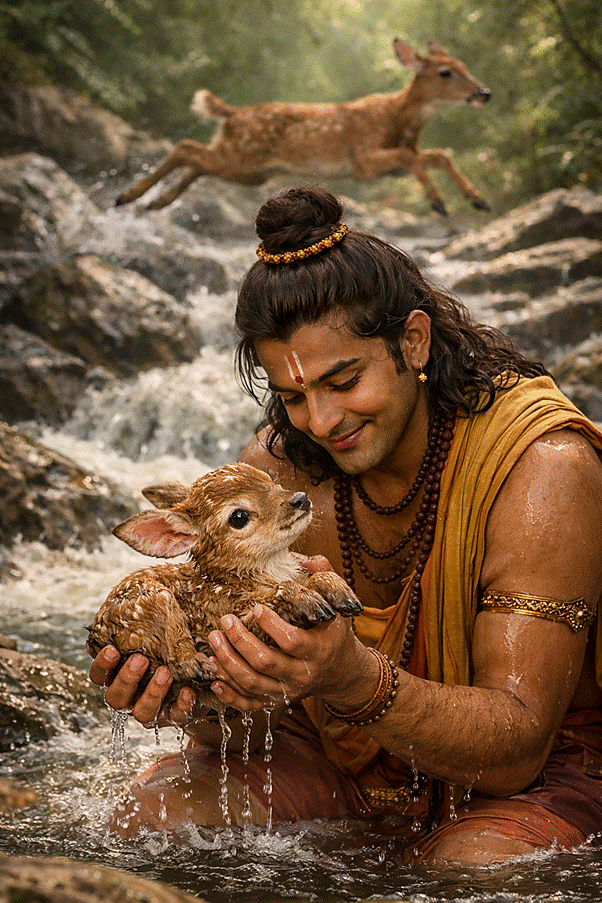
A herd of deer had come to drink water from the stream. Just then, a lion roared, scattering the herd in panic. Among them was a doe carrying a baby fawn in her womb. Out of fear, it leapt across the rocky waters. The fawn was cast into the stream, while the mother landed wounded on the far bank, staggered briefly, and fell lifeless. The fawn drifted helplessly downstream. Bharat, beholding this tragic scene, was moved to pity. He lifted the tiny creature from the water and thought: Who would care for this little one now? Carrying it to his hut, Bharat began to nurture it.
Compassion is a noble virtue, yet when exercised in forgetfulness of God, it can become a subtle chain of bondage. This was Bharat’s experience. He tended the fawn with affection—feeding it succulent grass, delighting in its playful frolics. Gradually, his mind, once steady as a Paramahamsa absorbed in divine contemplation, began to waver. He found himself enchanted by the fawn: How endearing it looks! When I offer it grass, it gazes at me as though I were its father. Does it love me as much as I love it?
Attachment crept in silently, like ivy around a tree. Bharat’s concern shifted from his spiritual pursuit to the well-being of the deer. As it grew and wandered off to graze, Bharat would anxiously wait for its return, hoping nothing had happened to it.
Slowly, the fawn became the axis of his emotional world.
Perils of Worldly Attachment
One day, the deer wandered off and did not return for two days. Bharat, restless and anxious, moved from place to place, his mind consumed with worry: Where has the little one gone? In this wild forest, who will care for it? His thoughts circled endlessly around the deer, leaving no room for anything else.
In his frantic search, Bharat reached a cliff overlooking a stream far below. Lost in worry and wholly absorbed in thoughts of the fawn, he slipped and fell from the edge. Jagged boulders lay at the bottom, and he was fatally wounded. As he lay there in his final moments, he saw the deer standing right in front of him. With his mind fixed upon it, Bharat departed from his body.
Shree Krishna says in the Bhagavad Gita,
यं यं वापि स्मरन्भावं त्यजत्यन्ते कलेवरम् |
तं तमेवैति कौन्तेय सदा तद्भावभावित: || ~ Verse 8.6
Whatever one remembers upon giving up the body at the time of death, O son of Kunti, one attains that state, being always absorbed in such contemplation.
And further,
अन्तकाले च मामेव स्मरन्मुक्त्वा कलेवरम् |
य: प्रयाति स मद्भावं याति नास्त्यत्र संशय: || ~ Verse 8.5
Those who relinquish the body while remembering Me at the moment of death will come to Me. There is certainly no doubt about this.
Because Bharat’s final thought was absorbed in the deer, he was reborn as a deer in his next life.
Thus began another chapter in Bharat’s life.
Though clothed in the body of a deer, Bharat was blessed by God with the awareness and memory of his past life. Looking back, he saw the folly of his former existence and deeply regretted it—how close he had come to realization, only to falter through attachment. Determined to make amends, he resolved to tread carefully. However, as a deer, he could not perform spiritual austerities, for only the human body allows such discipline. So, he wandered near the hermitages of sages, partaking of the sacred vibrations. From their huts emanated the chanting of the divine Names, and he quietly bathed in their resonance.
In this way, he spent his life as a deer. When that life came to an end, God granted him the human form once again, offering him the chance to resume his spiritual journey.
Frequently Asked Questions
1. How is Rishabhdev remembered in different spiritual traditions?
Rishabhdev is revered by the Jains, who honor him as the very first of their twenty-four Tirthankaras, preceding Mahavir.
2. If remembering God at death leads to Him, why practice devotion all our lives?
Death is a painful and unsettling experience. At such a time, the mind naturally turns to whatever thoughts have become part of one’s inner nature. According to the Skanda Puran, remembering God at the moment of death is exceedingly difficult. For the mind to turn to Him in that final moment, our consciousness must already be deeply absorbed in Him. The thoughts we dwell upon repeatedly become ingrained in our nature. Therefore, we must practice remembering God throughout our lives; only then will we develop a God-conscious inner nature.
3. Compassion is a divine virtue. Why did it then lead to Bharat’s downfall?
A virtue retains its purity only when practiced for the pleasure of God. Actions—even noble ones like compassion—become binding if motivated by personal attachment or emotional gratification. When offered in loving remembrance of God, however, they are sanctified and elevate the soul. In Bharat’s case, his compassion for the fawn gradually shifted into attachment centered on himself rather than devotion to God, and this led to his downfall.
Video Resource
The Only Purpose of Human Life - Priyavrat and Bharat Story | Bhagavatham Ep 12 Swami Mukundananda