

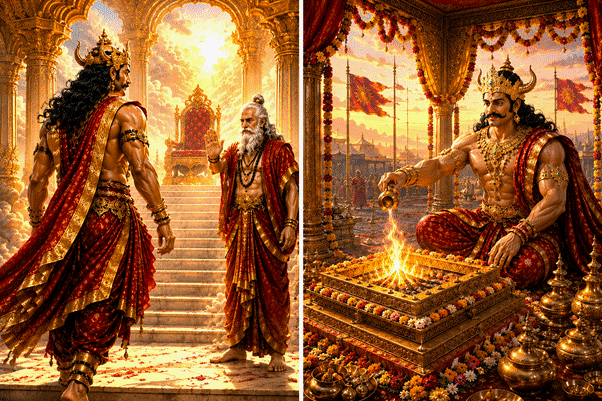
Bali, the grandson of Prahlad, was no ordinary demon king. Such was his might that even the heavens quaked before him. He vanquished Indra and wrested the celestial kingdom from the devatas, leaving them bereft of their abode. Yet, just as Bali stepped forward to ascend Indra’s throne, his guru Shukracharya stopped him. “Bali, the throne of Indra cannot be secured by sheer force. If you want your reign to be stable, you must perform one hundred Ashwamedh yagyas.”
“Then I shall remain in the celestial realms and perform them here,” Bali declared.
Shukracharya’s gaze deepened as he spoke. “The devatas belong to a bhog yoni. Here, they only exhaust the fruits of past virtues; they cannot perform new, fruit-bearing karmas. It is humans alone who possess the power of purusharth (conscious self-effort), the freedom to act and earn new merit.” Realizing this, Bali descended to the earthly plane and commenced the solemn sacrifices. One by one, ninety-nine were completed. Now only the hundredth remained—and with it, Indra’s throne would be his.
Alm of Three Steps
Grief engulfed Aditi, the second wife of Kashyap and the mother of the devatas. To see her children—once radiant dwellers of the celestial abodes—now robbed of their glory and thrust into exile was more than she could bear. In her anguish, she sought counsel from her husband. Kashyap, ever wise and compassionate, urged her to embrace the payovrat form of bhakti.
With deep faith, Aditi immersed herself in worship of the Supreme Lord. Moved by her devotion, Bhagavan bestowed an extraordinary benediction upon her: He Himself would descend as her son. Thus, from Aditi's womb was born Vaman Bhagavan.
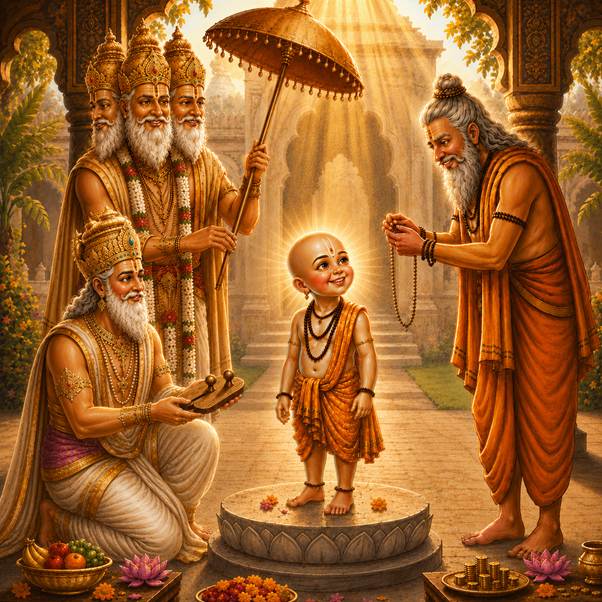
Vaman’s stature was dwarfish. He grew to a precise height of fifty-two fingers, or bavan, hence the Name Vaman. His Form was a masterpiece of divine aesthetics. While all infants possess a natural charm, when the Supreme Architect of the universe takes the Form of a child, that beauty becomes incomparable. Offerings soon poured in for the Divine child. Brahma ji gifted Him an umbrella, Bhrigu offered Him the (janeu) sacred thread, and Brihaspati eagerly presented Him with wooden sandals. Vaman’s pearly teeth glistened like moonlight, and His very being radiated an ethereal allure that none could resist.
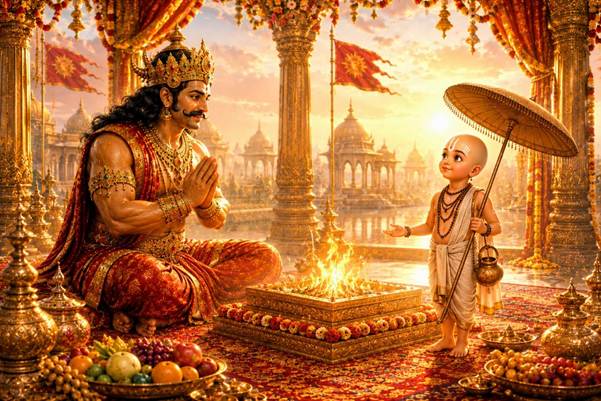
In that exquisite roop-madhuri, the Almighty, veiled in the tender guise of a Brahmin boy, set forth. His steps carried Him to the yagya mandap of Bali, where the king’s monumental hundredth sacrifice was underway. The moment Bali’s eyes fell upon Vaman, he was spellbound. Unaware that the Supreme Lord stood before him, he was simply enchanted by the boy’s beauty. Welcoming Him with deep reverence, Bali bowed and spoke, “O brahmin devata, Your presence has sanctified my yagya shala. How may I serve You? Please ask for whatever charity You desire, and it shall be Yours. Do you want a herd of cows, royal garments, glittering gold, pure silver, or vast lands? Tell me what You want?”
Vaman, however, displayed great frugality. He replied, “It is not wise to have many desires. It is better to live simply. I ask of you just three steps of land—measured by my own feet—where I may sit undisturbed and perform my daily prayers.” Bali was astonished. “Maharaj!” he exclaimed, “You stand before such a mighty king, who can give you entire realms and yet you ask for mere three steps of land? Ask for something greater.” But Vaman only smiled and said, “O king, there is no end to human desires. If I receive but three steps of land, I shall remain perfectly content.”
Word of Caution
Shukracharya—the sharp-witted preceptor of the asuras—narrowed his eyes. He recognized the young brahmin instantly, and a chill of foreboding coursed through him. Leaning close to Bali, he cautioned, “My child, open your eyes! This is no ordinary brahmin. This is Bhagavan Himself! He has donned this enchanting disguise solely to cheat you. Do not promise Him a single grain of dust. If you utter the vow, He will strip you of your crown, your wealth, and your entire empire. He will take everything from you!”
But Bali remained unmoved. With a serene and ecstatic smile, he replied, “Gurudev, if Bhagavan Himself has come to my doorstep seeking alms, then no soul could be more blessed than I am. And if He wishes to take away everything from me, then what greater fortune could there possibly be?”
This sentiment echoes across ages in the timeless words of Saint Kabir:
यह शीश है लहू की तुमड़ी, हरि अमृत की खान।
शीश दिए जो हरि मिले, तो भी सस्ता जान॥
This head is but a vessel of blood, while Hari is an inexhaustible mine of nectar. Even if one must surrender their head to attain the Divine, consider it a bargain!
Bali chose to ignore the warnings of his guru. Fixing his gaze upon the Divine child, Bali declared, “I shall give.” Vaman replied, “Then take the sankalp; sanctify your promise with a vow.” Bali lifted the sacred ceremonial pot of water to formalize his pledge.
Yet Shukracharya resorted to a desperate stratagem to foil the effort. Shrinking into a subtle form, the guru slipped inside the spout of the vessel, tightly blocking the passage. Bali tilted the pot once, then twice, but not a single drop emerged. Puzzled, he placed the vessel down and picked up a sharp, slender twig and thrust it into the spout to clear the obstruction.
Just then, Shukracharya peered through the tiny opening, eager to inspect whether his plan had succeeded. But in that instant, the sharp tip of the twig shot through and pierced his eye. His entire scheme collapsed in a heartbeat. Blinded in one eye, Shukracharya recoiled and fled. With the obstruction gone, Bali completed the Sankalp at last. No sooner had the vow been sealed than Vaman began measuring the promised land. What followed was unfathomable.
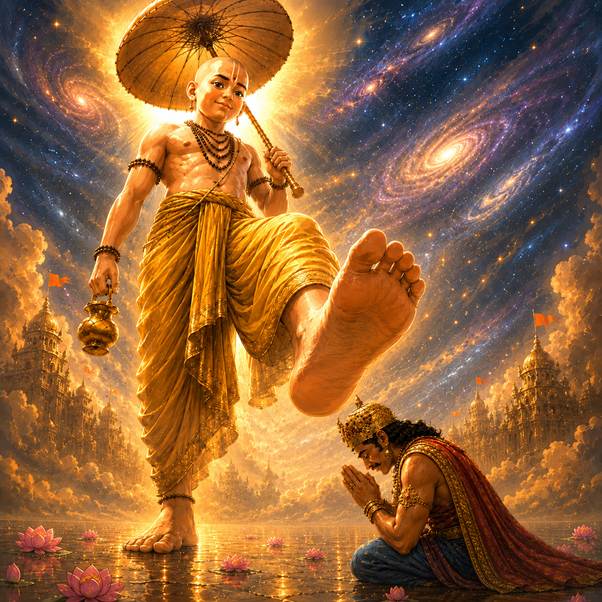
The little Brahman boy began to expand. He grew taller, wider, and infinitely vaster. Within moments, He transformed into a colossal being that straddled the universe. Where Bali had once seen His face, he could now scarcely glimpse the toenail of His foot. A tremor of awe surged through Bali. Staring upward in disbelief, he whispered, “What infinite wonder is this!”
Then Vaman Bhagavan took His first step. With that single stride, He covered the entire earth. Raising His foot for the second step, He ascended through space, swept across, and conquered the celestial realms. His Form became so massive that the toenail of His foot punctured the crust of the universe. Through that opening, the transcendental waters beyond the material creation came gushing in as a stream. Having touched the lotus feet of the Lord, those primordial waters manifested as the Surasari Ganga—the holy river Ganges.
Vaman Bhagavan’s voice then resounded across the cosmos, and he spoke, “Now tell me Bali, where shall I place My third step?”

The Final Step
Unblinking and unhesitating, Bali spoke, “Where is the doubt, Maharaj?” Then, bowing before the awe-inspiring form of Vaman Bhagavan, he lowered his head in utter humility and said, “My Lord, please place Your third step upon my head.”
This was no longer the charity of a king offering land to a Brahman. At that moment, Bali offered his very self. It was atma-samarpan—offering one’s soul to the Lord. Seeing such absolute surrender, Vaman Bhagavan was deeply pleased and accepted Bali’s offering.
Then Bhagavan said, “Bali, you are Daityaraj. Now you must go to the nether regions.” With eyes full of love, Bali replied, “Maharaj, I shall gladly go to the nether world without the slightest regret—save for one plea. Wherever I turn within my palace, whenever I step forth from my doors, let my eyes behold only Your divine darshan. And when I return home, my eyes must once again rest upon Your face. Let me never lose sight of You.”
A tender smile arose upon Vaman Bhagavan’s lips. “So be it,” He said. “But if you wish to behold Me at every moment, then I Myself must stand at your door as your guardian.” Even today, Vaman Bhagavan is believed to stand sentinel at His devotee’s gate, never leaving Bali’s side.
At this juncture in the narrative, Parikshit said to Shukadev, “Maharaj, you have narrated the katha of Swayambhuva Manu. Please enlighten me regarding the other Manus as well.” As though lifting one curtain at a time, Shukadev began describing the different Manvantars—the vast epochs through which creation journeys across time. He explained that in the second Manvantar, the Manu was Rochan; in the third, Uttam; and that it was in the fourth Manvantar of Tamas Manu that the celebrated Gajendra Uddhar leela unfolded.
As the narration moved forward through the great cycles of time, Shukadev arrived at the seventh Manvantar—the Vaivasvat Manvantar—the very age in which we presently exist, within the twenty-eighth Chatur Yug. It is in this period that he narrated the histories of the Surya Vansh and the Chandra Vansh—the illustrious solar dynasty descending from Surya Dev and the lunar dynasty descending from Chandra Dev.
Buried deep within the history of the ancient Surya Vansh lies a staggering secret—one we shall exhume in the next chronicle…
Frequently Asked Questions
Question: What can Bali’s willingness to lose everything teach us about devotion and trust in God?
Answer: Even after realizing that Vaman Bhagavan would strip him of his kingdom and power, Bali did not withdraw his promise or allow fear to overpower his faith in God. Instead, he joyfully surrendered everything—including his very self—to the Lord. Bali’s life teaches us that surrender to God is never a loss; rather, it is the threshold to the highest spiritual gain. In Bhagavad Gita Verse 5.29, Lord Krishna says, He is सुहृदं सर्वभूतानाम्—'the benevolent well-wisher of all living beings.’ When we truly imbibe this truth, faith becomes far more than merely asking God to fulfill our desires. It becomes the strength to trust His infinite wisdom, even when His plans defy our understanding. While it is easy to praise God when life unfolds according to our wishes, true devotion shines forth in testing moments—just as it did in the life of Bali. Do we still hold on to Him with faith and love when life challenges us? Very often, the most transformative moments of life arise when we loosen our grip on control, place our absolute trust in the Divine, and remain open to His grace. Discover the power of surrendering to God’s will in this insightful video, ‘Understanding God’s Plan for You’ by Swami Mukundananda.
Question: Why are festivals like Onam and Bali Pratipada associated with King Bali even today?
Answer: After witnessing King Bali’s extraordinary surrender and devotion, Vaman Bhagavan blessed him with everlasting glory. Although Bali was sent to rule the nether regions, Bhagavan granted him the boon of returning to the earthly plane once every year. This annual homecoming of Bali is celebrated through festivals such as Onam and Bali Pratipada, symbolizing prosperity and harvest. These festivals commemorate not merely Bali’s greatness as a king, but more importantly, his complete self-surrender and the boundless, protective grace of Bhagavan upon His devotee.
Video Resource
Miracles of God When you Surrender to him with Faith - The Vamana Avatar Story | Swami Mukundananda