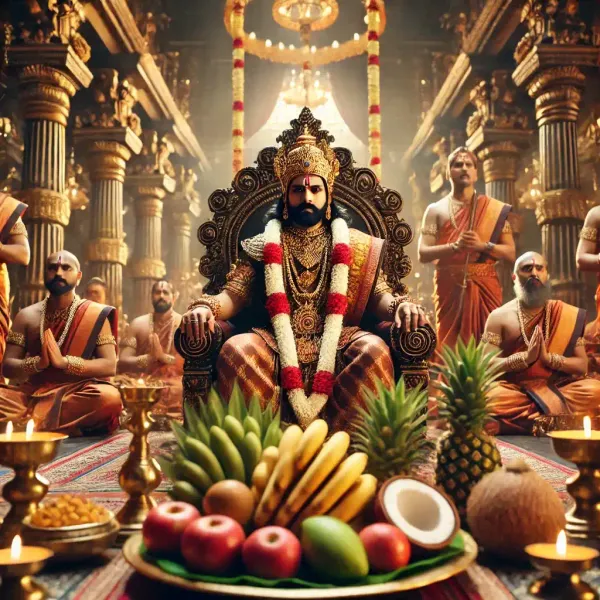
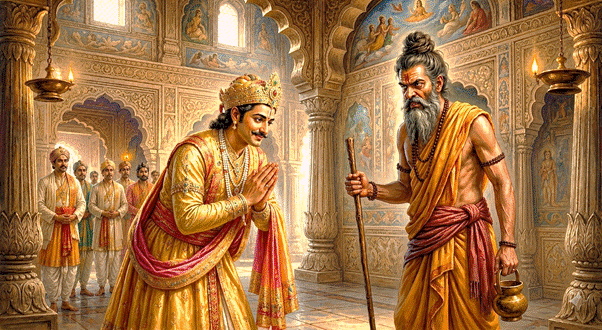
In the illustrious Surya dynasty reigned the noble King Ambarish. More wondrous than the expanse of his empire was the depth of his devotion. Every faculty of his being was consecrated to the Divine. His feet journeyed to the temple, his eyes sought the Lord’s darshan, his nostrils inhaled the aroma of offered garlands, his ears drank the nectar of katha, and his tongue chanted the holy Name.
With deep love for the Lord, Ambarish once undertook a rigorous vow of Nirjala Ekadashi—abstaining entirely from both food and water on every eleventh lunar day. At last came the climactic fast of the year. It was to be broken precisely during the Madhyahn period of the ensuing Dwadashi.
As the auspicious hour drew near, Sage Durvasa arrived unannounced at the palace. Delighted, Ambarish welcomed him with great reverence. “Maharaj, your presence is a blessing. May I offer you something to eat?” Yet beyond the tranquillity of the moment, a storm was brewing.
Durvasa's Fury Backfires
Durvasa said, “I shall eat, but first let me refresh myself. I will bathe in the river and then return.”
Off he went to the riverbank, leaving King Ambarish waiting with folded hands for his honored guest. But as time wore on, the king’s concern mounted. Durvasa's bath seemed unending, and the auspicious hour for breaking the fast was ebbing away.
Marooned in a dilemma, Ambarish sought the counsel of learned scholars. To partake of food before his guest returned would be a grave discourtesy; yet to let the sacred hour pass would defile his vow. The wise men offered a subtle resolution. “O King, drink a sip of water. It will suffice to break your fast, yet it will not count as a meal.” Reassured by their words, Ambarish lifted the water to his lips and sipped.
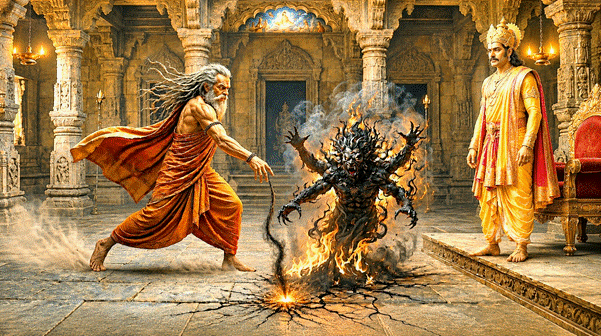
Meanwhile, Sage Durvasa became aware of what had transpired. When he returned to the palace, he erupted like a volcano. “I am your guest,” he thundered. “Yet you lack the basic etiquette of hospitality! You dared to drink water before my arrival? For this insolence, you shall be punished.” Infuriated, Durvasa plucked a single lock of hair from his head and hurled it to the ground. From it sprang a Kritya—a fiendish entity. Pointing a finger at the king, Durvasa commanded the creature to kill Ambarish.
Even when faced with sudden, catastrophic ruin, Ambarish did not blench. He stood there serene. Bhagavan, however, would not bear an assault on His devotee. At once, the Lord released His Sudarshan Chakra. The divine disc instantly reduced the Kritya to ashes and then pivoted, locking its fiery gaze onto Durvasa himself. Terrified, the sage fled, yet the Sudarshan Chakra trailed him unremittingly.
First, Durvasa sought asylum from Indra, the king of the gods, only to receive a helpless shrug: “Against the Lord’s weapon? What power do I have?”
Panic-stricken, he rushed to Brahmaji, “Please save me!” But Brahma replied: “Who can stand against the will of Bhagavan? What can I do?”
He then implored Lord Shiv—“Help me!”—but Shiv ji too turned him away: “It is impossible for me to intervene.”
Tulsidas Ji writes in the Ramcharitmanas,
बिंधि न इँधन पाइऐ, सायर जुरै न नीर।
परै उपास कुबेर घर, जो बिपच्छ रघुबीर॥
If the Lord becomes displeased, then even the densely wooded Vindhya mountains will yield no firewood, the ocean will be unable to replenish its waters, and even Kuber, the lord of wealth, will face poverty.
In other words, when Bhagavan withdraws His grace, even the mightiest powers are rendered helpless. With every door closed to him, and the Sudarshan Chakra still in hot pursuit, Durvasa turned to the only hope that remained: Lord Narayan Himself.
Lord Narayan’s Verdict
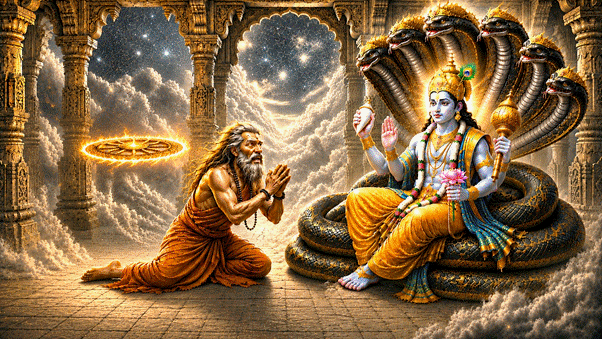
Exhausted and desperate, Sage Durvasa finally came before Lord Narayan. As he poured out his plight and pleaded to be rescued, Bhagavan unveiled a tender secret from the innermost depths of His heart.
श्रीभगवानुवाच अहं भक्तपराधीनो ह्यस्वतन्त्र इव द्वज ।
साधुभग्रस्तहृदयो भक्तैभक्तजनप्रय: ॥ 9.4.63 ॥
I am entirely under the influence of My selfless devotees and I am actually not independent. Because they are completely free from material desires, I reside exclusively in the core of their untainted hearts. Moreover, not just My devotees, but even those who serve and revere My devotees hold a special place in My heart.
He continued,
ये दारागारपुत्राप्तप्राणान् वत्तममं परम् ।
हत्वा मां शरणं याता: कथं तांस्त्यक्तुमुत्सहे ॥ 9.4.65 ॥
Pure devotees renounce their homes, spouses, children, relatives, wealth, and even their very lives solely to serve Me, harboring no aspirations for material gains in this life or the next. How, then, can I ever forsake such devoted souls at any time?
The principle revealed here is profound. When devotees offer their hearts completely to God and accept Him as their sarvasva (absolute everything), they become His pran-priya. They become as precious to Him as life itself. Since they love Him with their entire being, God reciprocates with equal intensity. Even an earthly mother cannot tolerate the slightest harm to her child. God is the eternal, spiritual mother of the soul. Thus, the Lord, even in His dreams, cannot bear an insult to His beloved devotee.
At this point, Lord Narayan disclosed the crux of the matter. “It is against such a devotee that you have committed an offense. Therefore, there is only one remedy. Return to Ambarish and seek his forgiveness.” With the Sudarshan Chakra still blazing at his heels, Durvasa hastened back to the palace. The sage fell at Ambarish’s feet and pleaded, “O noble king, please forgive me.”
Yet Ambarish felt no sense of triumph, nor did he harbor a single shred of resentment. Instead, he felt deeply embarrassed to see the revered sage suffering on this account. Filled with compassion, the king humbly prayed to the Sudarshan Chakra to be pacified. The incandescent disc finally withdrew its fury and returned to the hand of its Master. The storm had stilled, and Durvasa was saved from peril.
Surya Vansh and the Holy Ganga
Among the luminaries of the Solar dynasty was King Sagar, whose lineage would one day summon the holy Ganga to Earth.
Sagar once undertook the Ashwamedh Yagya, the grand horse sacrifice. A consecrated stallion was set loose to roam the lands. Eventually, it wandered off to the hermitage of Sage Kapil at Ganga Sagar. The king’s sixty thousand sons set out in search of it. Discovering the horse beside the sage, they leapt to a reckless conclusion. “This ascetic must have stolen our horse!” Their accusations shattered Kapil’s deep meditation. As his eyes snapped open, a single fiery glance reduced them all into mounds of ash. The yagya remained incomplete, and King Sagar soon departed this world.
Thereafter, the responsibility of the yagya passed from father to son. Sagar's heir, Asamanjas failed to restore the ritual. The task then fell to his son, Anshuman, who approached Sage Kapil with deep humility. Seeking forgiveness, he retrieved the horse and finally completed the sacrifice. Yet one question weighed heavily upon him. “Revered one,” he asked, “how may my ancestors attain spiritual welfare?” Sage Kapil replied, “Only when the holy waters of Mother Ganga sanctify their ashes shall they attain beatitude. Bring Her down from the celestial realms.” But despite his best efforts, Anshuman was unable to bring Ganga to Earth. His son Dilip also strove in vain. Generation after generation, the quest remained unfulfilled until the mantle passed to Bhagirath.
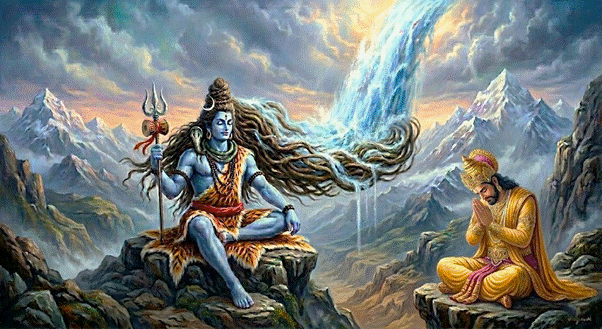
Bhagirath undertook severe austerities, worship, and prayer. His devotion melted Mother Ganga’s heart, and she agreed to descend from the celestial realms. Yet before doing so, she posed two daunting questions. First: “Who will withstand the force of my descent from the celestial realms?” Second: “Millions of people will bathe in my waters to wash away their sins. How will I bear the burden of those countless sins?”
Bhagirath answered, “Mother, Shankar Bhagavan will receive you in His matted locks and soften the force of your descent. As for the sins of humanity, great Mahatmas will also bathe in your waters, and their purity will sanctify the sins of others.” Assured by his answer, Mother Ganga gave her consent.
At last, Ganga plummeted towards Earth. Her exuberant torrents would have shattered the world had Shankar ji not caught her in His matted locks and restrained her there. Only after Bhagirath offered his prayers, did Lord Shiv release the sacred currents to cascade onto the earthly plains. Ganga is known by many names. She is called Sursari because she descended from the celestial regions, Bhagirathi because Bhagirath brought her to Earth, and Jatashankari because she first rested in the matted locks of Lord Shankar.
Bhagirath mounted his chariot and surged ahead, with River Ganga tracing his path. True to her spirited nature, she did not follow a straight course. Overflowing her banks, she flooded the hermitage of Sage Jahnu. Disturbed by the sudden deluge, the powerful sage swallowed the entire river. Looking back, Bhagirath gasped—the mighty river had vanished. Once more, he prayed. Moved by his sincerity, Jahnu relented and released the waters from his ear. Thus, the river earned her fourth name, Jahnavi.
At long last, the holy river reached Ganga Sagar. There, her pure waters touched the ashes of King Sagar's sons, granting them ultimate welfare and bringing to fruition a quest that had spanned generations.
From these sacred banks, we journey to Ayodhya, where another titan of the Surya Vansh awaits us—King Dasharath.
Frequently Asked Questions
Question: If Durvasa is a God-realized sage, how could he display such tremendous anger?
Answer: Just as God performs leelas, elevated saints too sometimes act in ways that conceal their true nature. Leela means to hide one's original identity. For example, Lord Ram is all-knowing, yet in the Ramayan, He wandered in search of Sita, asking, “Where is Sita?” Similarly, Durvasa Muni's service to God is to occasionally throw tantrums and put devotees in difficult situations. Through such incidents, when God steps in to protect them, their glory is revealed. Further, the Lord’s bhakta-vatsalata—loving care for His devotees—is beautifully manifested. Thus, Durvasa serves God in this astonishing way.
Question: In this world, all are God’s children. Then why does He consider an offense to His devotee more serious than even an offense directed toward Himself?
Answer: God is indeed samdarshi—equitable toward all. He is also infinitely compassionate and readily forgives offenses committed against Him. However, in the Bhagavad Gita Verse 4.11, Shree Krishna declares a divine principle: “In whatever way people surrender unto Me, I reciprocate accordingly.” The devotees of the Lord lovingly and completely dedicate themselves to Him. He, in turn, becomes bound by their devotion and personally protects and guides them. The scriptures, therefore, caution us to be extremely careful in our dealings with such saintly devotees.
The Vishnu Puran states:
विष्णुस्थाने कृतं पापं गुरु स्थाने प्रमुच्यते ।
गुरुस्थाने कृतं पापं वज्रलेपो भविष्यति ।।
A sin committed against Lord Vishnu can be forgiven at the feet of the Guru; but a sin committed against the Guru becomes as hard as a coating of diamond (vajra-lepa) and is exceedingly difficult to remove.