
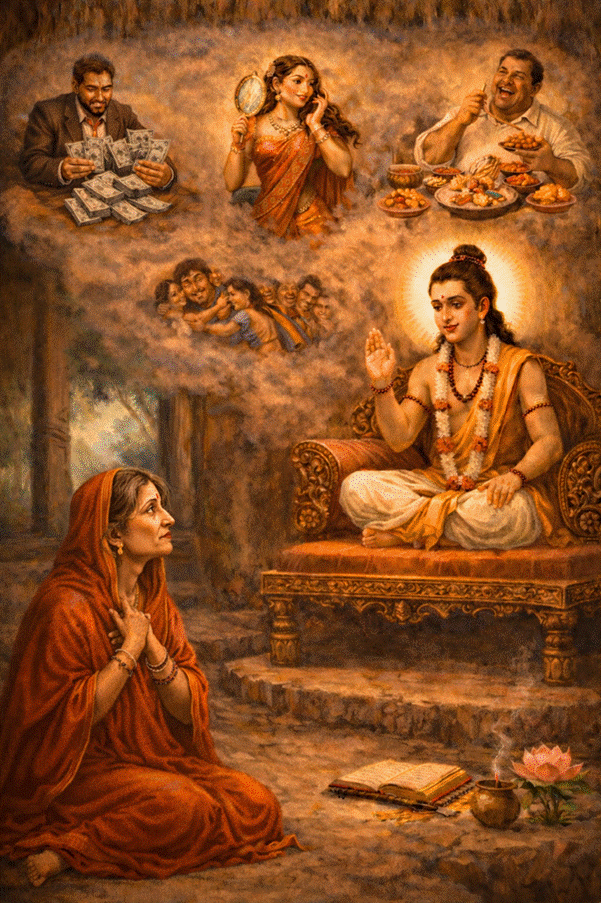
Overwhelmed by the relentless tug of the senses—the subtle ‘paramours’ that beguile the soul—Devahuti turns to her son, Bhagavan Kapil, seeking a way to rise above her suffering. With compassion, Kapil ji explains that the soul is inherently pure. Yet, when it becomes ensnared in materialistic conception, it begins to identify itself with the body and pursues the fleeting pleasures of the material energy ‘maya’. This craving for worldly delight binds the soul to the ceaseless cycle of birth and death.
Maharshi Kapil then illuminates the path ahead. He teaches that the human form is a rare and precious opportunity. If one engages in bhakti to the Supreme, that devotion becomes the means to transcend the bondage of rebirth and attain true freedom.
Centuries later, the same eternal truth is heard again in Bhagavad Gita verse 8.15, where Shree Krishna declares: “Having attained Me, the great souls are no more subject to rebirth in this world, which is transient and full of misery, because they have attained the highest perfection.”
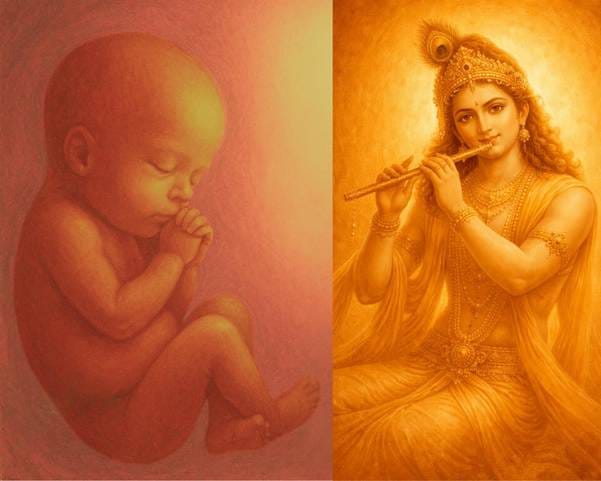
Prayer in the Womb
Maharshi Kapil begins describing the soul’s journey as it enters the mother’s womb. Long before modern science uncovered the mysteries of embryonic development, these ancient verses from the Bhagavatam spoke of the body’s formation in stages.
In the first month, the head begins to take shape.
By the second month, the limbs—hands and feet—emerge.
In the fifth month, the child experiences hunger and thirst.
By the seventh month, awareness dawns.
The soul gradually becomes conscious of its condition—suspended upside down, confined in darkness, and surrounded by blood, mucus, and waste. Weighed down and utterly helpless, it is seized with anguish and begins to question its plight: Where am I? What is this suffering?
It is at this moment, explains Bhagavan Kapil, that a profound realization stirs within. Reflecting on its divine origin, the soul turns to God in prayer: My Lord, please take me out of this place. I promise that when I come out, I will engage in Your devotion and strive to attain the ultimate goal You have set for me.
However, once the child emerges into the world, the powerful currents of the material energy swiftly take hold. The soul, still tender and unfortified, lacks the strength to resist their pull. Gradually, the clarity it once glimpsed within the womb fades, and the vow it made in prayer is forgotten. Ensnared by illusion, it becomes absorbed in the same materialistic conception of life, chasing fleeting pleasures and losing sight of its true purpose.
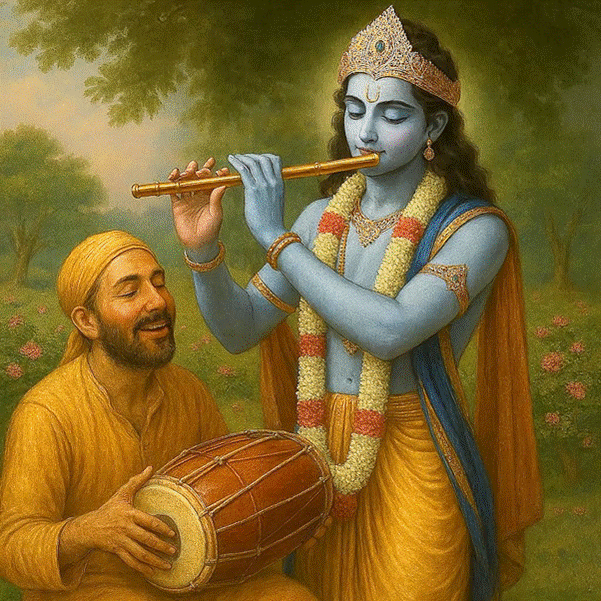
The Remedy
Further, Bhagavan Kapil reveals how bhakti enables the soul to transcend the entanglements of material illusion.
Kapil ji explains that a soul bound by maya is enmeshed in five sheaths or koshas—annamaya, pranamaya, manomaya, vijnanamaya, and anandamaya. Liberation from the endless cycle of birth and death, requires that these coverings be burned away and transcended.
With a relatable analogy, He illustrates how bhakti brings about this transformation.
जरयत्याशु या कोशं निगीर्णमनलो यथा॥ ~ Verse 3.25.33
Bhakti effortlessly dissolves the subtle body of the living entity, much like the fire in the stomach naturally digests all that is consumed, requiring no separate endeavor.
When we eat, we only place the food in our mouth. The rest of the process unfolds automatically. The food first transforms into ras (nutritive fluid), which turns into rakt (blood); from blood arises mans (flesh), then medha (muscle), followed by haddi (bone), majja (marrow), and finally virya, (the vital essence). We do not consciously manage any of this. We do not worry whether the bread we ate yesterday has become blood, bone, or muscle. We simply eat, and digestion takes care of the rest.
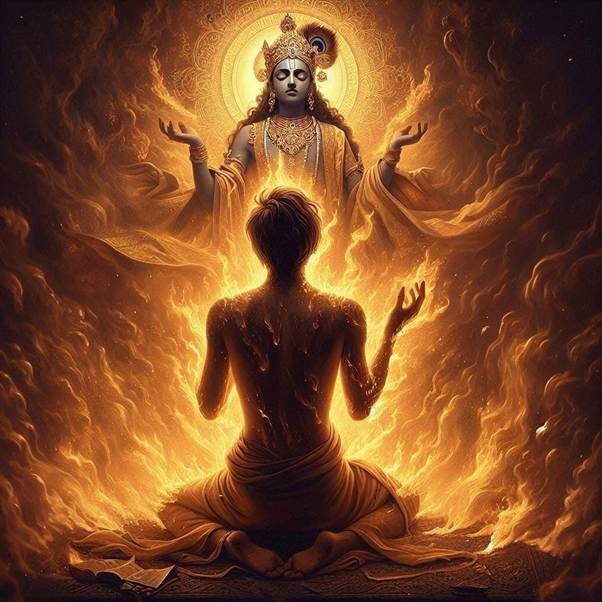
Similarly, on the path of bhakti, our role is disarmingly simple: we just attach the mind to God. Slowly, almost imperceptibly, a deep yearning to behold the Lord awakens within. This viraha—the sacred pain of longing—is no ordinary emotion. It is a fire kindled in the heart. And once lit, that inner flame begins its silent work.
It burns through the subtle sheaths that veil the soul, even without our conscious awareness of the process. Thus, the instruction Kapil ji gives is crystal clear: “Increase your love for God. When the fire of yearning begins to blaze in the heart, it will gradually consume the five koshas and bestow liberation.”
Kapil ji then draws attention to a crucial point.
The Role of the Mind
“On the path of Bhakti, my dear mother”, said Kapil Maharaj, “hold fast to this one sutra of mine: whatever form of devotion you embrace—whether it be puja, paath, japa, or kirtan—let the mind be wholly absorbed in God. For it is the mind that binds the soul and the mind that sets it free.”
This same principle is echoed in the Panchadashi with crystalline clarity: मन एव मनुष्याणां कारणं बन्धमोक्षयोः “The mind is the cause of bondage, and the mind is the cause of liberation.”
When the mind clings to the world, it remains bound within the three modes of material consciousness:
● Tamas (mode of ignorance)
● Rajas (mode of passion)
● Sattva (mode of goodness)
But when the mind becomes attached to God—who is transcendental and supremely pure—it too begins to be purified. Slowly, it sheds its material afflictions such as anger, greed, envy, hatred, pride that torment the soul, and thus rises above worldly limitations.
चेत: खल्वस्य बन्धाय मुक्तये चात्मनो मतम्।
गुणेषु सक्तं बन्धाय रतं वा पुंसि मुक्तये॥ ~ Verse 3.25.15
When the consciousness of a living being is drawn towards the three modes of material nature, it is known as conditional life. However, when that soul becomes deeply attached to the Supreme Divine Personality, its consciousness transcends material bondage and attains the state of liberation.
The mind is then the pivot, the fulcrum upon which the soul’s journey rests. It can enslave, or it can liberate. Bhakti is the sacred art of turning the mind Godward, transforming it from the source of bondage into the very instrument of freedom.
Nature of Bhakti
And Kapil Maharaj then goes on to describe the very nature of bhakti.
लक्षणं भक्तियोगस्य निर्गुणस्य ह्युदाहृतम्।
अहैतुक्यव्यवहिता या भक्ति: पुरुषोत्तमे॥ ~ Verse 3.29.12
True devotion is characterized by an unwavering absorption of the mind in God, free from any distractions or selfish desires.
Here, Kapil ji speaks of the defining symptoms of pure bhakti. These characteristics recur throughout the Bhagavatam, since it is the Amalatma Puran—stainless and unsullied by worldly desires. Therefore, it is also revered as the Paramahamsa-Samhita.
Kapil ji emphasizes that bhakti must be nirgun (free from worldly cravings). One should not approach the Divine with petitions for material gains. Instead, devotion should be ahaituki (without ulterior motive) and avyavahita (unbroken, constant). Thus, the mind must be anchored in God and Guru alone.
Yet a natural question arises: How does one cultivate such bhakti? What if faith, detachment, or even interest in God has not yet awakened within?
Maharshi Kapil anticipates this very concern and, with deep compassion, reassures His mother that there is no cause for worry. There exists a simple and powerful way to kindle faith and devotion from within—Satsang, being in the company of the wise and the holy. Such is the transformative power of Satsang that simply being in the presence of saintly personalities, faith, interest, and devotion begin to blossom naturally. It is much like how fragrance diffuses from a flower when one comes close.
सतां प्रसङ्गान्मम वीर्यसंविदो भवन्ति हृत्कर्णरसायना: कथा:।
तज्जोषणादाश्वपवर्गवर्त्मनि श्रद्धा रतिर्भक्तिरनुक्रमिष्यति॥ ~ Verse 3.25.25
In the association of pure devotees, discussion of the pastimes and activities of the Supreme Personality of Godhead is very pleasing and satisfying to the ear and the heart. By cultivating such knowledge, one gradually becomes advanced on the path of liberation, and thereafter, one is freed, and one's attraction becomes fixed. Then real devotion and devotional service begin.
After imparting this wisdom, Maharishi Kapil prepared to depart. Devahuti, with reverence and humility, offered her pranam to her divine son. Blessing his mother, Kapil ji left and journeyed towards a place now known as Gangasagar.
Devahuti, meanwhile, lived exactly as instructed. She absorbed her mind completely in God. In time, her body itself dissolved into water as she departed, and that sanctified spot came to be known as Bindu Sarovar. The holy place where Devahuti attained spiritual perfection in Gujarat is revered today as Siddhpur.
Even now, Siddhpur holds profound spiritual significance. Tradition maintains that while Pitr Shradh (oblations for the father) is performed in Gaya, Matr Shradh (oblations for the mother) is offered in Siddhpur—forever consecrated by the memory of Devahuti’s supreme realization.
Frequently Asked Questions
- Question: Do spiritual paths other than bhakti also help dissolve the five sheaths that envelop the soul?
Answer: Certain spiritual disciplines, such as Ashtanga Yog prescribe rigorous austerities like the panchagni kriya to dissolve these sheaths. However, such practices demand extreme effort and are nearly impossible for most people in today’s age.
Bhakti, by contrast, offers a gentler and more accessible path. Through heartfelt devotion, the coverings around the soul are gradually dissolved without strain, harsh discipline, or even conscious effort. One need not concern themselves with the mechanics of the sheaths; the process unfolds naturally and effortlessly as devotion deepens.
- Does seeking liberation align with the spirit of pure devotion?
Answer: True devotion to God is unconditional and untainted by personal motives. To approach Him seeking material boons is clearly self-interest. However, the desire for mukti (liberation from the cycle of birth and death), though spiritual in nature, is still rooted in self-concern, as it reflects one’s desire to escape worldly miseries and attain bliss. A devotee who loves God purely does not make liberation the goal. Instead, liberation arises naturally as a byproduct of bhakti, without being sought.
The scriptures further clarify that on the path of devotion, a devotee does not even accept the five distinct forms of liberation:
सालोक्यसार्ष्टिसामीप्यसारूप्यैकत्वमप्युत।
दीयमानं न गृह्णन्ति विना मत्सेवनं जना:॥ ~ Verse 3.29.13
A pure devotee does not seek or accept any form of liberation—whether salokya (residing on the same planet as the Lord), sarshṭi (sharing His opulences), samipya (close association with Him), sarupya (having a Form like His), or ekatva (oneness with Him)—even when these are graciously offered by God Himself. A pure devotee only desires to serve Him selflessly.
A pure devotee desires only to serve the Lord, finding happiness in His happiness and aligning completely with His will.
As Jagadguru Shree Kripalu ji Maharaj says in the Bhakti Shatak:
ब्रह्म लोक पर्यंत सुख, अरु मुक्तिहुँ सुख त्याग।
तबै धरहु पग प्रेम पथ, नहिं लगि जैहैं दाग॥ ~ Verse 45
“If you wish to walk the path of divine love, then abandon all desires for pleasure up to Brahma’s abode and the desire for all kinds of liberation as well or the pure water of divine love will get tarnished.”
Video Resource
Fastest Way to Break the Karmic Cycle - Srimad Bhagavatam Part 9 | Swami Mukundananda
[RC1]Msg for the US team: Please insert video here as per the hyperlink.