

A man once walked alone through a forest when three robbers confronted him. The first said, “Let us kill him and take all he has.” The second objected, “No, let us loot him but spare his life.” They tied the traveler, stole his possessions, and left him helpless. After some distance, the third robber returned, untied him, saying: “I cannot take you out, but I can show you the way to escape.”
These robbers symbolize the three modes of Maya (the material energy), pervading the consciousness of all who dwell in this world. The Shwetashvatar Upanishad (4.5) [v22] describes Maya as tri-colored:
1. Black – Tamas (mode of ignorance): pulls the soul into darkness and delusion.
2. Red – Rajas (mode of passion): ensnares the soul in endless worldly pursuits.
3. White – Sattva (mode of goodness): lifts the soul towards higher virtues and ethics yet keeps it in the clutches of Maya.
In the world, we witness life to be a farce of colors: we rinse away one stain only to be smeared with another. Through willpower and discipline, we wrestle to cleanse ourselves of these influences, yet Maya holds sway over us.
Is there a color beyond this palette?

Transcending the Shades of Maya
The Vedas remind us that our inherent nature is divine. Each soul is an eternal fragment of God. Yet this radiant identity is concealed, for Maya has a way of smudging the mind—until we forget the true color of our being.
Shree Krishna declares in the Bhagavad Gita:
ममैवांशो जीवलोके जीवभूत: सनातन: |
मन:षष्ठानीन्द्रियाणि प्रकृतिस्थानि कर्षति || ~ Verse 15.7
“The embodied souls in this material world are My eternal fragmental parts. But bound by material nature, they are struggling with the six senses, including the mind.”
Maya works by distorting perception, a state the scriptures call viparyaya-buddhi.
Imagine three mice who drank spilled alcohol and became intoxicated.
One mouse, swaggering, said, “Look at me! I am the King of this land. Bow before your ruler!” The second mouse, thumping his chest, said, “King? Ha! I am the mighty conqueror. I shall march across kingdoms and claim them all!” The third twitching his tail, said, “You fools! Forget kings and conquerors. Tonight, I will eat the cat itself!”
Their judgment was utterly corrupted. Likewise, under Maya’s illusion, our own understanding becomes distorted. The very word Maya derives from mā (not) and yā (what is)—“that which is not what it appears to be.” Caught in this mirage, we mistake the soul for the body, assume worldly possessions to be permanent, and forget that nothing material walks with us beyond death. We think puffing cigarettes, getting the next big house and luxury car, or even getting into a loving relationship will grant us happiness—only to encounter suffering instead. The result is inner turmoil: a mind splashed with anger, greed, lust, envy, hatred.

The Color We Are Searching For
Across countless ages, humanity has chased happiness in myriad forms. And beneath every pursuit lies the same longing: the desire to be happy. Yet the pleasures of the world, however dazzling, prove to be fleeting. Even those crowned with fame and fortune have confessed this truth.
Justin Bieber, a global icon of fame and success, admitted: “People see the outside, remarkable things. But they don’t know the other side. This life really gets at me. I find it too difficult to go through the day.”
John D. Rockefeller, the wealthiest man of his era, confessed: “I had millions, but it did not give me six days of happiness.”
What explains this paradox?
The Vedas clarify that the desire for pleasure is not in itself wrong; the error lies only in seeking it in the wrong place. Consider a fish taken out of water. We may try to comfort it: massage it with oil, wrap it in a blanket, install heaters, even pour hot coffee into its mouth. Yet if the fish could speak, it would cry: “I don’t want all this. If you wish to give me happiness, put me back into water.” Similarly, we keep offering the soul sense pleasures through the body and mind. But the soul delivers the same verdict: “This is not my happiness. Give me my true happiness.”
Since the soul is a fragment of God, no amount of worldly glitter—however dazzling—can quench its deeper thirst. The bliss it seeks is divine, and God Himself is the embodiment of bliss. The Ramayan echoes beautifully: ānanda sindhu madhya tava vāsā, binu jāne kata marasi piyāsā. “O Lord, You are the ocean of bliss, and You reside within us. Without knowing You, how can our thirst for happiness ever be quenched?”
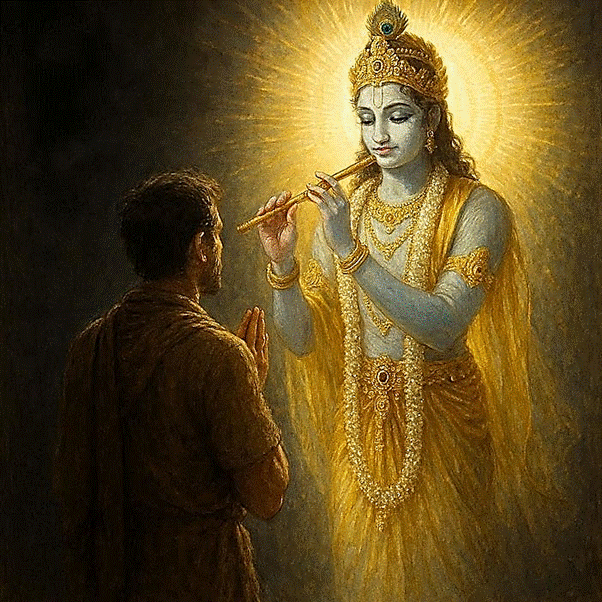
The Hue of God
This longing for happiness remains unfulfilled because we have turned away from God. The remedy: turn back toward Him.
God is pure light; Maya, a veil of darkness. When we face God—the effulgent source of bliss and knowledge—we are illumined. Turning away, all we see is a dark shadow. Though God is like the sun, Maya envelops us the moment we avert our gaze from Him. As one of God’s energies serving Him, Maya conceals His true nature and enmeshes souls who are vimukh, turned away from Him. Through repeated disappointments in the world, Maya imparts a silent lesson to the soul: lasting happiness lies only in becoming sanmukh—facing the Supreme Soul, the Divine.
And it is this orientation that decides the color of our consciousness.
All objects and personalities in this world operate under the three modes (Tamas, Rajas, Sattva) of material nature. When the mind attaches itself to them, it too becomes colored by these modes. But when the same mind is absorbed in the Supreme Almighty—who is beyond the material realm—it becomes purified.
Shree Krishna states in the Bhagavad Gita:
मां च योऽव्यभिचारेण भक्तियोगेन सेवते |
स गुणान्समतीत्यैतान्ब्रह्मभूयाय कल्पते || ~ Verse 14.26
“Those who serve Me with unalloyed devotion rise above the three modes of material nature and attain the spiritual platform.”
Thus, the sovereign remedy for inner afflictions like lust, anger, greed, envy, and illusion is to detach the mind from the world and immerse it in the Supreme Lord. Unlike material attachment, which stains the mind, divine attachment elevates and sanctifies it.
The Ramayan affirms this truth: prema bhagati jala binu raghurāī, abhiantara mala kabahuñ na jāī. “Without the water of loving devotion to God, the impurities of the mind can never be washed away.”
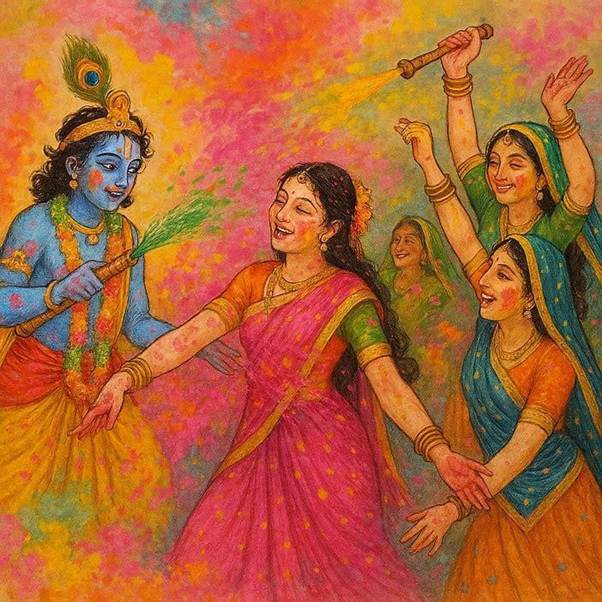
Anointing the Colors of Devotion
The most effective and effortless way to engage the mind in God is through hearing (Shravan), chanting (Kirtan), and most importantly, remembering (Smaran) the Lord’s Names, Forms, Pastimes, Virtues, and Abodes. This threefold practice, known as Tridha Bhakti, is extolled by saints and scriptures.
Here is an enchanting Pastime of Shree Krishna that gave Holi its sacred charm.
One spring morning, Krishna gazed at Radha’s fair complexion and sighed to His Mother: “Maiyya, why am I dark while Radha is so fair?” Mother Yashoda replied gently: “On Holi, you may color Radha as you wish.” Delighted, Krishna awaited the festival and, when Holi arrived, joyfully drenched Radha and the gopis in vibrant hues, playfully splashing colors with pichkaris.
Being colored outwardly is no marvel—that happens every Holi. The true celebration is when we are dyed within, in the divine hue of His love. When the heart is steeped in devotion, worldly desires lose their charm. Such a soul sees only God, hears only of God, speaks only of God, and ultimately becomes one with Him. As the saying goes:
या अनुरागी चित्त की गति नहिं जाने कोय।
ज्यौं ज्यौं बूड़ै श्याम रंग त्यौं त्यौं उज्ज्वल होय।।
The ways of an amorous mind are unfathomable: the deeper it immerses in Shyam Sundar’s color, the more luminous and pure it becomes.
So, as we play Holi, let us pray: “O Lord, please inundate our hearts in Your divine color.”
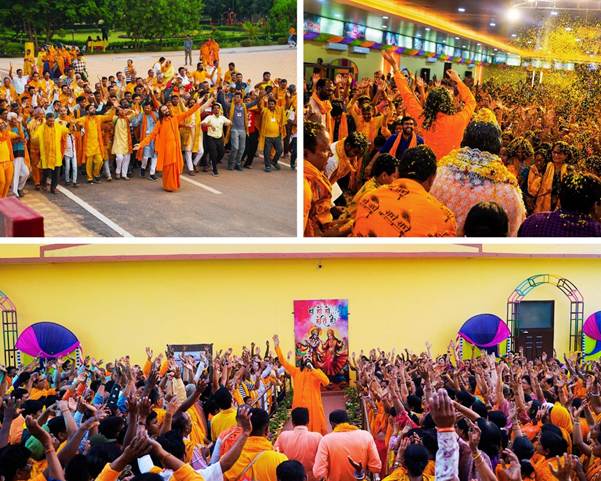
Drench in Divinity
If you wish to bathe your mind in fountains of perennial wisdom, sprinkled with the fragrant hues of bhakti—you are warmly invited to the JKYog Holi Spiritual Retreat with Swami Mukundananda. Held in the serene embrace of the JKYog Bhakti Ashram in Cuttack, India, this retreat is more than a festive gathering; it is a holy carnival of consciousness. Every aspect of the shivir is designed to awaken love for God while nurturing the seeker—physically, emotionally, and spiritually.
Morning Prayers & Shree Maharajji’s Lectures
Each dawn unfurls with heartfelt morning prayers that gently align the mind with life’s true purpose. The simple yet profound plea to the Lord, ending with the thrice-repeated invocation: “Grant me alms of Your love,” softens the heart and sets the tone for the day ahead.
Jagadguru Shree Kripalu Ji Maharaj’s lectures gleam like pearls of wisdom. His words, rich with piercing clarity and humor, make the loftiest truths not only comprehensible but delectable. At times, listeners are drawn into the tender pastimes of Radha-Krishna, sung in Shree Maharajji’s melodious voice. Devotion wells up and eyes glisten with pure joy.
Swami Mukundananda Ji’s Discourses
Each JKYog retreat centers around a chosen theme. This time, Swamiji will illuminate the timeless wisdom of the Bhagavad Gita. His discourses are like holy rain on parched soil: authentic, practical, and insightful. Enriched with the spice of tattva-gyan, the sweetness of bhakti, and a dash of humor, his teachings are a complete feast for the soul.
Kirtans and Bhajans
The beatific kirtans composed by Shree Kripalu Ji Maharaj, carries participants into the many moods of devotion, effortlessly absorbing the mind in divine remembrance. Regarded as a Maha-sadhana in the age of Kali, hours of bhajans feel less like practice and more like a blessing, where the mind is stilled and the heart basks in the glory of God.
Seva Opportunities
Service is the cornerstone of devotion, and JKYog offers abundant opportunities for it. From jhulan seva (swinging the deities), offering bhog, to bathing the deities with panchamrit, each moment becomes an expression of humility, surrender, and love.
Parikrama
Parikrama is more than a walk. It is satsang in motion. Led by Swamiji, devotees circle the Ashram premises, gardens, and the JKU campus, voices entwined in chanting, feet moving to the rhythm of drumbeats. The atmosphere blossoms into a jubilant procession of togetherness.
Devotional Dance & Music Performance & Hari Bol Dance
If spirituality ever seemed sombre, retreats like these shatter that notion. The Mehfil cultural program bursts with color and creativity, where participants offer dance, music, drama, instruments in loving devotion. The evening crescendos into the Hari Bol dance, where the entire community moves as one—swirling in harmony with the Holy Name.
Phoolon Ki Holi
And finally comes the most cherished experience—Phoolon Ki Holi. As fragrant flower petals cascade like showers of divine grace, Holi transcends into the sublime. Swami Mukundananda Ji himself steps onto the stage, showering colors imbued with affection. With Braj Holi kirtans filling the air and Swamiji’s voice leading the chorus, the consciousness is awash in a palette of colors beyond words.
Call to Action
Join the Holi Sadhana Shivir with Swami Mukundananda, and let the rainbow of divine love paint your soul.
📅 18 Feb – 22 Feb 2026
📍Jagadguru Kripalu University Banara, Cuttack, Odisha, India