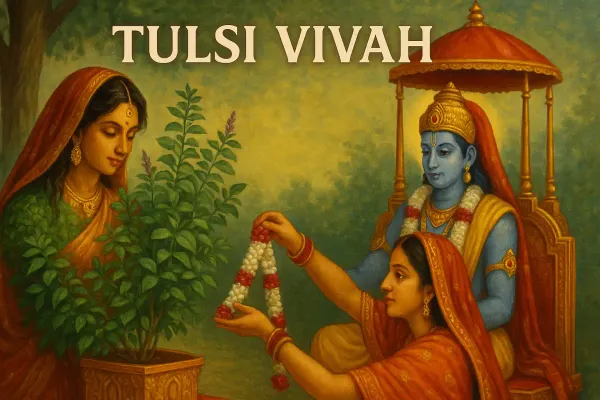
The festival of Tulsi Vivah is one of the age-old, beautiful and deeply symbolic rites in Hindu culture. It marks not just a ritual wedding of the sacred tulsi plant (holy basil) with Lord Vishnu (or a form thereof), but also a profound spiritual symbolism of devotion, purity, transformation, and the union of the soul with the Divine. In this blog we will explore in detail the date for 2025, the vidhi (rituals), the muhurat (auspicious time), the story/legends behind it, and its significance. In the final section we will tie it back to the teachings of Swami Mukundananda and see how we can apply the deeper message of Tulsi Vivah to our lives.
Date for Tulsi Vivah 2025
The date of Tulsi Vivah varies from region to region, since it is based on the lunar calendar and the tithi (lunar day) in the month of Kartik. According to several sources, the ceremony is typically performed between Prabodhini Ekadashi (the 11th lunar day of the bright half of Kartik) and Kartik Purnima (the full moon of Kartik).
For 2025, sources indicate that Tulsi Vivah falls on the Dwādashī (12th lunar day) of the Shukla Paksha of Kartik in many locations. For example, one Marathi-language article mentions that in 2025 the tithi of Tulsi Vivah is the Kartik Shukla Dwādashī.
While the exact local muhurat will depend on your region (time zone, local sundarāśṭaka, etc.), one can plan for the evening hours of the designated day (since the marriage ritual is traditionally done when the bride is adorned and the family gathers).
In short:
- Month: Kartik (Hindu lunar calendar)
- Day: Shukla Paksha Dwādashī (or approximate) for many regions in 2025
- Typical time: After evening, with the evening aarti or mandap set-up
- Note: Always check your local panchāng (Hindu almanac) for the exact muhurat in your city.
Muhurat (Auspicious Time)

Determining the muhurat is crucial in Hindu ritual practice, and for Tulsi Vivah it is no different. Here are some general guidelines:
- The ceremony should ideally start after the evening aarti, once the day has cooled and the mind is calm and reverent.
- In many households the ceremony may begin just after sunset, when family members gather around the tulsi plant, dressed for the occasion.
- The tithi (lunar day) must be correct — typically Dwādashī of Shukla Paksha of Kartik — and the local sunrise/sunset times need to be taken into account.
- If one misses the exact muhurat on that date, many traditions permit doing the ritual on the same lunar day’s “pradosh” (evening) or even the next auspicious day, as long as the tithi is honoured.
- The significance here is not merely the “time” but the state of mind — the family is pure, there is worship, devotion and the sense of treating the tulsi-plant as the bride, Lord Vishnu (or his form) as the groom.
Thus, when planning for Tulsi Vivah in 2025, ensure: correct tithi in your region, a calm and devotional atmosphere, dress and décor to reflect the seriousness of the ritual, and ideally in the evening hour when the energy is soft and conducive to spiritual union.
Story Behind Tulsi Vivah
Understanding the story behind Tulsi Vivah enriches the ritual and gives it deep meaning. There are multiple versions of the legend; here is a commonly narrated one:
The Legend of Vrinda, Jalandhar and Tulsi
According to the scriptures (e.g., the Padma Puran and other Puranic texts), there existed a powerful demon-king named Jalandhar. He gained invincibility by means of the chastity (pativrata bhakti) of his wife, Vrinda Devi, who was deeply devoted to her husband and also to the Divine.
When the gods were unable to defeat Jalandhar because of Vrinda’s protective devotion, they appealed to Vishnu. Vishnu, in order to break Jalandhar’s shield of devotion, took on the guise of Jalandhar and approached Vrinda. When she discovered the deception, she cursed Vishnu saying that he would become a stone (Shaligram). Vrinda then immolated herself in anger and sorrow, and her soul took the form of the tulsi plant. Vishnu accepted the curse and took the stone (Shaligram) form, yet to honour Vrinda’s devotion, he promised to marry her in her new form as the tulsi plant.
The Sacred Marriage
Thus, in honour of this story, the ritual of Tulsi Vivah enacts the marriage of the tulsi plant (symbolising Vrinda Devi, and also seen as an incarnation of Goddess Lakshmi) with the Shaligram (symbolising Vishnu) or with Vishnu’s idol. This signifies that pure devotion (represented by Vrinda / Tulsi) has become one with the Divine (Vishnu) in eternal union.
Why It Symbolises the End of Inauspicious Time
The festival is also related to the end of the four-month period of Chaturmasa (during which many devotees refrain from weddings and major ceremonies). With the Tulsi Vivah, the wedding season begins again.
Additional Symbolism
- The tulsi plant is revered not just as a botanical entity, but as the living embodiment of devotion, of the soul longing for God.
- The marriage ceremony is done with all the trappings of a human wedding (mandap, decorations, bride‐groom imagery) to signify that devotion is no less than a sacred marriage with God.
- As the tulsi plant is ubiquitous in Hindu homes, the festival also brings the family and devotees together in a communal act of worship, endowing the home with auspiciousness.
Vidhi (Rituals)
Here’s how the ritual is generally carried out — you may find variations regionally or depending on family/tradition.
Preparations
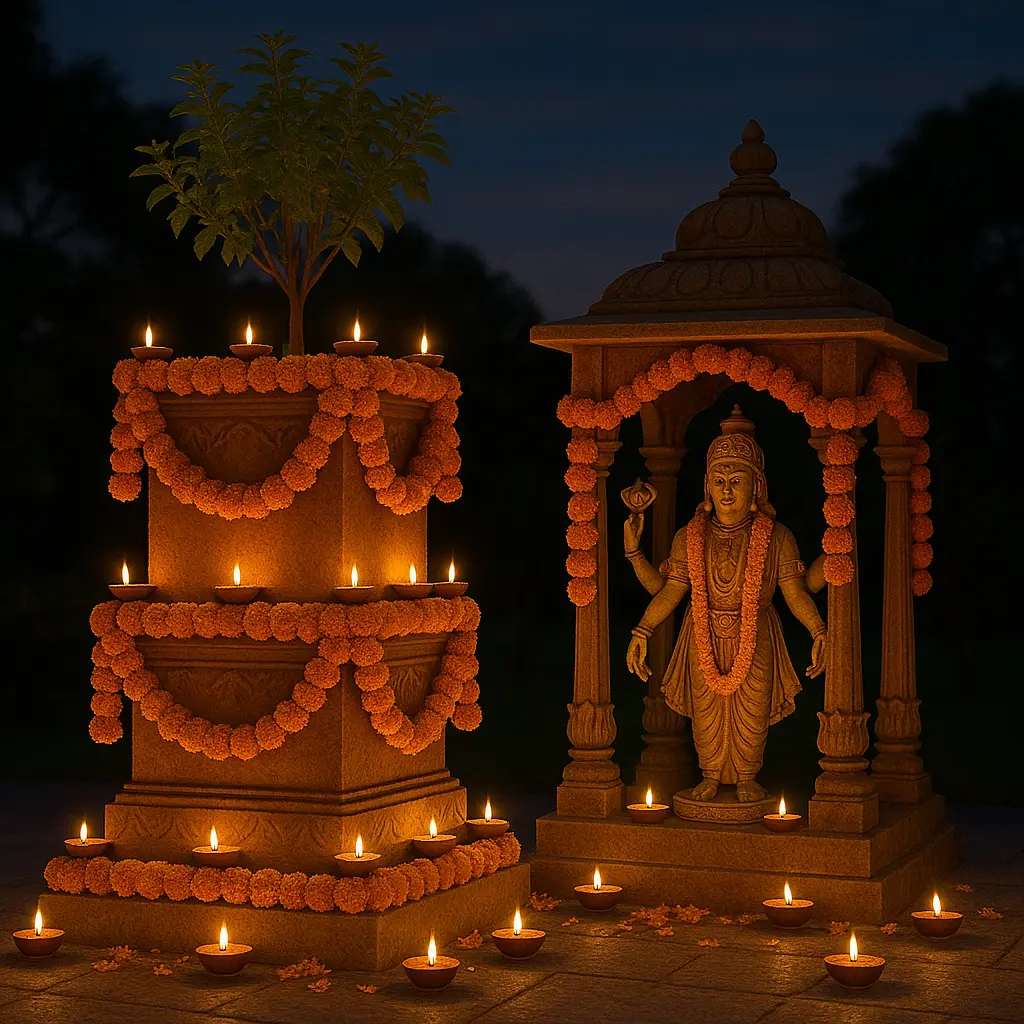
- In the days leading up to the ceremony, devotees clean and decorate the Tulsi plant (often growing in the courtyard or verandah) with lights, flowers, cloth, small canopy (mandap) etc.
- The plant may be washed, fresh soil may be given, and new pots or a decorated base may be arranged, signifying respect and honor for the “bride”.
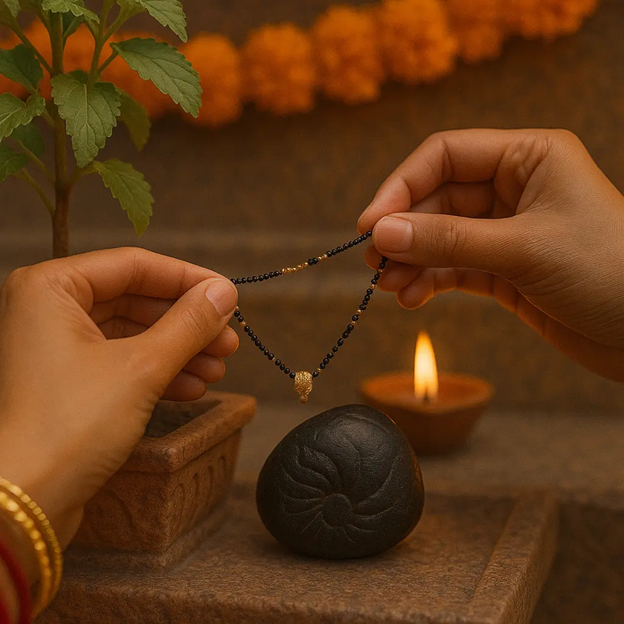
- The “groom” is represented by a Shaligram stone, or sometimes a branch of an amla tree, or an idol of Vishnu or Krishna.
- A wedding canopy (mandap) is created, sometimes with bricks or decorative stand around the tulsi plant, to signify a marriage mandap.
The Ceremony
- On the designated day (Kartik Shukla Dwādashī), after the evening aarti, the family gathers around the decorated tulsi plant.
- The bride (tulsi plant) is adorned with cloth, flowers, jewellery (symbolic), and the groom (Shaligram or Vishnu icon) is placed beside the plant.
- A traditional wedding ceremony is enacted: invocation of Ganesh, tying of cloth (kundala or kamalabharana) between bride and groom, exchange of garlands, application of tilak, offerings of vermilion and rice, circumambulation or symbolic homage.
- Aarti is performed with lamp, incense, and bhajans are sung in praise of Vishnu-Tulsi union.
- Devotees may fast until the ceremony begins, then break the fast after the ritual.
- Married women especially pray for the well-being of their husband and family; unmarried women may pray for a good spouse and happy married life.
Concluding Rituals

- Prasad (sacred offering) is distributed — often sweets, fruits, and items symbolic of the union.
- The decorated tulsi may be left with lights overnight, and then the family may continue devotion in the days following.
- In some homes and temples, the ritual is followed by a feast or communal celebration.
- Importantly, the ritual invites the devotee to reaffirm their inner union with the Divine — the outer ritual is a means to awaken inner devotion.
Significance of Tulsi Vivah
This festival carries many layers of significance, both external and internal — cultural, social, spiritual.
Cultural and Household Significance
- It heralds the beginning of the wedding season in many Hindu traditions — after the monsoon and the inauspicious Chaturmasa period.
- It honours the tulsi plant, which is considered sacred and is often present in Hindu homes; decorating and revering the plant fosters an environment of purity and auspiciousness.
- It strengthens family and community bonding: the ritual encourages gathering, shared worship, and communal celebration.
- For married women and families, it provides an occasion of devotion, gratitude, and prayer for domestic harmony, prosperity, marital happiness. For unmarried young women, it offers symbolic devotion for finding good life-partners.
- It preserves traditional culture: the enactment of a symbolic wedding is often filled with songs, rituals, decorations, and creates continuity of heritage.
Spiritual and Symbolic Significance
- The inner meaning can be framed as the union of the soul (jīva) with the Supreme (Paramātmā). The tulsi plant, representing the devotee’s purity and devotion, unites with Vishnu (the Divine) — symbolising surrender, devotion, transformation.
- The transformation of Vrinda into tulsi, and then her marriage to Vishnu, teaches themes of sacrifice, purity of motivation, the power of unwavering devotion, and the mercy of the Lord.
- It reminds us that devotion is not second class — the ritual elevates the simple tulsi plant to the bride of the Lord, showing that what matters is the quality of devotion, not grandeur.
- In the context of time-cycle symbolism, ending Chaturmasa and beginning the auspicious time suggests that stagnation, inaction or the monsoon of spiritual inactivity can end; one can begin fresh with devotion.
- According to many interpreters, as the tulsi plant is worshipped daily in many homes, the ritual elevates everyday devotion into a sacred wedding, encouraging regular practice.
Some Key Messages
- Purity of heart matters more than external splendour. The story of Vrinda shows that devotion carried the day.
- Surrender: Vrinda’s transformation and union with Vishnu shows that the soul ultimately merges with the Divine when it surrenders.
- Symbolism of time: The festival helps devotees mark a shift from inauspicious to auspicious time, reminding them to shift from inertia to enthusiasm in spiritual life.
- Every-home temple: The tulsi in one’s home becomes a living shrine; the marriage ritual makes it personal and present.
- Renewal: Each year the ritual invites new commitment, fresh energy, and re-dedication.
Tulsi Vivah 2025 — What to Keep in Mind

- Check your local panchāng for the correct lunar tithi and muhurat in your region (city/time zone).
- Prepare the tulsi plant (or if you do not have one, you may install a new one for the ritual) with care, as you would prepare a bride: clean, decorate, honour.
- Choose an evening hour when the family can be together in peace and devotion (often after sunset).
- Create the mandap or decorative space around the tulsi plant: bring flowers, cloth, lights, make it festive yet dignified.
- Perform the ceremony with sincerity: garlanding the tulsi, offering to LORD Vishnu (Shaligram or idol), perform aarti, offer prayers, sing bhajans if possible.
- Use the occasion to reflect: not just as a ritual formality but as an inward step — “How am I cultivating devotion? How is my personal connection with the Divine? How can I renew it this year?”
- Let the after-ritual be one of gratitude and service: after the ceremony distribute prasad, share the spirit of joy with others, and maintain the tulsi plant with daily devotion.
- For those unmarried or seeking marital harmony, use it as a devotional focal point: not just for external fulfilment but for seeking the deeper fulfilment of the soul’s union with God.
- For those already on the spiritual path, let the ritual remind you: the outer form is beautiful, but the inner devotion is what matters.
Final Thoughts: Connecting to Swami Mukundananda’s Teachings
The teachings of Swami Mukundananda offer us a powerful framework to internalize the ethos of Tulsi Vivah in our spiritual lives. Let us reflect on some key themes and how they connect:
1. Mind, Intellect & Ego
Swamiji emphasises that the mind creates desires, the intellect discriminates and the ego latches on.
In the context of Tulsi Vivah, the ritual can serve as a pointer to bring our mind-desires (for worldly fulfilments) under the control of our intellect (which discriminates what is transient) and to surrender the ego (which says “I will do this by my effort”) to the Divine. The tulsi plant (symbolising pure devotion) is the mind made pure; the intellect’s decision is: “I dedicate myself to the Lord”; the ego dissolves in the wedding of the soul with God.
2. Bhakti (Devotion) as the Transformative Path
Swamiji often teaches that the highest path is Bhakti Yoga — loving surrender to the Divine, aligning our actions, thoughts and feelings to God.
Tulsi Vivah is a perfect enactment of Bhakti: the devotee (Tulsi) offers herself to the Lord (Vishnu) in loving union. The ceremony reminds us that devotion is not mere ritual, but the heartfelt offering of our entire being. Swamiji’s emphasis on aligning life, mind, and heart to the Divine resonates here: the symbolic marriage invites us to live devotion, not just observe it.
3. From External Ritual to Internal Reality
Swamiji reminds us that external forms are helpful, but the inner reality is paramount. The ceremony of Tulsi Vivah invites the outer ritual of wedding, but its deeper significance is the inner wedding of the jīva with the Paramātmā. When we view the plant as ourselves, the ritual becomes a personal spiritual milestone.
Swamiji’s clear emphasis on self-effort combined with Divine grace comes into play: the soul makes the effort (decorating, ceremony, devotion) and the Lord receives the offering (the wedding moment). Let us remember that the Lord’s grace is always ready: “He promised to marry,” so the soul only needs to open the heart.
4. Renewal and Inner Commitment
Just as annually Tulsi Vivah invites us to renew devotion, Swamiji encourages us to renew our spiritual resolve each day. The start of the wedding season symbolises new beginnings; in our spiritual lives we too can mark times of recommitment.
The union of Tulsi and Vishnu is not just on one day but symbolizes a permanent state of the soul abiding in God. Swamiji’s teachings on sustaining meditation, devotion, right thoughts reinforce that the ritual is a marker, but the walk continues.
5. Living the Symbolism in Daily Life
At the core of Swamiji’s philosophy is that the spiritual life is not separate from everyday life. The tulsi plant in your courtyard, the evening aarti, the decorations—all these point to the fact that the Divine is present in your home, your heart, your humble existence. When you perform Tulsi Vivah with sincerity, you are declaring: “My life, my home, my heart is dedicated to God.” This matches Swamiji’s message: your home is a temple, your heart is the shrine.
Thus, as you celebrate Tulsi Vivah 2025, let the external ceremony be the mirror of your inner resolve:
- Resolve to bring your mind under the control of your intellect, in devotion to the Lord.
- Resolve to live Bhakti in your day-to-day: every action becomes an offering, every thought a prayer.
- Resolve to treat your home, family, relationships as sacred, not separate from your spiritual life but part of it.
- Resolve to renew your inner commitment each year, each day — to remain “married” to the Divine in heart, words and deeds.
May the symbolism of Tulsi Vivah awaken in you the eternal union of the soul with the Supreme, and may the teachings of Swami Mukundananda guide you in walking that path with clarity, devotion and inner transformation.
Call to Action
Let this Tulsi Vivah 2025 be more than a ritual — make it a heartfelt offering of devotion. Prepare your tulsi plant with love, perform the wedding ceremony with faith, and meditate on the divine union of Tulsi Devi and Lord Vishnu as the symbol of your own soul’s union with God.
As Swami Mukundananda teaches, when every act becomes an offering and every breath a prayer, life itself turns into worship. Let your home glow with devotion, purity, and divine love this Kartik month.
References
- Padma Purana, Skanda Purana – legends of Vrinda Devi and Jalandhar.
- Swami Mukundananda. The Science of Mind Management
🔗 Buy on Amazon - Swami Mukundananda. 7 Divine Laws to Awaken Your Best Self
🔗 Buy on Amazon
FAQs
Q1. What is Tulsi Vivah?
Tulsi Vivah is the ceremonial marriage of the sacred tulsi plant (representing Goddess Tulsi or Vrinda Devi) to Lord Vishnu or His Shaligram form. It marks the end of Chaturmas and the beginning of the auspicious wedding season.
Q2. When is Tulsi Vivah in 2025?
In 2025, Tulsi Vivah will be observed on Kartik Shukla Dwādashī, which falls in November 2025. The exact date and muhurat may vary by location, so consult your local panchāng.
Q3. Why do we celebrate Tulsi Vivah?
It commemorates the divine marriage of Tulsi Devi and Lord Vishnu, symbolizing the union of the human soul (jīva) with the Supreme Lord. It also marks the start of auspicious events like weddings and new ventures.
Q4. What are the main rituals of Tulsi Vivah?
Devotees decorate the tulsi plant like a bride, place a Shaligram or Vishnu idol as the groom, and perform wedding rites including garland exchange, aarti, and prasad distribution with devotional songs and prayers.
Q5. What is the spiritual meaning of Tulsi Vivah?
It represents the merging of pure devotion with the Divine. The ceremony teaches surrender, love, and transformation — the devotee (Tulsi) uniting with God (Vishnu) in eternal bhakti.
Q6. How can we observe Tulsi Vivah at home?
Clean and decorate the tulsi plant, prepare offerings, chant Vishnu mantras or bhajans, and perform the symbolic wedding with faith and humility. End with aarti and distribute prasad to family and guests.