
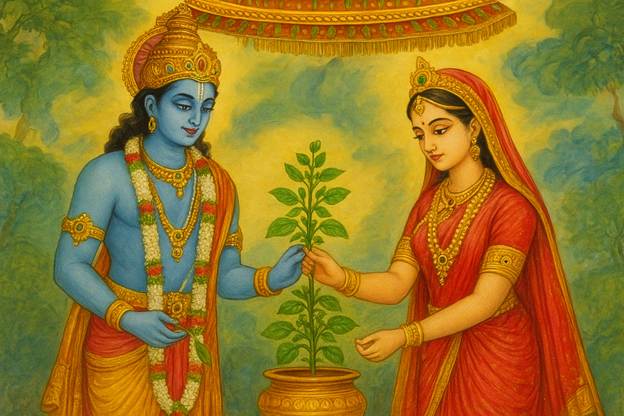
The scriptures confirm that there is one Supreme Entity who takes on different forms, like Radha and Krishna, Shiv and Parvati, and Lakshmi and Vishnu, to relish the bliss of divine love. Just as a person feels lonely in isolation, the all-complete Bhagavan expanded Himself into two — the Supreme Enjoyer (Purusha) and the Supreme Energy (Prakriti). This sacred duality allows the Lord to express infinite varieties of loving pastimes. Divine bliss, or rasa, finds expression through these leelas, captivating the hearts of devotees. The Tulsi Vivah is one such heart-warming pastime of the Lord.
The Sacred Place of Tulsi in Hindu Tradition
In the vast garden of creation, where every leaf and blossom reflects divine beauty, one plant has been given a place of unparalleled sanctity — the sacred Tulsi. Revered in every Hindu home, Tulsi is more than a plant; she is worshipped as a goddess, often called Vishnupriya, the beloved of Lord Vishnu. Of all the flora mentioned in the scriptures, Tulsi is regarded as the most sacred — the embodiment of purity, devotion, and divine grace.
From ancient times, the Tulsi plant has been worshipped in courtyards and temples across India. Every morning and evening, devotees light a lamp before her, offer water, and circumambulate her sacred presence. The ritual is often performed by young girls and women, symbolizing purity and the nurturing strength of devotion. Even the soil around Tulsi is believed to be holy. The Padma Purana calls her Vaishnavi — the consort of Vishnu, whose very fragrance purifies the environment and whose touch sanctifies all who serve her.
Tulsi Devi, an expansion of Radha Rani is also known as Bhakti Devi — the goddess of devotion. By her grace alone, souls receive the gift of divine love.
The Legend of Vrinda: The Devotee Who Became Tulsi
Behind the sanctity of the Tulsi plant lies a story woven with love, devotion, and divine purpose — the legend of Vrinda, whose devotion transformed her into the sacred Tulsi.
Long ago, there lived a virtuous woman named Vrinda, the wife of the mighty demon king Jalandhar. So steadfast was her devotion and chastity that her purity became a shield protecting her husband from harm. Even Lord Shiv could not defeat Jalandhar because Vrinda’s faith and devotion made him invincible.

To restore cosmic balance, Lord Vishnu devised a plan with divine compassion. He assumed the form of Jalandhar and appeared before Vrinda. Deceived by the illusion, Vrinda unknowingly broke her vow of fidelity. At that very moment, Jalandhar lost his divine protection and was slain by Lord Shiv in battle.
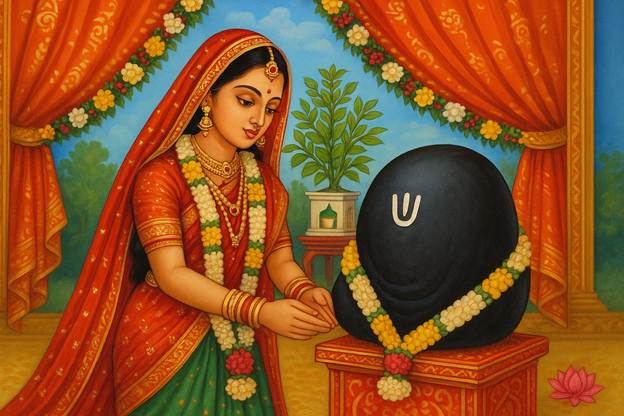
When Vrinda discovered the truth, she was heartbroken. Grief-stricken, she cursed Lord Vishnu, declaring that he would turn dark and be separated from his beloved — a curse that came true when Vishnu incarnated as Lord Rama and was separated from Sita. In another form, he turned into the black Shaligram stone, worshipped as a symbol of the Supreme.
Vishnu blessed Vrinda for her unwavering devotion. He promised that she would be worshipped eternally in her new form — as the sacred Tulsi plant — and that He Himself would marry her in every cycle of time. Thus, Vrinda was reborn as Tulsi, the purest among plants, adored in every household as the goddess of purity, prosperity, and devotion.
The Divine Wedding: Tulsi Vivah
To honor this eternal bond between the Lord and His devotee, Hindus celebrate Tulsi Vivah, the celestial marriage of Tulsi and Shaligram (the stone form of Lord Vishnu). This sacred ritual is performed on the day of Prabodhini Ekadashi, which falls in the bright fortnight (Shukla Paksha) of the Hindu month of Kartik (October–November).
This day also marks the end of Chaturmas — the four-month period when Lord Vishnu is believed to rest — and the beginning of the auspicious Hindu wedding season. In essence, Tulsi Vivah is a symbol of divine union between bhakt (devotee) and Bhagavan(God).
How Tulsi Vivah is Celebrated
On the day of Tulsi Vivah, devotees observe a fast and prepare for the divine wedding with great enthusiasm. In the evening, the Tulsi plant is bathed, dressed in new garments, and adorned like a bride. She is decked with sixteen ornaments — solah shringar — garlands, bangles, and bright vermilion on her tender leaves.
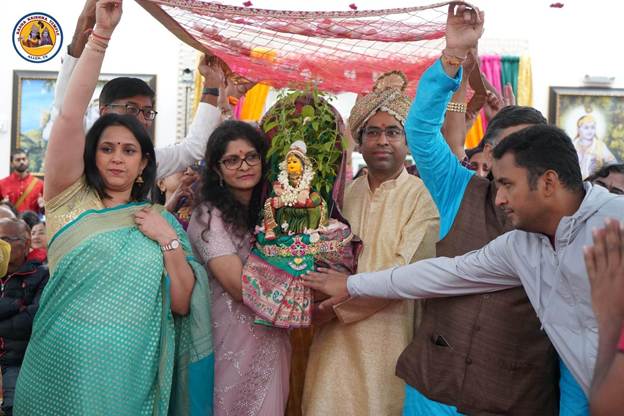
A small mandap (canopy) is beautifully decorated with flowers and lamps. The Shaligram, representing Lord Vishnu, is placed nearby and adorned as the groom with yellow clothes, jewels, and a crown. A sacred thread is tied between the two, signifying their union, while priests and devotees chant the mangal mantras.
Then the symbolic marriage is performed with all the traditional rituals — songs of mangalashtaka, offerings of rice and vermilion, and joyous chanting of “Shubh Mangal Savdhan!” as the divine couple are united. The white cloth separating them is removed, signifying their eternal togetherness.
The ceremony concludes with the distribution of sweet prasād, often made from sugarcane, groundnuts, fruits, and jaggery. The atmosphere is filled with devotion, music, and laughter — a reminder that God is not a distant entity but one who lovingly accepts the heart of a sincere devotee.
Symbolism and Spiritual Significance
Tulsi Vivah is more than a ritual — it is a divine allegory. The marriage of Shaligram and Tulsi symbolizes the eternal union between the Supreme Soul and the individual soul. It teaches that when the soul, purified through devotion and surrender, meets the Divine, it results in everlasting bliss.
In the Puranas, Tulsi is described as śuddha-bhakti (pure devotion), while Shaligram embodies Paramātma (the Supreme Soul). Their union signifies the merging of pure love with the Divine will — the highest goal of human existence.
The scriptures describe Tulsi as the abode of all gods.
Lord Brahma resides in her branches, the river Ganga flows in her roots, the four Vedas dwell in her upper part, and all deities reside within her leaves.
Hence, offering even a single Tulsi leaf to the Lord with love is said to bestow infinite merit and purify the heart.
As Swami Mukundananda beautifully explains, “When devotion becomes selfless, it becomes divine. In the love of Tulsi for Lord Vishnu, we find the essence of Bhakti — the soul’s complete surrender to God.”
Regional Traditions and Cultural Diversity
Across India, Tulsi Vivah is celebrated with local customs that enrich its devotional tapestry.
In Maharashtra, the ceremony mirrors a traditional wedding — complete with music, colorful attire, and the chanting of Mangalashtaka mantras. In Saurashtra, grand processions are taken out from one temple to another, as invitations are exchanged between the “families” of Tulsi and Shaligram.
In Odisha, devotees observe a special tradition during the month of Vaisakha (April–May). To protect Tulsi from the summer heat, they suspend a small perforated pot filled with water above the plant, allowing it to drip slowly throughout the day — a symbol of tender care and devotion.
Even in Bengal, some families regard Tulsi as their household deity, worshipping her daily with love and reverence. Everywhere, this sacred festival is a living reminder of how faith, love, and nature beautifully intertwine in Indian spiritual life.
The Inner Message: Purity, Surrender, and Devotion
Tulsi Vivah teaches profound spiritual truths for seekers of all times. Tulsi’s transformation from Vrinda, the devoted wife, to the sacred plant worshipped by all, represents the soul’s journey from loving devotion to union with the Divine.
In modern life — driven by speed, ambition, and material goals — Tulsi Vivah stands as a gentle reminder of what truly sustains us: purity of intention, humility in devotion, and faith in divine grace. When we water the Tulsi plant daily, offer her light, and bow before her, we are symbolically nurturing these very qualities within our hearts.
The Bhagavad Gita says:
Patraṁ puṣpaṁ phalaṁ toyaṁ yo me bhaktyā prayacchati –
“Even a leaf, a flower, fruit, or water offered to Me with devotion is accepted by Me.” (9:26)
The offering of a simple Tulsi leaf, when done with love, becomes an act of cosmic significance. It reminds us that God does not seek grandeur. He seeks our heart.

A Festival of Hope and Renewal
Tulsi Vivah also marks a new beginning — the end of the monsoon and the start of the auspicious wedding season in Hindu tradition. Spiritually, it signifies the soul's awakening from the slumber of ignorance.
For unmarried girls, it holds special importance. It is believed that those who perform Tulsi’s adornment and participate in her wedding with devotion are blessed with a virtuous spouse and a harmonious life. The items used to decorate Tulsi are often gifted to a young girl or a Brahmin, spreading the merit of the ritual further.
In every sense, Tulsi Vivah celebrates the sacred bond between the soul and the Divine — reminding us that love, when purified by devotion, becomes a bridge to divine bliss.
Conclusion: The Eternal Message of Tulsi Vivah
Tulsi Vivah is more than a festival—it is a celebration of divine love, purity, and surrender. The sacred marriage between Tulsi and Lord Vishnu invites us to reflect upon our own relationship with the Divine.
As devotees gather around the fragrant Tulsi plant, singing hymns and offering lamps, they participate in an ancient promise — that God and the devotee are forever bound by love. In this sacred union of Tulsi and Vishnu lies the assurance that divine grace is never far from those who serve with faith and humility.
In the words of Swami Mukundananda, “When the heart becomes pure like Tulsi, God Himself comes to reside within it. That is the true Tulsi Vivah — the union of the soul with the Supreme.”
Call To Action
- Learn more about the story of Tulsi Vivah and subscribe to the Swami Mukundananda Youtube Channel: Unheard Story Behind Tulsi Vivah l Swami Mukundananda l Radha Krishna Temple of Dallas
- The Radha Krishna Temple of Dallas is hosting Tulsi Vivah on Sunday, November 2, 2025, from 10:00 AM to 12:30 PM. The event celebrates the divine wedding of Tulsidevi and Shree Krishna through rituals, kirtans, and festivities. Join in person or online. Relish the festivities with:
● Ganesh Pooja
● Krishna’s Baarat
● Kanyadaan and Phere
● Prasad Distribution
- To learn more and to partake of the Tulsi Vivah offerings, visit: https://www.radhakrishnatemple.net/tulsi-vivah