

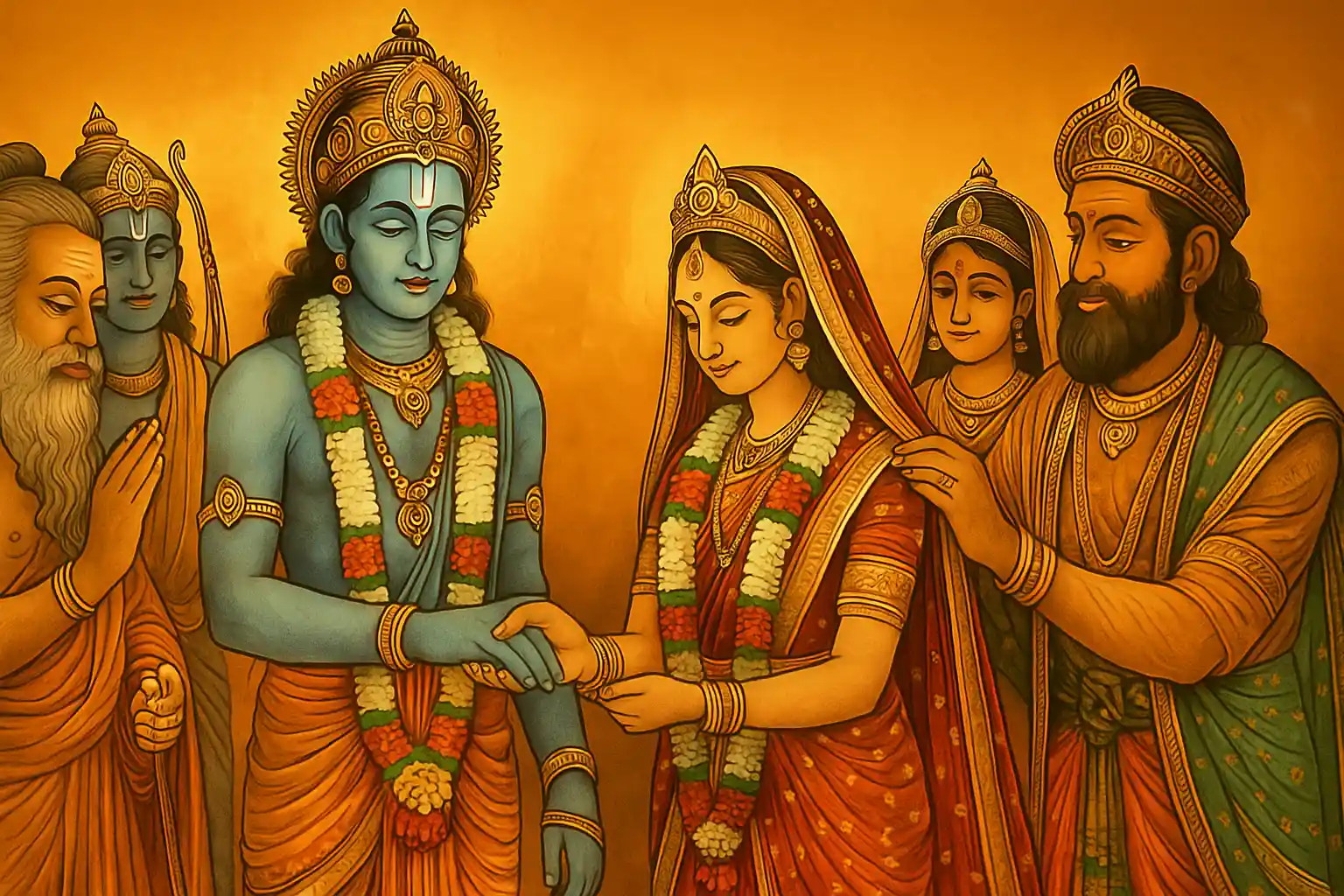
“श्री सीता–राम विवाह पंचमी” —
भक्ति, धर्म और आदर्श दाम्पत्य के दिव्य मिलन का पावन उत्सव।
The Vivāha Panchamī is the divine festival celebrating ideal love, bhakti, and dharma.
Vivah Panchami is a Hindu festival that commemorates the wedding of Lord Ram and Goddess Sita, celebrated on the fifth day of the waxing moon in the month of Margashirsha. The festival is a celebration of their divine union, symbolizing love, devotion, and the triumph of dharma. Celebrations are particularly vibrant in places associated with their story, such as Ayodhya in India and Janakpur in Nepal, where re-enactments of the wedding, processions, and devotional songs are held even today.
This marriage of Ram and Sita is not only a historical event — it is the eternal union of Dharma and Shakti, Purusha and Prakriti, Virtue and Devotion. Their love was not born of desire, but of divine purpose.
Through the wedding and even the laughter of Sita’s friends, the Lord teaches that life’s highest beauty lies in purity, humility, and joyous surrender.
Vivah Mahurat / Timings:
- New Delhi, India
Panchami Tithi Begins: 09:22 PM on November 24, 2025
Panchami Tithi Ends: 10:56 PM on November 25, 2025 - Dallas, Texas
Panchami Tithi Begins: 09:52 AM on November 24, 2025
Panchami Tithi Ends: 11:26 AM on November 25, 2025
Rituals and Puja performed during Vivah Panchami
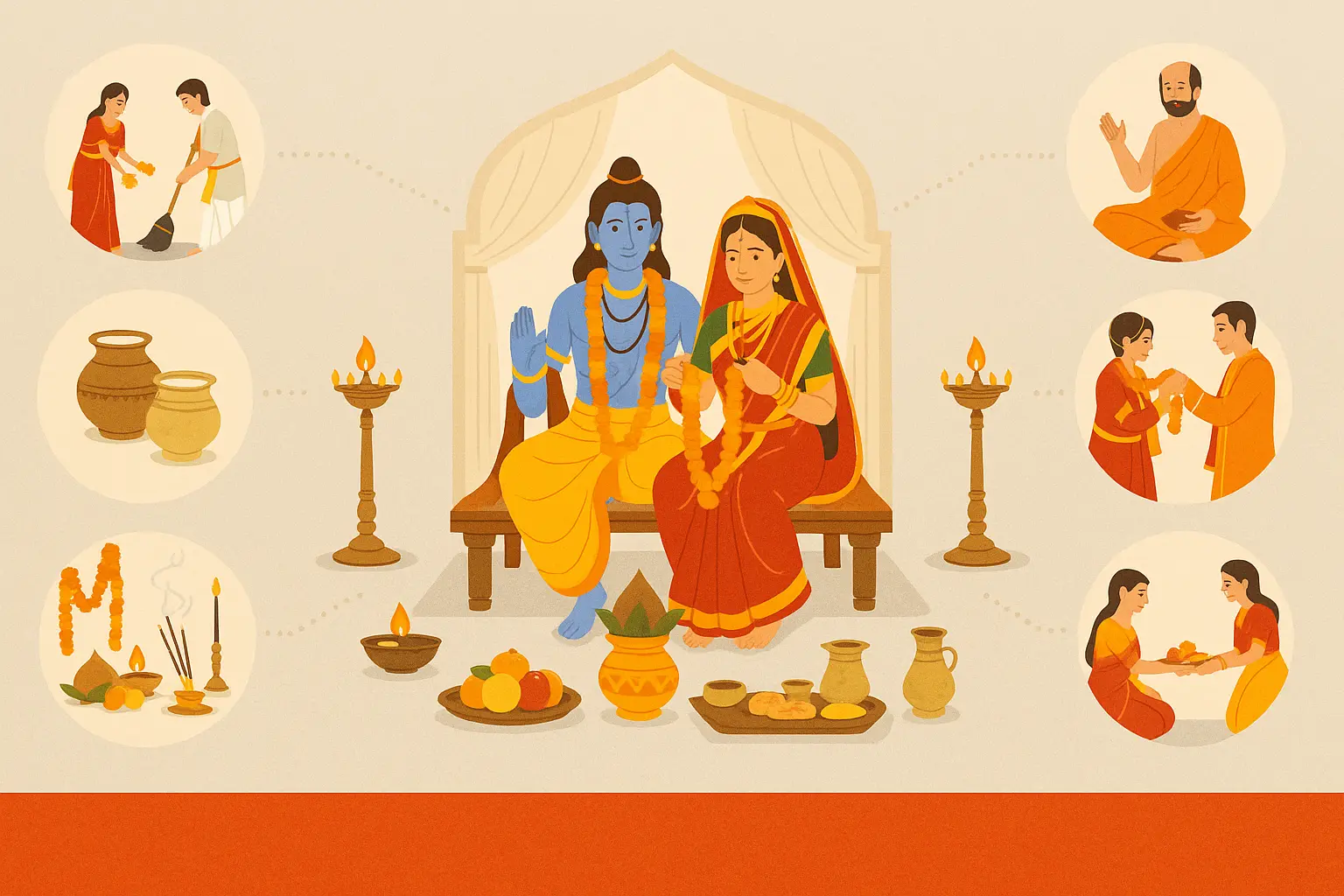
Before Puja
- Clean and sanctify prayer room / mandap.
- Place clean idols / framed images of Ram & Sita on mandap.
- Prepare Panchamrit (milk, curd, ghee, honey, sugar) & cooling vessel.
- Arrange flowers, garlands, incense, oil/ghee lamps, camphor.
- Prepare naivedya/prasad (sweets, fruits) and enough servings for devotees.
- Keep holy water (Ganga jal or clean water), new cloths for deity, jewelry (optional).
- Prepare printed Ram-Sita Vivah katha (for recitation) and bhajan booklets.
- Check sound system / microphone (for community program).
- Confirm puja samagri & priest availability; check muhurat again for your exact location.
During Puja
- Start with Ganesh invocation & sankalpa (state intentions).
- Perform abhishek / panchamrit on murti (if temple permits); otherwise offer as naivedya.
- Dress & alankara (decorate) the deities; tie garlands.
- Recite Ramayana excerpt (Sita Swayamvara / Vivah portion) or play recorded Ram Katha.
- Conduct a symbolic “vivah” (exchange garlands, perform aarti) if doing a ritual wedding.
- Offer aarti; distribute prasad to attendees.
After Puja
- Clean altar and return deity clothing/jewelry to safe place.
- Distribute prasadam & arrange community langar or refreshments.
- Record donations & thank volunteers/donors.
- Optional: short satsang / talk referencing themes (humility, devotion, purity).
Quick table — Vivah Panchami 2025 (Delhi & Dallas)
| Item | Details (Delhi, India) | Details (Dallas, Texas, USA) |
|---|---|---|
| Panchami Tithi Begins | 09:22 PM on November 24, 2025 | 09:52 AM on November 24, 2025 |
| Panchami Tithi Ends | 10:56 PM on November 25, 2025 | 11:26 AM on November 25, 2025 |
| Gregorian Date | November 25, 2025 (Tuesday) | November 25, 2025 (Tuesday) |
| Typical Rituals / Puja Vidhi | • Abhyanga (holy bath), clean altar with Rama-Sita murti or photo. • Idol decoration, offering panchamrit, flowers, incense. |
• Abhyanga (holy bath), clean altar with Rama-Sita murti or photo. • Idol decoration, offering panchamrit, flowers, incense. |
The Epic Story of Ram–Sita Vivah (The Celestial Marriage of Lord Ram and Goddess Sita)
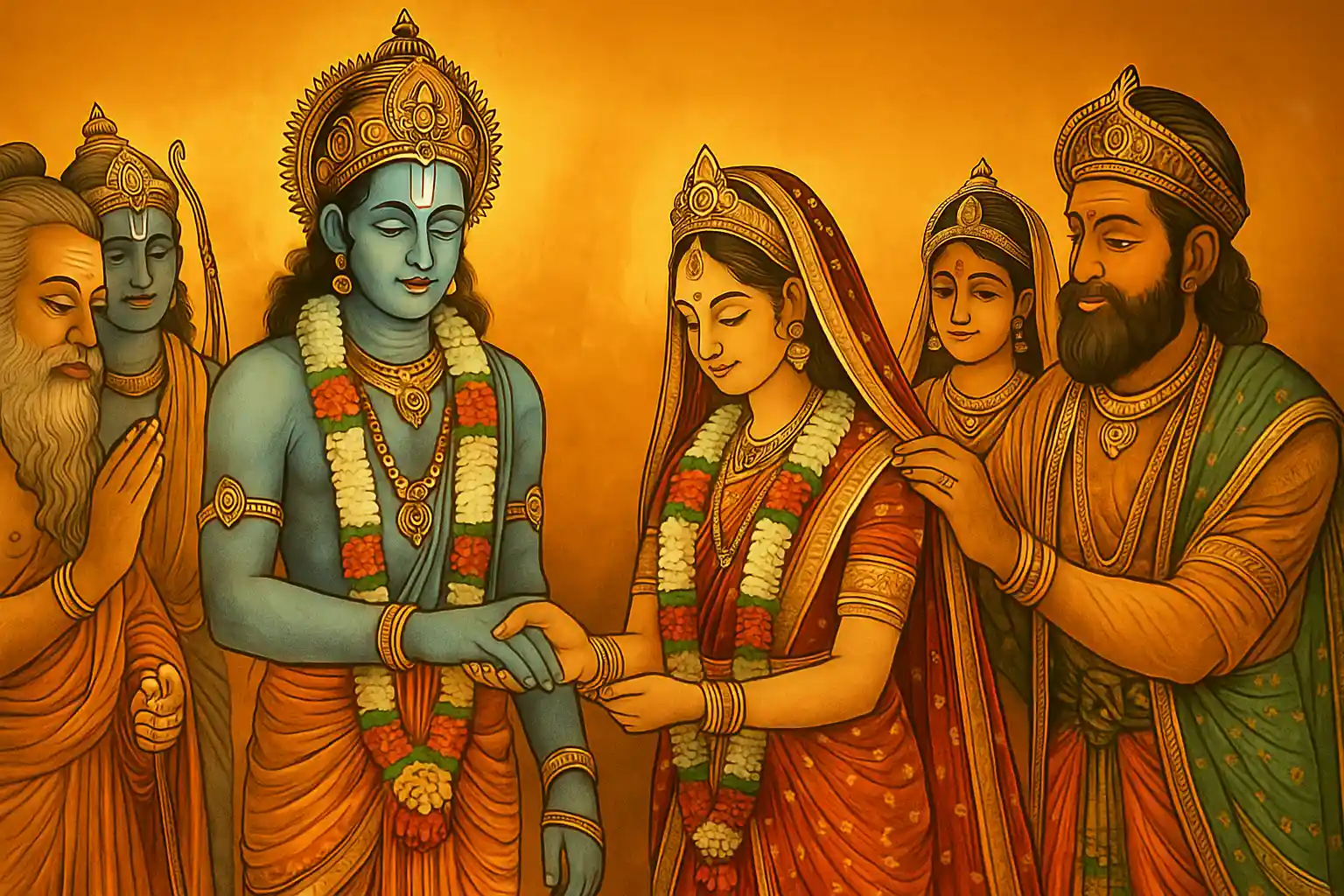
Long ago, in the sacred city of Mithila, the noble King Janak reigned, a wise and dharmic ruler. One day, while ploughing the fields during a yajña (sacrifice), his plough struck something in the earth. To his amazement, he found a divine baby girl lying in a golden casket — radiant as a thousand suns. The king took her in his arms and named her Sita, “the one born of the furrow.”
He raised her as his beloved daughter, considering her a gift from Mother Earth herself.
King Janaka’s Promise and the Bow of Shiva
As Sita grew up, she was unmatched in beauty, grace, and virtue. Once, as a child, she effortlessly lifted the bow of Lord Shiva (Pinaka) kept in the royal shrine — a weapon so heavy that no man could even move it.
King Janak, witnessing her divine strength, made a solemn vow:
“Whosoever strings this sacred bow shall win the hand of my daughter Sita.”
Thus began Sita’s Swayamvar, a royal ceremony inviting kings and princes from across the world to prove their strength and devotion.
Arrival of Lord Rama in Mithila
Meanwhile, in Ayodhya, King Dasharath sent his sons — Ram and Lakshman — with Sage Vishvamitra to protect his yajñas.
After fulfilling their duty, the sage brought the princes to Mithila to attend the Swayamvar.
When Ram entered the court, his serene radiance filled the hall. Sita, seeing him for the first time, felt her heart overflow — a divine recognition, the reunion of Lakshmi and Vishnu upon earth. Ram too saw in Sita the embodiment of purity, devotion, and grace.
The Test of the Bow
One by one, mighty kings and warriors attempted to lift the bow but failed. Then, upon Vishvamitra’s command, Ram approached.
He bowed reverently to Lord Shiv, touched the bow, and with effortless grace lifted and strung it — only for the mighty bow to break in two with a thunderous crack that shook heaven and earth.
The devas rejoiced:
“This is no ordinary man — He is the Supreme Lord Himself!”
King Janak’s eyes brimmed with tears:
“My vow is fulfilled! Sita, the daughter of Janak, shall be wedded to Ram, the son of Dasharath!”
The Grand Wedding in Mithila
Messengers raced to Ayodhya, inviting King Dasharath and his royal family. Soon Ayodhya’s princes arrived in splendor. The city of Mithila bloomed like heaven itself — streets strewn with flowers, lamps glittering like stars, the air filled with the fragrance of sandalwood and the sound of conch shells.
The auspicious day, Margashirsha Shukla Panchami, dawned — the day now celebrated as Vivah Panchami.
All four brothers were married that day:
- Ram to Sita,
- Bharat to Mandavi,
- Lakshman to Urmila, and
- Shatrughn to Shrutakirti.
The Gods showered flowers from the heavens, celestial musicians sang hymns, and joy overflowed in every heart.
Kobber Puja:
After the wedding rituals, the joyful Kobber Puja took place — a playful ceremony where Sita’s sakhis (friends) teased the groom before letting him enter the bride’s chamber.
Swami Mukundananda narrates this scene with warmth and laughter, revealing how divine love can also sparkle with humor and sweetness.
As Rama stood outside, smiling in his quiet dignity, Sita’s friends surrounded him, giggling. One of them said teasingly:
“O Prince of Ayodhya! You broke Lord Shiv’s bow, but can you now open this simple door without our permission?”
Another chimed in:
“You won Sita Devi by might — but to enter her room, you must win us by delight!”
Lakshman, always protective and quick-tempered, frowned playfully, ready with a retort. The sakhis laughed louder:
“Ah, look! Even his younger brother guards him like a royal lion! Tell us, brave Lakshman, does your brother always hide behind you when words become sharper than arrows?”
Lakshman smiled, half-amused, half-embarrassed. “Sisters,” he said, “our Lord doesn’t fight with words; His glance conquers hearts before swords ever rise.”
The laughter grew, and even Ram could not help but laugh softly.
Swami Mukundananda explains that this moment shows the tender humanity of the divine — how the Supreme Being can share in play, humility, and affection.
Finally, one of the elder companions said lovingly,
“Enough teasing, sisters — let the Lord of Ayodhya see His queen.”
As the door opened, the fragrance of flowers filled the room, and Ram’s eyes met Sita’s. Their gentle smiles spoke of divine love — pure, selfless, and eternal.
Main Learning from Swami Mukudananda’s
lecture on Sita Ram Weddings
Humility over pride
- The breaking of the divine bow is not just an external physical feat; it symbolizes the breaking of one’s ego or pride. Swami emphasizes that true strength is not only physical or external power, but internal surrender and humility.
- Pride becomes a barrier in relationships; letting go of ego allows true connection and harmony.
Devotion (bhakti) is foundational
- The marriage is portrayed as a union based on deep devotion — both parties act from devotion: Ram to duty and righteousness, Sita through purity and surrender.
- Devotion means surrendering personal desires and aligning with divine will or dharma (righteousness).
Symbolism of ideal relationship
- The wedding is more than a social ceremony; it is symbolic of ideal marital life: mutual respect, fulfilling roles, abiding by duty, purity, and love.
- Each partner has responsibilities, but also must maintain humility, respect, and mutual support.
Inner transformation & character building
- The ritual and ceremony are metaphors for inner change: cleaning one’s mind, removing ego, refining character, cultivating virtues like patience, respect, purity.
- Before external rituals, one must prepare internally (purity of mind, intention, ethical living).
Purity and values
- Sita represents purity, ideals, strength in subtle / moral domain. Ram represents righteousness, fulfilment of duty, moral clarity. Their union shows how virtues complement one another.
- Emphasis on upholding dharma even in challenging circumstances; staying true to values.
Spiritual significance
- The wedding is not just about two persons but is a divine leela (play) — it teaches higher spiritual truths: union of individual soul with the divine.
- It reminds devotees to surrender, pure intention, and aligning with cosmic purpose rather than purely personal ambition.
Celebrations in India and Nepal
Vivah Panchami is celebrated in Ayodhya, India, and Mithila, Nepal, to commemorate the wedding of Lord Ram and Goddess Sita, with large-scale festivities including processions, pujas, and re-enactments of the wedding.
Mithila, Nepal
- Janakpurdham as the focal point: The celebrations are centered around Janakpurdham, believed to be the birthplace of Goddess Sita.
- Week-long celebration: The festivities often last for seven days, starting with prayers and culminating on the day of the wedding anniversary.
- Grand procession: A major highlight is the 'baraat' (groom's procession), which features decorated chariots, elephants, and dancers, with many devotees coming from Ayodhya and other Indian cities to participate.
- Cultural performances: Various dance performances, cultural programs, and religious rituals are held, drawing large crowds of locals and visitors.
- Re-enactment: Devotees re-enact the wedding of Ram and Sita with great enthusiasm.
Ayodhya, India
- Temple decorations: Temples dedicated to Lord Ram and Goddess Sita are beautifully decorated with lamps and flower garlands.
- Idols are adorned: The idols of the deities are adorned with new clothes and ornaments for the occasion.
- Rituals: Special 'pujas' (prayers) are performed, and wedding-like conversations take place in the temples as part of the 'Ram Vivah Utsav'.
- Live telecasts: In recent years, civic bodies have installed LED screens across the city for the live telecast of the main celebrations to allow more devotees to witness them.
- Devotee participation: Hundreds of thousands of devotees participate in the events, both in the temples and at community gatherings.
- Commemorates the union: Both locations celebrate the wedding of the divine couple, symbolizing love, devotion, and marital harmony.
- Ritualistic ceremonies: The core of the celebration involves performing wedding-like rituals, either through large-scale public events or at the household level.
- Connecting the two cities: The celebrations highlight the ancient connection between Ayodhya (Ram’s birth place) and Mithila (Sita’s birth place)
Benefits & Donation / Spiritual Merits
Here are commonly believed benefits and aspects of donations or charitable acts on Vivah Panchami according to tradition / religious sources:
| Area | Spiritual Merits | Donation Merits | Social Benefit |
|---|---|---|---|
| Marital / family life | Devotion to Rama & Sita is believed to yield positive karma, purity, blessings, and spiritual growth. | Donating (daan) on the day is considered highly meritorious. It’s believed donations made on this auspicious day enhance one’s spiritual benefits and blessings. | Donations help temples or communities organize the festival celebrations, help underprivileged people to take part in the events, support temple upkeep etc. |
| Rituals / Puja Steps | The puja is said to purify one's soul and bring blessings from Lord Rama and Sita for a prosperous life. | Making donations during this time increases spiritual merit, especially if done with the intent of helping others. | Contributions to charity or temple projects help the broader community, especially the underprivileged, and support religious institutions. |
| Items for Rituals | Rituals performed with proper devotion are believed to bring blessings and purification to the devotee. | Items like clothes, food, or prasad offered during the puja are considered to have spiritual merit. | Offerings made during the festival benefit the community and help organize larger temple activities. |
| Festivals and Celebrations | By participating in the rituals, devotees can purify their hearts and grow spiritually. | Charitable acts are encouraged during the festival to enhance spiritual and worldly benefits. | By making donations, communities are able to support the festival and enhance the lives of the less fortunate. |
May the divine union of Shri Sita–Ram shower the world with peace, love, and auspiciousness — जयति सीता–रामोऽयं, मंगलं लोकमङ्ग
Vivah Panchami is a Hindu festival that commemorates the wedding of Lord Rama and Goddess Sita, celebrated on the fifth day of the waxing moon in the month of Margashirsha. The festival is a celebration of their divine union, symbolizing love, devotion, and the triumph of dharma. Celebrations are particularly vibrant in places associated with their story, such as Ayodhya in India and Janakpur in Nepal, where re-enactments of the wedding, processions, and devotional songs are held.
As we learned the pivotal role of Donation during Vivah Panchami 2025. We are fortune to receive an opportunity to help Swami Mukundananda Ji and his JKYog mission in supporting the underprivileged through Jagadguru Kripalu University (JKU) and Jagadguru Kripalu Hospital & Research Center — a transformative initiative bringing education, healthcare, and hope to rural India.
“True wealth is found not in what we have, but in what we give.”
🎓 Support the JKU Project – Here's How You Can Help:
💛 Make a Direct Donation
Light up a life with your generous contribution.
👉 Donate Now
👣 Start Your Own Fundraiser
Create your own fundraising page and rally your family, friends, or community.
👉 Start Fundraising Here
🤝 Join the Walk for Education & Healthcare
Be part of a global movement to raise awareness and funds.
🌼 Your Contribution Supports:
- Free & subsidized education for underprivileged children, youth, and adults
- Modern and alternative healthcare, including child health, dental, physiotherapy, and natural healing
- Vocational training and micro-enterprise development
- Promotion of spiritual, physical, and mental well-being based on Vedic and Yogic sciences
🌺 Conclusion
“श्री सीता–राम विवाह पंचमी” is not merely a festival — it is a living reminder of divine principles that sustain human life.
In Sita and Rama, we see the perfect balance of love and duty, tenderness and strength, devotion and dharma. Their union teaches that real joy emerges not from possession but from selfless service and faith.
May the blessings of Shri Sita and Shri Ram bring peace to our homes, purity to our hearts, and righteousness to our actions.
🌿 जय सीता राम । May the world rejoice in their eternal union.
If you have enjoyed the blog on Vivah Panchami, you may also appreciate other sacred hymns that deepen your spiritual connection and devotion. Discover the divine power and meaning behind these timeless chants:
- Shree Ram Raksha Stotra – Click Here
- Vishnu Sahasranamam – Click Here
- Mahamrityunjay Mantra – Click Here
- Sundarkand Path – Click Here
- Shiv Tandav Stotram – Click Here
📚 Learn about all 9 forms of Goddess Durga and explore Navratri rituals in our Complete Navratri 2025 Guide »
✨ Explore Diwali & Chhath Puja Blogs
Top 50 Diwali Wishes 2025
Spiritual greetings & status ideas
Explore over 50 heartfelt greetings, spiritual messages, and inspiring WhatsApp status ideas that reflect divine love and light for Diwali 2025.
Read More →Diwali Greetings 2025
Quotes for family & friends
Celebrate Diwali 2025 with heartfelt wishes, meaningful messages, and inspiring quotes for loved ones. Share the joy of Deepavali with spiritual warmth.
Read More →Diwali Dates & Muhurat
5-day guide & puja timings
Plan your Diwali 2025 celebrations with this full guide—covering 5 days of rituals, muhurat timings, and deeper spiritual meaning behind each festival day.
Read More →Rangoli Designs 2025
Traditional & creative styles
Celebrate Diwali with stunning Rangoli—from classic floral to 3D and LED designs. Explore eco-friendly and artistic ways to welcome prosperity this Deepavali.
Read More →Lakshmi Puja 2025
Puja date, rituals & seva
Worship Goddess Lakshmi with correct Diwali 2025 muhurat, rituals, and support JKYog’s rural upliftment. Light lives and invite divine blessings.
Read More →Navratri 2025 Guide
Puja date, rituals & seva
Discover Navratri 2025 in depth! Get the complete calendar, daily goddess significance, fasting rituals, regional traditions, and muhurat timings.
Read More →🌸 FAQ — Shri Sita Ram Vivah Panchami 2025
1. What is Vivah Panchami?
Vivah Panchami is the sacred festival that celebrates the divine wedding of Lord Rama and Goddess Sita, symbolizing the union of Dharma (righteousness) and Shakti (divine energy). It falls on the fifth day (Panchami Tithi) of the waxing moon in the month of Margashirsha (November–December).
2. Why is Vivah Panchami considered important?
The festival honors the ideal of divine love, devotion, and duty. It inspires devotees to live with purity, humility, and balance in relationships — emulating the sacred union of Rama and Sita as Purusha and Prakriti.
3. How is Vivah Panchami celebrated?
Devotees perform puja and katha (readings of the Ramayana), reenact the divine wedding, and decorate temples with flowers and lights. In Ayodhya (India) and Janakpur (Nepal), grand processions and Ram–Sita marriage enactments take place, drawing thousands of devotees.
4. What are the muhurat timings for Vivah Panchami 2025?
- New Delhi, India:
Panchami Tithi Begins – 9:22 PM on Nov 24 | Ends – 10:56 PM on Nov 25 - Dallas, Texas, USA:
Panchami Tithi Begins – 9:52 AM on Nov 24 | Ends – 11:26 AM on Nov 25
Most pujas are conducted on November 25 during Panchami Tithi morning hours.
5. What are the steps of Vivah Panchami Puja?
Before Puja: Prepare mandap, idols, Panchamrit, flowers, lamps, prasad, and holy water.
During Puja: Perform abhishek, aarti, recite Sita Swayamvar katha, and symbolically reenact the wedding.
After Puja: Distribute prasadam, thank participants, and conduct a community langar or satsang.
6. What are the spiritual benefits of celebrating Vivah Panchami?
Observing this puja is said to remove obstacles in marriage, bless couples with harmony, and help devotees purify the mind. It represents the victory of humility over ego and devotion over desire.
7. Is Vivah Panchami only for married couples?
No. While married devotees perform puja for peace and harmony, unmarried devotees, especially women, observe Vivah Panchami with faith to seek a virtuous life partner like Lord Rama.
8. How do donations (daan) on Vivah Panchami help spiritually?
Offering food, clothes, or money to the needy and temples on this day is believed to multiply one’s spiritual merit ( punya ). It enhances prosperity and helps spread the divine message of service and compassion.
9. What lessons did Swami Mukundananda emphasize from Sita Ram Vivah?
He teaches that the breaking of Shiv Dhanush symbolizes the breaking of ego, that true strength lies in humility, and that divine love is rooted in selflessness, devotion, and righteous duty.
10. Where are the main Vivah Panchami celebrations held?
- Janakpur, Nepal: Week-long festival with Ram–Sita wedding reenactment and grand processions.
- Ayodhya, India: Temple decorations, pujas, and mass celebrations of the divine marriage, connecting the two holy cities of Ayodhya and Mithila.