

Introduction: Tracing the Supreme Cause
In our quest to understand the nature of existence, we often trace our lineage: I had a father, he had a father, and so on. This chain eventually leads to Manu Maharaj, the progenitor of mankind, whose father was Brahma, and Brahma’s origin lies in Lord Narayan, the Supreme Divine. This brings us to an essential question: Who is the cause of God? Who created the Creator?
The answer lies in one profound truth — God is Swayambhu (self-existent). He is not created by anyone, nor is He dependent on any cause. As the Bhagavad Gita explains and the Vedic scriptures elaborate, God is the root of all causes, the eternal fountainhead from which creation, sustenance, and dissolution spring forth.
To understand this, let us delve into an ancient mantra that describes the eleven divine names of God, divided into three enlightening categories:
1. गुणवाचक (Gun Vachak) – Qualities
2. रूपवाचक (Roop Vachak) – Form
3. क्रियावाचक (Kriya Vachak) – Actions
This exposition not only unveils the magnificence of the Divine but also refutes the incomplete understanding that God is nirguna (without attributes) and nirakar (formless), as held by some schools of thought.
I. Gun Vachak: The Divine Qualities of God
1. Shukram (Omnipotent and Resplendent)
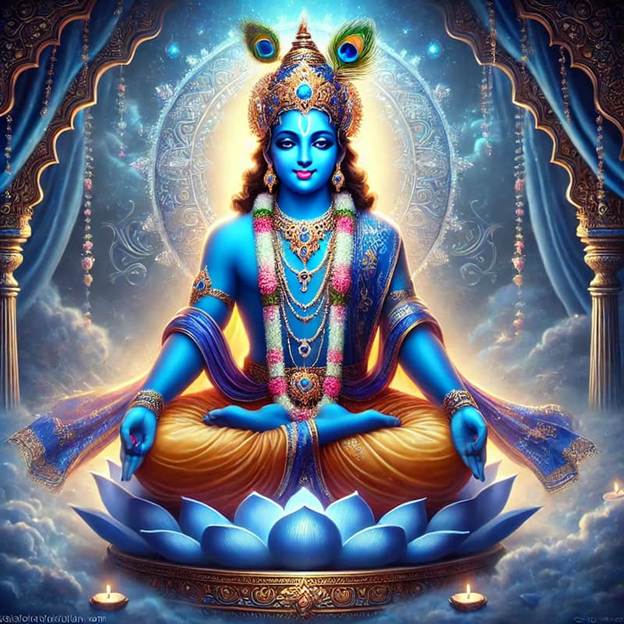
The word Shukram signifies the all-powerful and luminous nature of God. He is the eternal light in all beings, the energy behind the universe.
“Those who surrender all desires and worship this resplendent Lord cross the ocean of life and death.”
BG 10.41
“yad yad vibhutimat sattvam shrimad urjitam eva va
tat tad evavagachchha tvam mama tejo ’nsha-sambhavam”
“Whatever you see as beautiful, glorious, or powerful, know it to spring from but a spark of My splendor.”
👉 Read Verse 10.41 with commentary
The Shukram Lord empowers the yogis and devotees to transcend the bondage of material existence. His resplendence is not merely physical but spiritual — a light that removes ignorance and purifies consciousness.
2. Shuddham (All-Pure)
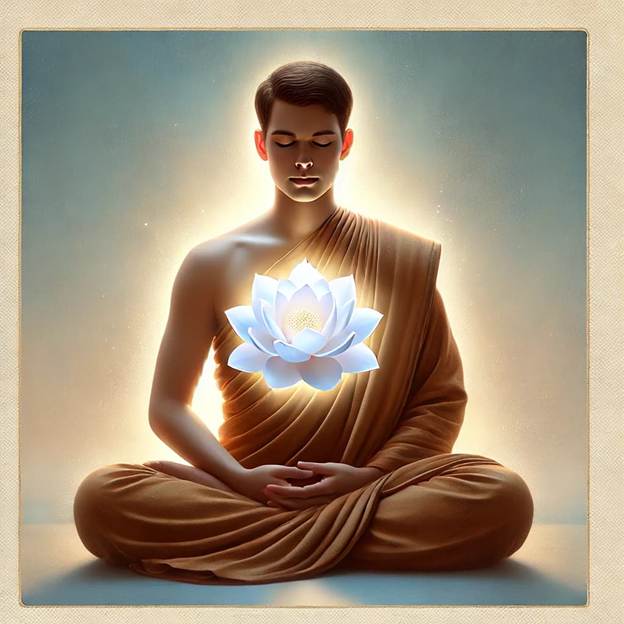
God is Shuddham — the purest existence. Pure not only in essence but in influence. When the mind touches the Divine, it too becomes purified.
BG: 14.26
“mam cha yo ’vyabhicharena bhakti-yogena sevate
sa gunan samatityaitan brahma-bhuyaya kalpate”
“Those who serve Me with unalloyed devotion rise above the three modes of material nature and come to the level of the Brahman.”
👉 Read Verse 14.26 with commentary
Swami Mukundananda beautifully explains that the contact of the mind with the Supreme is enough to purify the soul from the three modes (sattva, rajas, tamas). Like a stream of water flowing over coal can cleanse it over time, connection with God transforms our nature into divine purity.
3. Apāpaviddham (Untouched by Sin)
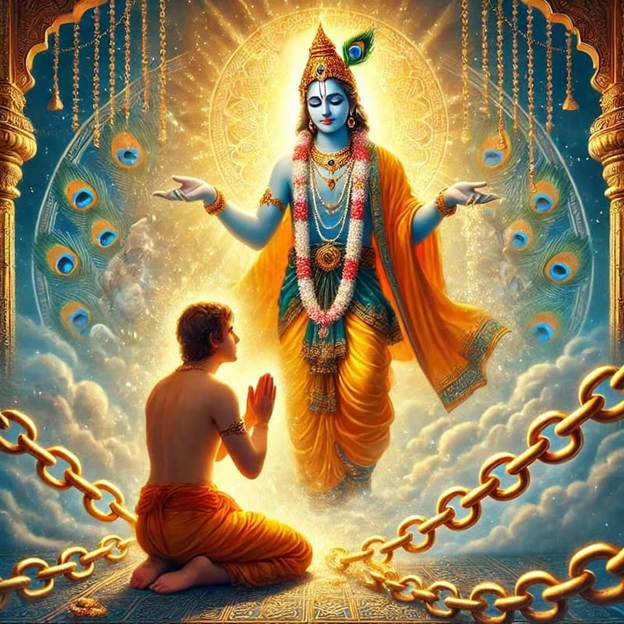
Despite being the controller of all actions and karma, God is untouched by sin.
BG 4.14
na mam karmani limpanti na me karma-phale spriha
iti mam yo ’bhijanati karmabhir na sa badhyate
“Activities do not taint me, nor do I desire the fruits of action. One who knows Me in this way is never bound by the karmic reactions of work.”
👉 Read Verse 4.14 with commentary
Even the greatest yogis meditate on His lotus feet and, by His grace, sever their karmic bondage.
“yat-pāda-paṅkaja-parāga-niṣevaya triptā yoga-prabhāvitā akhila-karma-bandhāḥ”
— Shrimad Bhagavatam
These three qualities refute the Jnani’s claim that God is nirguna (without qualities). Instead, they reveal God as the embodiment of divine gunas, distinct from the three modes of material nature.
II. Roop Vachak: The Transcendental Form of God
4. Avarinam (Indivisible Form)
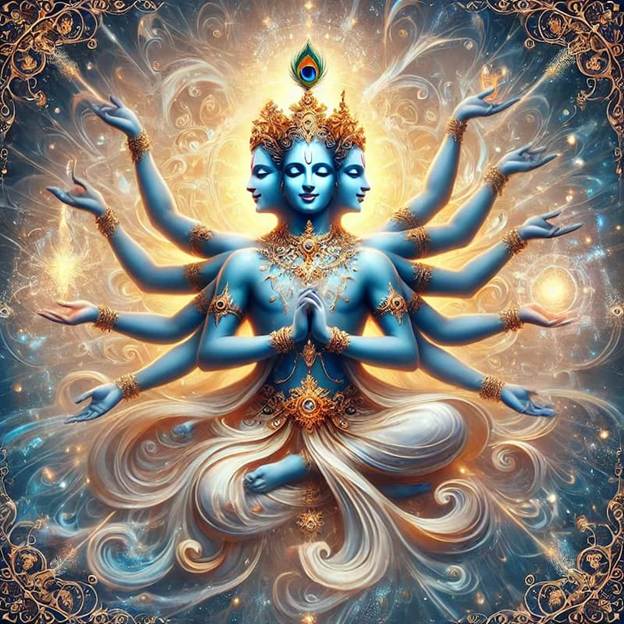
God’s body is not made of parts like ours. There is no division of limbs or organs. Every part of His form is complete and capable of performing all functions.
Brahmaji offers his pranams to Govinda, whose “every limb is full of bliss and through every limb He can do the work of all other limbs.”
God is not limited by eyes to see or ears to hear.
“Bin pad chāle, sunai bin kānā,
Kar bin karam karai vidhinānā.”
– Tulsidas
This form is described in the Kurma Purana:
“deha dehi vibhāgaścaiva nānyastheiṣāṁ kadācana”
(There is no distinction between body and soul in the Lord.)
Unlike us, who are souls inhabiting a material body, God is one with His body, and His form is purely spiritual.
5. Asnāviram (Without Arteries or Veins)
God’s form doesn’t require a nervous or circulatory system. He doesn’t need prāṇa to function, for He is the prāṇa of all.
“yasya prāṇasya prāṇaḥ”
(The Lord is the life force of all life forces.)
– Kenopanishad
Unlike us who need oxygen, sleep, and food, the Divine Being is self-sustaining and ever-energetic, untouched by decay or fatigue.
6. Akāyam (No Material Body)
This term is often misused by those who believe God is formless. However, Akāyam here does not mean 'no body'—it means no material body. His form is divine, sac-cid-ānanda (eternal, full of knowledge and bliss).
“yas tu nirguṇa ityuktaḥ śāstreṣu jagadīśvaraḥ
prākṛitaiḥ guṇair hīnatvaṁ ucyate na tu guṇarahitam”
— Padma Purana
When scriptures say God is “nirgun” or “nirakar”, they mean free from material qualities and forms, not spiritual ones. He possesses innumerable transcendental forms.
BG: 4.8
“paritranaya sadhunam vinashaya cha dushkritam
dharma-sansthapanarthaya sambhavami yuge yuge”
“To protect the righteous, to annihilate the wicked, and to reestablish the principles of dharma, I appear on this earth, age after age.”
👉 Read Verse 4.8 with commentary
Whether as Shree Ram, Shree Krishna, or Narasimha, the Lord manifests a spiritual form that captivates and blesses devotees.
III. Kriya Vachak: Divine Activities of God
7. Kavi (The Supreme Poet & Knower of Truth)
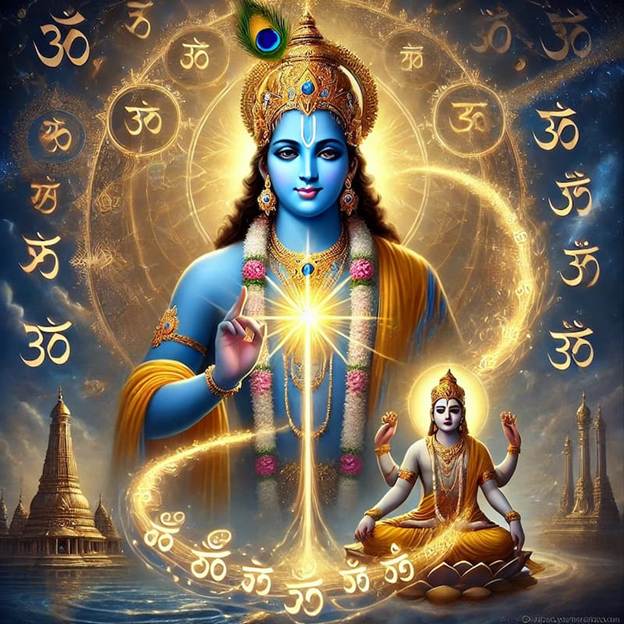
The word Kavi means one who sees the whole — past, present, and future — and can express divine truths eloquently.
“tene brahma hṛdā ya ādi-kavaye”
— Shrimad Bhagavatam
God explained the Vedas to Brahma, making him the first poet (Ādi Kavi), and this divine inspiration continues through all saintly poets: Vidyapati, Narsinh Mehta, Tyagaraja — all expressed divine love through poetry inspired by the Supreme Kavi.
8. Manīṣī (Knower of the Mind and Eternal Principles)
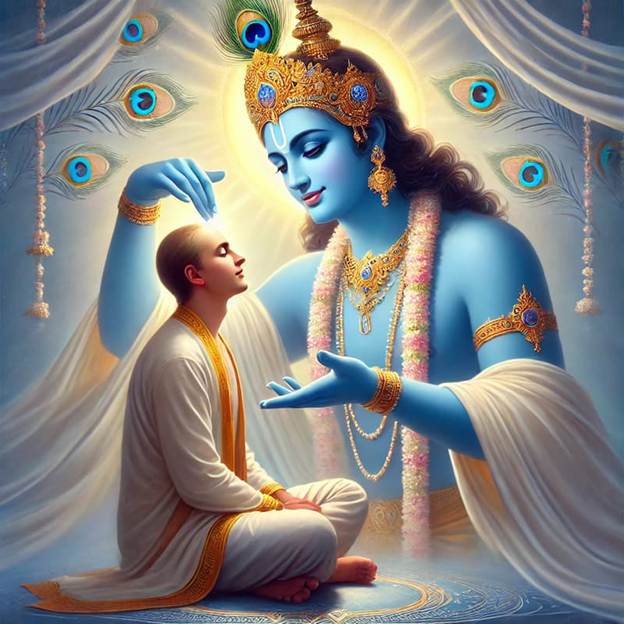
God is Manīṣī, the knower of all minds.
“yan manasā na manute yenāhur mano matam”
(The mind cannot reach God unless He reveals Himself.)
— Kena Upanishad
He not only knows our minds but also bestows divine knowledge. Shree Krishna as Manīṣī revealed the Bhagavad Gita to Arjuna — a timeless guide for all seekers.
9. Paribhū (Pervasive Controller)
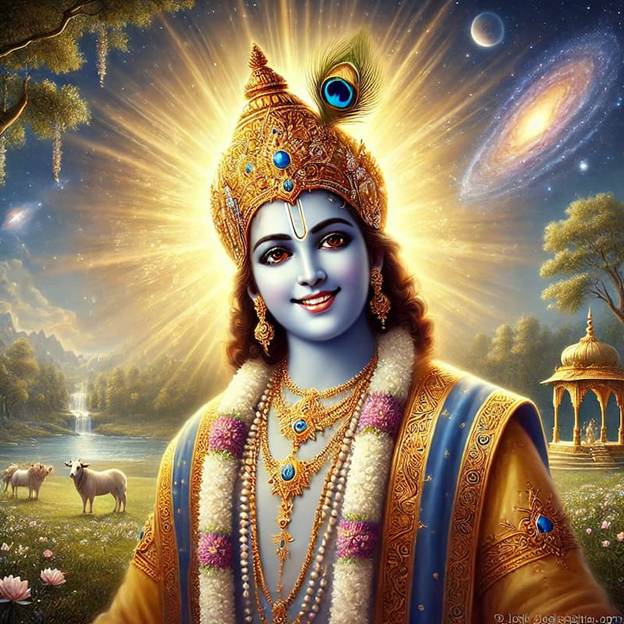
Paribhū means all-pervading. God is everywhere — in every atom, every heart, every corner of creation.
BG: 9.4
“maya tatam idam sarvam jagad avyakta-murtina
mat-sthani sarva-bhutani na chaham teshvavasthitah”
“This entire cosmic manifestation is pervaded by Me in My unmanifest form. All living beings dwell in Me, but I do not dwell in them.”
👉 Read Verse 9.4 with commentary
Like electricity powers every device while remaining unseen, God powers the universe invisibly but completely.
10. Swayambhū (Self-Existent)
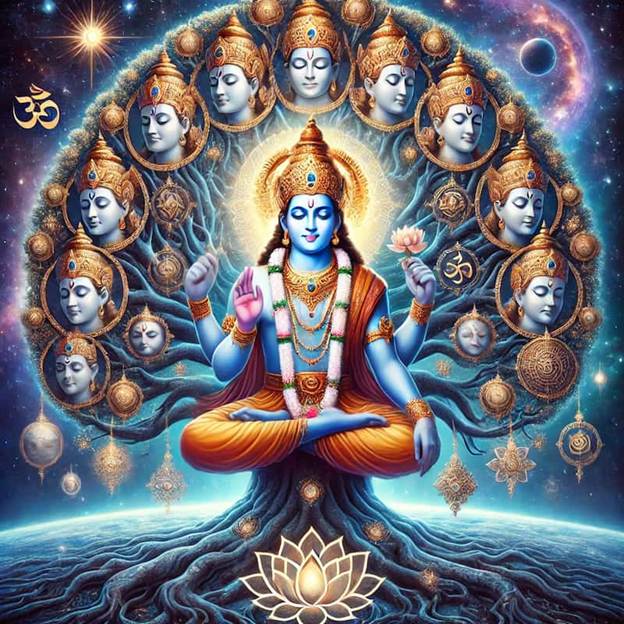
Unlike all beings that are born of others, God is Swayambhū — the uncaused cause.
BG: 10.2
“na me viduh sura-ganah prabhavam na maharshayah
aham adir hi devanam maharshinam cha sarvashah”
“Neither celestial gods nor the great sages know of My origin. I am the source from which the gods and great seers come.”
👉 Read Verse 10.2 with commentary
If God had a father, then that father would be the true God. Since everything has a cause, there must be one uncaused cause — and that is God Himself.
11. Vyadadhāt (The Supreme Dispenser of Destiny)
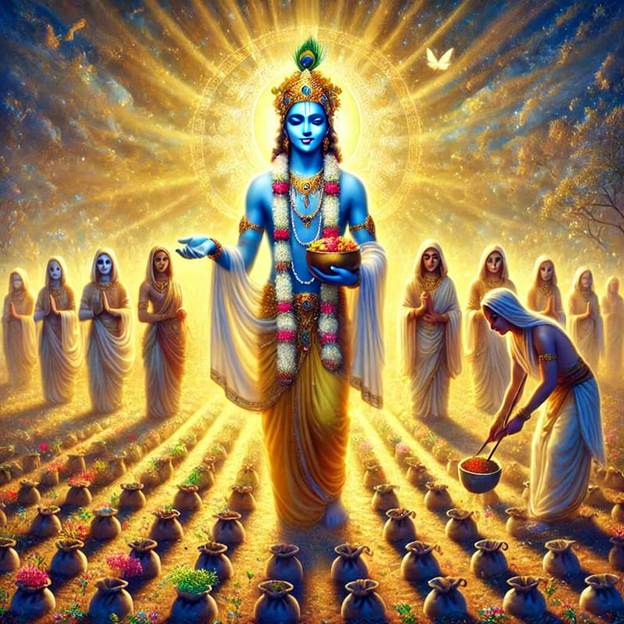
God not only creates but also provides every living being with a field of activity (karma-kshetra). He dispenses the fruits of action through the law of karma.
BG: 2.47
“karmany-evadhikaras te ma phaleshu kadachana
ma karma-phala-hetur bhur ma te sango ’stvakarmani”
“You have a right to perform your prescribed duties, but you are not entitled to the fruits of your actions. Never consider yourself to be the cause of the results of your activities, nor be attached to inaction.”
👉 Read Verse 2.47 with commentary
We are free to choose our actions, but the results are given by the Lord. These results — whether bitter or sweet — are not punishments, but learning tools designed to help us evolve.
Conclusion: A God with Attributes, Form, and Action
The eleven names discussed — Shukram, Shuddham, Apāpaviddham, Avarinam, Asnaviram, Akayam, Kavi, Manishi, Paribhu, Swayambhu, and Vyadadhāt — together paint a picture of a Supreme Divine Being who is:
- Omnipotent and resplendent
- Pure and untouched by sin
- Transcendent in form and yet personal
- All-knowing, ever-active, and full of compassion
- Pervasive yet distinct
- The origin and sustainer of all existence
Such a God cannot be attributeless or formless. Rather, He is beyond material form and filled with divine attributes that are incomprehensible to the material intellect.
When we understand God in this holistic way — as both personal and transcendent, both formful and formless, both with qualities and beyond qualities — we approach true bhakti (devotion), the path of divine love.
BG: 18.55
“bhaktya mam abhijanati yavan yash chasmi tattvatah
tato mam tattvato jnatva vishate tad-anantaram”
“Only by loving devotion to Me does one come to know who I am in Truth. Then, having come to know Me, My devotee enters into full consciousness of Me.”
👉 Read Verse 18.55 with commentary
Call to Action
Reflect deeply on these eleven aspects of the Divine. Meditate on each name as a gateway to divine understanding. Let your heart rejoice in the beauty of the Supreme Being, who is not distant or abstract but knowable, lovable, and accessible.
To deepen your relationship with God:
- Study the Bhagavad Gita: The Song of God with commentary by Swami Mukundananda
- Practice daily remembrance of God’s names (japa)
- Engage in selfless service (seva)
- Surrender with faith that you are always guided by the Divine Manishi, protected by the Paribhū, and uplifted by the Shuddham Lord.
Resources
Watch: Burn Karmas of Infinite Lifetimes by Knowing These 11 Divine Secrets of Krishna | Swami Mukundananda
Frequently Asked Questions (FAQs)
Q1: Is God with form or formless?
God is beyond material form, but He possesses innumerable spiritual forms. Scriptures describe both aspects. He is Nirakar in the sense of having no material form, but has divine forms like Shree Krishna, Shree Ram, etc.
Q2: What does it mean that God is Swayambhū?
Swayambhū means self-born. He has no creator. All other causes and beings originate from Him.
Q3: How can God be everywhere yet distinct?
Just as the sun pervades a room through its light but remains in the sky, God pervades the universe while existing in His divine abode.
Q4: How does understanding God’s nature help in spiritual progress?
Knowing God's attributes deepens faith, clears doubts, and enhances devotion, leading to liberation (moksha).