

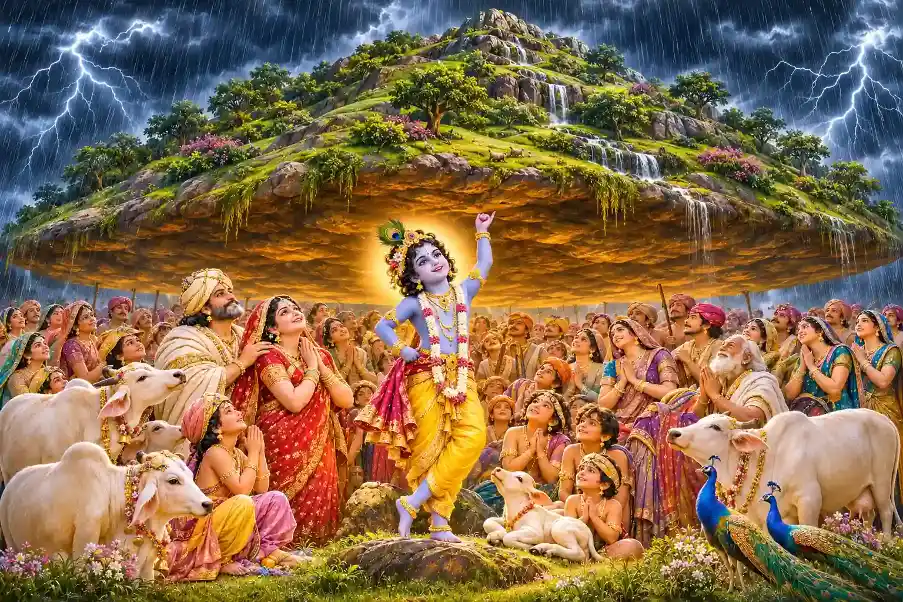
The sight is unforgettable: a seven-year-old boy, no taller than the calves He tends, holding an entire mountain aloft on the little finger of His left hand while rain lashes down in fury and wind howls around Him. Yet beneath that improbable umbrella, an entire village of men, women, children, and cows stands dry and safe.
This is the Govardhan Leela, and most of us know it as a spectacular miracle and a testament to Krishna's divine power. But as Swami Mukundananda explains, the lifting of the hill is only the outer layer, and beneath the miracle lies a teaching so profound that it foreshadows the very essence of the Bhagavad Gita spoken years later on the battlefield of Kurukshetra.
Swami Mukundananda's life mission is "transforming the world through wisdom," and the Govardhan Leela is one of the most luminous jewels in that treasury of wisdom because it is not merely a story to be marvelled at but a lesson to be lived in our daily lives.
The Context of Govardhan Leela: A Village Trapped in Fear
The residents of Braj were preparing for their annual ritual in which Indra, the king of the celestial gods and the god of rain, was worshipped every year not out of love but out of fear, because they believed that if they did not appease him, he would withhold the rains, their crops would fail, and their cows would starve.
This is the religion of fear, and it is a religion many of us still practice today because we pray out of anxiety about loss, failure, and what tomorrow might bring, turning our devotion into a transaction where we offer something to receive something in return.
Krishna, still a child, saw this clearly and asked a question that changed everything: why are you worshipping Indra? The villagers were stunned and replied that he sends the rain, but Krishna pointed to something they had overlooked because the rain comes from the clouds, the clouds are formed by the sun, the grass grows because of the rain, the cows eat the grass, the hill provides the grass, and the Supreme Lord from whom everything including Indra himself derives its power provides the hill.
The worship of Indra was worship of a middleman, and Krishna gently redirected the villagers' devotion to Govardhan Hill, which He declared to be a divine manifestation and a form of the Lord Himself, and the villagers trusting Him prepared a grand offering for the hill while Krishna in a moment of breathtaking intimacy assumed the form of the hill and accepted their offerings Himself.
This was not about insulting Indra but about teaching the villagers and us that true worship belongs to God alone and not to His servants, and as Swami Mukundananda ji explains in his discourses on Shreemad Bhagavatam, the Govardhan Leela delivers Krishna's decisive verdict on what constitutes Ananya Bhakti or exclusive undivided devotion to God and to whom we should pray and to whom we need not.
The Storm of Indra's Ego: When Pride Invites Destruction
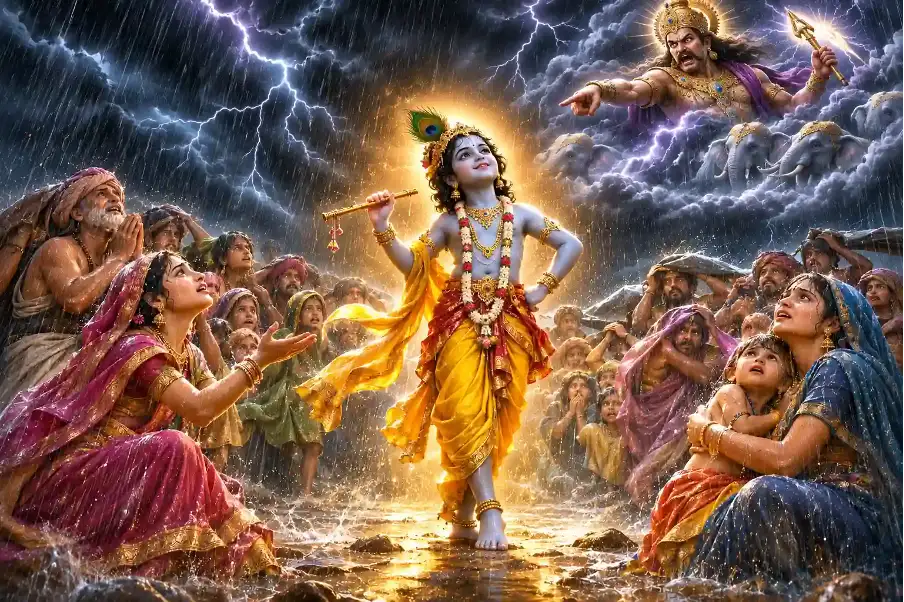
Indra was furious that his worship had been stopped by a child, and his wounded pride unleashed destruction as he summoned the Samvartaka clouds, the very clouds reserved for the dissolution of the universe, upon the tiny village of Braj.
The Shreemad Bhagavatam describes the scene with vivid intensity, stating that seeing the inhabitants of Gokula rendered practically unconscious by the onslaught of hail and blasting wind, the Supreme Lord Hari understood that this was the work of angry Indra, and the skies turned black while rain fell in sheets and hail and wind battered the land.
The terrified villagers ran to Krishna and asked what they should do, and Krishna with a smile that held the calm of eternity told them not to fear because they had taken shelter of the right divine principle and would now see how God protects His devotees. The Bhagavatam reveals Krishna's inner resolve that He must protect the cowherd community by His transcendental potency because He is their shelter, their master, and indeed their own family, having taken a vow to protect His devotees, and then He lifted the hill.
The Miracle of the Little Finger: A Display of Divine Grace
Swami Mukundananda often emphasizes that the details of Krishna's leelas are not incidental but rich in nuance and the detail that Krishna did not lift Govardhan with His mighty arms or use a weapon or cosmic power but lifted it on His little finger is profoundly significant.
The little finger is the weakest and most insignificant part of the hand, and the Supreme Lord chose it to make one thing unmistakably clear: this is not a display of physical strength but a display of divine grace, because the mountain was not held by muscle but by love, and when God decides to protect you the weakest instrument becomes the most powerful.
The Shreemad Bhagavatam describes it with sublime simplicity, stating that Lord Krishna Himself picked up Govardhana Hill with one hand and held it aloft just as easily as a child holds up a mushroom, and for seven days and seven nights Krishna stood without eating, sleeping, shifting the weight, or complaining of fatigue, forgetting hunger and thirst and putting aside all considerations of personal pleasure as the people of Vraja gazed upon Him.
Beneath the hill, something extraordinary was happening because the villagers were not just being rescued but were being given seven uninterrupted days in Krishna's presence where every glance rested on His face, every conversation was about Him, and every fear dissolved in His nearness.
Swami Mukundananda draws a beautiful lesson from this: the greatest blessing is not merely being rescued from life's difficulties but growing closer to God through them, and the storm outside was fierce but inside beneath the hill there was only Krishna.
The Heart of Govardhan Leela: Krishna Prefers Love to Majesty
Here is the part of the story that most of us miss and it is perhaps the most moving, because after seven days Indra realized his mistake and the Bhagavatam records that when Indra observed this exhibition of Lord Krishna's mystic power he became most astonished and pulled down from his platform of false pride with his intentions thwarted he ordered his clouds to desist, and he descended from his celestial throne bowed before Krishna and begged forgiveness.
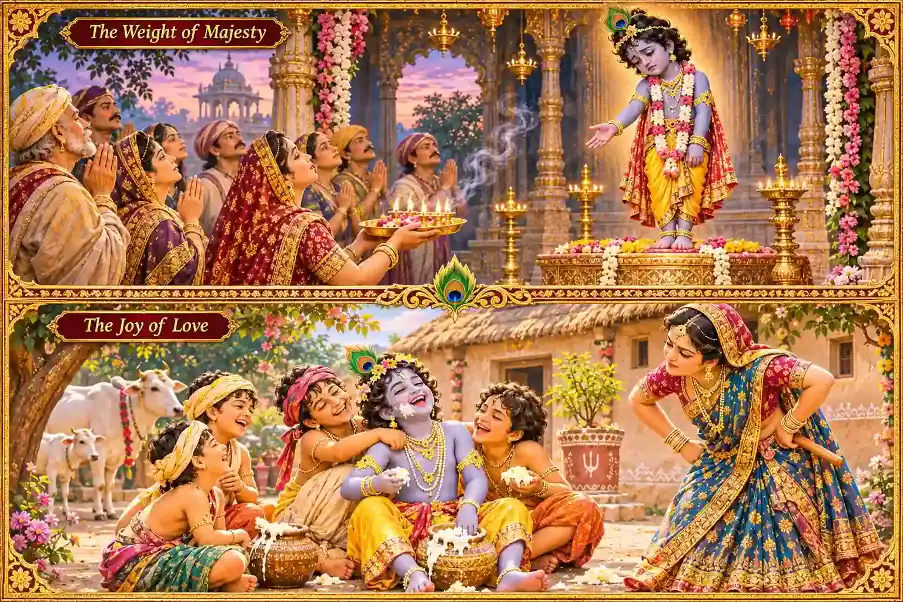
However, something had changed, because the people of Braj had witnessed something incomprehensible, and the boy they had raised, the child they had scolded and loved, the friend who had stolen their butter was God, and gradually their hearts shifted so that the easy intimacy was replaced by reverence and they began to look at Him differently.
Krishna felt this and it pained Him, and Swami Mukundananda describes this poignantly because Krishna did not want to be worshipped from a distance but wanted to be loved, wanted to be called Kanhaiya by His friends, embraced by His mother, and treated as one of their own, and the majesty of the miracle was a burden rather than a joy because it created a distance He never asked for.
Through His Yogamaya, Krishna restored the innocence of their love, and His cowherd friends in their beautiful simplicity refused to accept that He was God, murmuring that Kanhaiya could not have lifted a mountain and that He was one of them, with some even suggesting that Krishna might be tired and offering to take turns holding the hill while He rested, but Krishna smiled and knew that if He handed over the hill even momentarily the truth of His divinity would overwhelm them and replace affection with awe.
This is the secret of Govardhan: God is all-powerful yes, but His greatest joy is not in displaying His power but in receiving the pure uncalculated love of His devotees, and He would rather be your friend than your king and would rather be loved than admired.
The Wisdom of Govardhan Leela: Scripture, Logic, and Transformation
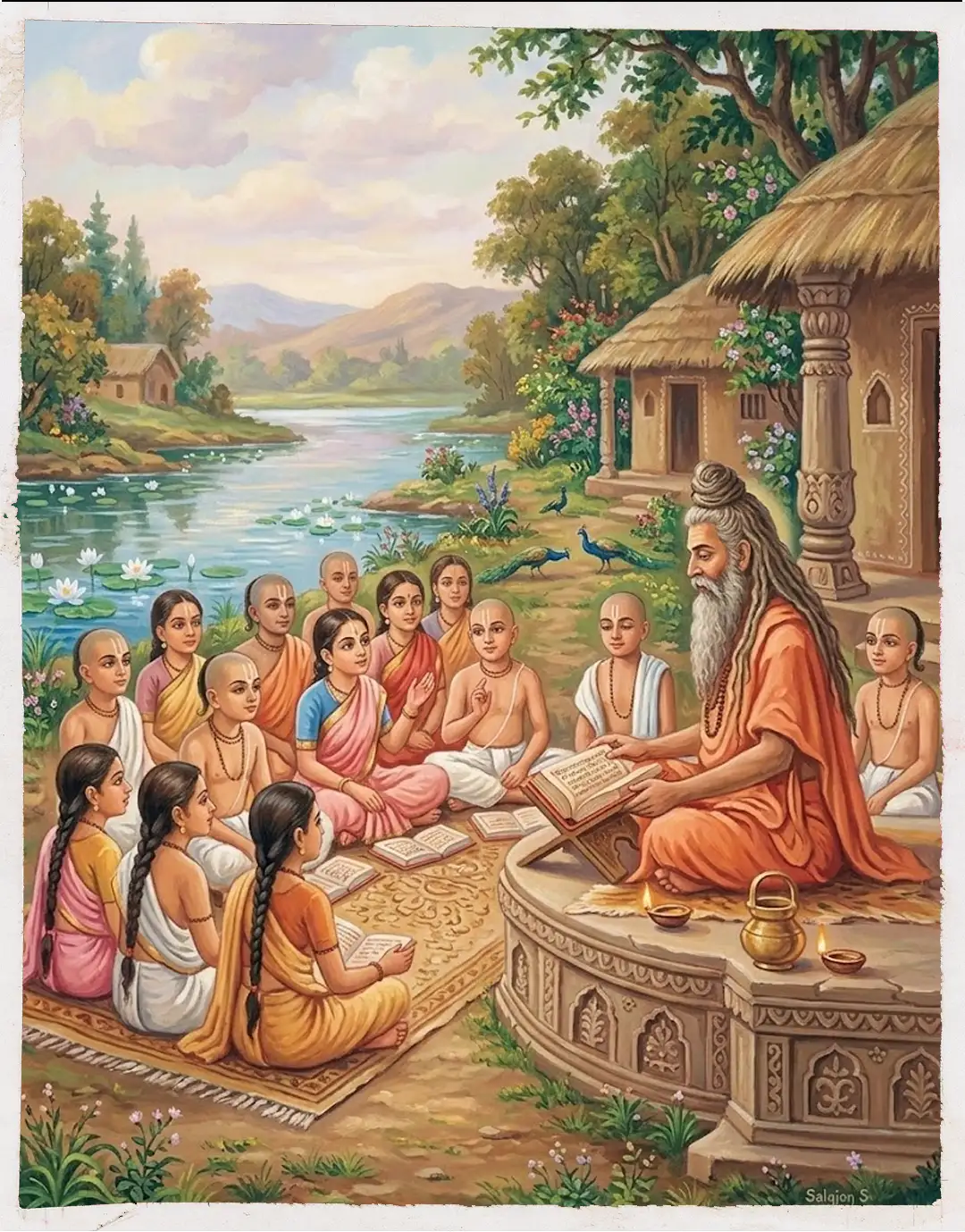
Swami Mukundananda's mission of transforming the world through wisdom finds one of its clearest expressions in this leela because the wisdom of Govardhan is not confined to a single event in ancient Braj but is a living teaching rooted in scripture and accessible through logic that transforms how we understand God, worship, and life itself.
In the Bhagavad Gita, Krishna declares that those who worship Him alone (thinking of no one else,) for them who are ever steadfast, He carries what they lack and preserve what they already have.
अनन्याश्चिन्तयन्तो मां ये जना: पर्युपासते ।
तेषां नित्याभियुक्तानां योगक्षेमं वहाम्यहम् ॥ 22॥
ananyāśh chintayanto māṁ ye janāḥ paryupāsate
teṣhāṁ nityābhiyuktānāṁ yoga-kṣhemaṁ vahāmyaham
BG 9.22: There are those who always think of Me and engage in exclusive devotion to Me. To them, whose minds are always absorbed in Me, I provide what they lack and preserve what they already possess.
This is the promise Krishna demonstrated at Govardhan before He spoke it at Kurukshetra because the villagers who took exclusive shelter in Him and abandoned their fearful appeasement of Indra were carried through the storm.
Ananya Bhakti is not a theological abstraction but the practical recognition that the One who provides everything is the One worth approaching directly, and as Swami Mukundananda teaches, don't waste time watering the leaves. Nourish the root, because the logic is irrefutable that if God is the source of all power then all lesser powers are His servants, and to worship the servant while ignoring the Master is not devotion but a failure of understanding which the Govardhan Leela corrects with surgical precision.
The Nature of Surrender in Govardhan Leela
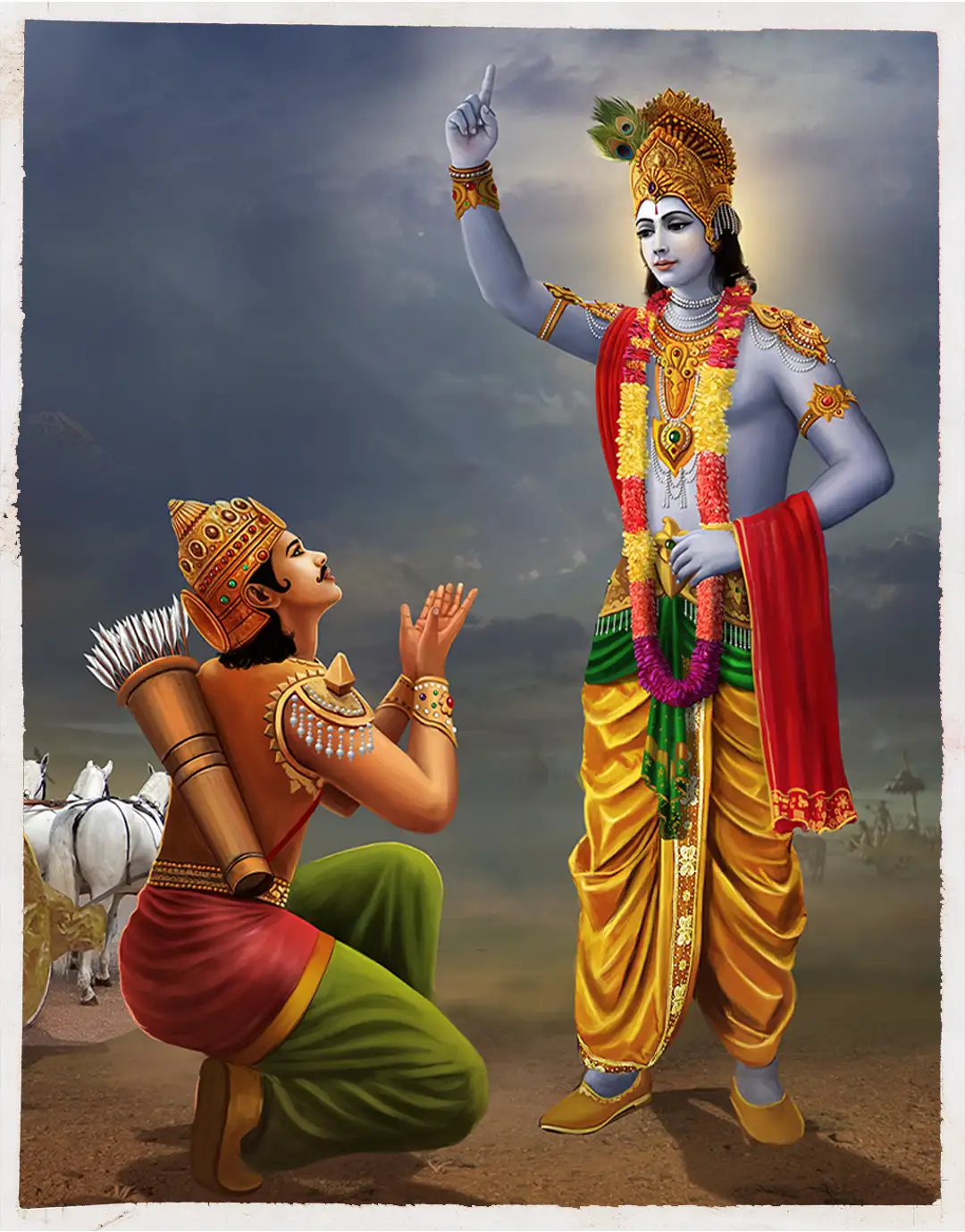
Before Krishna asked Arjun to surrender everything to Him in the Bhagavad Gita, He demonstrated what surrender looks like because the villagers did not fight the storm and did not try to outsmart Indra but simply trusted Krishna and took shelter beneath the hill He held.
Krishna's inal instruction in the Bhagavad Gita is to abandon all varieties of dharma and simply surrender unto Him alone, and He shall liberate you from all sinful reactions.
सर्वधर्मान्परित्यज्य मामेकं शरणं व्रज ।
अहं त्वां सर्वपापेभ्यो मोक्षयिष्यामि मा शुच: ॥ 66॥
sarva-dharmān parityajya mām ekaṁ śharaṇaṁ vraja
ahaṁ tvāṁ sarva-pāpebhyo mokṣhayiṣhyāmi mā śhuchaḥ
BG 18.66: Abandon all varieties of dharmas and simply surrender unto Me alone. I shall liberate you from all sinful reactions; do not fear.
Surrender is not passivity but the intelligent recognition that there is One who can protect you from storms you cannot even see let alone fight. The villagers of Braj understood something that scholars often miss: surrender is not the abandonment of effort but the relocation of trust, because they still gathered their families and brought their cows, but their confidence was not in their own preparations but in the boy who stood above them holding the mountain.
God's Protection Provides Shelter Within the Storm

Krishna did not stop the storm and did not snap His fingers to make Indra disappear but allowed the storm to rage and provided shelter within it, and this is how grace often works because the difficulties of life may not vanish but beneath them holding them at bay is a little finger that carries the weight of a mountain.
The Shreemad Bhagavatam confirms this by stating that the villagers entered beneath the hill where they found ample room for themselves and all their cows, wagons, servants, priests, and all other members of the community as well, and
God's protection is not a promise of a life without storms but a promise of a refuge that no storm can penetrate.
The Fall of Pride and the Rise of Humility
Indra's arrogance is not merely a mythological detail but a mirror, and the Bhagavatam's commentary notes that the word isha-mani is very significant because Indra arrogantly considered himself to be the Lord and thus exhibited the typical attitude of a conditioned soul, and everyone in this world is more or less guilty of the syndrome called isha-mana or proudly considering oneself the Lord.
The Govardhan Leela is a warning against the pride of position because Indra had power and a role but confused the gift with the Giver and forgot that his rain was borrowed and his thunder a loan, and when we identify with our roles, our successes, our titles, and our spiritual attainments, we recreate Indra's mistake, and the storm we unleash may not be made of hail and wind but is no less destructive.
The Highest Relationship Is Love, Not Awe
Perhaps the most profound wisdom of Govardhan is the one most easily overlooked because after the miracle Krishna actively worked to restore the villagers' intimate love for Him and did not want them to relate to Him as an awe-inspiring wonder-worker but wanted to be their Kanhaiya.
In the Bhagavad Gita, Krishna describes the highest devotee as one who is not disturbed by the world and who does not disturb the world, who is free from joy, envy, fear, and anxiety, and such a devotee is dear to Him.
However, even this does not capture the intimacy of Braj because the Gita's path of devotion is majestic while the Govardhan Leela reveals something more tender: God's ultimate desire is not to be glorified but to be loved, and He will perform any miracle, bear any burden, and hold any mountain if it brings His devotees closer, but if the miracle creates distance He will undo the miracle in their hearts because He would rather be your friend than your God.
What Govardhan Leela Teaches Us Today

Swami Mukundananda's wisdom invites us to look inward because the Govardhan Leela calls us to examine our worship and ask whether we are praying out of fear like the villagers before Krishna's intervention and whether we are treating God as a cosmic vending machine where we insert prayer and receive blessing.
Krishna's message is that true devotion is Ananya Bhakti or exclusive undivided love for the Supreme alone, not because other powers don't exist but because they are all His servants, and the wisdom of Govardhan is a call to redirect our trust from intermediaries to the Source.
The leela also teaches us surrender because the villagers did not fight the storm but simply trusted Krishna and took shelter beneath the hill He held, and in our own lives the storms come as illness, loss, uncertainty, and failure, and the wisdom of Govardhan is not that these storms will not touch us but that beneath them all is a Presence that holds the weight of mountains on a little finger, and surrender is the act of stepping beneath that shelter.
The leela reveals the nature of God's protection because He allowed the storm to rage and provided shelter within it, and this is how grace often works because the difficulties of life may not vanish but beneath them holding them at bay is a little finger that carries the weight of a mountain, and the storm is real but so is the shelter.
Finally, the leela warns us against pride because Indra's fall is our own, and every time we forget that our abilities, our positions, and our very breath are gifts, we recreate his mistake, and the wisdom of Govardhan is the wisdom of humility which is the recognition that we are not the Lord and the relief that we do not have to be.
The Umbrella of His Presence: A Final Reflection
The people of Braj huddle together beneath Govardhan watching the rain fall harmlessly outside while the cows are calm, the children are safe, and above them all stands Krishna unmoving with His arm raised and His eyes soft with love.
That is what He offers us: not a life without storms but a shelter within them, not a God who demands appeasement but a Lord who longs for our love. The question is not whether Krishna can lift the mountain because He can, but whether we will take shelter beneath it. When we do, when we trust Him enough to step out of our fear and into His presence, we discover what the villagers of Braj discovered: that the greatest protection is not from the storm but from the separation that kept us from Him, and beneath that shelter we find something we never expected because we find a friend, we find a home, and we find the One who held a mountain on His little finger simply because He could not bear to see His devotees suffer.
Swami Mukundananda's mission is to transform the world through wisdom, and the Govardhan Leela is that mission in miniature: a wisdom so profound that it lifts the weight of a mountain and so tender that it fits on a little finger.
Frequently Asked Questions (FAQs)
Q1. Why did Lord Krishna lift Govardhan Hill?
Lord Krishna lifted Govardhan Hill to protect the residents of Braj from the devastating storm unleashed by Indra. When Indra became furious because the villagers stopped worshipping him, he sent torrential rain, hail, and powerful winds to punish them. Krishna lifted Govardhan Hill on His little finger, providing shelter to the villagers and their cows for seven days and seven nights. This divine act demonstrated that God is the ultimate protector of His devotees.
Q2. What is the deeper spiritual meaning of Govardhan Leela?
The deeper meaning of Govardhan Leela is the importance of exclusive devotion, complete surrender, and unwavering faith in God. It teaches that instead of worshipping out of fear or seeking favours, devotees should develop a loving relationship with the Supreme Lord. As explained through Swami Mukundananda ji's teachings, true devotion means placing complete trust in Krishna, the ultimate source of all power and protection.
Q3. Why did Krishna lift Govardhan Hill with His little finger?
Krishna lifting Govardhan Hill with His little finger symbolises that divine power is not dependent on physical strength. The Lord can accomplish the impossible effortlessly through His divine potency. The little finger also represents the extraordinary nature of divine grace, showing that when God chooses to protect His devotees, no obstacle is too great.
Q4. What does Indra's defeat teach us about pride and humility?
Indra's defeat teaches that pride, arrogance, and attachment to one's position can lead to spiritual downfall. Although Indra possessed immense celestial power, he forgot that his abilities were gifts of the Supreme Lord. His experience reminds us to remain humble, recognise God as the ultimate source of everything, and never allow success or authority to create arrogance.
Q5. What is Ananya Bhakti, and how does Govardhan Leela explain it?
Ananya Bhakti means exclusive and undivided devotion to the Supreme Lord. Govardhan Leela demonstrates this principle by showing that Krishna is the ultimate source of all powers and the one deserving our complete faith and surrender. It encourages devotees to develop a direct, loving relationship with God rather than approaching Him merely to fulfil material desires.
Call To Action: Bringing Govardhan Leela into Modern-Day Life
Let us learn to replace fear with faith, ego with humility, anxiety with surrender, and material attachment with devotion.
This year while participating in Govardhan pooja let’s discover practical ways to cultivate Ananya Bhakti and experience Krishna's wisdom in your daily actions. Begin your journey of transformation with Swami Mukundananda.


