

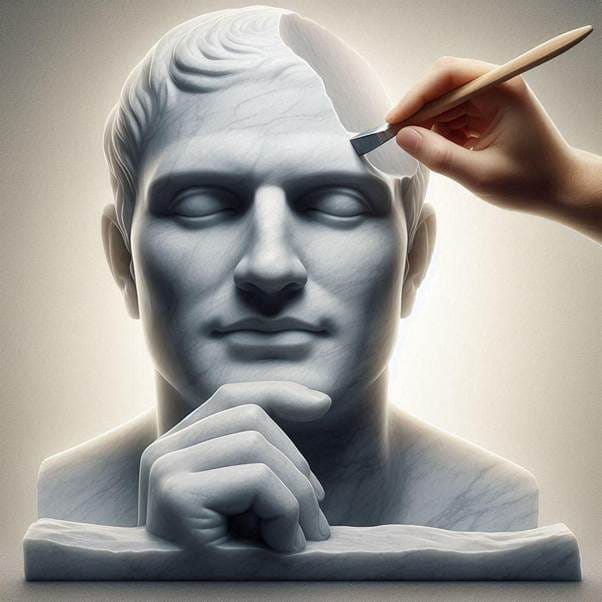
A woman was plagued by a recurring dream. Each night, a terrifying monster chased her to the edge of a cliff. One night, trembling and breathless, she finally turned and asked, “Where did you come from?” The monster paused and replied, “From nowhere. I have been lurking because you harbored me in your mind!”
Like the woman, we are often cornered by doubts, anxieties, limitations. Though they seem external, they are born within, from the depths of our psyche. And beneath them lie our beliefs: the quiet convictions that shape the way we think, act, and feel—without us even realizing it. This article explores how beliefs are formed, how they mold our lives, and how we can consciously reshape them using timeless Vedic wisdom.
What Are Beliefs?
Our world is a swirling ocean of stimuli such as news, opinions, experiences. To make sense of it all, we form beliefs: mental shortcuts that help us understand and navigate life. Beliefs become the lens through which we perceive the world. For instance, one person may believe the universe is kind and supportive, while another may believe it is harsh and indifferent. That single belief shapes how a person responds to people, challenges, and opportunities.
However, beliefs are not just passive thoughts; they actively mold our reality. Some uplift us. Others limit or even sabotage us. And once a belief takes root in the intellect, the subconscious begins to act on it as if it were fact—regardless of whether it is true or not.
Consider this light-hearted example.
One Monday, Dinesh walked into the office feeling perfectly healthy. His colleagues, playing a prank, took turns expressing concern: “You look pale,” said one. “Are you okay? You seem tired,” said another. A third asked if he had a fever. By the time a fourth exclaimed, “You look terrible!” Dinesh was convinced. Though fine that morning, he began to feel weak, called in sick, and went to bed—manifesting symptoms of an illness that did not exist. His body obeyed the belief his mind accepted.
This shows how beliefs can make us sick—but they can also make us well.
Medical science confirms this through the well-known placebo effect, where patients recover after taking a fake pill, simply because they believe it is real medicine. The subconscious registers: I am receiving treatment, so I must heal. And often, healing follows. It is not the pill, but the belief behind it that heals.

Impact of Beliefs
Beliefs influence us in ways far deeper than we realize—even touching matters of life and death.
Dr. David Phillips, a researcher at UC San Diego, studied over two million death records to identify subtle patterns. His findings revealed a surprising trend: women’s death rates dipped just before their birthdays and rose afterward, while men’s deaths spiked before their birthdays and declined afterward.
The researchers discovered that women often associate birthdays with connection and nurturing, holding on with hope—even while gravely ill—to experience another year of love and celebration. Men, by contrast, tend to link birthdays with performance and success. The milestone can trigger anxiety or feelings of inadequacy and weaken the will to live. Interestingly, this pattern did not hold for celebrities, whose sense of identity and self-worth often comes from outside validation like fame, public recognition, or career achievements. This shows the roots of our values, decisions, and priorities all trace back to the beliefs we have absorbed—often unconsciously.
Henry Ford famously said:
“Whether you believe you can succeed, or you believe you cannot, either way you are right.”
If your intellect is convinced you can succeed, it rallies your mind, body, and spirit in that direction. But if your belief says you cannot achieve success, then even your potential drops. Belief commands the behavior of your inner world, and your outer life follows.
Take the story of Alfred Nobel.
Known today for the Nobel Peace Prize, he was once infamous as the ‘Dynamite King.’ He made his fortune inventing dynamite—a tool of both industrial progress and destruction. When his brother passed away, a newspaper mistakenly published an obituary for Alfred instead. The headline read: “Dynamite King Dies,” condemning him as a man who profited from death and war.
Reading his own obituary over breakfast was a shocking moment of self-confrontation: Was this how the world would remember him? That moment shifted his beliefs about legacy and purpose. He rewrote his narrative and founded the Nobel Peace Prize, a legacy that changed how he would be remembered. What changed? His beliefs—about what truly mattered. From them, new values arose. From those values, a new life unfolded.
So how do we shift our values?
By first revisiting our beliefs, because every value system stems from them. Do you believe you are merely the body, or do you believe you are an eternal soul? Do you believe the universe is random, or divinely orchestrated? These core beliefs silently dictate what inspires you, what you pursue, and what you become. Ultimately, your beliefs are the compass of your life. If they are rooted in fear, ignorance, or hearsay, they steer you towards confusion and suffering. But when aligned with truth, wisdom, and higher knowledge, they uplift and transform you.

How Are Beliefs Formed?
The irony is that we often choose clothes more carefully than our beliefs.
Some beliefs come to us from hearsay: “All my friends succeeded in real estate. It must be the best option.” Others arise from limited experience: “I failed two interviews. I can never do well in interviews.” Some are formed by repetition—whether true or false. As Joseph Goebbels, the propaganda minister of Nazi Germany, declared: “A lie told a thousand times becomes the truth.”
The Vedas caution us against adopting beliefs based merely on hearsay. Instead, they urge us to build our beliefs on the foundation of authentic, reliable knowledge. When our beliefs are rooted in Truth, our entire life becomes auspicious.
astīstyevopalabdhasya tattvabhāvaḥ prasīdati ~ Kaṭhopaniṣhad 2.3.13
This mantra from the Krishna Yajur Veda’s Upanishad says that we all know the definition of God that He is All-Pervading, All-Powerful, the Creator of all. If only we could believe what we know, we would become God-realized, without doing anything else. What more can be said about the power of beliefs!
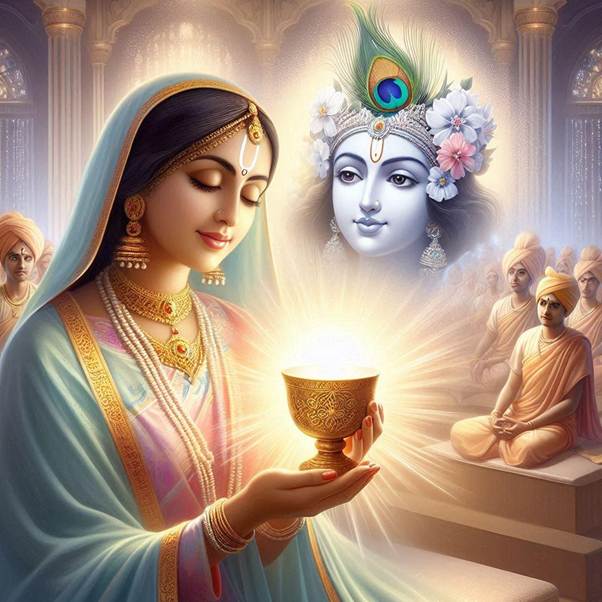
Meerabai truly believed it. When she was given charanamrit—the sacred water said to be the foot wash of her beloved Giridhar Gopal—it was, in fact, a cup of poison. Yet, she accepted it with firm faith, “If this is the charanamrit of my Lord, it cannot harm me.” Her conviction was rooted in her trust in the divine nature of God, which rendered the poison powerless.
But how do we cultivate such powerful beliefs?
Creating Empowering Beliefs
The scriptures advise: “O soul, have faith in the scriptures and in the spiritual master.”
Everyone holds beliefs. Atheists believe the universe created itself, theists believe in a divine Creator. What matters is whether those beliefs uplift or degrade us. Even when we fall ill, we follow a doctor’s instructions blindly: we trust the name, the paper, the pharmacist, and take unknown pills—often without question. Why not place that same faith in a source that has guided saints and sages for millennia?
The Vedas offers a time-tested three-step method for establishing beliefs rooted in transcendental knowledge: Shravan (Hearing), Manan (Contemplation), Nididhyasan (Conviction).
Let us explore step-by-step.
1. Shravan – Hear or read divine knowledge
The divine knowledge we read in scriptures or hear from the Guru is termed as shravan. Reading or hearing from the right sources equips us with the knowledge to lead a fulfilling life.
Take, for example, a common belief we hold—that we are the body. This makes us see bodily relations—family, friends, possessions—as our own and seek security in them. But scriptures teach that we are the soul, and our true, eternal companion is God, who stays with us across lifetimes. Without this understanding, we rely on what is temporary. Shravan corrects false beliefs and helps us shift from material dependence to trust in divine protection.
Saint Tulsidas said:
eka ghaḍī ādhi ghaḍī ādhi meṅ puni ādha
tūlasī saṅgata sādhu kī, koṭi kaṭe aparādha
“Listening to divine knowledge from saints is so powerful that even a brief moment of it is sufficient to destroy the karmic reactions of countless sins.”
Much of what we hear is eventually forgotten. At the time, it may feel like we have understood it. But without reinforcement, knowledge begins to fade. Therefore, the Vedas emphasize: Repeatedly hear or read the divine knowledge. To retain and deepen it, repetition through shravan is essential.
2. Manan – Contemplate deeply
After hearing, retain the knowledge by internalizing it through thoughtful contemplation. This is also called chintan: revisiting a piece of knowledge again and again with your intellect. Contemplate over what has been heard. Reflecting on wisdom keeps it in conscious awareness and makes it useful.
For instance, we all know that anger is harmful. Yet in the heat of the moment, emotion overrides reason, and we are left regretting our actions, “What did I just do!” This happens because that knowledge slips from our intellect in that moment. That is why scriptures say: forgetting divine wisdom lowers one to the level of animals.
Our humanness lies in our ability to retain wisdom in conscious awareness. To do that, we must contemplate on the knowledge repeatedly. Just like a cow grazes grass, then chews the cud—taking it from one stomach and passing it to another and back again—similarly, we must hear the knowledge and then ruminate over it.
3. Nididhyasan – Decide firmly with conviction
The third step is making a firm decision with your intellect in accordance with the wisdom. This decision transforms wisdom into conviction, and that conviction changes everything!
Here is a story to drive this point home.
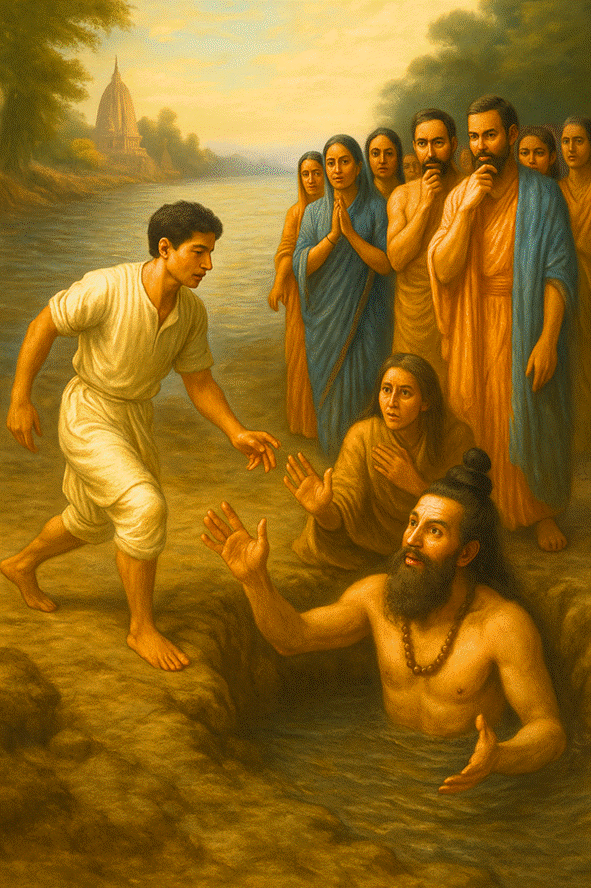
Once, Parvati asked Bhagavan Shiv, “When the Ganga has the power to wash away all sins, why don’t devotees become sin-free after bathing in it?” Shankar Ji replied, “The problem is: they all have the knowledge, but they don’t believe it.”
To illustrate, he took Parvati to Kashi by the banks of River Ganga, both in disguise. Shankar Ji fell into a ditch of mud, while Parvati, disguised as an old woman, started wailing, “My husband has fallen into a cursed pit! If no one helps him by tonight, he will die!” Passers-by rushed to help, but she added, “Wait—there is a condition. Only someone who is completely free of sins can rescue him. Otherwise, that person will also die.”
Many had just bathed in the holy Ganga, but on hearing the condition, they walked away in fear. Eventually, a man said, “Why fear? My sins have been washed by the holy Ganga.” He jumped in and rescued the disguised Shankar Ji. Smiling, Bhagavan Shankar said, “Apart from him, no one else truly believed in the divinity of Ganga ji.”
Thus, the process of creating faith, or beliefs, by conscious choice is nididhyāsan. Rather than allowing our intellect to pick up beliefs unconsciously, we consciously choose to establish them based on infallible principles from the scriptures.
Conclusion
Our lives are like raw marble, sculpted by the chisel of our convictions. Just as a master sculptor carefully crafts a beautiful piece of art, our beliefs shape us into who we are today. But the good news is that, unlike marble, our beliefs can be reshaped, reformed, and refined. Through Shravan, Manan, and Nididhyasan, we can replace limiting beliefs with truths that uplift us. When our beliefs align with divine knowledge, they don’t just change our thoughts; they transform us. In choosing the right beliefs, we don’t just shape our life—we find our self.
Take Action
📘Get your copy of The Science of Mind Management, a treasure trove of divine wisdom by Swami Mukundananda. Discover timeless principles and practical methods to establish empowering beliefs that uplift and transform your life.
🧘♂️Join the Life Transformation Program in Houston from 19th July to 1st August. Immerse yourself in Swamiji’s profound insights, participate in enriching discussions, and experience his teachings come alive. 🤝Don’t miss the chance to meet Swamiji personally during an exclusive Meet & Greet session.
Resources
● #1 Key to Creating Right Beliefs in Life - MUST WATCH | Swami Mukundananda
● How Your Beliefs Shape Your Personality? | Swami Mukundananda
● Understanding your Subconscious Mind to Break Negative Beliefs - Swami Mukundananda
● 3 Steps to Create a Strong Belief System to Achieve Any Goal | Swami Mukundananda