
There is a well-known saying: बिन माँगे मोती मिले, माँगे मिले न भीख—without asking, one receives pearls; by asking, one does not even get alms. In the path of devotion, this expresses a profound truth. Those who approach the Lord only for favors often miss the essence of bhakti, while those who come with love and surrender discover the greatest treasure of all.
Scriptures say that God becomes indebted to such selfless devotees. He does not merely bless them; He offers Himself, bound by the chords of their pure love. The Lord declares in the Shreemad Bhagavatam:
अहं भक्त-पराधीनो ह्यस्वतन्त्र इव द्विज~ Verse 9.4.63
“Although I am supremely independent, yet I become enslaved by my devotees who love me selflessly. They conquer my heart and I submit my independence to them.”
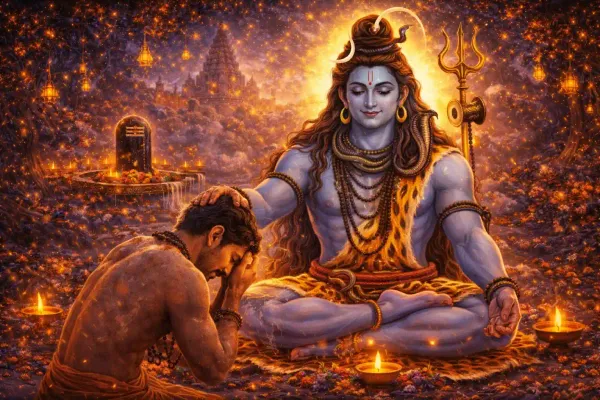
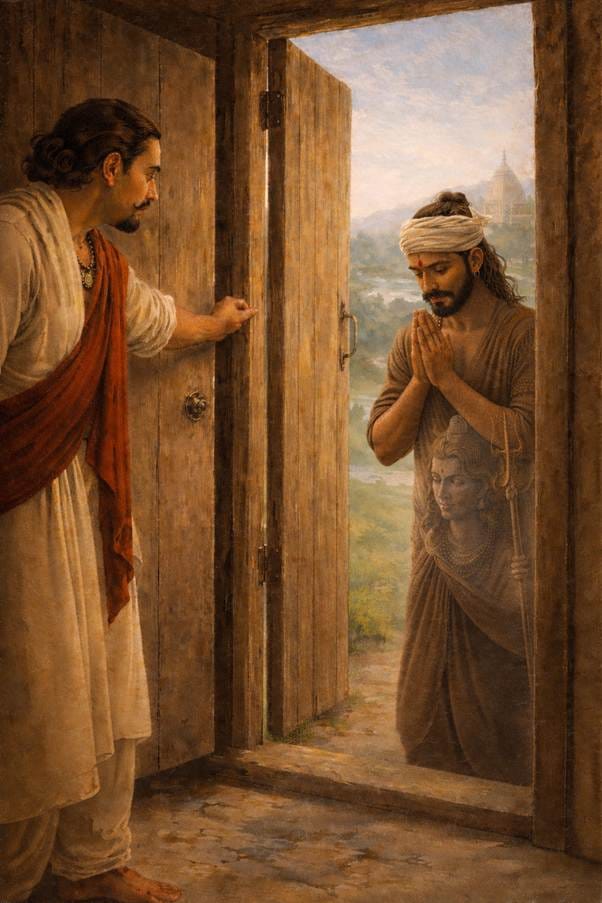
Can the master of the universe truly become enslaved? Indeed, this is what unfolded in the life of Vidyapati, when Bhagavan Shiv willingly came to his doorstep disguised as a humble servant named Ugna.
Ugna Serves Vidyapati
Vidyapati, a 14th-century poet-saint of eastern India, was a devoted worshiper of Bhagavan Shiv. When the Lord came to his home as Ugna, Vidyapati unknowingly engaged his own Ishtadev in service. He never imagined that the hands fetching water and the feet walking beside him belonged to the very Lord he adored with such fervor.
Together they journeyed across regions. On one such journey, they crossed a barren stretch of land. Exhausted and parched, Vidyapati had gone without water for long. Out of compassion, Lord Shiv—who eternally bears the sacred Ganga in His matted locks—produced a vessel of water and offered it to Vidyapati. As soon as Vidyapati tasted the water, he sensed it was no ordinary drink; it was Ganga jal, the holy water of the Ganges. Curious, he asked Ugna where it had come from. Pressed to reveal the truth, Ugna disclosed His divine Form as Gangeshwar.
The revelation struck Vidyapati like a thunderbolt. Overwhelmed, he lamented, “Alas! I have unknowingly engaged my worshipable Lord in my service.” But Lord Shiv reassured him, saying that it was His own wish to serve His devotee and asked that His identity remain secret. Vidyapati agreed. Yet, knowing now that Ugna was Bhagavan Himself, Vidyapati found it impossible to treat Him like a servant. Instead, he strove to ensure Ugna’s comfort.
This unusual favoritism troubled Vidyapati’s wife, who grew increasingly irritated with Ugna. One day, in a fit of anger, she scolded him and even beat him with a stick. Shocked beyond measure, Vidyapati cried out, “What are you doing? He is Bhagavan Shiv!” The words had barely left his mouth when he realized his grave mistake: He had broken his promise. At once, Ugna vanished from their home.
Distraught, Vidyapati wandered through towns, temples, and forests in search of his beloved Ugna. At last, Bhagavan Shiv granted him darshan once more at a place that came to be known as Ugnasthan and instructed him to continue his life’s mission: to spread the glories of bhakti.
The scriptures repeatedly extol the glory of Nishkam Bhakti—selfless devotion. As per the Shreemad Bhagavatam Mahapuran, Shree Krishna says: “I walk behind my pure, selfless devotees.” This seems paradoxical—should not God lead, with the devotee following behind? Why would the Lord follow?
Shree Krishna explains,
निरपेक्षं मुनिं शान्तं निर्वैरं समदर्शनम् ।
अनुव्रजाम्यहं नित्यं पूयेयेत्यङ्घ्रिरेणुभि: ॥ ~ Verse 11.14.16
“I wait for the dust of the feet of my devotees to rise and fall upon me that I may be purified by it.”
Is it not wondrous that Bhagavan, who is pavanam pavananam—the purifier of the pure—expresses such a sentiment? It reveals the exalted state of selfless devotees, whose love is so pure that even the Supreme delights in honoring them.
Yet in the world, we often miss out on the very meaning of bhakti.
Bhakti or Bargaining?
Two neighbors, Ram Dutt and Vishnu Dutt, once lived side by side. What began as a harmless rivalry soon grew into envy as each tried to outshine the other. Ram Dutt sailed on a cruise to Alaska and proudly posted his pictures online. Not to be outdone, Vishnu Dutt traveled to Hawaii and shared his own photos. Ram Dutt bought a Mercedes; Vishnu Dutt answered with a Tesla. Over time, their competition hardened into bitterness.
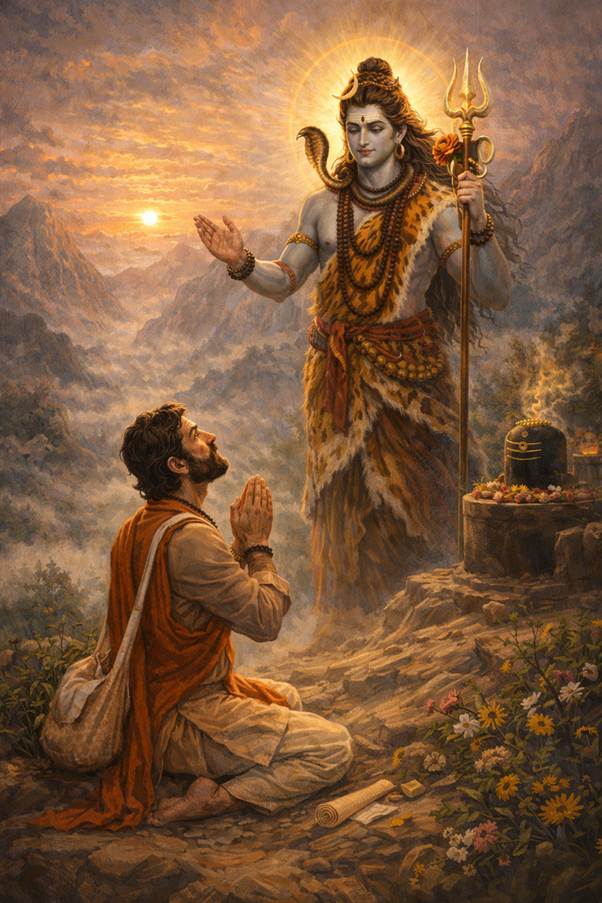
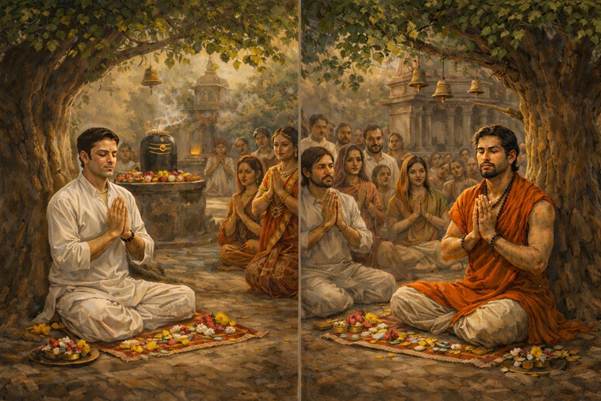
One day, Ram Dutt thought: the only way to surpass Vishnu Dutt was to seek a boon from Bhagavan Shiv. At dawn, he went to a temple. Bowing before the shivling, he seated himself beneath a tree and began chanting: “Om Namah Shivay.” As they say, envious minds think alike. Vishnu Dutt too arrived at the same temple that morning. Hearing Ram Dutt’s chant, he instantly grasped his neighbor’s intent. Determined not to fall behind, he also offered pranams to the shivling, sat under another tree, and began his own chant: “Namah Shivay Om.”
Hours passed, and the temple soon bustled with worshippers. All were astonished to see the two neighbors utterly absorbed in chanting Lord Shiv’s name. Mistaking them for great saints, devotees bowed in reverence and laid flowers at their feet. By evening, Maa Parvati observed their relentless chanting and said to Lord Shiv, “Maharaj, these two have been taking Your name incessantly since morning. Please give them darshan.”
Shiv ji replied, “Parvati, I shall go. But know this—they will not truly benefit.” Still, at her request, the Lord appeared before Ram Dutt first and invited him to seek a boon. Overjoyed yet cautious Ram Dutt pondered: If I ask for a mansion, Vishnu Dutt will demand two. If I ask for a billion dollars, he will seek twice as much. Suddenly, an idea struck him. He prayed, “O Lord, when You meet Vishnu Dutt, please give me double of whatever boon You bestow upon him.” Shankar Ji smiled and said, “Tathastu,” granting his wish.
Later, when Lord Shiv appeared before Vishnu Dutt and asked what boon he desired, Vishnu Dutt inquired, “Maharaj, first please tell me—what have You given to Ram Dutt?” Shiv ji answered, “Whatever you receive, he shall receive double.” Realizing the futility of competing, Vishnu Dutt paused and thought: now there is only one way for me to surpass my neighbor. And so, he prayed, “Maharaj, make me blind in one eye.” Lord Shiv granted his wish.
Thus, Vishnu Dutt became blind in one eye. And Ram Dutt, receiving double, became completely blind! The devotees of the locality, who had believed that two great sages had manifested in their midst, now saw the truth. These men had seemed absorbed in devotion, but their minds were elsewhere.
What Is Bhakti?
Bhakti is synonymous with upasana, which literally means “to sit close to the Lord.” Scriptures and sages describe it in many ways:
● The Gopal Tapani Upanishad teaches: bhakti means to take the mind to God and relish His divine bliss.
● Maharshi Kapil, in the Shreemad Bhagavat Mahapuran, offers an analogy: just as the holy Ganga springs from Gomukh—a small opening the size of a cow’s hoof in the Himalayas—and flows unceasingly until it merges with the ocean at Gangasagar, so too should all our thoughts stream continuously towards God. Such an uninterrupted current is bhakti.
● Jagadguru Shankaracharya illustrates through a simple image: pierce a potato with needles, and they remain lodged because the needles are firm while the potato is soft. Likewise, when our thoughts remain firmly fixed in God, imbued with divine consciousness, that is bhakti.
● Ved Vyas clarifies the very origin of the word: bhakti is derived from the root bhaj, meaning “to serve.” Thus, bhakti is the loving service of the Supreme Divine and His representative—the Guru, the spiritual master.
● Jagadguru Shree Kripaluji Maharaj explains: bhakti itself is a divine power of God. This bhakti is of two kinds: sadhan bhakti and siddh bhakti. Sadhan bhakti is the stage of practice, where one strives to turn the mind to God and purify the heart. When the vessel of the heart becomes ready, Bhagavan, through the Guru, bestows divine love—this is siddh bhakti, an aspect of God’s Yogmaya, His supreme divine power.
What happens when this divine bhakti is received?
The Shwetashwatar Upanishad states: the bonds of maya are cut asunder, the accumulated karmas of endless lifetimes are burned to ashes, and the ignorance within is dispelled. From that moment, the soul experiences union with God. Swami Mukundananda, in his book Narad Bhakti Sutras, explains Narad ji’s description of such a devotee:
तद्प्राप्य तदेवावलोकयति, तदेव श्रुणोति, तदेव चिन्तयति, तदेव भाषयति ~ Sutra 55
On attaining divine love, one sees only Him and hears Him alone. One speaks only of Him and thinks of Him alone.
What to Ask from God?
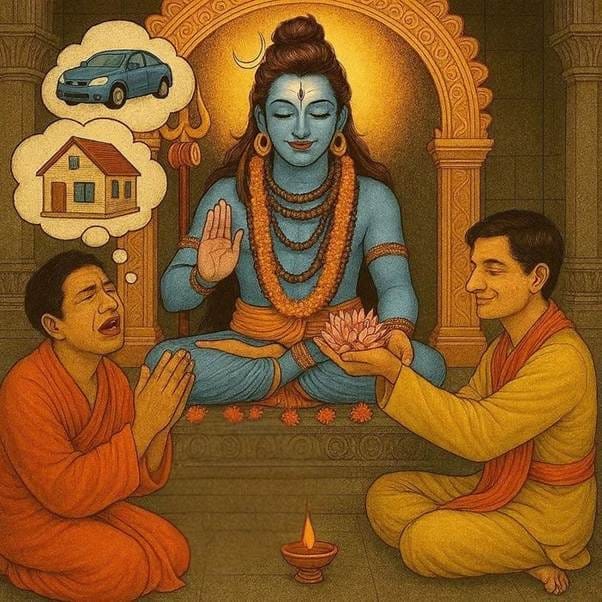
At this point, introspection is essential. Too often, much of what we call devotion is no more than a list of requests: “O Lord, help me get this promotion…cure my child…solve my financial troubles…arrange a good marriage for me.” Such prayers reflect what the mind is most attached to.
If someone prays, “May my child top the exam,” the lips may chant the Lord’s name, yet the mind remains fixed on the child. What appears to be devotion to Him is, in reality, attachment to a worldly outcome, with God in the background as a means to attain it. As long as we approach God as a fulfiller of wishes, our bond stays transactional. But when we turn to Him with love and surrender, prayer blossoms into a sacred communion.
The story of Ram Dutt and Vishnu Dutt illustrates how desire-driven worship can cloud judgment and lead one astray. Saints, therefore, advise a different kind of prayer—one rooted in humility and trust:
“मेरी चाही मत करो, मैं मूर्ख अज्ञान; तेरी चाही में प्रभु है मेरा कल्याण।”
“My Lord, do not fulfill my wishes, for I am ignorant and do not know what is truly good for me. In Your will alone lies my welfare.”
Once the heart resolves to love God and make serving Him the highest goal, prayer itself begins to change. It becomes purer, selfless, and radiant with surrender, finding expression such as these:
● Bhakti: “O Lord, deepen my devotion so that it may bring greater joy to You.”
● Gyan: “Bless me with divine wisdom, that I may always walk upon the path illuminated by my Guru.”
● Vairagya: “Help me detach from worldly distractions and grant me the strength to surrender wholly to You.”
● Seva: “Lord, fill my heart with the spirit of service, so that I may serve You tirelessly.”
● Humility: “I pray, O Lord, make me forever a humble servant in the service of my Master.”
In prayers like these, the gifts sought are not for personal pleasure or worldly gain, but for the joy of serving the Lord and drawing ever closer to Him.
Final Thoughts
True prayer is not a pursuit of pleasure, but a yearning for bhakti, wisdom, purity—gifts that bring joy to the Divine. In such selflessness, God becomes both the path as well as the destination. No longer a distant deity to be feared, but One with whom the soul shares its most sacred bond. And so, as the night of Mahashivratri unfolds this year, and as you stand before Lord Shiv, pause and ask yourself: what is the one thing you would pray for?
Call to Action
Watch this Q/A video on the importance of Mahashivratri.
Listen to this soulful bhajan ‘Om Namah Shivay.’
Resources
● Don't Pray to Shiva to Ask Boons - The Power of NOT Asking God
● An UNTOLD Story of Lord Shiva - Watch this to Experience God | Swami Mukundananda