

Human life is a sacred opportunity gifted to us by the Supreme Lord after countless births. The Īśopaniṣad reminds us that life is not meant merely for chasing fleeting pleasures, but for awakening to our divine identity. When Mantra 2 declares that one should “desire to live for a hundred years performing one’s duties,” it does not glorify longevity — it glorifies purposeful spiritual living. A long life is valuable only when filled with noble actions performed in remembrance of God. The sages beautifully explain that just as the lotus rises above muddy water, the seeker too can live amidst the world yet remain untouched by its impurities.
Swami Mukundananda Ji often says, “When we dedicate our actions to God, our work becomes worship.” This is the essence of Upanishadic wisdom — live but live with God; act but let your heart stay anchored in Him; desire long life, not for enjoyment, but for spiritual evolution.
1. Īśopaniṣad – Mantra 2 (Sanskrit, Translation & Meaning)
Sanskrit
कुर्वन्न् एवॆह कर्माणि जिजीविषेत् शतं समाः ।
एवं त्वयि नान्यथेतोऽस्ति न कर्म लिप्यते नरे ॥
Translation (Swami Mukundananda Ji)
“One should aspire to live for a hundred years by performing one’s prescribed duties. In this way, there is no other path by which karma will not bind you.”
Simple Meaning
The mantra teaches that human beings should aspire to live a full life while performing their duties without ego and attachment. When actions are offered to God and the heart remains pure, karma cannot bind the soul.
2. Jijīviṣā — The Pure Desire to Live for 100 Years
The word jijīviṣet means “to desire long life,” but this desire is not worldly. The Upanishad explains that seekers may desire long life because God is eternal, the soul is eternal, and human life is a rare chance to strive toward Him. Thus, the soul naturally seeks continued existence to perform righteous duties, purify the heart, engage in seva and sādhanā, and progress toward God-realization. Life becomes a sacred opportunity for spiritual evolution.
“The purpose of long life is not long enjoyment, but long purification.”
The value of life lies not in its length, but in the consciousness with which it is lived. If the motive is pure, longevity serves spiritual advancement; if selfish, it becomes bondage.
3. Two Kinds of People: Bhogis and Yogis
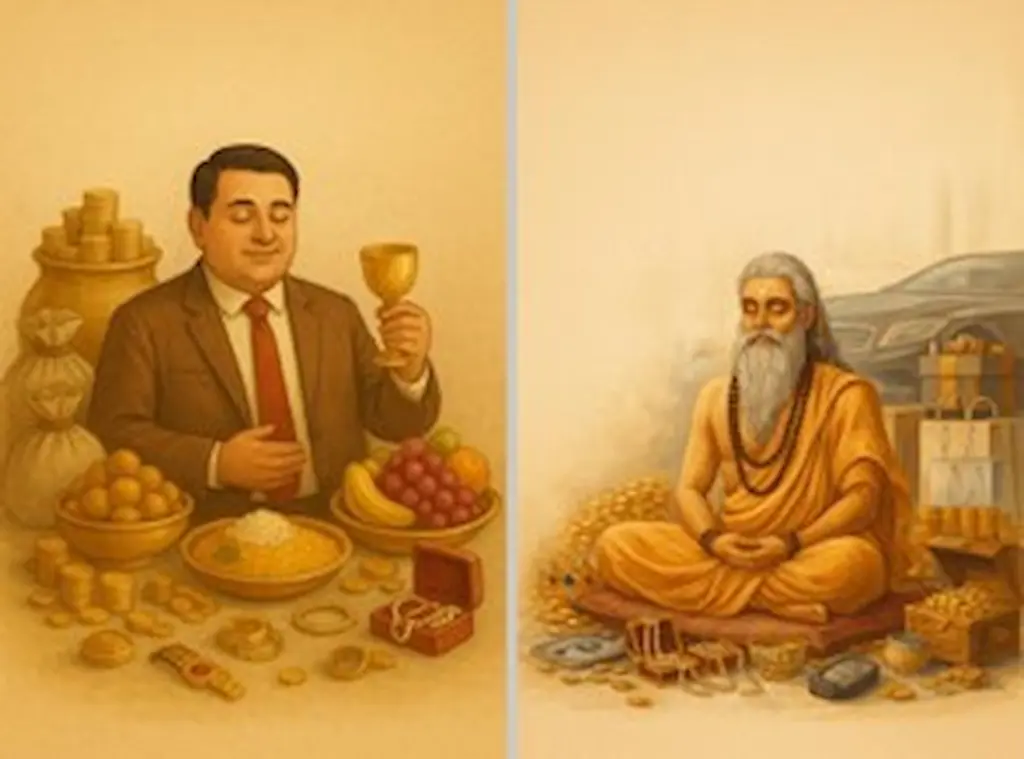
a) Bhogis — Those Who Seek Enjoyment
Bhogis wishes for a long life primarily to extend their engagement with worldly pleasures. Their hearts cling to material comforts, achievements, sensory delights, and social praise. Even if they were to live a hundred years, such a life would deepen attachment and multiply desires. Entangled in fleeting pleasures, they remain restless, moving endlessly through saṁsāra where true peace remains elusive.
b) Yogis — Those Who Seek the Divine
Yogis, by contrast, view life as a sacred gift meant for spiritual upliftment. They understand that the soul has wandered through countless births before receiving a human body — even celestial beings long for this opportunity. The yogī prays for long life not from attachment, but aspiration: more years to deepen devotion, strengthen humility, serve selflessly, and dissolve the ego. For such seekers, longevity is grace, not indulgence. Every action becomes a divine offering that leads the soul toward liberation. Thus Mantra 2 gently teaches: live in the world yet aspire beyond it, performing duties with devotion so that life itself becomes an offering that frees the soul.
4. Sri Aurobindo’s Insight — “Evaṁ Kurvan…”
Sri Aurobindo beautifully explains Mantra 2 through the phrase “Evaṁ kurvan…” — “Thus doing…” meaning live in the world, perform all duties, yet remain inwardly free. The mantra does not advise renouncing the world; rather, it instructs us to act without attachment.
- Live in society
- Fulfill responsibilities
- Offer duties to God
- Renounce attachment, not action
This is the heart of karma yoga.
Sri Aurobindo: “Do the works of life, but do not let life bind your spirit.”
Swami Vivekananda echoes the same spirit: “Arise! Awake! And stop not till the goal is reached.”
The mantra teaches that true spirituality has not escaped but engagement — acting sincerely while remaining unattached, just like a lotus rises above muddy water. A true yogī embraces responsibilities with devotion, knowing everything belongs to God (as declared in Mantra 1). Living this way transforms human life into a divine journey.
5. Bhagavad Gita Support — “Yastu karma-phala-tyāgī…”
To deepen this understanding, Lord Krishna affirms the same principle in Bhagavad Gita 18.11:
Sanskrit Verse
यस्तु कर्मफलत्यागी
सत्यागीत्युच्यते प्रभो ।
न हि देहभृता शक्यं
त्यक्तुं कर्माण्यशेषतः ॥
Transliteration
Yas tu karma-phala-tyāgī sa tyāgīty ucyate prabho;
Na hi deha-bṛtā śhakyaṁ tyaktuṁ karmāṇy aśeṣhataḥ.
Translation
“One who renounces the fruits of action” is the true renunciate. For embodied beings, it is not possible to renounce all actions entirely.”
Krishna clarifies that real renunciation lies not in abandoning action, but in offering its fruits to God. Swami Mukundananda Ji explains that:
- Renouncing action is escapism
- Renouncing attachment is true spirituality
- A karma-yogi remains free even while acting
“Work must continue, but ego must drop.”
When actions are done as offerings to God, they purify the heart and liberate the soul from karmic bondage.
6. The Three Types of Karma
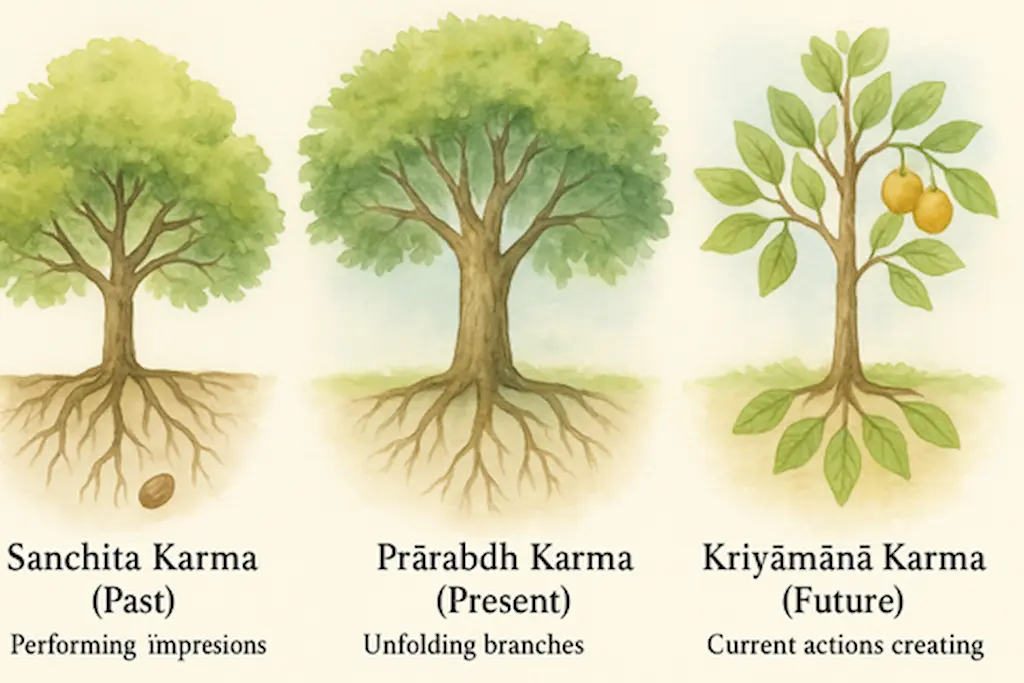
a) Sañchita Karma — The Storehouse of Past Impressions
Sañchita is the vast reservoir of karmic memories gathered over innumerable births. These latent impressions — tendencies, desires, strengths, and weaknesses — lie dormant like seeds that may sprout under the right conditions.
b) Prārabdha Karma — The Portion Chosen for This Life
From this storehouse, a specific portion unfolds as our present life. It determines our family, body, circumstances, challenges, and opportunities — the “arrow already released” that must complete its course.
c) Kriyāmāṇa (Āgāmi) Karma — The Karma We Create Now
This is the sphere of our free will — thoughts, choices, motives, and actions. When surrendered to God, kriyāmāṇa karma purifies the soul and weakens the force of sañchita and prārabdha. Hence the mantra teaches: live actively but live divinely.
7. Karma, Akarma & Vikarma — Full Expanded Version
Understanding karma alone is not enough; we must also understand how to act so that our actions purify us rather than bind us. The Upanishads and the Gita divide action into three kinds, each profoundly influencing the destiny of the soul.
a) Karma — Righteous and Prescribed Action
Karma includes all actions performed in accordance with dharma — fulfilling your duties with honesty, sincerity, and integrity. Whether one is raising a family, performing one’s profession, or participating in sacred rituals, these actions generate pious merit (puṇya). Such merit elevates the soul, sometimes even granting higher births or celestial enjoyments.
But even the highest righteous actions still produce a fruit that must be experienced. Thus, karma cannot free the soul. It binds subtly, because the doer still retains the sense of “I act, and I deserve the result.” While karma is far superior to negligence or wrongdoing, it cannot grant liberation unless offered without attachment.
b) Akarma — Action Without Bondage
Akarma is action in its purest form — action that does not bind at all. It does not mean inactivity; rather, it means performing action without ego and without desire for personal gain. One works enthusiastically yet inwardly remains surrendered. The sense of doership dissolves, and all results — pleasant or painful — are accepted as God’s prasād.
The Bhagavad Gita presents Arjuna as the ideal example. When Arjuna fought purely as an instrument of Krishna, his outward actions were intense, but inwardly he was untouched, free, and pure. This is akarma — living fully in the world while remaining inwardly centered in God.
Swami Mukundananda Ji explains: “The highest action is that which purifies, because it is performed without ego.”
When the heart is absorbed in God, action becomes worship, and duty becomes meditation. No karmic reaction arises from such surrendered action.
c) Vikarma — Actions That Bind and Darken the Heart
Vikarma refers to forbidden, harmful, or adharmic actions — those born of greed, anger, lust, jealousy, fear, or ignorance. These actions violate divine law and generate heavy karmic reactions. They pull the soul downward, deepen suffering, and obscure spiritual awareness.
Vikarma darkens the inner instrument (antahkarana), making the heart restless and clouded. If continued, it distances the jīva from God and strengthens material attachment. Hence the Upanishad urges seekers to avoid vikarma completely.
The Upanishadic Ideal
Together, karma, akarma, and vikarma reveal the transformative message of Mantra 2:
Do not renounce the world — renounce attachment.
Perform action — but perform it for God.
Let every act become akarma.
When life is lived this way, even ordinary activity becomes a means of liberation.
8. A Devotional Story — The Lotus Lesson

A devotee once asked a saint, “Master, how can I live in this world without getting entangled?”
The saint pointed to a lotus rising above muddy water:
“The lotus grows in water yet remains untouched.
Live in the world but let not the world live inside you.”
This captures the heart of Swami Mukundananda Ji’s explanation of Mantra 2.
9. Practical Wisdom for Daily Life
- Do your duties sincerely.
Give your best in every responsibility; sincerity itself becomes devotion. - Offer every action to God.
Mentally surrender each task — even the smallest — at His lotus feet. - Accept all results gracefully.
Success or setback, see both as divine arrangements meant for growth. - Let go of ego and ownership.
Remind yourself that you are merely an instrument of His will. - See life as purification.
Every challenge is designed to refine and mature the heart. - Keep devotion at the center.
Let remembrance of God gently accompany all activities.
“Duty becomes worship when done for God.”
Conclusion — The Complete Spiritual Roadmap
When Mantra 1 and Mantra 2 are read together, they reveal a luminous philosophy of life. Mantra 1 declares that everything in creation belongs to God. Mantra 2 teaches how to live in such a world — acting sincerely while remaining unattached.
When life is lived in this consciousness, action becomes worship, results become prasad, and surrender becomes inner freedom. The heart becomes peaceful, purposeful, and God-centered. This is the radiant essence of Swami Mukundananda Ji’s teachings: devotion rooted in understanding and understanding expressed through divine action.
Call to Action
For deeper insights into Bhakti and the Upanishads,
👉 Subscribe to Swami Mukundananda Ji’s official YouTube channel:
https://www.youtube.com/@swamimukundananda
References
- The Īśopaniṣad
- Bhagavad Gita (holy-bhagavad-gita.org)
- Teachings of Swami Mukundananda Ji
- Works of Sri Aurobindo and Swami Vivekananda
🌼 FAQs — Īśopaniṣad Mantra 2: Meaning, Karma & Spiritual Living
1. What is the central teaching of Īśopaniṣad Mantra 2?
Īśopaniṣad Mantra 2 teaches that we should live a full life performing our duties sincerely but without attachment to results. When actions are done with devotion and surrender to God, they do not bind the soul in karma. This transforms daily living into a path of liberation.
2. How does Mantra 2 relate to karma yoga?
Mantra 2 beautifully echoes the principle of karma yoga, which teaches acting wholeheartedly while surrendering the fruits to God. Like the Bhagavad Gita’s instruction, it emphasizes that renunciation of results — not renunciation of action — brings freedom.
3. What does it mean to perform actions without attachment?
Acting without attachment means doing one’s best, but relinquishing the desire for personal gain, praise, control, or specific outcomes. The action becomes God’s, not ours. When the mind stops claiming “I am the doer,” karmic bondage dissolves.
4. Can ordinary daily tasks also become spiritual?
Yes. According to Swami Mukundananda Ji, even routine activities — cooking, studying, working, caring for family — become divine when offered to God. The intention, not the task itself, determines whether the action purifies or binds.
5. How does understanding the three types of karma help spiritual progress?
Recognizing sañchita, prārabdha, and kriyāmāṇa karma helps us understand why life unfolds as it does, and where our freedom lies. We cannot change prārabdha, but we can transform present actions (kriyāmāṇa) into akarma through devotion and surrender. This gradually exhausts past karma and leads the soul toward liberation.