
Centuries ago, when Guru Nanak visited the court of Emperor Babar, he was offered a cup of bhang—an intoxicating drink. Smiling, he replied:
भांग तंबाकू छुतरा उत्तर जात प्रभात ।
नाम खुमारी नानका चढ़ी रहे दिन रात।।
“O Emperor, the intoxication of bhang, tobacco, or other substances fades by morning. But the intoxication of the Divine Name remains day and night.”
Indeed, worldly pleasures vanish like mist at dawn, but the effect of the Divine only deepens with time. Jagadguru Shree Kripalu Ji Maharaj poured forth this sacred nectar in his magnum opus (a treasury of 1008 verses) Prem Ras Madira. True to its name, it draws the mind into devotional ecstasy through the many moods of bhakti, philosophical truths, and enchanting pastimes of Shree Radha-Krishna.
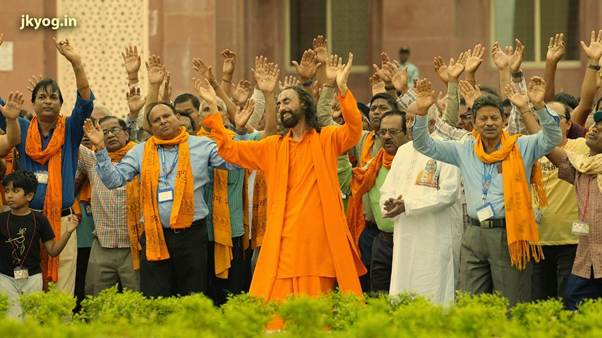
This very spirit came alive at the Prem Ras Madira Spiritual Retreat, held at JKYog Bhakti Ashram, Cuttack, India, in March 2026 in the gracious presence of Swami Mukundananda. Through his exposition, Swamiji unveiled the depth of the verses, interwoven with kirtans, meditations, and immersive experiences. An indelible moment arose when the vast gathering stood beneath the open sky and beheld a marvel wrought from sheer devotion.
Ambrosial Beginnings
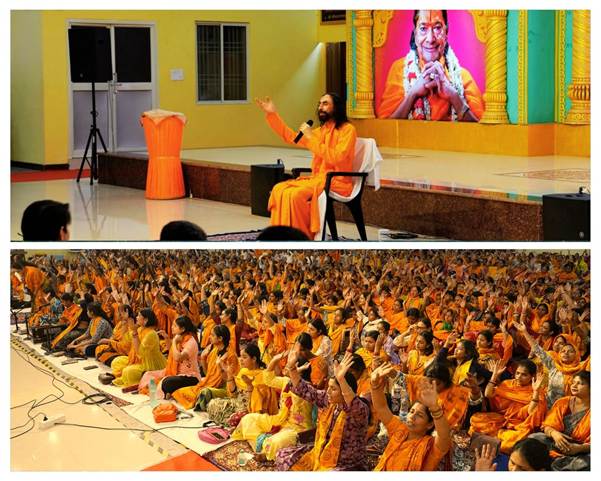
This holy voyage began as seekers from across the globe arrived, leaving behind the clamor of daily life for a higher calling. Swami Mukundananda ji welcomed them warmly as they offered heartfelt pranam at his lotus feet.
From the very outset, the ashram reverberated with an unbroken stream of kirtans. The glory of kirtan can scarcely be overstated. In the Padma Puran, Lord Shankar Himself extols it as Mahasadhana—the supreme practice. The compositions of Shree Maharajji flowed like ambrosia, imbued with insight and rhythmic sweetness, stirring the depths of the soul.
The opening kirtan, “Are Mann Suna Guru Tattwa Vichar,” set the tone by reminding seekers of the indispensable role of the Guru—the one who dispels the ignorance shrouding the soul and illumines the path to divine realization. “Hari Binu Bigari Nahin Bane” voiced the soul’s helpless cry: despite every effort, it remains ensnared by maya (material energy). The kirtan captured the weariness of the intellect, long striving to counsel the restless mind, only to confront its own limits. In the end, it concedes a humbling truth: without God’s grace, maya cannot be overcome. Attendees were visibly moved, tears glistening in their eyes, as they resonated with this expression of longing and surrender.
Stirring Discourses by Swami Mukundananda
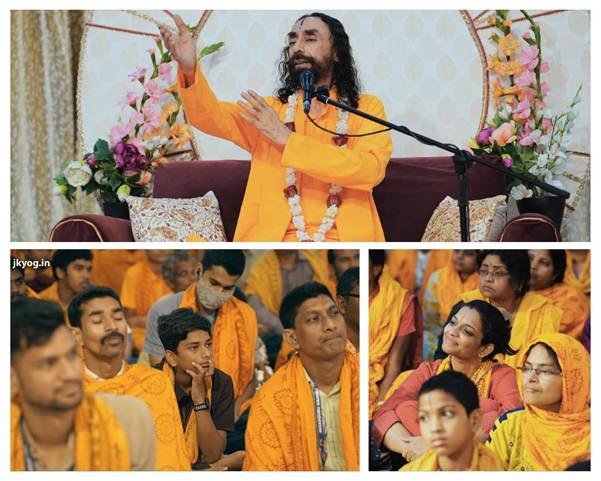
Ever mindful of the seekers’ spiritual ascent, Swami Mukundananda ji wove sweet leelas and timeless wisdom into every discourse.
Swamiji began with an exposition on the verse “Ya Kaare Ne Kare Kartab Kaare,” which depicts Shree Krishna’s playful Holi leela with the gopis of Braj. A gopi tells her sakhi, “This Shyam Sundar’s complexion is dark, and his deeds are dark too!” Often called chitchor, Shree Krishna steals the gopi’s heart, seemingly to tease, yet in truth only to color it with divine love.
Swamiji then shed light on the profound truths beneath this playful kirtan. He explained that our minds are ‘colored’ by the three modes of maya—sattva, rajas, and tamas—and the world simply reflects the state of our mind. Divinity pervades the universe; it is our mind clouded by maya that fails to perceive it. Yet when touched by the color of God, our perception is transformed. Though Shree Krishna’s complexion is dark, the more deeply it colors the heart, the more luminous our consciousness becomes.
Another gem was “Deenan ke Rakhvaar Suno Hari.” Here, God is invoked as Deenanath (Lord of the destitute), Patit Pavan (savior of the fallen), and Adham Udhaaran Haar (redeemer of the sinful).
Swamiji explained that, bound by illusion, the soul has wandered through 8.4 million life forms since time immemorial. The body, though outwardly decorated, is destined to decay once the soul departs. The mind remains tainted by lust, anger, greed, attachment, jealousy, hatred. In such a plight, even ‘miserable’ seems too small a word.
Swamiji further quoted from the Bhakti Shatak:
नाम पतित पावन सुनी, उर आशा बढ़ी जात।
भक्त वत्सल सुनी नाम पाई, मन महान अति दरपत।
When I hear Your name Patit Pavan, hope rises in my heart for I am fallen, and surely Your grace can reach me. Yet when I hear You called Bhakt Vatsal, the beloved of devotees, fear grips me for I am not worthy of being called Your devotee.
Thus, the soul beseeches: “O Lord Krishna, O Krishna, protector of the helpless, we appeal to Your boundless mercy—in which alone lies our hope.”
Swamiji next spoke on “Pathi Likhi Banaye Sakhan Ek,” illuminating two modes of devotion: Aishwarya bhakti, where God is worshiped with awe and reverence, and Madhurya bhakti, marked by intimacy and sweetness. Just as a governor’s children relate to him as a father rather than a dignitary, the residents of Braj related to Krishna with natural familiarity; His friends saw Him as their playmate, Yashoda as her child, and the gopis as their beloved.
When Shree Krishna departed from Braj for Mathura, His cowherd friends were plunged into grief. Though He promised to return in four days, days turned into months, and the sakhas cried out in anguish: “O dear friend, You are more precious than life itself. We burn in separation, yearning for You. Yet You have not sent even a single message. Is this Your love?” In their sorrow, the Brajvasis revealed the essence of Madhurya bhakti. Swamiji urged listeners to draw inspiration from such love and cultivate a deeper bond with God.
Such nectar-filled compositions could only flow from a rasik saint. It is no wonder Shree Maharajji is revered as Bhakti Yog Rasavatar; the very embodiment of divine love.
Infusing Namsankirtan and Roopdhyan
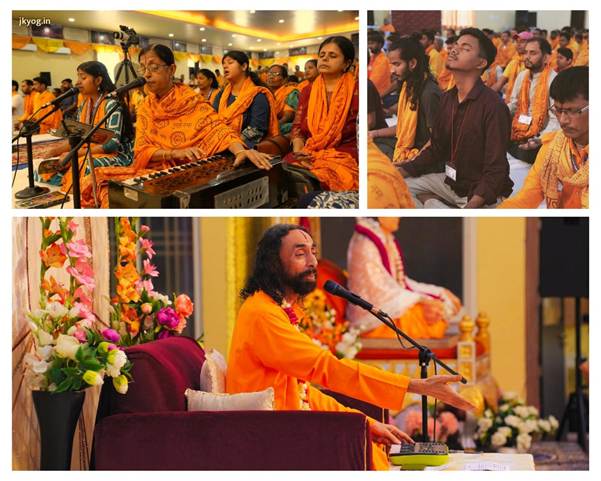
As each session drew to a close, the atmosphere throbbed with divine fervor. The shankh naad, jhanjh, and mridang resounded through the ashram, as chants of ‘Radhe Radhe, Hari Krishna’ rose like surging tides of devotion. Swamiji reminded everyone that unlike worldly names, God fully resides in His holy Name with all His divine powers, awakening one and all to His presence. With Swamiji leading the chorus, the namsankirtan became more than music; it became an immersive spiritual experience. Participants clapped, sang, and danced in unison, absorbed in the bliss of bhakti.
Following each discourse, Swamiji led the gathering into Roopdhyan meditation as taught at JKYog, gently impressing the remembrance of God upon the mind. Since the mind naturally gravitates towards images, contemplating the divine Form and Pastimes makes the practice of devotion vivid and heartfelt.
One such meditation followed a discourse on Shree Radha Rani. Swamiji transported devotees to the sacred Vrindavan Dham, where they envisioned themselves lovingly adorning Radhaji—applying henna to Her hands, fastening anklets upon Her feet, and placing fragrant garlands around Her neck. Beholding Her as the Eternal Mother, they felt deeply blessed to partake in such intimate seva.
Seva Seasoned with Love
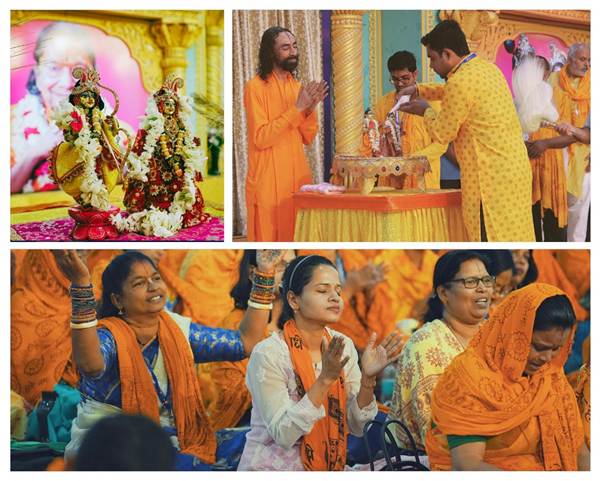
On the auspicious occasion of Chaitra Navratri, Swamiji expounded upon the kirtan “Avadh ke Ram bane Braj Shyam,” revealing that Lord Ram Himself appeared as Shree Krishna in Dwapar Yug, and Sita as Shree Radha—dispelling the notion that They are separate. A corresponding seva enabled devotees to internalize this revelation, rendering it tangible and unforgettable. The deities of Sita-Ram were brought forward, and Swamiji lovingly adorned Them with garlands. Thereafter, participants approached one by one to offer the panchamrit abhishek—each act an expression of love and gratitude for the rare fortune of serving the Lord.
A Dash of Contemplation
In the stillness of dawn, when the mind is most receptive, devotees heard Shree Maharajji’s divine words. In one lecture, he unravelled the mystery of God’s grace.
Bhagavan does not merely possess a body; He is inseparable from His Form. Every pore radiates grace, and the bound soul seeks grace from Grace Itself. Yet the Lord declares, मामेकं शरणं व्रज, “Take refuge in Me alone.” But this cannot happen while the heart remains crowded with worldly attachments; only when emptied of all else can God dwell within.
Citing the example of Draupadi from the Mahabharat, he affirmed that as long as she strove to shield herself in the Kaurav assembly, Shree Krishna did not intervene. But the moment she raised both hands in surrender and called upon Him alone, grace manifested instantly. Thus, one may say: “Tvameva mata cha pita tvameva”—“You alone are my mother and father.” But words alone do not suffice; the heart must align with them.
Then came the morning prayer, when one closes the eyes to the world and speaks to God from its bare depths. Some of its lines read: “O beloved Shree Krishna, my heart is so impure that even though I know You are lovingly waiting for me, I cannot truly reach You on my own. By Your causeless mercy alone, please accept me and draw me into Your refuge. Without Your love, life is unbearable. Grant me, therefore, the alms of Your divine love.”
Flavors of Faith
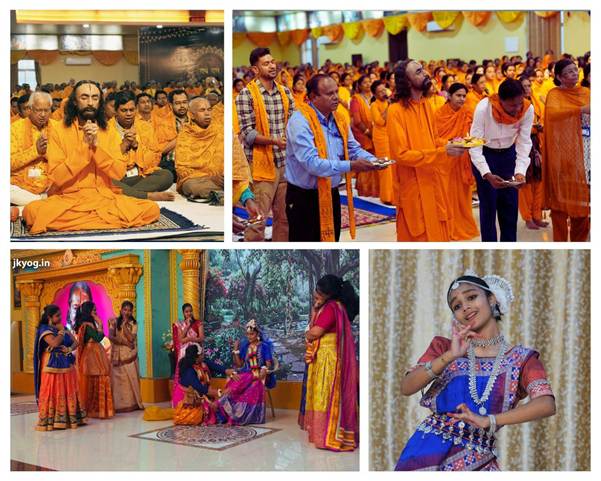
A vibrant cultural program (Mehfil) followed, where participants of all ages offered song and dance in service to Hari Guru. From classical renditions to spontaneous expressions, each performance carried its own charm. A gracefully enacted Radha Krishna leela transported all into the divine pastimes, while even the youngest participants swayed to soul-stirring devotional songs. Together, these offerings reflected the spiritual practices nurtured through the day. Thalis of aarti, adorned with lamps and fragrant petals, were then reverently offered at the feet of God and Guru. The collective spirit of devotion, artistry, and surrender left behind a lingering sense of fulfillment.
Carrying the Holy Chalice
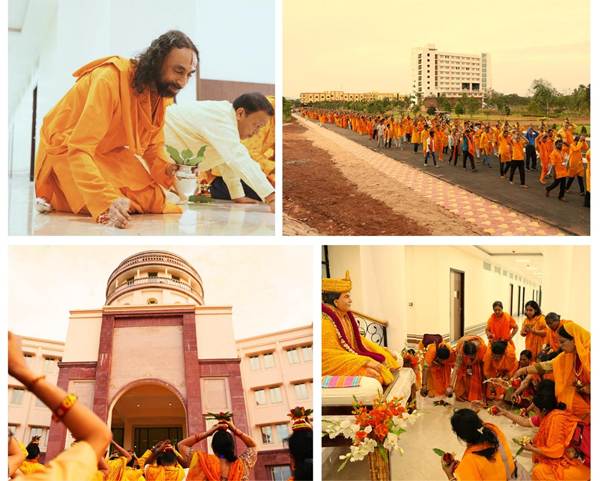
Blending the physical, mental, and spiritual dimensions of the retreat was the parikrama around the ashram grounds. Amidst lush greenery, blooming flowers, and a refreshing breeze, devotees moved in joyful rhythm to the beat of the dhol—a kirtan in motion. As Swamiji led the chorus, seekers walked and danced, chanting the names of Radhey Govind in mesmerizing melodies.
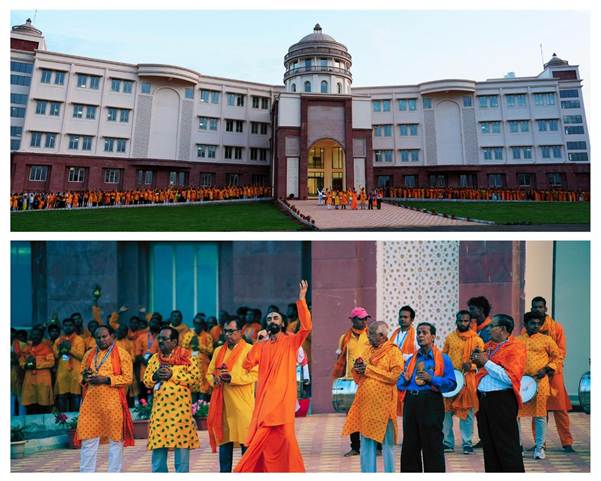
This parikrama carried deeper significance, for it unfolded on the campus of Jagadguru Kripalu University—a vision conceived over two decades ago. When Swamiji once asked Shree Maharajji what the highest seva could be for humanity, he replied: the seva of gyan—uplifting the masses through true knowledge.
That divine instruction gradually took form brick by brick through faith and unwavering seva bhav. JKU was envisioned not merely as an academic institution, but as a mission to impart professional excellence while nurturing ethical and spiritual values, shaping individuals into well-rounded and fulfilled human beings. Today, JKU stands as the embodiment of its guiding ideal: “उद्धरेत् विद्यया आत्मानम्” — Elevate yourself through knowledge.
The long-awaited moment was marked by the Kalash Yatra and JKU Prakshalan. Swamiji walked ahead carrying the kalash, while participants followed from JKYog Ashram to Jagadguru Kripalu University with kalash placed on their heads. There, they washed its floors—not merely with water, but with overflowing love and reverence for this priceless gift to the world.
Pouring Grace
Then, in a voice that touched the innermost chords of the heart, Swamiji sang: “Anath Dinanatham Kripalum Me Smarami, Sadguru Jagadguru Namami.” Protector of the helpless and the poor, the merciful one—I bow to the true Guru, the supreme teacher of the world. The audience responded in a resounding chorus, offering homage to Jagadguruttam.
Shree Jagadguru Kripalu ji Maharaj bestowed timeless treasures upon mankind, guiding all towards true wisdom and the sweetest path to the Divine. Swami Mukundananda carries forward that mission in the most accessible and heart-stirring way. Through his illuminating discourses, kirtans, and guided practices, waves of perennial wisdom and divine love continue to flow across boundaries so no sincere seeker is left untouched by their transformative power.
Call To Drink the Nectar of Devotion
Join the Bhakti Kirtan Retreat with Swami Mukundananda, April 17–19, 2026, at the Radha Krishna Temple of Dallas.
Whether you seek spiritual growth, cultural enrichment, or moments of inner peace, this retreat offers something for everyone.
Immerse yourself in:
● Soulful kirtans
● Heart-stirring Pad Vyakhya by Swamiji
● Divine celebrations that uplift and inspire
Can’t attend in person? Join ONLINE via the Bhagavad Gita Krishna Bhakti App.