
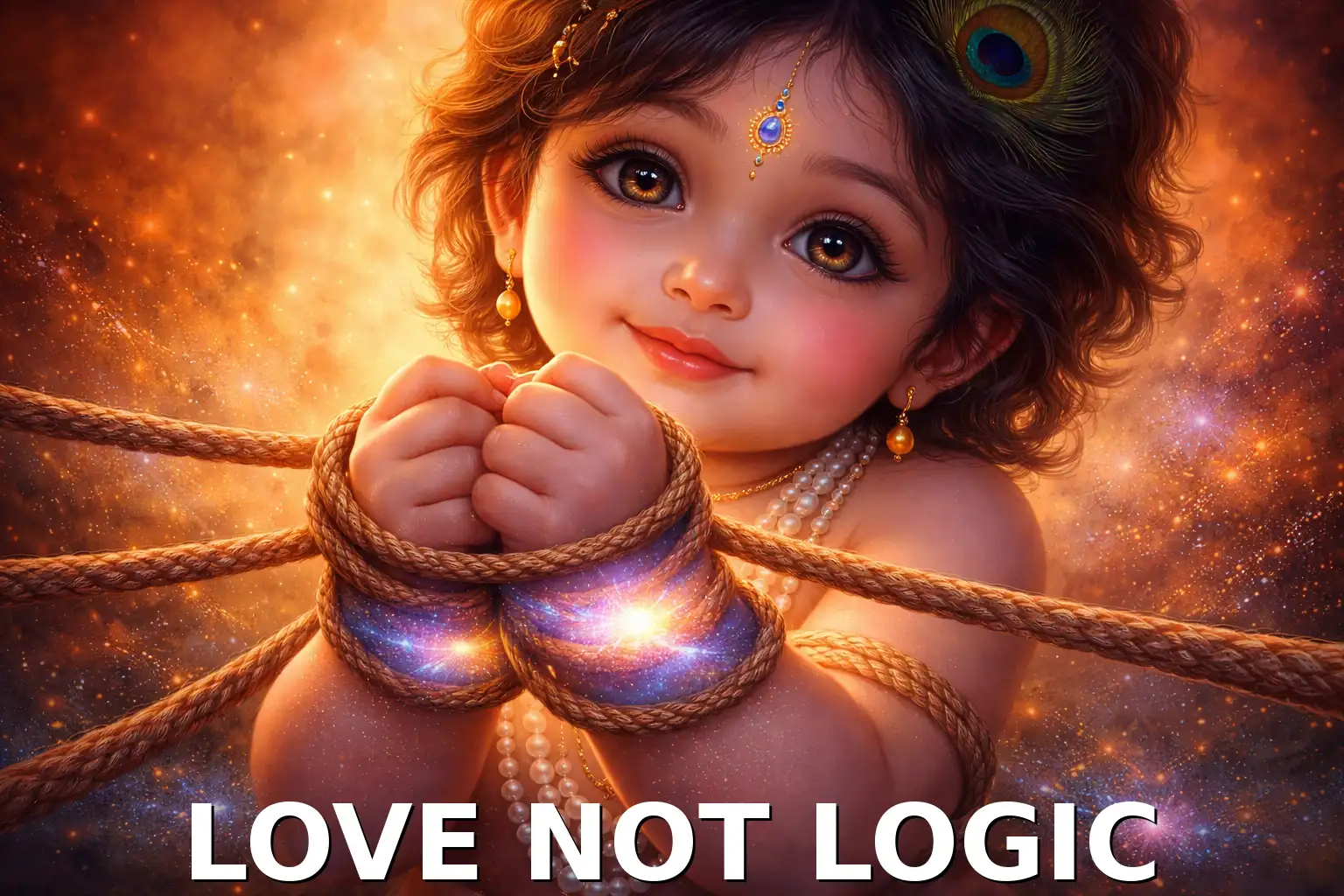
In the modern world, logic is treated as the highest court of appeal. We trust mathematics because it is precise, science because it is testable, and formal reasoning because it is internally consistent. We are taught, explicitly or implicitly, that what is true must also be logically tidy. If something appears contradictory, we assume it must be false, confused, or incomplete.
This mindset works reasonably well in the material sphere. But when we approach the subject of the Divine, our intellectual tools begin to show their limits.
The Ishavasya Upanishad, revered as one of the foundational summaries of Vedic philosophy, presents a vision of the Supreme that does not fit neatly into our rational categories. God is described there not through neat definitions, but through paradox: He moves and does not move. He is far and near. He is inside everything and outside everything. The Bhagavad Gita deepens the mystery further, portraying the Supreme Lord as unborn yet appearing in the world, independent yet bound by devotion, impartial yet deeply responsive to love.
To the intellect, these attributes appear mutually exclusive. To devotion, they are signs of transcendence.
The spiritual conclusion is profound: the Supreme cannot be conquered by logic alone. He is ultimately known through surrender, love, and grace. The heart must go where the head cannot.
“If God were small enough for your mind to fully understand, would He be great enough for your soul to worship?”
The Human Urge to Put God in a Logical Box
The human mind wants closure. It wants a God who can be diagrammed, classified, and explained. We want a Supreme Being who behaves according to the same laws of consistency that govern objects, formulas, and arguments.
But the Vedic tradition warns us that this instinct, while useful in the world, becomes an obstacle in spiritual life. If the Divine is infinite and the human mind is finite, then a total intellectual containment of God is impossible from the outset. The problem is not with God; the problem is with the measuring instrument.
Swami Mukundananda emphasize that God is alaukik—transcendental, beyond worldly categories. His nature is acintya, inconceivable to material intellect. This does not mean irrational in the sense of absurdity. It means supra-rational: greater than the mind can fully hold.
So the question is not whether God fits into logic. The question is whether logic is large enough to contain God.
“It Moves, and It Moves Not”: The First Great Paradox
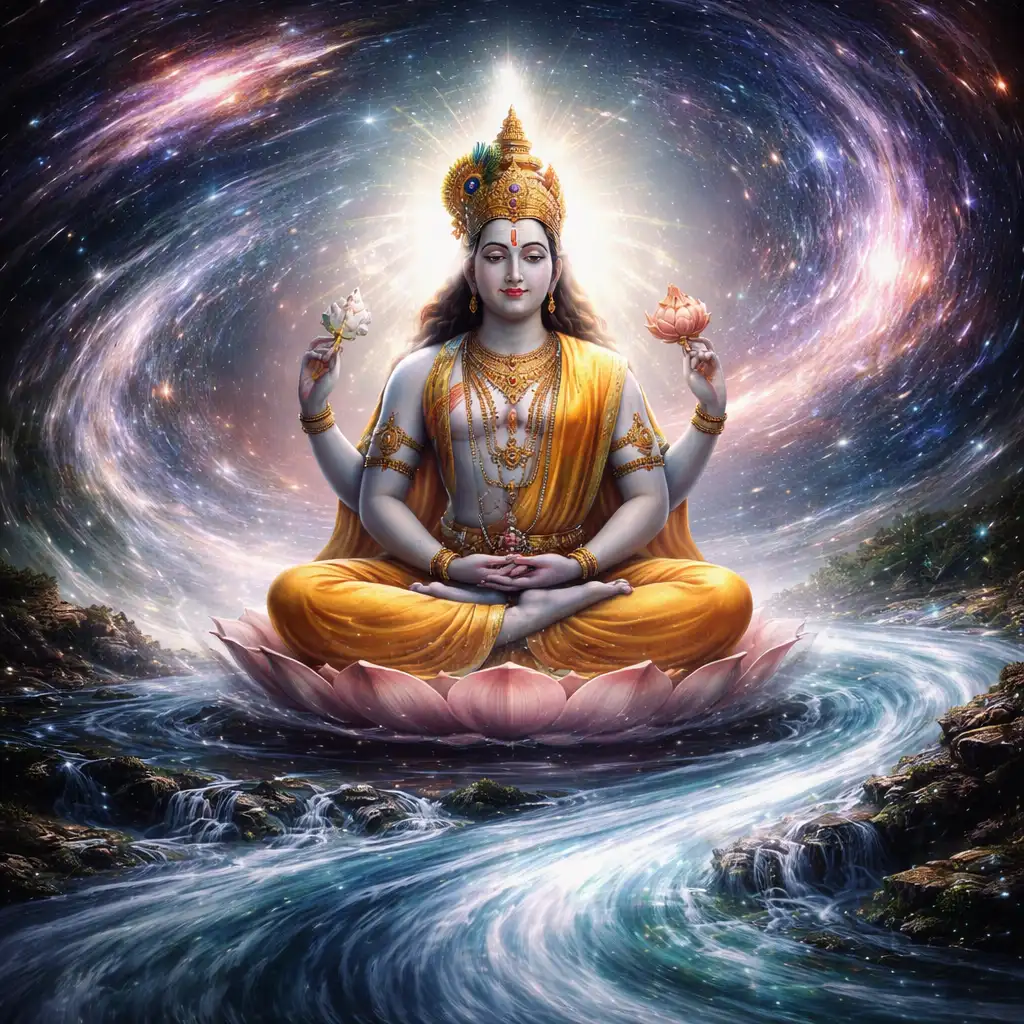
One of the most striking declarations in the Ishavasya Upanishad is this:
“tade jati tan naijati”
“It moves, and It moves not.”
At first glance, the statement seems self-contradictory. How can one reality be both moving and unmoving at once?
Yet this paradox opens a doorway into understanding the Divine in relation to the world.
The World in Constant Flux
The Greek philosopher Heraclitus famously taught that reality is always flowing. His phrase panta rhei—“everything flows”—captures the unstable nature of the material world. His famous illustration, “You cannot step into the same river twice,” makes the point vividly: by the second step, the water has moved on, the river has changed, and you too have changed.

This same insight appears in Sanskrit through the idea of sansar—that which keeps moving, shifting, sliding away. The material realm is never static. A tree is changing every moment. A body is aging every second. Even what appears still is moving at levels too subtle for our eyes to perceive.
In this sense, the Supreme “moves” because He pervades the universe in all its dynamism. He is present alongside the flux of material existence.
The Unmoving Foundation
And yet, the Upanishad immediately declares that He “moves not.”
Why? Because while the world changes, the Divine does not. God is the stable ground that makes change possible. He is not swept away by time, transformation, or decay. He remains the immovable basis upon which all motion appears.
A helpful image is that of a movie screen. The images dance, flicker, shift, and disappear. Battles rage, rivers flow, and faces come and go. But the screen itself remains still. Without the unmoving screen, the moving picture could not appear.
In the same way, God is both the companion of the moving world and the still reality beneath it.
The Birthless One Who Takes Birth
The Bhagavad Gita intensifies the paradox in Chapter 4.6,Krishna tells Arjuna:
“ajo ’pi sann avyayatma bhutanam ishvaro ’pi san…”
“Although I am unborn and My transcendental body never deteriorates, and although I am the Lord of all living entities…”
He declares Himself to be aj (unborn), meaning He has no beginning and has existed eternally. Logic dictates that if someone is unborn, they cannot "take birth.
Then in the same verse He says
“prakritim svam adhisthaya sambhavamy atma-mayaya”
“I still appear in every millennium in My original transcendental form, by My own divine power.”
By the power of His Yoga Maya (His personal divine potency), He manifests a body and takes birth in the world. The Vedas describe this as ajaymano bahudha vijayate—
Here reason stumbles again. If Krishna is aja—unborn—how can He appear to take birth? If He is eternal, how does He enter history? If He is beyond material embodiment, why does He manifest a form?
This is why Krishna says in Bhagavad Gita 4.5:
“bahuni me vyatitani janmani tava charjuna”
“Arjuna, you and I have passed through many births.”
But then He distinguishes Himself from Arjuna by explaining that Arjuna remembers none of them, whereas Krishna remembers them all.
This is the mystery described in the Vedic line:
“ajaymano bahudha vijayate”
“Though unborn, He appears in many forms.”
The Eternal enters time without ceasing to be eternal. The Unborn appears to take birth without ever becoming subject to birth.
The Difference Between Ordinary Birth and Divine Appearance
The contradiction dissolves only when we understand that divine birth is not like human birth.
The soul takes birth under compulsion. Karma pushes it into embodiment. It enters forgetful, limited, and bound by nature.
Krishna’s appearance is entirely different. He is not forced into matter. He does not forget. He does not become conditioned. He enters by choice, through His own power, fully conscious of all previous
The Softest Heart and the Hardest Heart

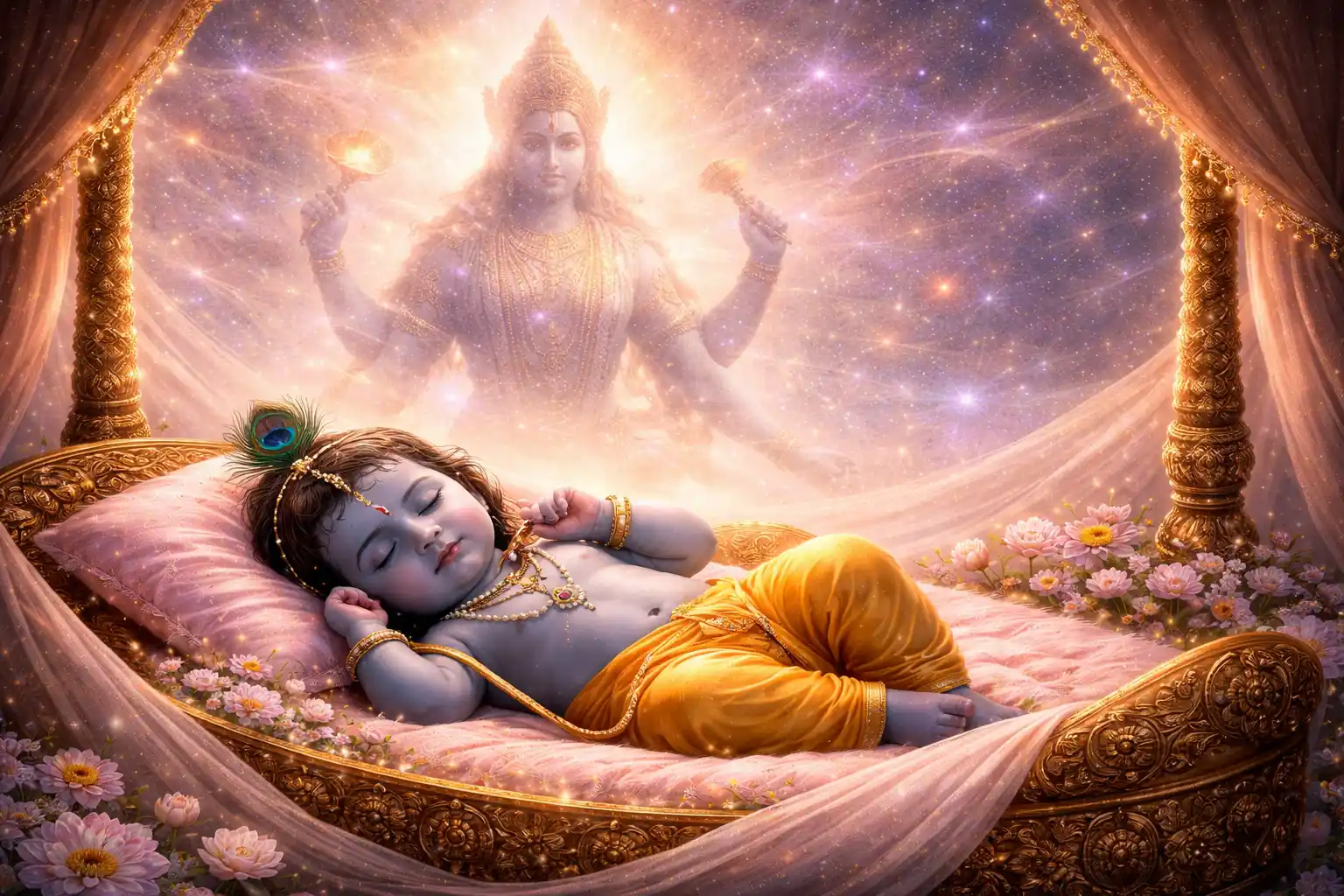
Among the most emotionally powerful paradoxes is the Vedic description of the Divine heart:
“vajradapi kathorani mriduni kusumani”
“Harder than a thunderbolt, softer than a flower.”
At first this sounds impossible, but it reflects the two-sided mystery of divine compassion and divine sovereignty.
Softer Than a Rose Petal
The bhakti scriptures describe God as so tender-hearted that He cannot bear the sincere cry of a soul. One tear of genuine longing draws His response. One moment of wholehearted surrender attracts His grace.
There is no softness in the world comparable to the softness of divine love. God hears even that prayer which never reaches the lips.
Harder Than a Thunderbolt
There is no material substance in the world that can compare to the softness of the Divine heart .Yet, the same God is responsible for Mahapralaya—the great dissolution of the universe. When it is time to wind up His creation, He watches as souls suffer and cry out in distress. At that moment, He "puts a Vajra (thunderbolt) on His heart" and remains unmoved as He completes the dissolution. This is why the scriptures describe Him as vajradapi kathorani mriduni kusumani—harder than a thunderbolt and softer than a rose petal. To the human intellect, this seems like a cruel contradiction; to the eye of devotion, it is the balanced nature of the Supreme Controller who acts out of a necessity that transcends our limited understanding.
God is not ruled by impulsive emotion. His softness is perfect, and His firmness is also perfect. He is never less than compassionate, but His compassion is governed by a total knowledge of the eternal good, not merely the immediate pain we can see.
The Supreme Independent Who Becomes Enslaved
Another stunning paradox appears in descriptions of God’s freedom.
The Vedic texts describe God as Param Svatantra—supremely independent with no one to administer over Him. He is the ultimate authority, and as the sage Narada once told Him, "You do whatever you like and are not answerable to anyone". This was famously illustrated when Narayana cursed Narada to become a monkey; Narada acknowledged that the Lord's will is absolute and independent However, the Supreme Lord makes an even more shocking claim: aham bhakta-paradhino—"I am enslaved by My devotees; I am no longer independent". He who administers over the entire universe allows Himself to be "tied up in the bonds of love" by those who worship Him. He is Samo’ham sarva-bhuteshu—unbiased toward all, with no friends or enemies—yet He immediately adds in the Gita that for those who engage in His devotion, "I reside in them and they reside in Me". He is the King who becomes a servant to His lovers, the Independent Master who becomes dependent on the affection of His devotees.
And yet, the scriptures also contain this astonishing confession from the Lord:
“aham bhakta-paradhino hy asvatantra iva dvija”
“I am dependent on My devotees; I am, as if, not independent.”
How can the absolutely independent God become dependent?
Love Accomplishes What Power Cannot
This is one of the deepest mysteries of bhakti. The Lord who controls the cosmos willingly allows Himself to be conquered by love.
He is not forced into dependence. He chooses it. The master of all becomes the servant of love.
This is beautifully embodied in the Damodar Lila, where Mother Yashoda tries to bind little Krishna with rope. Again and again the rope falls short—always by two fingers. She adds more rope, but still it is too short. Why? Because the Infinite cannot be tied by material means.
And yet, when her love reaches its fullness, Krishna allows Himself to be bound.
Not by rope.
By affection.
The same Lord who cannot be contained by the universe allows Himself to be “contained” in the love of His devotee. This is not weakness. It is the supreme strength of love.
Impartial to All, Yet Specially Present for the Devotee
In the Bhagavad Gita 9.29, Krishna declares:
“samo ’ham sarva-bhuteshu na me dveshyo ’sti na priyah”
“I am equal to all beings; no one is hateful to Me, no one is dear to Me.”
This sounds like perfect divine impartiality.
But the verse continues:
“ye bhajanti tu mam bhaktya mayi te teshu chapy aham”
“But those who worship Me with devotion are in Me, and I am in them.”
Again we meet a paradox. Is God equal to all, or does He favor His devotees?
The devotional resolution is subtle and beautiful. The sun shines equally everywhere, but a person who opens the window receives the light directly. God’s grace is universally available, but the devotee becomes especially receptive to it. The Lord is unbiased, yet love creates intimacy. Equality is not negated; relationship deepens experience.
Far and Near at Once

The Ishavasya Upanishad continues:
“taddure tadvantike”
“He is far, and He is near.”
This is not spatial confusion. It is a spiritual truth.
He Is Far
For those who approach the Divine with ego, pride, dry speculation, or spiritual ambition, God remains distant. The more the ego tries to “capture” Him, the farther He seems.
This is like chasing a rainbow. It appears close enough to pursue, but as you move toward it, it recedes. Purely intellectual pursuit often produces the same frustration. The seeker knows more words, more categories, more arguments—but does not feel any nearer to God.
The tradition explains that pride creates distance. As long as the ego remains intact, the heart remains closed.
He Is Near
But to the humble, the surrendered, the simple-hearted devotee, God is astonishingly near. He is not merely in the heavens or in abstract metaphysics. He is seated in the heart itself. He is the inner witness, the indwelling Lord, the closest companion of the soul.
So the same God is infinitely far from the proud and immediately near to the surrendered.
Inside Everything, Outside Everything
The Upanishad adds yet another mystery:
“tad antar asya sarvasya tadu sarvasyasya bahyatah”
“He is inside everything, and He is outside everything.”
. This was demonstrated in the world-famous Damodar Lila, when Mother Yashoda tried to tie the child Krishna with a rope. No matter how much rope she added, it was always two fingers too short. This is because Krishna has no "inside" or "outside"
This verse collapses our ordinary understanding of space.
He is the largest thing because the entire world is inside Him, yet He is smaller than the smallest Higgs boson particle because He resides within it to energize it. He is both the container and the contained.
That is why in divine play, Krishna can appear as an ordinary child and yet remain the cosmic Lord beyond measurement.
The Limits of Human Logic
The Limitation of Logic: The Detective and the Deity Why do these contradictions exist? It is because the Divine is Alaukik—transcendental—and cannot be grasped by the material intellect. To illustrate this, Swami Mukundananda shares a story of a traveler who lost his donkey. A "genius" man was able to deduce everything about the donkey—that it was lame, blind in one eye, and carrying wheat—simply by observing tracks and signs on the road. While this demonstrates the power of human logic, the Vedas warn that even the Devatas (celestial gods) cannot understand God through intellect alone. Even Brahma, the creator of the universe, became confused when he saw Lord Krishna eating the leftovers of cowherd boys, wondering how the Supreme could act so human.
So too with God. The intellect can point, infer, compare, and defend. It can study theology and argue metaphysics. But it cannot, by its own force, seize the Divine.
If Brahma can be bewildered, what to say of us?
Ganesh, Kartikeya, and the Limits of Intelligence
The story of Ganesh and Kartikeya also points to the place—and limit—of intellect.
When challenged to circle the world, Kartikeya relied on speed and strength. Ganesh used intelligence. Realizing that his parents, Shiva and Parvati, were the source and essence of the world, he simply circumambulated them. In that way, he fulfilled the deeper meaning of the challenge.
The story honors intellect. But it also implies that even great intelligence must eventually bow to spiritual insight. The highest truths are not accessed by cleverness alone, but by seeing with reverence.
This is why the devotional teaching says that when hearing the divine pastimes of Rama or Krishna, one should “drop the intellect” and savor them with the heart. This does not mean abandoning thought altogether. It means not insisting that the Infinite submit to our categories before we allow ourselves to love.
Yoga Maya: The Power That Harmonizes Contradictions
The key theological concept that explains these divine paradoxes is Yoga Maya.
When Krishna says, “I appear by My own power,” that power is Yoga Maya—His internal divine potency.
What Yoga Maya Does
Yoga Maya is not mere illusion in the ordinary sense. Rather, it is the Lord’s personal energy by which He reveals Himself, conceals Himself, and orchestrates divine play.
Through Yoga Maya:
- the unborn appears to take birth
- the infinite appears in a finite form
- the Supreme sovereign becomes a child in Yashoda’s lap
- the all-powerful becomes “bound” by love
- the transcendent becomes intimate without ceasing to be transcendent
Yoga Maya harmonizes what logic sees as contradiction. It allows opposites to coexist in the person of God without diminishing His supremacy.
This is why divine pastimes cannot be measured by material standards. They belong to a reality where contradiction is not confusion but fullness.
How Can One Drop the Intellect to Develop Faith?
This is an important practical question. “Drop the intellect” does not mean becoming anti-intellectual, naive, or careless. It means learning where intellect must stop pretending to be sovereign.
Faith develops when the intellect becomes servant, not master.
1. Cultivate Humility
Faith begins with admitting: “I do not know everything. My mind is limited.” Humility opens the heart where pride closes it.
2. Hear from Authentic Sources
Study scripture and hear from realized teachers. Not all surrender is blind; healthy faith is nourished by revelation, tradition, and saintly association.
3. Engage in Bhakti Practices
Chanting, prayer, remembrance, worship, and selfless service gradually purify the inner instrument. Faith is not only thought; it is cultivated experience.
4. Accept the Limits of Logic
Use reason where it helps, but do not demand that transcendence become fully manageable before you trust it. The intellect is a lamp, not the sun.
5. Lead With the Heart
The Divine is ultimately relational. Love, not analysis, grants entrance into intimacy with God.
The Three Kinds of Knowledge Needed for Devotion
For devotion to mature, at least three forms of knowledge are necessary.
1. Knowledge of the Self
One must understand: “I am not merely this body, mind, or social identity. I am the soul.” Without this, spirituality remains superficial.
2. Knowledge of God
One must understand something of the Divine nature—His greatness, transcendence, compassion, omnipresence, and sweetness. Devotion deepens when the object of devotion becomes clearer.
3. Knowledge of the Relationship Between the Soul and God
This is the most intimate knowledge of all. The soul is not an isolated unit drifting through existence. It belongs to God. Its fulfillment lies in loving connection with Him.
When these three are understood—Who am I? Who is God? What is my relationship with Him?—devotion acquires depth, direction, and stability.
Faith Over Fact: The Story of Shiva and Parvati at the Kumbh
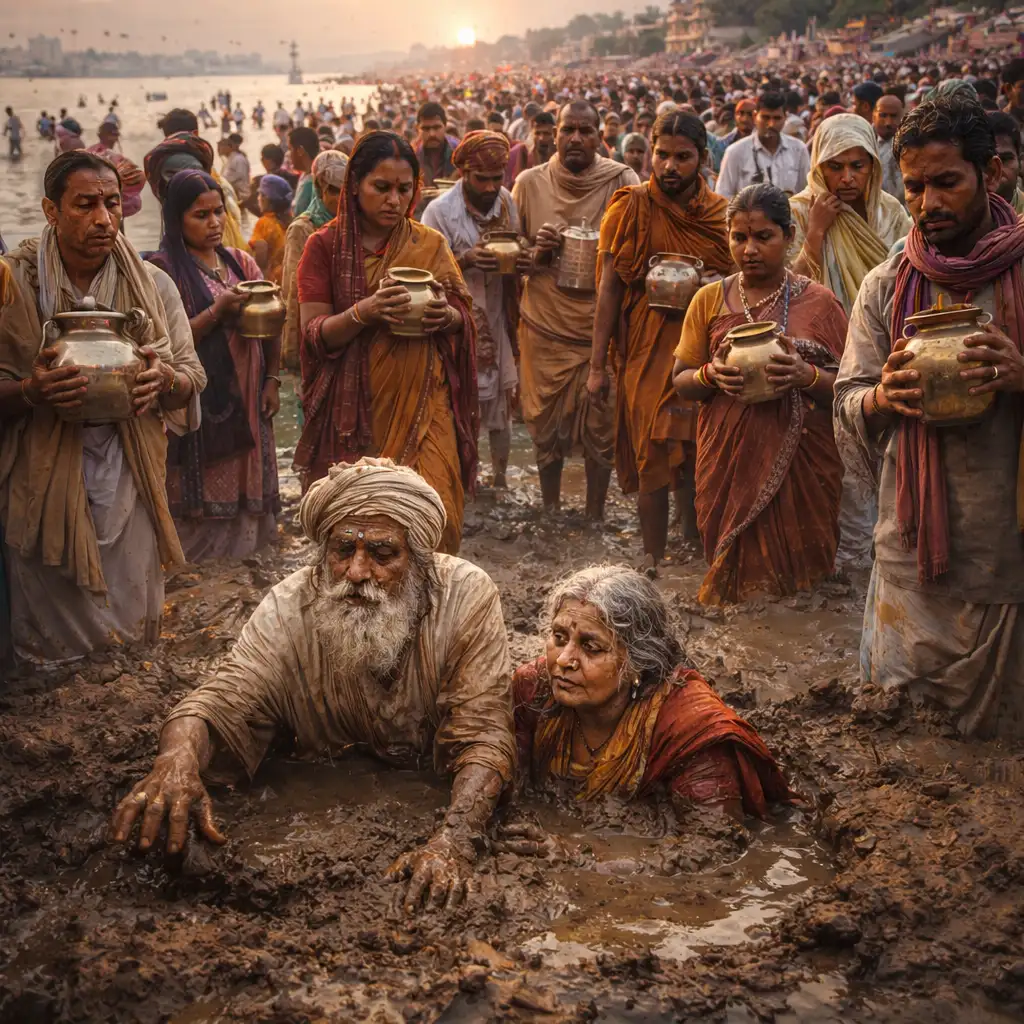
One of the most striking illustrations of the difference between ritual and faith appears in the story of Shiva and Parvati at the Kumbh Mela.
Millions had gathered to bathe in the Ganges, trusting that the sacred river purifies sins. Shiva then created an illusion in which He appeared as an old man stuck in the mud. Parvati asked passersby to help, but with one condition: only someone free from sin could touch him.
Thousands who had just bathed refused.
Why? Because though they had performed the ritual, they did not actually believe in its power. Their bodies entered the Ganga, but their hearts did not enter faith.
The lesson is piercing. Spiritual life is not sustained merely by external acts, nor by intellectual agreement. It requires trust in divine reality. Without faith, even holy acts remain strangely barren.
The Divine as the Resolution of Contradictions
The world runs on duality: day and night, truth and falsehood, joy and sorrow, creation and destruction. We are accustomed to opposites because material life is structured by opposition.
But in God, the Vedic vision suggests, contradictions do not collide—they are harmonized.
He is the Unborn who appears in history.
He is the Independent who becomes dependent on love.
He is the cosmic ruler who plays as a child.
He is beyond all things, yet dwells in the heart.
He is farther than the farthest, yet nearer than the nearest.
This is not disorder. It is divine fullness.
Conclusion: The Final Leap From Logic to Love
The more we examine the nature of the Supreme through the Ishavasya Upanishad, the Bhagavad Gita, and the stories of bhakti tradition, the clearer one truth becomes: God cannot be reduced to the categories of ordinary reasoning.
Logic has its place. It protects us from confusion. It helps us think clearly. It can even prepare the mind for philosophy. But it cannot generate divine intimacy. It cannot command grace. It cannot force open the mystery of the Infinite.
At some point, the seeker must move from explanation to surrender.
That is the final leap.
Not anti-reason, but trans-reason.
Not blind belief, but trust born of humility.
Not sentimentality, but devotion.
Not logic alone, but love.
For this is the real secret of the apparently contradictory nature of the Supreme: what looks contradictory to the mind becomes beautiful to the heart.
“tade jati tan naijati” — He moves, and He moves not.
“taddure tadvantike” — He is far, and He is near.
“aham bhakta-paradhino” — He is conquered by His devotees.
“ajo ’pi sann…” — Though unborn, He appears.
The intellect may stand at the edge of these truths and hesitate.
Love steps in.
And in that step, devotion begins.
Call To Action
To apply the profound wisdom of the Ishavasya Upanishad and the Bhagavad Gita to your life, you are invited to move beyond the limitations of dry logic and embrace the path of Love and Faith .Here is your Call to Action to transform your spiritual practice:
- Surrender the Intellect: Recognize that the Supreme is Alaukik (transcendental) and cannot be fully grasped by the material mind. To truly experience the Divine "near" you, you must be willing to "drop your intellect" and savor the pastimes and nature of God with your heart rather than your head.
- Cultivate the Three Pillars of Knowledge: True devotion (Bhakti) requires a foundation. Begin intentionally seeking:
- Mahatme Jnana: Developing a deeper understanding of who God is and His inconceivable nature.
- Sambandh Jnana: Reflecting on your personal relationship with the Divine.
- Seva Jnana: Understanding the purpose of serving Him and why it is the highest calling.
- Shed the Ego to Bridge the Distance: The sources remind us that God is "far" from those who harbor pride but resides "right in front" of the humble. Make a conscious effort to cultivate humility (Danya) in your daily life, as God "hates the ego in the souls" but is easily moved by those who rid themselves of it.
- Choose Faith Over Fact: Do not be like the travelers at the Ganges who bathed in the water but lacked faith in its power to purify. When you engage in prayer or meditation, do so with the absolute conviction that the Supreme—who is both harder than a thunderbolt and softer than a petal—is listening and ready to be "enslaved by your love".
By shifting your focus from trying to "solve" God to simply loving Him, you allow His Yoga Maya to reveal the Divine presence that is already sitting within your heart. Start today by offering a simple, humble prayer of surrender.How can I surrender my intellect to experience the Divine?What are the three pillars of knowledge for engaging de
✨ Frequently Asked Questions (FAQs) ✨
Exploring the Divine Beyond Logic
🌿 1. Why does God appear contradictory in scriptures?
The Divine is described through paradox because He is beyond human logic. What seems contradictory to us is actually the harmonious coexistence of infinite qualities within a single Supreme reality. These paradoxes are not flaws—they are windows into transcendence.
🌊 2. How can God be both far and near at the same time?
God is far from those who approach Him with ego, pride, or dry intellectualism. Yet He is closer than the closest to those who approach with humility and love. The distance is not physical—it is created or dissolved within the heart.
💖 3. What does it mean that God is “enslaved” by His devotees?
Although God is supremely independent, He willingly allows Himself to be bound by pure love. Devotion has the power to “control” the uncontrollable—not through force, but through affection. Love succeeds where power cannot.
🔮 4. What is Yoga Maya and how does it explain these paradoxes?
Yoga Maya is the Divine energy that makes the impossible possible. It allows God to remain infinite while appearing finite, unborn while taking birth, and all-powerful while becoming intimately accessible. It harmonizes all contradictions into divine play.
🕊️ 5. How can one move beyond logic to develop faith?
Faith grows when we:
- Embrace humility
- Accept the limits of intellect
- Engage in devotion (bhakti)
- Learn from authentic wisdom
- Allow the heart to experience what the mind cannot grasp
In essence, we don’t abandon logic—we transcend it through love.
✨ “Where logic ends, love begins—and there the Divine is found.” ✨