


Have you ever tried to sit quietly for just five minutes, entirely focused on a single thought or your breath, only to find your mind immediately racing toward a hundred different anxieties, memories, and future plans? If so, you are not alone.
In our fast-paced, modern era, the mind is constantly bombarded by notifications, endless to-do lists, and an overwhelming influx of information. We often feel like passengers in a vehicle where the mind is a reckless driver, steering us into anxiety, overthinking, and emotional exhaustion. We want to be peaceful, we want to be productive, and we want to be spiritually grounded, yet the mind fiercely resists.
Mastering the mind is perhaps the most significant challenge a human being can undertake. It is the ultimate frontier of personal development. But how do we tame something we cannot even see or physically touch?
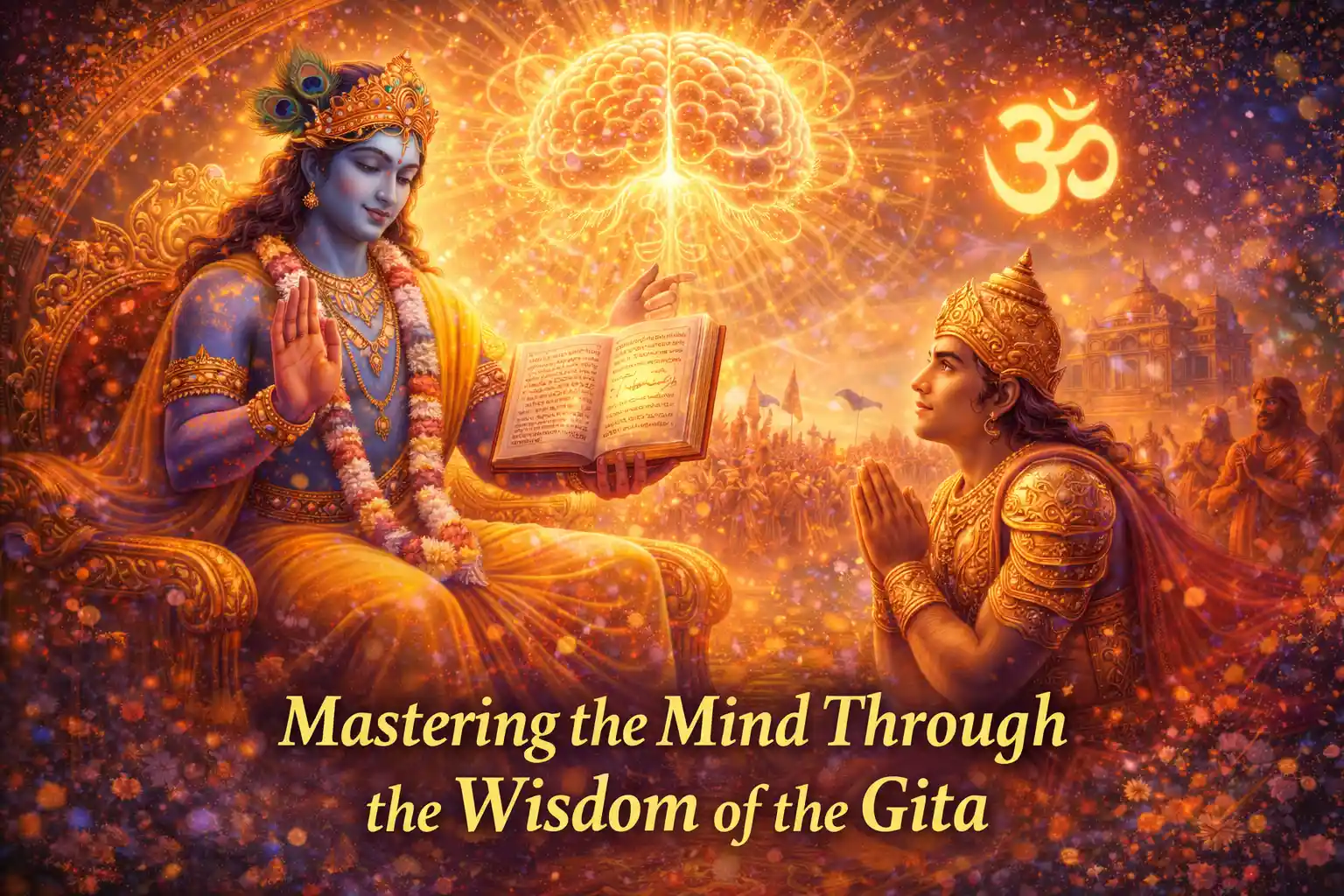
Long before modern psychology began exploring the complexities of human cognition, the ancient Vedic scriptures provided a perfect, foolproof manual for mind management. The Holy Bhagavad Gita, spoken on the battlefield of Kurukshetra, is not just a historical text; it is the ultimate psychological and spiritual guidebook. Through the divine dialogue between Lord Krishna and the warrior Arjuna, we are given profound insights into the nature of the mind and the exact techniques required to subjugate it.
Through the illuminating commentary of global spiritual leader Swami Mukundananda, let us dive deep into the wisdom of the Bhagavad Gita to discover how you can transform your mind from your most formidable enemy into your greatest friend.
The Universal Struggle: The Restless Nature of the Mind

To solve a problem, we must first deeply understand its nature. The struggle to focus is not a modern phenomenon caused solely by smartphones and the internet; it is an inherent condition of the human experience.
In the Sixth Chapter of the Bhagavad Gita, Arjuna, a magnificent warrior capable of defeating entire armies single-handedly, admits a profound vulnerability to Lord Krishna. He expresses the exact same frustration we feel today when trying to meditate or focus on our goals.
Arjun, in Bhagavad Gita 6.34, states:
चञ्चलं हि मन: कृष्ण प्रमाथि बलवद्दृढम् |
तस्याहं निग्रहं मन्ये वायोरिव सुदुष्करम् || 34||
chañchalaṁ hi manaḥ kṛiṣhṇa pramāthi balavad dṛiḍham
tasyāhaṁ nigrahaṁ manye vāyor iva su-duṣhkaram
BG 6.34: The mind is very restless, turbulent, strong and obstinate, O Krishna. It appears to me that it is more difficult to control than the wind.
In his profound commentary on this verse, Swami Mukundananda breaks down the four distinct adjectives Arjuna uses to describe the mind, extracting their exact meanings from the scripture:
- Chañchalam (Restless): "It is restless because it keeps flitting in different directions, from subject to subject."
- Pramāthi (Turbulent): "It is turbulent because it creates upheavals in one's consciousness, in the form of hatred, anger, lust, greed, envy, anxiety, fear, attachment, etc."
3. Balavat (Strong): "It is strong because it overpowers the intellect with its vigorous currents and destroys the faculty of discrimination."
4. Dṛiḍham (Obstinate): "The mind is also obstinate because when it catches a harmful thought, it refuses to let go, and continues to ruminate over it again and again, even to the dismay of the intellect."
Arjuna famously declares that trying to control this mental machinery is as impossible as trying to catch the blowing wind in your bare hands.
Modern Science Agrees: The Cost of a Wandering Mind
Arjuna’s ancient dilemma is deeply validated by modern scientific research. Why is it so crucial to rein in a restless mind? Because leaving it uncontrolled directly sabotages our happiness.
A famous, large-scale psychological study conducted by Harvard University researchers Matthew Killingsworth and Daniel Gilbert explored the phenomenon of "mind-wandering." Through a smartphone app, they tracked the thoughts, activities, and happiness levels of thousands of people throughout their daily lives.
The results were astonishing: the researchers found that people spend a staggering 46.9% of their waking hours thinking about something other than what they are actually doing. More importantly, the study concluded that "a wandering mind is an unhappy mind." When our mind is unanchored, it naturally defaults to ruminating on past regrets or worrying about future anxieties. Just as Arjuna described the mind as pramāthi (turbulent), modern science shows that an uncontrolled mind inherently generates psychological distress.
Therefore, mastering the mind is not just a spiritual luxury for ascetics in the Himalayas; it is an absolute necessity for anyone who wishes to experience genuine joy, peace, and success in the modern world.
Your Mind: Your Greatest Friend or Worst Enemy

The stakes of mind management are incredibly high. The mind is a neutral tool, a magnificent piece of internal machinery given to us by God. Depending on how it is trained, it can either elevate us to divine heights or drag us into the darkest depths of despair.
Shree Krishna makes this dual potential startlingly clear just a few verses earlier.
Bhagavad Gita 6.5 states:
उद्धरेदात्मनात्मानं नात्मानमवसादयेत् |
आत्मैव ह्यात्मनो बन्धुरात्मैव रिपुरात्मन: || 5||
uddhared ātmanātmānaṁ nātmānam avasādayet
ātmaiva hyātmano bandhur ātmaiva ripur ātmanaḥ
BG 6.5: Elevate yourself through the power of your mind, and not degrade yourself, for the mind can be the friend and also the enemy of the self.
This verse places the ultimate responsibility of our destiny squarely on our own shoulders. God has provided us with the materials, but it is our mind that builds the structure of our lives.
In his commentary on this verse, Swami Mukundananda issues a powerful warning and a message of hope: "Our biggest enemy is our own mind. It is the saboteur that thwarts our aspirations for perfection... A controlled mind can accomplish many beneficial endeavors, whereas an uncontrolled mind can degrade the consciousness with most ignoble thoughts."
Think about your daily experiences. When you face a difficult challenge at work, what does your mind do? Does it encourage you, acting as a friend? Or does it panic and whisper that you are going to fail, acting as an enemy? Shree Krishna reveals that the journey of spirituality is fundamentally the journey of befriending your own mind.
The Psychology of Self-Mastery: Cognitive Behavioral Therapy
The wisdom of Bhagavad Gita 6.5 mirrors the foundational principles of one of the most effective modern psychological treatments: Cognitive Behavioral Therapy (CBT).
CBT is based on the core concept that our thoughts, feelings, and behaviors are entirely interconnected. External events do not cause our emotional distress; rather, it is our mind's interpretation of those events that causes us to suffer.
For example, if two people lose their jobs, one might fall into severe depression, while the other might view it as an exciting opportunity to change careers. The external event is identical, but the mind's response dictates the outcome. CBT trains individuals to identify negative, unhelpful thought patterns and actively reframe them; essentially training the mind to stop acting as an "enemy" and start acting as a "friend."
What modern psychology teaches in clinical settings today is the exact same process of self- elevation (uddhared ātmanātmānaṁ) that Lord Krishna prescribed over five thousand years ago.
Lord Krishna’s Two-Fold Solution: Abhyasa and Vairagya
When Arjuna laments that the mind is as difficult to control as the wind, Lord Krishna does not dismiss his struggle. He acknowledges the immense difficulty of the task with profound compassion, but He provides a definitive, two-part formula for success.
श्रीभगवानुवाच |
असंशयं महाबाहो मनो दुर्निग्रहं चलम् |
अभ्यासेन तु कौन्तेय वैराग्येण च गृह्यते || 35||
śhrī bhagavān uvācha
asanśhayaṁ mahā-bāho mano durnigrahaṁ chalam
abhyāsena tu kaunteya vairāgyeṇa cha gṛihyate
BG 6.35: Lord Krishna said: O mighty-armed son of Kunti, what you say is correct; the mind is indeed very difficult to restrain. But by practice and detachment, it can be controlled.
In his brilliant commentary on this verse, Swami Mukundananda dissects these two indispensable tools: Abhyasa (Practice) and Vairagya (Detachment).
1. Vairagya (Detachment from the World)
The mind is naturally drawn toward wherever it believes happiness resides. If we believe that happiness comes from accumulating wealth, gaining social status, or indulging the senses, the mind will constantly race toward those worldly objects. This constant chasing is what makes the mind turbulent.
As Swamiji explains in his commentary: "Vairāgya means detachment. We observe that the mind runs toward the objects of its attachment, toward the direction it has been habituated to running in the past. The elimination of attachment eradicates the unnecessary wanderings of the mind."
True detachment is internal. It is the realization through the intellect that the material world is temporary and incapable of providing the infinite, eternal bliss that the soul genuinely craves. When you repeatedly convince your intellect that worldly objects cannot fulfill you, the mind slowly loses its obsession with them. The fuel that causes the mind to wander is cut off.
2. Abhyasa (Practice of Fixing the Mind on God)
Detachment alone is not enough. The mind is a dynamic entity; it must have somewhere to rest. If you pull it away from the world but do not attach it to something higher, it will inevitably bounce right back to its old worldly habits.
Swamiji gives the ultimate, practical instruction from his commentary: "Abhyās means practice, or a concerted and persistent effort to change an old habit or develop a new one... Take the mind away from the world—this is vairāgya—and bring the mind to rest on God—this is abhyās."
This practice utilizes Buddhi Yoga (the Yoga of the Intellect). The intellect must be empowered with spiritual knowledge. When the mind wants to run toward anger or anxiety, the empowered intellect must step in, gently but firmly, and say, "No, this is not good for us. Let us focus on God."
Practical Steps to Master Your Mind Daily

Understanding the philosophy of the Bhagavad Gita is the first step, but application is what truly transforms lives. Based on Swami Mukundananda's teachings, here are actionable steps you can implement today to practice Abhyasa and Vairagya:
1. Feed the Intellect Daily
Your mind is controlled by your intellect, but your intellect is only as strong as the knowledge it holds. To empower your intellect, you must consume high-quality, spiritual knowledge daily. Spend time reading scriptures like the Bhagavad Gita or listening to discourses by realized saints. This fortifies your inner "charioteer."
2. Practice Mindfulness and Observation
You cannot control what you do not notice. Throughout the day, practice observing your thoughts without judgment. Catch your mind when it begins to spiral into negativity or overthinking. Recognize that you are the observer (the soul), not the restless thoughts themselves.
3. Implement the "Pause Button"
When provoked by external circumstances, the untrained mind reacts instantly with anger, fear, or greed. Practice taking a deep breath and hitting a mental "pause button" between a stimulus and your response. Use that brief moment to let your intellect decide the best, most spiritually aligned course of action.
4. Attach Your Mind to the Supreme
Whenever your mind feels restless or empty, consciously direct it toward God. Practice Roop Dhyan (meditation on the form of God) or chant the divine names. The more your mind tastes the sweetness of divine connection, the easier it will detach from worldly anxieties.
5. Be Patient and Persistent
Lord Krishna calls it Abhyasa (practice) for a reason. You are trying to rewire mental habits that have been formed over lifetimes. Do not become discouraged when your mind wanders during meditation or daily life. The victory lies simply in noticing it has wandered and gently bringing it back.
Conclusion
Mastering the mind is not an overnight accomplishment; it is the glorious, lifelong endeavor of the spiritual seeker. The human mind is indeed restless, turbulent, obstinate, and strong; just as Arjuna described. But it is not invincible.
By understanding the nature of your mind and applying the timeless twin-engines
of Abhyasa (practice) and Vairagya(detachment) prescribed by Lord Krishna, you can slowly but surely tame the wild winds of your thoughts. With the guidance of profound spiritual masters like Swami Mukundananda and the eternal wisdom of the Bhagavad Gita, you possess all the tools necessary to elevate yourself.
Commit to the journey of inner mastery today. Train your intellect, patiently discipline your thoughts, and watch as your restless mind transforms into your most powerful, serene, and faithful friend on the path to ultimate joy.
Call to Action
Are you ready to truly master your mind and elevate your life?
- Subscribe to Swami Mukundananda’s YouTube Channel for daily doses of inspiration, practical mind management techniques, and profound spiritual wisdom.
- Deepen your knowledge by exploring the Holy Bhagavad Gita through Swami Mukundananda's masterful, easy-to-understand online commentary.
- Join our community for transformative events, spiritual retreats, and vibrant gatherings at the Radha Krishna Temple in Dallas. Connect with like-minded seekers and nourish your soul today!
Frequently Asked Questions (FAQs)
1. Why does my mind always seem to focus on negative thoughts?
Due to human evolution and past conditioning, the mind has a "negativity bias," constantly scanning for threats. Furthermore, if the mind is not engaged in higher spiritual thoughts, its default mode is to wander into worldly anxieties. The Gita teaches us to counter this by consciously redirecting the mind toward the Divine through Abhyasa (practice).
2. What is the difference between the mind and the intellect?
The mind (manas) is the faculty of emotion, desire, and producing thoughts. The intellect (buddhi) is the faculty of discrimination, logic, and decision-making. In the chariot metaphor of the Gita, the mind is the reins, and the intellect is the charioteer. Spiritual growth requires strengthening the intellect to control the mind.
3. Does detachment (Vairagya) mean I shouldn't care about my family or job?
Not at all. Swami Mukundananda teaches that true Vairagya is internal detachment, not physical renunciation. It means performing your duties toward your family and career with absolute excellence, but doing so as a service to God, without being anxiously attached to the outcomes or expecting the world to provide perfect happiness.
4. I try to meditate, but my mind wanders within seconds. Am I doing it wrong?
No, you are experiencing exactly what Arjuna described in verse 6.34! A wandering mind is natural at first. The practice (Abhyasa) is not about having zero thoughts; it is about the constant, patient effort of pulling the mind back to your focal point every time you realize it has wandered.
5. How can I practice mind management during a busy workday?
You don't need to be sitting in a monastery to practice. You can practice by taking short, mindful breaks, ensuring you don't react impulsively to stressful emails, and internally dedicating your work to God. Whenever you feel overwhelmed, take a brief moment to chant or remember the Divine to reset your mental state.
Further Reading
Keep the momentum going! Deepen your understanding of mind management by exploring these related, highly impactful articles from our blogs:
 RKT Blog Team
 RKT-Blog
 JKYog Team