
On Exclusive Devotion, Divine Shelter, and the Freedom That Comes When We Finally Let Go

Here is a question. Sit with it before you read another word:
If everything you are currently depending on were taken from you by tomorrow morning – what would remain?
Your position at work. Your savings. The people you lean on. The years of spiritual practice you quietly carry within. Your own intelligence, your own resilience, your own ability to figure things out.
If all of it vanished by morning – not gradually, not with warning – what would remain?
A sudden chill follows that question, doesn’t it?
It settles deep within, because whether we admit it or not, we have spent our brief, flickering lives constructing an answer. Stone by stone, we have built a fortress of supports – carefully arranged, quietly labeled security.
And yet - beneath the confidence we perform for the world, we feel the structural tremors. The unseen cracks in the walls. We have felt it shake when the phone rings at midnight, when the economy dips, or when we simply catch our own reflection and realize how little we actually control.
And in those moments, something within us knows:
The fortress is not as strong as we pretend.
Swami Mukundananda Ji, drawing from the timeless wisdom of the Narad Bhakti Sutras, reveals this truth with piercing clarity:
The granite we leaned our entire weight against was never stone. It was always, and only, a monument made of sand.
As the torches of the enemy flickered outside our cave, I looked at the “stones” I had gathered around me. I realized that my rank, my strength, and my plans were dissolving between my fingers. I was ready to hear what Narad Muni had to say about the only support that never crumbles.
I Heard the Teaching. Then I Lived It.
The sound reached my feet before it reached my ears.
A rhythmic thud against the earth. Boots. Many of them moving through the trees just beyond the cave mouth. My companion and I had pressed our spines flat against the cold stone wall, our breath held to almost nothing. We had been separated from our battalion. There was no plan left. No exit. No strategy clever enough to save us.
And in that particular silence — the kind that come only when every option has collapsed — something unexpected happened. A voice entered the cave.
Not the enemy’s voice. My Guruji’s.
Not physically. But in the way a true teaching follows you into fears, into darkness, into the exact moment you need it most.
The words of Swami Mukundananda Ji arose within me as clearly as if I were sitting once again in the Satsang hall:
“Naturally we wish to have supports. We wish to have security.
And what do we base it upon?
Some people base it upon their post.
Some people say so and so is my relative.
Some people say I am protected because of my wealth.
Somebody says I have done so much sadhana.
Your security is based on these external props that are fallible.”
I had heard Swamiji say this before. I had nodded. I had understood them — or so I believed.
What I did not yet know is this:
Understanding a teaching and living a teaching are separated by an abyss.
The distance between the head and the heart is not crossed in comfort. It is crossed in collapse. And sometimes, by His infinite mercy, God arranges a cave.
This is the story of my cave. And of the night I stopped nodding at Swamiji’s words and started actually believing them.
You do not need scholarly knowledge to enter this teaching. You need only one things: Honesty.
The quiet recognition already present within you that the supports you have built your sense of security upon are not as unshakable as you have told yourself.
If you have ever felt that subtle fear beneath your confidence…
If you have ever wondered what would remain if everything else were taken away…
Then this teaching is for you.
Narad Bhakti Sutra 10
Five Words That Change Everything
Sutra 10 defines exclusive devotion — the highest form of spiritual love — in five Sanskrit words:
Anyāśrayāṇāṃ tyāgo’nanyatā
— Narad Bhakti Sutra 10
Let us enter this slowly, because every word is a doorway.
Anyāśrāya means “other supports” or “other shelters.” In Sanskrit, ‘ashraya’ means a place of refuge — somewhere you go when you need protection. The ‘anya’ means ‘other’ — other than God. So anyashraya means any shelter we seek that is not God. The post we hold. The money in the bank. The people we depend on. The spiritual practices we perform. Our own intelligence and strength. Each of these is an anyashraya — a substitute shelter.
Tyaga means abandonment or release. Not physical abandonment — Swamiji is clear that you should keep your job, your savings, your relationships. What is released is the dependence. The illusion that any of these is your ultimate protector.
Ananyata means non-otherness — having no other refuge. Exclusive refuge. God alone.
Together, the sutra says: Exclusive devotion is the abandonment of all other supports and the reposing of one’s faith entirely and only in God.
This sounds simple. It is, in fact, the work of a lifetime. Because we are all, without exception, gripping something other than God and calling it security.
Swamiji names five of these supports specifically. He calls them external props — crutches that feel solid until the moment we truly need them, and are revealed, in that moment, to be fallible.
Let us examine each one. And as we do, I will tell you what happened in my cave — because in that darkness, I felt each support fail in real time. I felt Swamiji’s teaching move from my head to my bones.
The five false supports: Everything We Were Both Holding
Back in the cave, I watched my companion’s hands move from object to object. He was running inventory — reaching for each support in turn, the way a drowning man’s hands move not with purpose but with the desperate need to be holding something. And as I watched him, I recognized every gesture. Because I had made them all before.
Let me tell you what we were both holding.

False Support #1: Pada Bala - The Security of Position
Pada Bala — in Sanskrit, ‘pada’ means post or position, and ‘bala’ means strength or power. So, Pada Bala is the strength we derive from the position we hold. It is the security that comes from a title, a rank, a role — the quiet confidence of a person who believes that their standing in the world will protect them.
His hand found the officer’s crest on his uniform first. I had seen him touch it a hundred times — the unconscious gesture of a man reminding himself who he is.
I understood. I had my own version. Twenty years of rank. A name that opened doors. A title that had given me, for two decades, the quiet confidence of a man who believes the world is arranged in his favor. In the daylight world, that title meant everything. Doors opened. People listened. There was a straightness in the spine that came simply from knowing who you were in the hierarchy.
But the cave did not know my rank.
The darkness pressing from the entrance did not pause to read my commendations.
The enemy outside would not bow to my title.
They would see only a target.
Swamiji illuminates why position is always a fallible support — not just about position, but about what position does to us while we hold it. The problem is not only that position can be taken away. The problem is what it quietly builds within.
If the position is high – it breeds pride. History gives us a striking example in Daksha Prajapati – a being of immense statue, exalted beyond ordinary comprehension. And yet, so intoxicated by his own status that he disrespected even Lord Shiv.
The Ramcharitmanas echoes this truth:
There is no one who holds a position and remains completely untouched by pride.
And then comes the worldly exposure.
Think of someone who spent twenty years building what looked like unshakeable standing. The awards on the wall. The email chains where everyone waited for their reply. It felt permanent. It felt earned. It felt real.
And then-
A brief email. A restructuring decision. A quite meeting where the role you carried for years is suddenly no longer yours.
Not a moral failure. Not a collapse of ability. Just a revelation:
What was never truly yours…was never truly yours to depend on.
Swamiji’s point is precise and piercing:
Position does not merely disappear. It deceives while it remains.
It slowly convinces us:
“I am secure because of who I am.”
It straightens the spine for the wrong reason.
The post may last twenty years or twenty days. Either way, it was always an instrument in God’s hands. Never the source. Never the shelter.
The only question is this:
Did you realize that while you still held it or only after it slipped away?
My companion’s hand fell away from the crest. Mine had already fallen, somewhere before this night.
False Support #2: Dhana Bala - The Security of Wealth
Dhana Bala — ‘dhana’ means wealth or riches, and ‘bala’ means strength. The security that comes from what is in the bank, in the investment account, in the property portfolio. Of all five supports, this one is the most seductive because it is the most tangible. You can count it. You can watch it grow. In a world that measures security in net worth, it feels not just rational but responsible to feel protected by a growing bank balance.
His fingers found the leather pouch next. I heard the soft clink of coins as his grip tightened.
Real gold. Enough to bribe, to bargain, to buy passage across any border that rank alone could not open. We had both spent years accumulating exactly this kind of security — the counted, tangible, reassuringly heavy kind.
But there was no one to bribe in this cave.
No border the gold could open.
No amount of it could purchase one more breath
if God did not will it.
This is where Swami Mukundananda Ji draws our attention to a truth that modern thinking rarely considers:
Wealth is not stability. It is movement.
In the Vedic tradition, wealth is personified as Lakshmi. Lakshmi is Chanchala – the wavering one, the undependable one, the ever-restless one. She is here today and gone tomorrow. This is not a lament. It is her nature. What flows in will flow out. To build your house of ultimate security on flowing water is to build on what was never designed to be a foundation.
Swamiji illustrates where the pride of wealth leads and how even that pride becomes an occasion for God’s grace through a powerful story from the Vedic tradition.
Kubera is the treasurer of the heavens in the Vedic tradition — the wealthiest being in all of creation. His sons, Nalakubara and Manigriva, inherited unimaginable abundance and were completely destroyed by it. They were so drunk on wealth that they lost all shame and all restraint. Narada Muni, the great sage, saw this and in his compassion cursed them — because sometimes the medicine of loss is the only thing that can open a soul to grace. They became Yamlarjun trees. And in that form, rooted and unable to run, they waited. As a child Shree Krishna came, played His Damodar Leela, passed between those very trees and in a moment, liberated them both. Even the consequence of pride became the occasion for divine encounter.
And this is the deeper truth:
God does not abandon. He arranges. He waits.
Have your savings. Plan wisely. Be responsible. But do not anchor your heart in what was never meant to stay. Let your deepest dependence rest not in the bank balance you see but in the One who gave you the capacity to earn, the opportunity to receive, and the grace to sustain.
False Support #3: Sambandha Bala - The Security of Relationships
Sambandha Bala — ‘sambandha’ means relationship or connection, and ‘bala’ means strength. The security that comes from the people in our lives — our family, our friends, the network of people who love us and whom we love. Of all five supports, this one is the most tender to examine, because the comfort of human love is genuinely real. When someone who loves you is in the room, something in the body relaxes. The breath deepens. The heart loosens its guard. This in not illusion. This is one of the most beautiful gifts woven into mortal life.
The gold gave way to something softer. I saw it in his eyes before his hands moved — that particular distance that comes when a man is no longer in the cave but somewhere else entirely.
He was home. I know, because I went there too.
My family’s faces.
The quiet warmth of a room that knows you without explanation.
So close … in memory. So impossibly far … in reality.
Miles away.
Completely unable to reach into this dark.
This is where Swami Mukundananda Ji offers a truth that only a deeply compassionate teacher can say without diminishing love:
Every relationship in the material world is temporary.
Either our loved ones will leave before us, or we before them. Upon death, the soul proceeds alone. The relationships however genuine, however deep are left behind. And even while they last, they carry, at their deepest current, the faint coloring of self interest. Not maliciously. Simply by the nature of life in the three gunas.
The three gunas — for those new to Vedic philosophy — are the three fundamental qualities that govern all material existence: tamas (inertia and darkness), rajas (passion and restlessness), and sattva (clarity and goodness).
Swamiji illustrates this with characteristic warmth and humor:
A husband and wife went to the Grand Canyon. The wife kept wandering dangerously close to the edge despite her husband’s repeated warnings. Finally, the husband said “If you cannot resist the edge, please hand me the sandwiches first. Then feel free to jump.”
The laughter carries a bittersweet truth. Even in genuine love, self-interest is never entirely absent. Something within us still protects itself. Still calculates. Still preserves. This is not a condemnation of love. It is an invitation.
Do not reduce love by expecting from it what it was never meant to give.
Cherish every relationship you have. Hold them with gratitude. Receive them as the sacred gifts they are. But do no ask them to be your ultimate protection. Because they cannot stand in that place.
Simply know, in the deepest place, that the source of your safety is not the relationship. It is the One who gave you the relationship. The One who sustains it. The One who remains when all forms change.
My companion’s eyes slowly returned to the cave. The love in them had not disappeared. But something new had entered alongside it — a quiet, honest recognition of what love can and cannot do.
False Support #4: Sadhana Bala - The Security of Spiritual Practice
Sadhana Bala — ‘sadhana’ means spiritual practice, and ‘bala’ means strength.
Sadhana Bala is the strength we believe we have earned through our devotion.
The prayers offered.
The fasts observed.
The seva performed.
The scriptures studied.
The names chanted.
Of all the supports, this one is the most deceptive. Because it looks like devotion. It feels like closeness to God. And yet, it can quietly become something else.
This was the last thing I reached for in the cave. And it surprised me most of all.
I have done the practices.
Daily prayers without fail for years.
Fast observed.
Satsang attended whenever possible.
Seve offered with sincerity.
There was a quiet ledger in my mind – a running tally of devotion and somewhere beneath conscious thought, I had always assumed that this ledger meant something.
That it was a kind of down payment. That God, having received so many deposits, surely God is obligated to protect me.
It was subtle. Almost invisible. But it was there:
The expectation that devotion creates entitlement.
And in the silence of the cave, Swamiji’s words entered ike a light turned on in a room I had been sitting in the dark:
He spoke of a revered saint who chanted the Bhagavad Gita 325,000 times. That number alone commands reverence. And yet the fruit of this extraordinary effort was not nearness to God- it was a pride so immense, an anger so fierce, that people for twenty five miles in every direction would warn each other: beware of that baba.
The sadhana had fed the ego rather than dissolved it. The practice had become a spiritual invoice rather than a love offering. A spiritual invoice instead of love.
The Atharva Veda states with clarity:
Without being anointed in the nectar of God’s grace, nobody can attain Him.
This is the turning point.
Sadhana prepares the vessel. It cannot fill it. Only grace fills it. And every thread of our practice has one true purpose: to dissolve the pride of practice itself.
To bring us to what Swamiji calls Sadhan- Hinata – the luminuous humility that we are utterly, gratefully dependent on grace. Not on our performance of grace-worthy deeds.
“No matter how much I have done…I cannot earn You.”
Let us pause on that word: sadhan-hinata. Because this is where the path turns inward. Sadhan-hinata does not mean abandoning practice. It means seeing it clearly.
Sadhana is not currency. It is cleansing.
Not something we use to purchase God’s protection but something that empties us, so we can receive Him.
And yet, so often, we slip into a subtle transcation:
Do enough japa à receive protection.
Attend enough Satsang à earn grace.
As if God were a system. As if devotion were a calculation.
But sharanagati is not a transaction. It is a transformation.
We do not practice to claim God. we practice to become empty enough that when grace comes, there is nothing left in us to resist it.
The saint who chanted 325,000 times had immense practice. what he lacked was the very fruit that practice is meant to produce: Humility.
And this is why the pride of Sadhana is the most dangerous of all. Because it looks like holiness. It sounds like devotion. It even feels like closeness. And yet it quietly replaces dependence on God with dependence on self.
My hands were empty now. The crest. The gold. The memory of home. The prayer ledger. None of it had been wrong. None of it had been wasted. But all of it was now seen clearly.
An instrument. Not a foundation.
A gift. Not a guarantee.
False Support #5: Svabala - The Security of One’s Own Strength
Svabala — ‘sva’ means self or one’s own, and ‘bala’ means strength. This is the security that comes from trusting in one’s own capabilities — one’s intelligence, one’s resilience, one’s track record of figuring things out. Of all five supports, this is the most invisible. It does not feel like a crutch. It feels like wisdom. It feels like maturity. It feels like the responsible, self-sufficient approach to life.
I am capable.
I am intelligent.
I have navigated hard situations before.
I will figure this out.
This quiet confidence in one’s own abilities is what Swamiji, drawing from the Vedic tradition, calls kartritvabhiman — the pride of doership. The deep-seated belief, often entirely unconscious, that I am the one making things happen. That my outcomes are a product of my efforts. That if I think hard enough, work smart enough, prepare thoroughly enough, I can ultimately manage my own way to safety.
In the cave, I felt my hand find the hilt of my sword. My grip tightened instinctively. I was a trained soldier. Strong. I had fought my way out of difficult situations before. The body remembers its victories. The hand finds the hilt because the hand has been right before.
But there were thirty of them outside.
One exit.
My arm already tired from the march.
My steel finite.
And the darkness — not tired at all.
Swamiji teaches that we forget the most fundamental fact of existence: God is the powerhouse. We are the wire He runs His current through. Every capability we possess — every talent, every strength, every flash of intelligence — is His energy moving through us. If He withdraws, what can the wire do on its own?
This is not a call to passivity. It is a call to honest attribution. Work with your full strength. And know, in the deepest place, where that strength actually comes from.
My grip on the hilt loosened. Not because I decided to let go. But because I had finally, honestly seen what that sword could and could not do that night.
And in the loosening, something unexpected arrived. Not despair. Something closer to relief.
THE TURNING POINT: The Only Prayer Left
My companion had gone still.
Not the stillness of giving up. The stillness of arriving somewhere. I had watched him reach for each support — the crest, the gold, the memory of home, the prayer ledger, the sword — and find each one insufficient. And now he had stopped reaching. His hands were open in his lap.
He was not a deeply religious man. I had known him long enough to know that.
And in that moment, when every support had been seen for what it was – the prayer arose within me. Not carefully formed. Not drawn from memory. Not offered as practice.
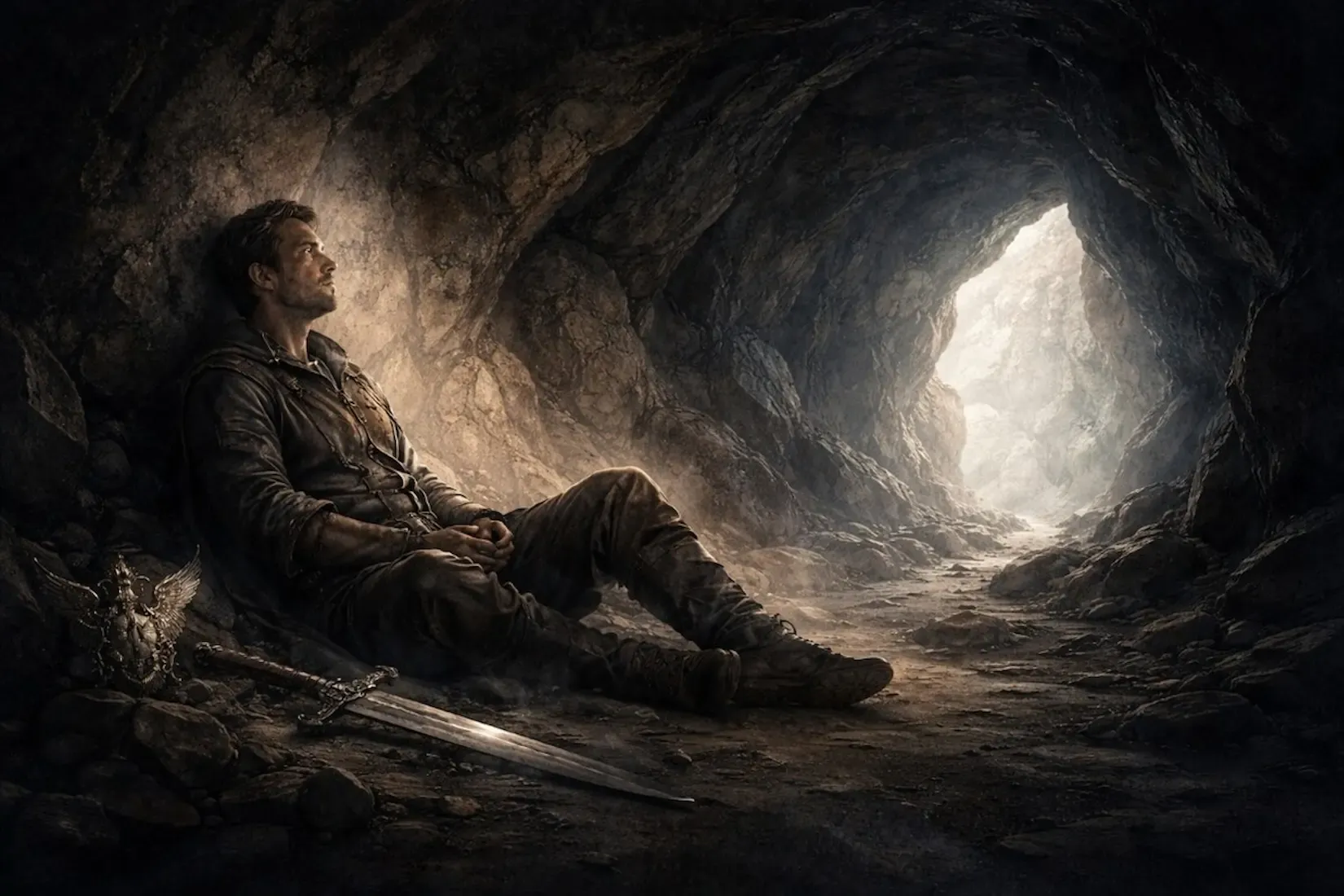
“My Lord, You are everywhere. If You wish, You can protect me.”
No conditions. No spiritual credentials presented. No list of prayers completed. No bargaining. Just a soul at the absolute end of its own resources, turning — with open hands — toward the only shelter that remained. Just this: If You wish.
This is Anyashraya tyaga in its living form. Not a philosophy discussed in a lecture hall. Not a concept understood with the mind. A man in a dark cave with enemy torches approaching who has finally, completely, honestly released every other support and placed his faith in God alone.
I did not pray it because I believed it would work. I prayed it because there was nothing left to believe in.
And in that complete absence of certainty — in that open-handed helplessness — something that felt like peace began to move through the cave.
This, I understood at last, was what Swamiji had been pointing to the entire time. Not a technique. Not an achievement. The state that arrives when every other support has been honestly released. Sadhan-hinata — the luminous helplessness that is, paradoxically, the strongest place a soul can stand.
THE ANSWER: What God Sent Instead of an Iron Gate
I opened my eyes when I heard my companion exhale.
He was looking at the cave entrance. I followed his gaze.
A small spider had dropped silently from the roof of the cave mouth and was spinning. Thread by thread, in the unhurried rhythm of its ancient craft, a web was appearing across the opening. Gossamer. Delicate. So thin the torchlight from outside passed straight through it.
My face changed. Not peace yet, but a kind of wounded recognition. Something closer to disbelief. I had just emptied my hands and offered a prayer. And this was the answer. A spider.
Lord, I prayed to You for protection
and You sent me a spider.
This is like putting salt in my wounds.
The footsteps reached the cave entrance.
Voices. A torch lifted. Light flooded the web, turning it briefly to silver.
A soldier’s voice: “Do you think somebody could be inside the cave?”
Another: “There’s a spider’s web on the entrance. Nobody can be here.”
And speaking like that, they walked off.
For a long time, neither of us spoke or moved.
The web held its place across the entrance — that gossamer thread between us and everything that wanted to harm us. My companion turned to me. His face had been broken open.
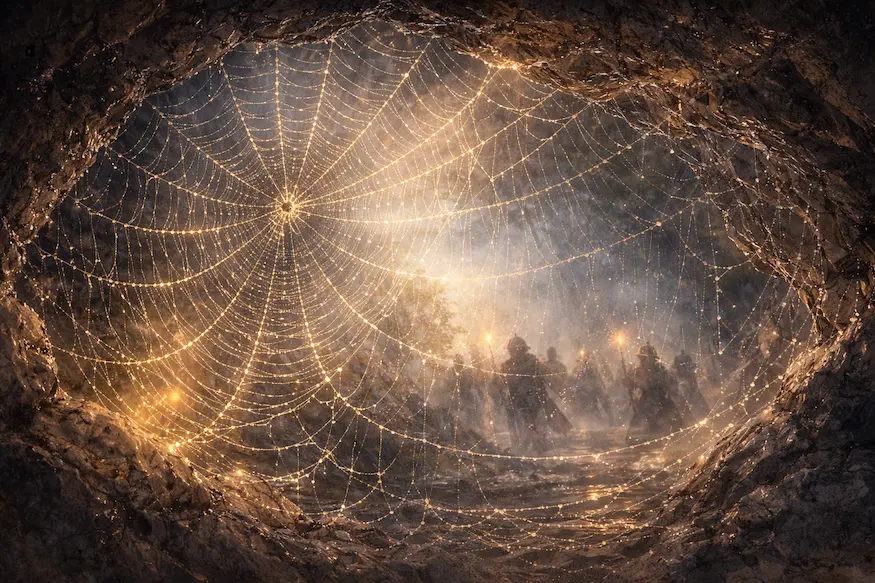
I said it quietly. But it has echoed in me every day since:
“If God’s grace is there, a spider’s web can serve the purpose of an iron gate. And without God’s grace, an iron gate is not stronger than a spider’s web.”
So, your faith should be in that One. This is also exclusive devotion.
The instrument was gossamer. The power behind it was not.
Every iron gate I had ever trusted, every support I had ever built — they had only ever worked because His hand was behind them. When His hand withdrew, no iron gate was thick enough. When His hand was present, no spider’s web was too thin.
When you know Whose hand is weaving, you stop panicking about the thread.
This Truth Is Older Than Any Cave
Swami Mukundananda Ji teaches that what my companion and I discovered in one night of fear, a king of elephants had been learning for a thousand years. The story is from the Srimad Bhagavatam — one of the most sacred texts of the Vedic tradition, a vast ocean of devotional wisdom that Swamiji draws from again and again to bring ancient truth into living contact with the human heart.
Gajraj was the king of elephants. In the Vedic tradition, the elephant is a symbol of power, majesty, and strength — and Gajraj was the greatest of them all. Unchallenged. Matchless. The kind of power that makes every other creature step aside without a word. If you were to see Svabala — reliance on one’s own strength — walking on four legs, it would look like Gajraj.
Then one day, wading into a lake, a crocodile seized his leg beneath the surface.
Gajraj pulled. The crocodile held.
He fought with everything his magnificent body possessed — every ounce of legendary strength, every reserve of endurance. The ancient texts say this battle lasted a thousand years. A thousand years of trusting his own power against an adversary that simply would not yield.
And the crocodile held.
Then came the moment every human being is terrified of — and which turns out, in God’s economy, to be the very door to liberation. The complete, total, final exhaustion of self-reliance. The moment when the hand opens because there is nothing left in it to grip.
With the last of his strength, holding a lotus above the water as an offering, Gajraj cried out — not to his own power, not to any worldly support, but to the Lord Himself:
“Namo namas te…
I have no other shelter.
You alone are my refuge.”

And the Lord Vishnu came. Immediately. Not after further struggle. Not after Gajraj accumulated more merit or proved himself worthy. In the very moment that self-reliance was finally, completely released — in that exact moment — God arrived.
The Sudarshana Chakra — the divine discus of Lord Vishnu — flew. The crocodile was slain. And Gajraj, who had trusted his own strength for a thousand years, was liberated in the precise moment he abandoned it.
Swamiji teaches that the crocodile in this story represents maya — the material energy, the power of illusion that keeps the soul bound to the material world and blind to its own divine nature. Maya is not a physical creature that can be defeated by physical strength. It is a cosmic force. And our own strength, however great, has limits. Maya does not.
Against this adversary, God’s grace is not optional. It is the only force that is sufficient. This is what Gajraj discovered. This is what my companion discovered in the cave. This is what Swamiji has been teaching all along.
Gajraj fought for a thousand years. My companion and I fought for one night. You may be in your own battle right now — your own cave, your own crocodile that will not let go. The length of the struggle is different. The liberation is identical. It arrives the moment self-reliance is released and God is given the whole weight.
You do not have to fight for a thousand years. You can put it down tonight.
THE HEART OF SWAMIJI’S TEACHING: What It Means to Be Truly Secure
When I returned from the cave and sat again in Swamiji’s Satsang, I heard him bring the entire teaching to its resting place. I had heard these words before. But now every syllable landed differently because I had lived them:
People in American society are feeling insecure. And people in the villages in India are feeling secure. Because your security is based on these external props that are fallible. And if you decide: my security is based on my Lord, He will take care of me – Rakhe Krishna mare ke, mare Krishna rakhe ke – then you will feel secure.
Sharanagati is not the name of a sadhana. It is a state of sadhana where you are doing sadhana, but your faith is not in your sadhana. Your faith is in His grace. And then you will feel secure.
Rakhe Krishna mare ke, mare Krishna rakhe ke. This is a verse from the devotional tradition that Swamiji quotes with great love. It means: if Krishna keeps you, no power in existence can destroy you. If Krishna takes you, no power in existence can save you. Your life is entirely in His hands. And this — understood not as a frightening loss of control but as the most complete and permanent security imaginable — is Sharanagati.
The iron gates we build — the post, the wealth, the relationships, the sadhana, our own strength — are not the enemy. They are instruments. Beautiful, God-given, useful instruments. The only mistake is mistaking the instrument for the foundation. The only error is gripping the thread and calling it an iron gate.
The foundation was always Someone else. And that Someone has never, for a single moment, let go.
What Shree Krishna Promised
And this promise that God alone is the only unshakeable shelter is not new. Shree Krishna spoke it Himself, on a battlefield, five thousand years ago.
At the very end of that conversation — after eighteen chapters of profound teaching on duty, action, knowledge, and devotion — Shree Krishna speaks a verse that Swamiji holds as the most complete expression of divine promise in all of scripture:
Sarva-dharmān parityajya mām ekaṃ śaraṇaṃ vraja,
Ahaṃ tvāṃ sarva-pāpebhyo mokṣayiṣyāmi mā śucah.
— Bhagavad Gita 18.66
"Abandon all varieties of dharmas and simply surrender unto Me alone. I shall liberate you from all sinful reactions; do not fear."
Let us receive each part of this slowly.
Sarva-dharman parityajya — abandon all. This word parityajya carries the same energy as tyaga in Narad Muni’s sutra. A complete, wholehearted release. Not of your duties and responsibilities and relationships — but of the illusion that any of these is your ultimate protector.
Mam ekam sharanam vraja — come to Me alone. Not God plus your portfolio. Not God plus your position. Not God plus your spiritual record. God alone. This is ananyata — Narad Muni’s word for exclusive refuge — in Shree Krishna’s own voice.
Aham tvam sarva-papebhyo moksayisyami — I shall deliver you. Not: work hard enough to deliver yourself. Not: accumulate sufficient merit to qualify. I shall deliver you. The Lord Himself is taking personal responsibility.
And then the two words that contain the entire promise: Mā śucah. Do not fear.
Not try not to fear. Not reduce your fear. Do not fear — as if fear itself becomes structurally impossible once you understand that the One who holds you has already, unconditionally, taken personal responsibility for your deliverance.
Notice where this verse was given. Not on a mountain of solitude. Not to a renunciant who had already released the world. It was given in the middle of a battlefield, to a soul who had just lost all confidence in every support he had ever leaned on. At the moment of greatest crisis. At the moment the cave closes in.
That is always when the key arrives. That is always when the spider spins.
THE PRACTICE: What Sharanagati Actually Looks Like in a Life
Sharanagati is a Sanskrit word that means complete surrender to God — the state of taking God as one’s only shelter. It is perhaps the most misunderstood word in the spiritual vocabulary. People hear ‘surrender’ and imagine passivity — someone who has given up, who has stopped trying, who is floating helplessly and calling the floating spiritual.
That is not Sharanagati.
Swamiji is precise: keep your job. Keep your savings. Keep your relationships. Keep your spiritual practice. Continue every sensible effort life requires. Sharanagati lives not in the outer actions but in the inner relationship with those actions. The outer life continues almost exactly as before. But something in the interior has reorganized so fundamentally that everything is quietly transformed.
The work is the same but no longer driven by the fear beneath the opening question. The Sadhana is the same but has become a love offering rather than a spiritual invoice. The relationships are the same but are held now as gifts rather than foundations.
Swamiji observes something that stops the modern mind cold: people surrounded by every material convenience — insurance policies, investment strategies, contingency plans fortifying them on every side — are often the most anxious. A low hum of fear runs underneath all of it, never quite silenced. Meanwhile, a simple soul who has truly surrendered the outcome of her life into God’s hands sleeps with a peace that no portfolio has ever been able to purchase. The difference is not the size of the bank account. It is entirely interior: where is your anchor actually buried?
1. Name the false support — without shame
The next time anxiety rises, pause before reacting. Ask gently: what am I currently gripping for ultimate safety? Your title, your savings, someone’s approval, your spiritual record, your own ability to manage things? Simply naming it — without drama or judgment — is already the beginning of tyaga. You cannot release what you have not yet honestly seen.
2. Begin each morning with the soldier’s prayer
“My Lord, You are everywhere. You see my situation completely. I trust You with the outcome.” Thirty seconds. Every morning. It is ananyata practiced in miniature, before the day floods in with its demands. Over time, it quietly rewires the deepest orientation of the soul.
3. Separate the instrument from the source
When good things come through your job, your relationships, your efforts — receive them with gratitude and say inwardly: this is an instrument. God is the source. This one small practice, repeated daily, gradually moves the seat of trust from the anyashraya to the One who wields it. It transforms your relationship with both abundance and loss.
4. Go on a retrospective grace hunt
Look back at your own life and find your spider’s webs. The moments when what God sent looked entirely inadequate and turned out to be precisely sufficient. The closed door that led to the right one. The delay that turned out to be protection. The loss that drove you deeper into God. This is not nostalgia — it is evidence-building for faith. What He has done, He will do again.
5. Let your sadhana become a love offering, not an invoice
If your practice carries even the faintest quality of I have done enough to qualify for God’s grace — gently soften that grip. As Swamiji teaches: all the sadhana that we do is to destroy the pride of sadhana. To reach sadhan-hinata. To learn to be fully dependent on the grace of God from inside. Practice as love. Chant because it brings you closer to Him, not because it builds a claim upon Him.
THE CONCLUSION
What Remains
I walked into that cave carrying Swamiji’s teachings in my mind.
I walked out carrying them in my bones.
The inventory I ran that night — the post, the gold, the memory of home, the prayer ledger, the sword — is the same inventory every human being runs in their moment of greatest fear. We have all been building our answer to the same question our entire lives. Constructing, brick by careful brick, a fortress of supports we call security.
And somewhere beneath the confidence we perform in daylight, we already know the fortress is not as solid as we have told ourselves. Because we have felt it shake.
Swamiji has been gently, lovingly pointing to this our entire lives:
“Your security is based on these external props that are fallible. If you decide: my security is based on my Lord – He will take care of me. And then you will feel secure.”
That is the whole teaching. Everything else — the sutra, the cave story, the examples, the stories of Daksha and Nalakubara and Gajraj — is Swamiji’s patient, luminous effort to bring us to the place where we can actually receive those two sentences. Where they land not in the mind but in the marrow.
Imagine a person who has been gripping a railing in a dark corridor for so long that their hand has forgotten what it feels like to be open. They grip because they are afraid of what happens when they let go. And then one day — through grace, through exhaustion, through a teaching that finally lands somewhere below the intellect — they release the railing.
And in the releasing, they discover that the floor was always there. Solid. Unhurried. Holding them not because they gripped hard enough, but simply because that is what the floor does. That is what it has always been doing, through every moment they were afraid.
This is Sharanagati. This is Anyashraya tyaga. The releasing is not a loss. It is the moment you discover you were never in danger of falling. You were always, already, held.
The spider’s web is enough when the grace of God is behind it. Your life exactly as it is, with all its uncertainties and unanswered prayers is held by the same hands that hold the stars.
Mā śucah. Do not fear.
You are not alone in your cave. You never were.
Call To Action
🌟 Final Call to Action
👉 For more life-changing teachings, subscribe to the official YouTube channels:
👉 Watch the complete Narad Bhakti Sutra series on the Bhagavad Gita Krishna Bhakti Channel:
Buy the "Narad Bhakti Sutras" by Swami Mukundananda
Now that we’ve explored the divine wisdom of the Narad Bhakti Sutras, it’s time to take the next step on your spiritual journey. To deepen your understanding of the Narad Bhakti Sutras, we highly recommend Swami Mukundananda’s commentary, which beautifully unpacks each mantra providing a clear and practical guide for modern seekers.
Order the Book: Swami Mukundananda’s Commentary
Unlock the deeper wisdom of the Narad Bhakti Sutras with this insightful commentary by Swami Mukundananda. Perfect for modern seekers who wish to explore the divine teachings in greater depth.
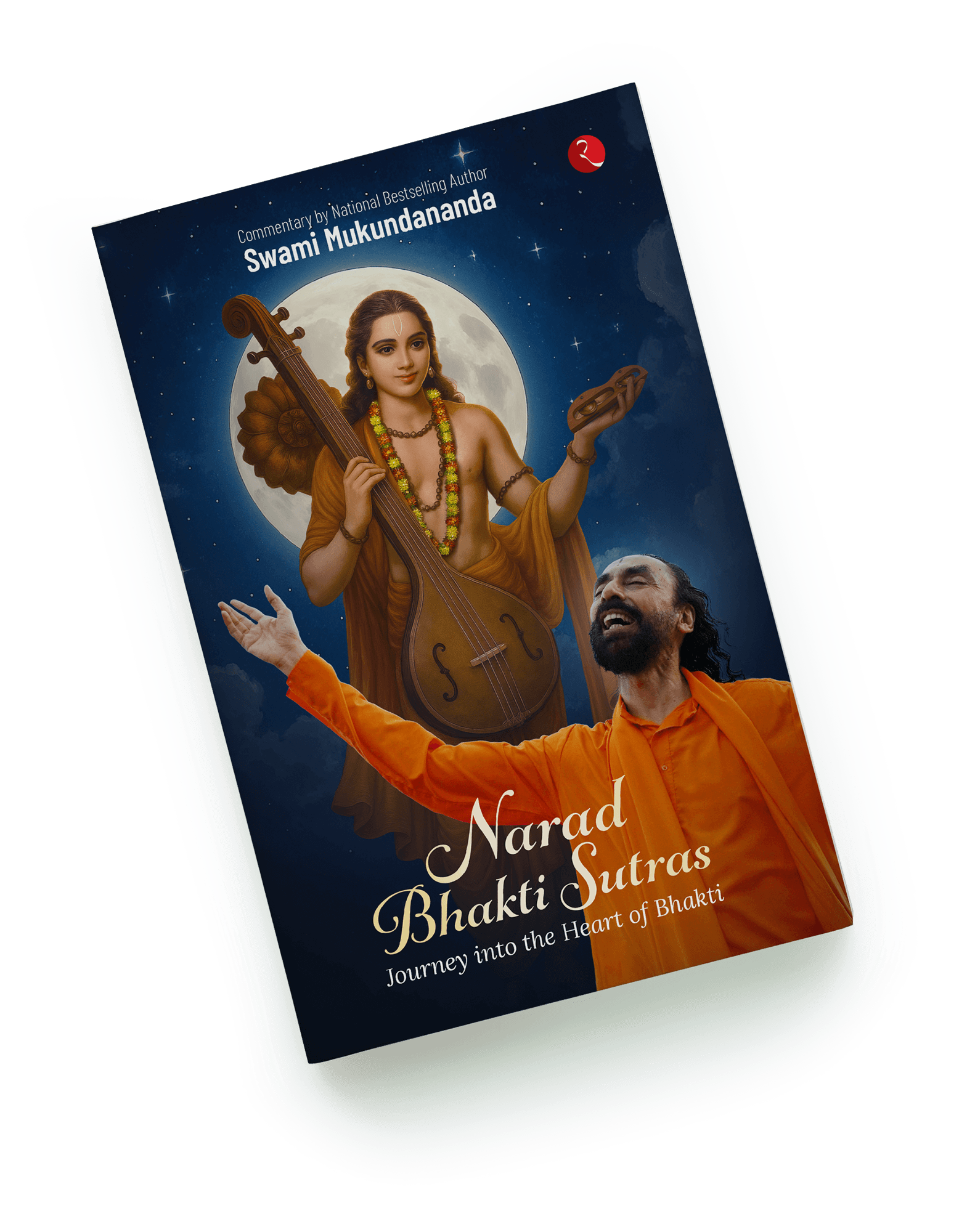
Order the Book Now (India)Order the Book Now (USA)
FAQ
Does Sharanagati mean I should stop making plans and efforts?
Not at all.
As Swami Mukundananda Ji often explains:
Have your 401(k) in place—but do not place your faith in your 401(k). Place it in God.
Keep your job.
Keep your savings.
Keep your responsibilities.
Work with full effort.
The shift is entirely internal:
Where does your trust ultimately rest?
Work as if everything depends on you.
Trust as if everything depends on God.
These are not in conflict.
Together, they create a life that is both fully engaged…
and deeply at peace.
My faith is genuinely weak. How do I even begin?
Begin exactly where you are. Sharanagati does not demand perfect faith. It asks only for honesty.
One worry placed in God’s hands today.
One outcome held a little more loosely than yesterday.
One sincere prayer—even if brief, even if uncertain.
Faith is not a switch. It is a fire. Built slowly—one small piece of trust at a time. And one day, almost without noticing, it begins to warm your entire life.
Is it wrong to feel comforted by my family and savings?
Not at all. The warmth of relationships and the stability of wise planning are real gifts. They deserve gratitude. But Swami Mukundananda Ji makes a subtle and powerful distinction:
Receive them as gifts—do not mistake them for your ultimate shelter.
A gift received with gratitude keeps you connected to the Giver. A gift mistaken for the Giver… quietly replaces Him. Cherish everything you have. Just know—deeply and clearly—where it comes from… and Who truly sustains you.
I have never practiced any religion. Can this teaching still reach me?
Yes. And perhaps… more directly than you expect. Because the heart of this teaching does not depend on religious background. It depends on honesty.
Ask yourself:
Where have I placed my sense of security?
Have those supports ever fully removed fear?
That question alone is enough to begin. The cave does not ask for credentials. The prayer that arose that night was not sophisticated. It was simply true. And truth is available to every human being regardless of background, belief, or tradition.
This feels like it is for renunciants. Can someone with a family and career truly live it?
This teaching is especially for you. Renunciants have already released many external supports.
But real Sharanagati is tested in the world—
In the workplace.
In relationships.
In parenting.
In uncertainty.
In the thousand moments each day where trust can shift away from God. The soldier in the cave had a family. He had wealth. He had strength. He was not a monk. He was in the middle of life. And that is exactly where grace revealed itself.
Your life—exactly as it is—
is the perfect place to begin.