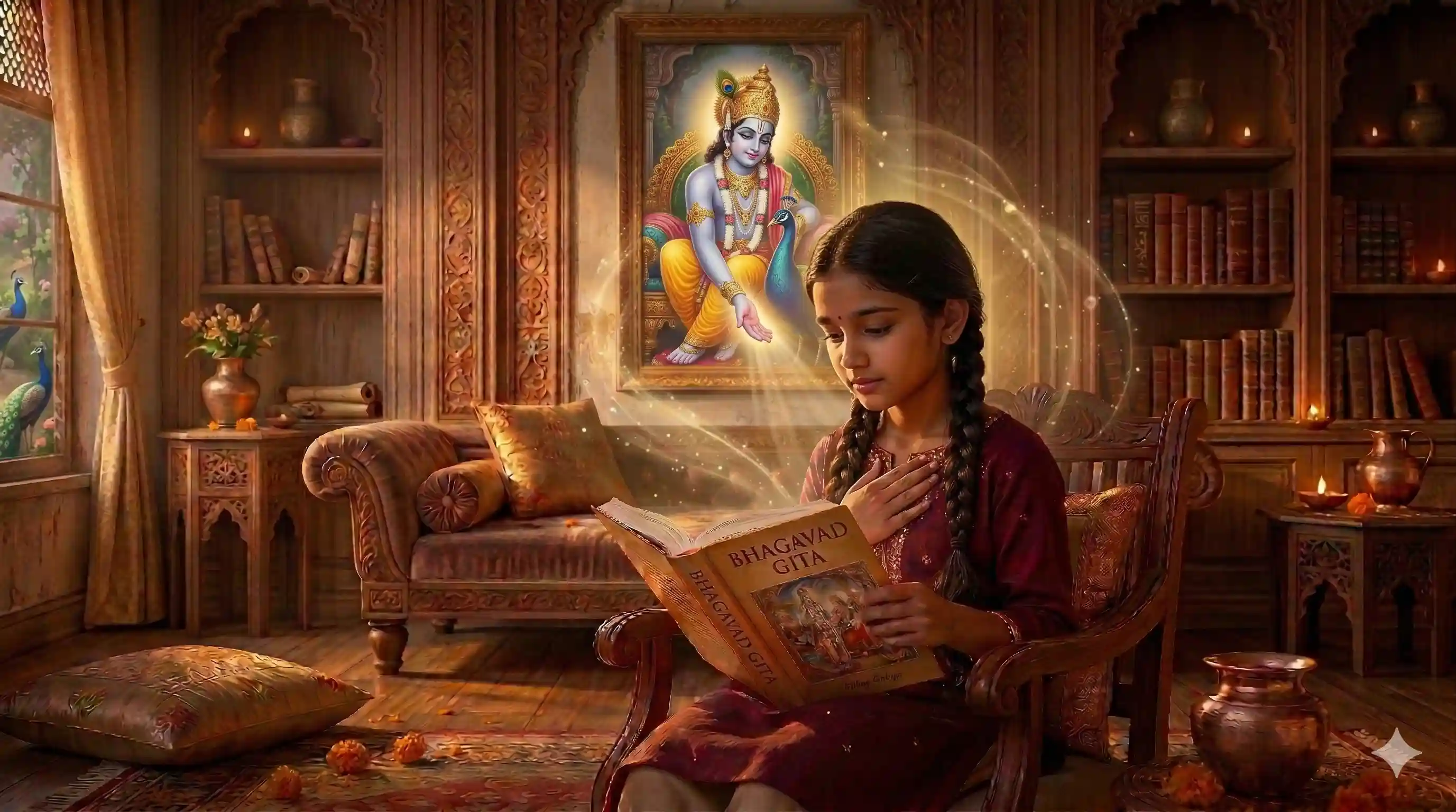


Introduction: The Language of Love in Devotion
In the spiritual realm, sincerity of the heart outweighs extravagance of the hand. Unlike the material world, where our actions are judged by appearances and opulence, the divine looks for one thing alone—bhakti, devotion. As Shree Krishna tells Arjun in the Bhagavad Gita, even the simplest of offerings, when made with love, are accepted by Him with open arms:
Bhagavad Gita 9.26
“patram pushpam phalam toyam yo me bhaktya prayachchhati
tadaham bhaktyupahritam ashnami prayatatmanah”
“If one offers to Me with devotion a leaf, a flower, a fruit, or even water, I delightfully partake of that item offered with love by My devotee in pure consciousness.”
👉 Read Verse 9.26 with commentary
This singular verse encapsulates the infinite compassion and accessibility of the Divine. Swami Mukundananda beautifully explains that the external object offered is insignificant; it is the internal emotion—the love and surrender—that reaches God.
Simplicity in Devotion: The Divine's Compassion
Swami Mukundananda emphasizes that God is not a businessman who calculates the material worth of what we offer. Unlike worldly interactions, where value is often measured by price, in the divine economy, love is the only currency.

Imagine you’re poor and have nothing—no wealth, no possessions. Can you still connect with God? Absolutely. Shree Krishna says, “Take a leaf and offer it.” No leaves? “Take a flower.” No flowers in autumn? “Offer water.” Even if all else fails, offer your tears of longing.
This unconditional accessibility shows Shree Krishna’s infinite karuṇā—compassion. In a world where a slight deviation in etiquette or appearance can lead to exclusion or punishment, God invites us regardless of what we possess. All He desires is our love.
“God looks at the intention, not the item. One tear of genuine longing is more valuable than a mountain of gold offered in pride.”
— Swami Mukundananda
The Empty Box of Love: A Diwali Parable
Let us take a modern parable. During Diwali, a family faced financial hardship. The neighbors exchanged lavish gifts, but this family could not afford even a small present. The daughter, with innocent enthusiasm, decorated a large gift box and offered it to her father.
The father, frustrated by her perceived waste, scolded her. But the next morning, she handed him the box and said, “Happy Diwali, Papa. This is my gift for you.” Moved, the father softened—until he opened the box and found it empty.
He scolded again, “You gave me an empty box!” The little girl, eyes brimming with innocence, replied, “But Papa, I filled it with kisses for you.”

The father wept in shame and realization. He had missed the essence—the box wasn't empty; it was filled with love.
Similarly, Shree Krishna does not look at what you offer to Him but the sweetness with which it is offered. The Supreme Father’s love is infinitely more tender than any worldly parent.
Story of Advaita Acharya: When Tulsi and Water Summoned God
This profound truth is not just theoretical—it’s supported by sacred stories. Over 500 years ago in Bengal, Advaita Acharya, a devout scholar, witnessed the decline of dharma and the rise of atheism. His heart ached for humanity, and he knew only God could save the people.
Recalling Shree Krishna’s promise from the Gita:
Bhagavad Gita 4.7
“yada yada hi dharmasya glanir bhavati bharata
abhyutthanam adharmasya tadatmanam srijamyaham”
“Whenever there is a decline in righteousness and an increase in unrighteousness, O Arjun, at that time I manifest Myself on earth.”
👉 Read Verse 4.7 with commentary
But Advaita Acharya had no grand yajna or temple. All he had was tulsi leaves and water. He fervently prayed and offered this simple devotion, shedding tears in divine yearning..

Touched by the purity of his bhakti, Shree Krishna Himself descended as Chaitanya Mahaprabhu, fulfilling the divine promise. The simplicity of devotion invoked the Supreme Lord—this is the power of love untainted by show or pride.
God Seeks the Giver’s Love, Not the Gift’s Worth
In our material world, offerings are often judged by their monetary or aesthetic value. A wedding gift must be grand. A party favor must be branded. But when we turn toward the Divine, the scale changes entirely.
Swami Mukundananda shares a humorous anecdote to illustrate this distortion. In the days of physical coins in India, when people unknowingly received counterfeit coins, they often didn’t want to throw them away nor could they use them. So what did they do?
They placed them in the temple donation box.
“Let God deal with it!” they’d say. The worst went to the One who deserves the best.
It’s a comical yet tragic truth—when it comes to worldly pleasures, people give their best to themselves and offer the leftovers to God. But love doesn't work like that. If you genuinely love someone, you want to give your best.
The Tale of Two Currency Notes: $1 and $100
Here’s another story from Swami Mukundananda’s teaching. A hundred-dollar bill and a one-dollar bill met at the U.S. Federal Reserve Treasury, both old and worn out, ready to be shredded.
The $100 bill boasted, “I went to Vegas casinos, cruise ships, fine restaurants, and five-star resorts.”
The $1 bill sighed, “I visited churches, temples, and food donation boxes.”
Surprised, the $100 bill said, “I’ve never heard of those places.”
This story subtly highlights how people often offer the least valuable parts of their wealth or time to God, saving the best for themselves. True love means giving our best to our Beloved, not our leftovers.
Love Must Be Genuine and Sincere
In spiritual life, genuineness is everything. Even the most expensive rituals, grand yajnas, or temple donations fall short if the heart is not involved. Conversely, even a whisper of “Krishna” spoken with love moves the Divine.
Swami Mukundananda reminds us:
“True love is not measured by what is given, but by the sacrifice made to give it.”
A millionaire donating $10 is not the same as a beggar offering a single rupee with tearful surrender. Shree Krishna accepts both, but the latter reaches Him quicker, for it carries the fragrance of sacrifice.
The divine isn’t moved by size, but by depth.
The Bhagavatam Echo: Scriptural Harmony
This idea is not limited to the Bhagavad Gita. The Shrimad Bhagavatam also echoes this exact sentiment with the same verse:
“patraṁ puṣpaṁ phalaṁ toyaṁ yo me bhaktyā prayacchati…”
Whether in the epic discourse of Shree Krishna to Arjun or in the divine pastimes of the Lord's incarnations, this verse recurs like a chorus, driving home the universality and timelessness of God’s message: Love Me with all your heart, and I am yours.
God Wants Effort, Not Ease
Some people say, “Well, since Shree Krishna accepts even water, I’ll only offer that.” But this thinking misses the essence.
God sees the intention and effort behind the act. If someone has plenty yet chooses to give the least, that's not love—that’s apathy.
Swami Mukundananda warns against this tendency. He says:
“Don't give what you don’t need and call it love. True devotion is when you give what you cherish.”
If you truly love God, you exert yourself. If you’re poor, water and tulsi leaves suffice. If you’re capable, then holding back is not humility—it’s miserliness.
Devotion in Action: Stories from Saints
Throughout India’s spiritual heritage, we find examples of pure-hearted devotion accepted by God:
1. Shabari’s Berries
In the Ramayan, the tribal woman Shabari offered half-eaten berries to Lord Ram. She had tasted them to ensure their sweetness—so deep was her devotion. While others may have seen it as disrespect, Shree Ram saw her love and ate each one with joy.
2. Sudama’s Rice
Sudama, Shree Krishna’s childhood friend, came to Dwaraka with nothing but flattened rice. Ashamed, he still offered it to Shree Krishna, who devoured it with relish, rewarding Sudama with riches—not because of the gift, but due to the love it carried.
3. Saint Tukaram
The saint-singer Tukaram composed abhangas for Lord Vitthala. He had no material wealth but poured his soul into kirtans. His words, soaked in longing, brought God to his humble doorstep.
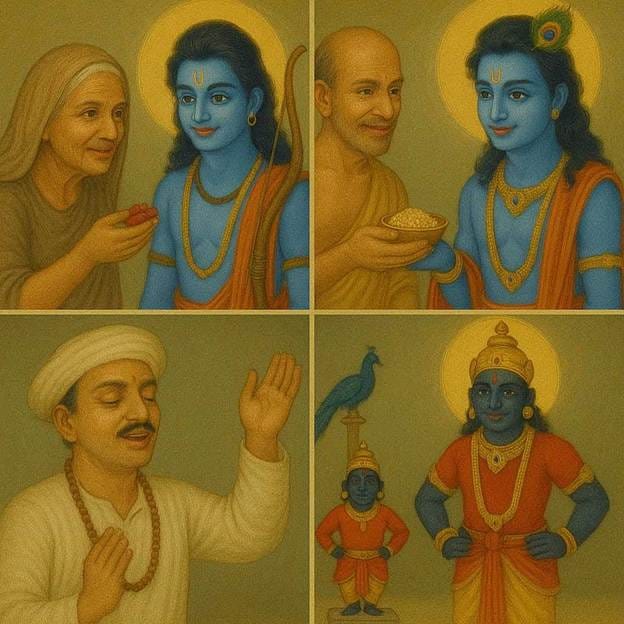
In every age, these stories reaffirm the Gita’s truth—God craves devotion, not display.
How to Practice Devotion with Love
You don’t need a temple or ritual to begin your devotion. Here’s how Swami Mukundananda recommends engaging your heart:
1. Chant with Sincerity
Even 5 minutes of chanting “Radhe Krishna” or “Hare Ram” with tears and longing can connect you with the Divine.
2. Offer What You Eat
Before meals, mentally offer your food to God. Even this mental act transforms eating into devotion.
3. Live as an Instrument
Offer your actions to God as per Gita 3.30:
“Performing all works as an offering unto Me, constantly meditate on Me as the Supreme. Become free from desire and selfishness, and with your mental grief departed, fight!”
4. Daily Gratitude Offering
Before bed, offer your day to God—both your joys and sorrows. This simple prayer becomes a leaf, flower, or fruit of devotion.
Conclusion: The Heart of Devotion
The Bhagavad Gita, Swami Mukundananda’s commentaries, and the examples of saints all declare one truth: God is not looking for what you give but how you give it. A child’s kiss, a widow’s coin, a tearful song—all are sacred when offered with love.
In a world striving for perfection and validation, God stands apart, arms open wide to accept the imperfect but sincere devotee. Whether you have flowers or none, money or not, a temple or a tiny corner in your room—if you have love, you already have everything.
Call to Action: Offer Your Heart Today
You don’t need to wait until you have the perfect offering, the right setting, or ideal circumstances. Start now—with whatever you have. A simple prayer, a heartfelt tear, a quiet moment of remembrance—all of these are divine gifts when offered with love.
🙏 Take a small step today:
- Light a candle and offer it mentally to God with love.
- Offer your meal—even silently—with gratitude and devotion.
- Chant a few names of the Lord with sincerity.
- Write a letter to God expressing your heart.
📿 Let your life become a living offering.
If this message of love and devotion touched your heart, share this blog with someone who needs the reminder that God is not far—He is only a loving thought away.
🪔 Join in-person satsang with Swami Mukundananda to deepen your practice and experience divine love with fellow seekers. Visit JKYog website for upcoming events.
💖 Remember: The smallest act of love, offered with devotion, becomes the grandest worship in the eyes of God.
Resources to explore
Watch: What GOD Truly WANTS From You? How to LOVE God as per BHAGAVAD GITA? Swami Mukundananda Video
Subscribe to Swami Mukundananda’s YouTube channel
Read Bhagavad Gita, The Song of God by Swami Mukundananda Online
❓ FAQs
Q1: Can I worship God without any rituals or a temple?
Yes! According to Bhagavad Gita 9.26, even a leaf or a drop of water offered with love is enough. The heart matters more than the ritual.
Q2: Why should I offer my best to God? Isn’t offering anything enough?
While Shree Krishna accepts any sincere offering, true love expresses itself in giving the best you can, not just what you don’t need.
Q3: Is devotion possible during tough times when I have nothing?
Yes. Many saints, such as Sudama and Advaita Acharya, had nothing, yet their heartfelt devotion pleased God immensely.
Q4: How can I make my daily life devotional?
Offer your actions, thoughts, and food mentally to God. Even small acts, done with love, become devotion.
Q5: What if my mind wanders during devotion?
Shree Krishna appreciates the effort. Keep bringing your mind back gently. Swami Mukundananda emphasizes abhyasa (practice) and vairagya (detachment) from Bhagavad Gita 6.35.