
Every day gives us twenty-four hours but knowing that time is precious does not by itself tell us how those hours should be used. Once we begin valuing time, a deeper responsibility arises: we must decide what deserves the life passing through those hours.
In the first principle of this series, we explored Swami Mukundananda's teaching that time is a gift of God, and that every day gives us another chance to grow, serve, practice sadhana, and move toward our highest spiritual welfare. Yet recognizing the value of time is only the beginning; a precious resource becomes truly meaningful only when it is directed toward a worthy purpose.
Swamiji illustrates this with a simple story. A man once slowed his car at a junction to ask an elderly passerby for directions. Sir, where will this road take me, he asked. Where do you wish to go, the elderly man asked in return. Nowhere in particular, the traveler admitted. Then why do you ask, said the elderly man. What difference will it make? The lesson reaches far beyond travel: we may run every day, working hard from morning until night, without pausing to consider what we are running toward, or whether our goals are truly worthwhile. Hard work and accomplishment, Swamiji reminds us, are not necessarily the same thing.
The second principle of mastering time, therefore, is purpose before productivity: before asking how to fit more into the day, we need to understand what we are trying to accomplish with the life those days are creating.
Purpose Gives Direction to Precious Time
Modern life encourages us to think in terms of goals: academic achievement, professional advancement, financial stability, good health, relationships, and personal success. These goals are not inherently opposed to spiritual life; many represent legitimate responsibilities pursued with sincere effort.
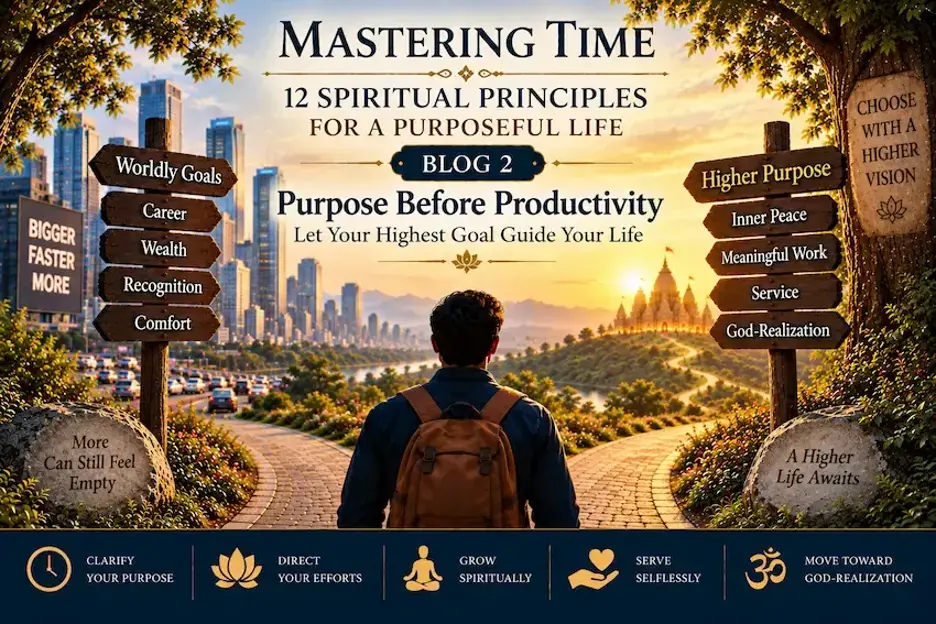
The difficulty begins when temporary goals are pursued without reference to a higher one. Career, wealth, comfort, reputation, and ambition can all demand our time simultaneously, and when no governing purpose places them in perspective, every demand competes for first place. Sometimes the deeper problem is not too little time, but too many directions.
A person may work for years to reach a professional milestone only to find another one immediately appears. Financial security can become the desire for a higher standard of living, requiring still more time and energy to maintain. None of this makes achievement wrong, but it needs context: without understanding life's highest purpose, temporary goals can assume an importance they were never capable of carrying.
According to Swamiji's teachings, the highest purpose of human life is God-realization. When this understanding becomes central to the intellect, worldly responsibilities do not disappear; they occupy their proper place within a much larger journey. Purpose is not one more goal to squeeze into an already crowded calendar. It is the principle that gives meaning and direction to everything else on the calendar.
A Resolute Intellect Creates a Unified Direction
The Bhagavad Gita gives a profound foundation for this principle in Bhagavad Gita 2.41:

व्यवसायात्मिका बुद्धिरेकेह कुरुनन्दन ।
बहुशाखा ह्यनन्ताश्च बुद्धयोऽव्यवसायिनाम् ॥ 41॥
vyavasāyātmikā buddhir ekeha kuru-nandana
bahu-śhākhā hyanantāśh cha buddhayo ’vyavasāyinām
BG 2.41: O descendent of the Kurus, the intellect of those who are on this path is resolute, and their aim is one-pointed. But the intellect of those who are irresolute is many-branched.

Shree Krishna explains that those who follow the spiritual path with determination possess a resolute intellect and a one-pointed aim, while the intellect of the irresolute becomes many-branched. Swamiji uses the analogy of the intellect as a vessel containing many pieces of knowledge: the knowledge that becomes active begins influencing the mind. Merely possessing spiritual knowledge, therefore, is different from keeping the right knowledge active when choices are being made.
Applied to daily life, this explains why our calendars become scattered. We carry many ideas about happiness, success, security, and recognition, and when competing conclusions become active in the intellect, the mind is pulled toward many corresponding goals, each making a claim upon our time. The expression bahu-shakha, many-branched, captures this: one branch reaches toward achievement, another toward comfort, and the branches keep multiplying because no single higher purpose has been given the authority to organize them.
By contrast, vyavasayatmika buddhi describes an intellect resolute about the destination. This does not mean a spiritual person has only one activity; a life can contain many responsibilities while still having one governing purpose. The parent, professional, caregiver, and spiritual aspirant need not represent separate lives pulling against one another; they can become expressions of one life whose ultimate direction has been clearly understood.
Many Goals Can Serve One Higher Purpose
Understanding God-realization as the highest purpose does not require us to reject worldly responsibilities; it changes our relationship with them. Work no longer has to provide our entire identity. Money becomes a means of fulfilling responsibilities rather than the measure of human worth. Health deserves care because the body is the instrument through which we fulfill our duties and engage in spiritual practice. Relationships remain meaningful while also becoming opportunities to develop patience, sacrifice, and gratitude.
Without a higher purpose, worldly goals can quietly become destinations in themselves, and we expect from them a permanent fulfillment that temporary achievements cannot provide. Each accomplishment produces satisfaction for a time, but the mind eventually adjusts and another desire arises.
A higher purpose removes this impossible burden from worldly success. We can appreciate achievement without asking it to complete us, and participate wholeheartedly in the world without forgetting that the deepest purpose of human life lies beyond what the world can give. Spirituality does not make ordinary life less meaningful; it gives ordinary life a deeper meaning.
Activity Becomes Progress Only When the Direction Is Right
Swamiji makes the distinction between movement and meaningful progress vivid through the example of processionary caterpillars, which have a strong tendency to follow the one immediately ahead. In the illustration Swamiji shares, they were arranged so that each continued following another until the procession formed a closed circle. Food was available nearby, yet the caterpillars continued moving around the same path: considerable activity and effort, but not taking them toward what they needed.
Human life can acquire a similar momentum. We often inherit a sequence of expectations about what should come next: education leads to career, career leads to advancement, advancement leads to greater income. Society rewards every stage of the procession, making it even less likely that we will stop to examine the direction of the journey.
The spiritual concern is not that we participate in these milestones, but that we may move from one to another automatically, without examining what the journey is meant to accomplish. Busyness makes this hard to notice, because activity creates the sensation of progress. Yet meaningful progress cannot be measured only by how much ground we have covered; direction matters as much as distance. Once purpose becomes clear, professional growth, caring for family, and serving society may all be worthwhile, their place clearer when they support rather than replace the higher purpose for which the human opportunity has been given.
A Clear Priority Helps the Intellect Resist Immediate Attraction

Knowing the destination does not mean the mind will always prefer the path that leads toward it. Immediate attractions remain powerful, which is why clarity in the intellect matters.
Swamiji illustrates this through the story of King Janak, father of Sita, renowned for living amid great royal opulence while remaining completely detached within. Two scholars once debated whether this reputation was deserved and asked the king directly. Janak, testing their impudence, sentenced them to be hanged the next day, but first gave them a night of royal luxury. The next morning he offered a reprieve: each would walk through the capital carrying a cup of oil filled to the brim, past their favorite shops, and if they returned without spilling a drop, they would be forgiven. Both completed the walk with the oil intact.
Janak then asked two questions. During the night of luxury, had their minds been tempted? No, because they knew they would be hanged by morning. During the walk, had their minds wandered toward the marketplace? No again, because their attention had been on preserving the oil. It was the same world, Janak told them, yet they had remained detached from everything it offered, because their intellect had decided that something else mattered more.
This, he explained, is also his own secret: he remains untouched by his kingdom's opulence because his intellect stays focused on a greater priority, the remembrance that any day could be his last and that the best use of every moment is remembrance of God.
Our own mind will always notice what is pleasant or tempting. Purpose does not eliminate this; it gives the intellect something clearer to hold onto, strong enough that the mind stays oriented toward it even while temptation remains present.
A Powerful Purpose Awakens Extraordinary Effort
Clarity about the destination does more than help us resist distraction; it can also transform the intensity with which we move toward what matters. Swamiji illustrates this through the story of a schoolboy who loved soccer but was rarely selected among the main players. His father regularly attended his practices, even though he was blind. After father and son were absent for several days, the boy returned before an important match and pleaded with his coach for a chance to play. On the field, he performed with an intensity the coach had never seen before. Afterward, the boy explained that his father had died the previous week, and because his father had been blind, this was the first time his father could truly watch him play.
Swamiji takes the lesson to the spiritual level: God is our eternal Father, always watching over us. When this remains merely an idea, it has little influence on our actions; when it becomes a living conviction, the same responsibilities can be performed with a different consciousness. The activity may not have changed, but the reason for performing it has.
A powerful purpose does not merely tell us what deserves our effort; it can awaken effort that weaker motivations struggle to sustain. King Janak's example and the schoolboy's story illuminate two complementary aspects of purpose: a clear higher priority gives the intellect strength to turn away from competing attractions, while a powerful higher reason gives us strength to apply ourselves more wholeheartedly to what deserves our effort.

Spiritual Motivation Grows from Remembering Grace
Swamiji's own explanation of motivation takes this principle even deeper. When asked how he maintains his motivation, he speaks of remembering the graces he has received: meeting a true Guru, receiving spiritual knowledge, the opportunity to serve, walking the path of bhakti toward Radha-Krishna, and being able to help others. Along with these graces, he remembers that life is short and that he does not know how long this golden opportunity will remain. That remembrance inspires him.
This reveals a beautiful distinction between ordinary and spiritual motivation. Ordinary motivation often begins with something we hope to obtain; spiritual motivation can begin with gratitude for what we have already received.
When grace remains active in the intellect, spiritual effort can be experienced differently. Sadhana becomes not another demand on our schedule, but an opportunity we have received; seva becomes an expression of gratitude rather than another obligation. The mind may still resist, and discipline will still be necessary, but what changes is the reason for making the effort. When gratitude strengthens that reason, purpose begins acquiring emotional force.
Purpose Protects Us from Borrowed Definitions of Success
One of the subtler challenges of modern life is that we can pursue goals we never consciously chose. Every society carries visible and invisible definitions of success, and we absorb expectations from family, peers, and social media, gradually measuring ourselves by income, position, or influence without ever deciding whether these correspond to our deepest values. Comparison intensifies the problem, continually introducing new benchmarks: what once seemed sufficient begins to feel inadequate when someone else appears to have more. The destination keeps moving because it was never truly examined.
A spiritual purpose provides an internal standard less vulnerable to these shifting comparisons. Instead of letting the surrounding world hold exclusive authority over what constitutes a successful life, we begin including spiritual growth in our understanding of progress: greater humility, discipline, compassion, and devotion may never appear on a conventional list of accomplishments, yet they represent some of the most meaningful developments of a human life. This creates an important freedom: we do not need to abandon the world to stop allowing it to determine the purpose of our life.
Purpose Must Enter the Calendar to Transform the Life
It is possible to agree completely with the idea of a higher purpose and still organize daily life as though that purpose did not exist. Spiritual principles become transformative only when they begin influencing actual choices, and the calendar is one place where this becomes visible.
Urgent responsibilities naturally demand attention: work deadlines arrive with dates, appointments occupy fixed hours, bills announce when they are due. Spiritual growth, by contrast, rarely arrives with an external deadline. No calendar alert tells us that our patience has weakened, so spiritual practice can be postponed repeatedly, not because we decided it does not matter, but because louder external demands continually displace it.
This is why purpose must become active in the intellect rather than remaining an inspiring idea. When the higher goal is remembered, we begin making room for what supports it instead of expecting it to survive on whatever time happens to remain. This does not mean a rigid schedule in which every hour must appear spiritually productive; purpose provides orientation rather than rigidity. Over time, this orientation creates coherence, and work, relationships, health, service, learning, and spiritual practice can each occupy an appropriate place.
Creating a Personal Purpose Compass
The practical exercise in Blog 1 focused on awareness. The 7-Day Sacred Time Audit invited readers to observe where their hours were actually going before attempting to redesign the schedule. The second principle takes that observation one level deeper by examining the direction behind those hours.
Set aside a quiet period and write a brief statement describing what you understand to be the highest purpose of your life. Keep it simple enough that you can remember it; the purpose is not to produce beautiful language, but to bring clarity to the intellect.
Next, look at the major areas that currently receive your time: spiritual practice, family, work, health, learning, service, and personal ambitions. Consider how each relates to the purpose you have written. Some will directly support it, some will support the responsibilities necessary for a balanced life, and a few may have gradually acquired more importance than they deserve.
Choose one area in which greater alignment is possible: giving sadhana a more protected place in the day, bringing greater spiritual consciousness into work, using an ability in service, or reducing a commitment that no longer serves a meaningful purpose. One thoughtful adjustment made from clarity is more valuable than a dramatic restructuring that cannot be sustained.

Purpose Turns Time Management into Life Management
Time management is often presented as the art of fitting everything into the available hours. Spiritual wisdom invites us to see it differently: the goal is not to fit everything into life, because everything does not deserve an equal place in life. Once the highest purpose becomes clear, time management becomes an exercise in alignment. The intellect learns to distinguish between means and ends, between immediate preference and lasting welfare, and between movement and genuine progress.
This is the deeper significance of vyavasayatmika buddhi. A resolute intellect does not reduce life to a single activity; it gives the many activities of life a unified direction. Work, family, health, learning, service, rest, and spiritual practice may occupy different amounts of time according to our circumstances, but they no longer need to compete as though each were the ultimate goal.
Purpose therefore changes time management into something deeper than scheduling. It becomes life management: the measure of a well-used life is no longer how efficiently we complete our tasks, but whether the way we use our days is gradually carrying us toward our highest purpose. This brings the first two principles of the Mastering Time series together. The first established the value of time; the second gives that precious time a direction. When we understand both, productivity finally finds its proper place, becoming a tool for living deliberately rather than an end in itself.
Yet clarity of purpose introduces the next challenge. Even when the destination is clear, a meaningful life still contains many legitimate responsibilities, while every day contains only twenty-four hours. The next step is learning to distinguish what is genuinely important from what merely appears urgent. That leads naturally to the third principle of mastering time: Prioritize What Matters: Build Your Day Around Life's Critical Areas.
Key Takeaways
• Purpose must come before productivity. Efficiency helps us move faster, but purpose determines whether our effort is directed toward a worthwhile destination.
• Many goals can serve one higher purpose. Career, family, health, finances, and service can remain important without becoming life's ultimate destination.
• Bhagavad Gita 2.41 is the spiritual foundation. Vyavasayatmika buddhi is a resolute intellect directed toward one highest goal; bahu-shakha describes an intellect scattered among competing directions.
• Activity is not necessarily progress. The traveler and processionary caterpillar illustrations show that effort acquires meaning only when the destination is clear.
• Purpose strengthens both restraint and effort. King Janak's oil-cup story shows a clear priority helping the intellect resist attraction, while the schoolboy's story shows a meaningful reason awakening greater effort.
• Remembering grace can deepen spiritual motivation. Swamiji's remembrance of Guru, spiritual knowledge, seva, and the opportunity to help others shows how gratitude becomes a source of purposeful effort.
• Purpose must eventually influence the calendar. Spiritual purpose becomes transformative when it shapes the goals, commitments, and habits that receive our time.
Frequently Asked Questions
1. What does “purpose before productivity” mean?
It means becoming clear about what life is ultimately meant to accomplish before concentrating on how to accomplish more. Productivity systems help us use time efficiently, but they cannot determine which goals deserve our life. Once the highest purpose is understood, productivity becomes a tool for organizing our responsibilities around a meaningful destination.
2. What does Bhagavad Gita 2.41 teach about purpose?
It contrasts vyavasayatmika buddhi, a resolute, one-pointed intellect, with the bahu-shakha, many-branched, intellect of one who lacks firm determination. A life can contain many responsibilities without becoming directionless when those responsibilities are understood within one governing spiritual purpose.
3. Does making God-realization the highest purpose mean neglecting career, family, or worldly responsibilities?
No. A higher spiritual purpose does not require abandoning legitimate responsibilities. Career, family, health, education, and service can all occupy meaningful places in life; purpose simply changes the position these goals hold in our consciousness, so we fulfill them sincerely while they support our growth and spiritual progress.
4. How does a clear purpose help when the mind still prefers easier or more pleasurable choices?
A clear purpose strengthens the intellect's ability to remember what matters more. King Janak's story demonstrates this: competing attractions may remain present, but when the intellect recognizes something more important is at stake, attention can stay directed toward the higher priority. Purpose does not remove temptation; it gives a stronger reason for not letting immediate preference determine the direction of life.
5. How can I begin aligning my daily life with my highest purpose?
Begin with one thoughtful adjustment rather than redesigning your entire schedule. Write down what you understand to be the highest purpose of your life and examine the major areas receiving your time and energy. Notice whether they support that purpose or have acquired more importance than they deserve, then choose one sustainable change, such as protecting time for sadhana or bringing greater spiritual consciousness into an existing responsibility. Alignment develops gradually through repeated choices.
Further Resources
 JKYog Team