

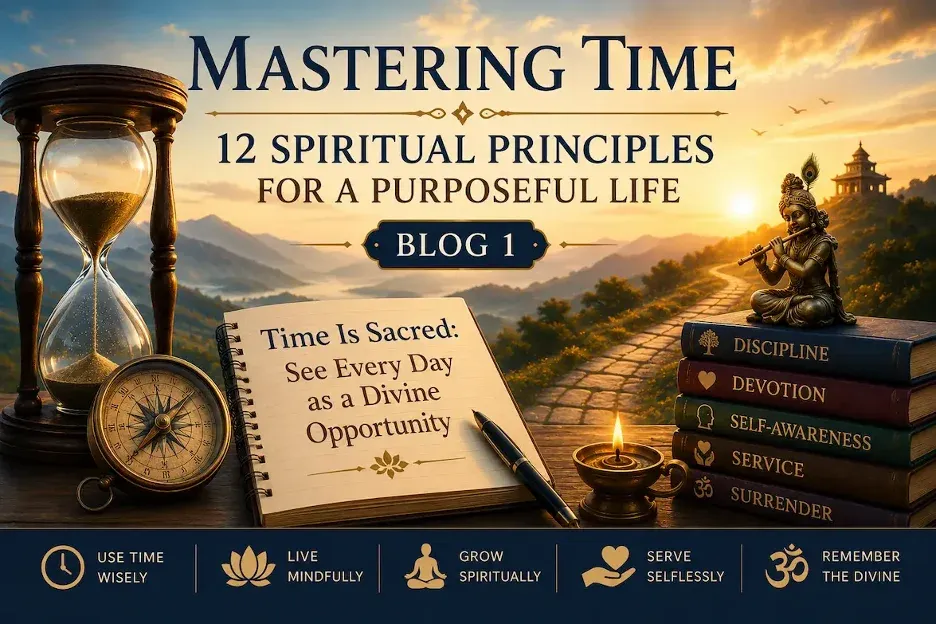
Every morning, the same twenty-four hours arrive, exactly as they did yesterday, as they will tomorrow. No one has ever received more than this. No one ever will.
Yet by evening, those same hours have disappeared.
A few minutes went into checking the phone. A little more disappeared into unnecessary browsing. One conversation stretched longer than intended. Important work was postponed. Spiritual practice was pushed to later. The day became crowded, but not necessarily meaningful.
This is usually treated as a time-management problem. We search for better schedules, productivity systems, and routines. These can certainly help. But Swami Mukundananda's teachings take us to a more fundamental question: Do we truly understand the value of the time we are trying to manage?
Swamiji asks us to "consider time as a gift of God."
That changes everything.
If time is merely something we possess, we may feel free to spend it however we please. But if time is a gift of God, each day carries both grace and responsibility. The hours before us become opportunities to fulfill our duties, serve others, purify the mind, grow in wisdom, remember God, and move toward the ultimate purpose of human life.
Time is not simply something we spend. It is the medium through which we spend our life.

Why Time Is One of Life's Most Precious Gifts
We often recognize the value of something only when we realize that it is limited. Money lost today may be earned again. A possession can sometimes be replaced. But the hour that has passed cannot be called back.
This is why Swami Mukundananda places such importance on the judicious use of time. In his teaching on free time, he explains that modern society has given many people freedoms that previous generations did not enjoy, reducing the time required for many basic tasks of survival. But greater freedom does not automatically produce a better life.
Swamiji explains that every privilege comes with a responsibility. Free time, therefore, is like a two-edged sword. It can be used in ways that contribute to our physical, mental, and spiritual welfare, or it can be consumed by habits that gradually pull us downward. He specifically points to unnecessary surfing, games, chit-chat, gossip, and other wasteful activities as examples of how precious hours can slip away. His purpose is not to make us fearful of leisure, but to awaken us to the responsibility that accompanies the freedom we have been given.
When God and society have provided circumstances in which we do not need to spend every waking hour securing basic survival, Swamiji teaches that we should use that privilege for our own benefit, for the benefit of our soul, and for the benefit of society.
This gives time management a different meaning. The goal is no longer to squeeze more tasks into an already crowded day. It is to use the gift of the day in a way that contributes to what is genuinely worthwhile.
Human Life Is a Rare Spiritual Opportunity
The preciousness of time becomes even clearer when we consider the preciousness of human life itself.
Swamiji's teachings repeatedly remind us that the human form is not meant merely for eating, sleeping, earning, entertaining ourselves, raising a family, accumulating possessions, and eventually growing old. These activities have their place. But the human intellect gives us a possibility that goes beyond material survival: we can inquire into the purpose of life, examine the workings of our mind, and distinguish between impulses that elevate us and those that degrade us. We can cultivate devotion, perform sadhana, serve, and develop divine qualities. Above all, we can consciously turn our mind toward God.
Swamiji draws upon the spiritual tradition to emphasize how rare such an opportunity is. Human birth, the aspiration for spiritual liberation, and the guidance that leads the soul toward its highest welfare are presented as extraordinary graces.
Seen from this perspective, another morning is not ordinary. To wake with a functioning body, an intellect capable of reflection, and an opportunity for spiritual effort is itself a blessing. Health will not always remain the same. Energy changes. Circumstances change. Opportunities we assume will always be available can quietly disappear.
This does not mean we should become anxious about every passing minute. It means we should stop taking human life for granted. Every day is an opportunity to move life in a meaningful direction.
Day and Night Are Quietly Consuming Our Lifespan
Swamiji illustrates this truth through a striking spiritual allegory.
A man enters a forest and soon finds himself surrounded by danger. Ferocious animals chase him. An old witch waits to embrace him. Trying to escape, he falls into a pit and is left hanging from a vine. A snake waits below. Two mice, one white and one black, begin nibbling at the support from which he hangs. Bees sting his face.
Yet in the middle of all this danger, drops of honey fall from a hive above him. He tastes them. They are sweet. For a few moments, he becomes so absorbed in enjoying the honey that he forgets everything else.
Swamiji explains the symbolism. The forest represents material existence. The animals represent diseases. The witch represents old age. The snake represents death. The many bees represent desires that disturb the peace of the mind. And the two mice? The white mouse represents day, the black mouse represents night. Together, day and night are steadily consuming our lifespan.
The drops of honey represent the temporary sensual pleasures that can absorb us so completely that we forget the larger reality of our condition.
The point is not that every worldly pleasure must be rejected. The warning is about forgetfulness. When temporary pleasures become so absorbing that we forget the purpose of our human journey, our sense of proportion is lost.
The days continue to pass whether we are conscious of their value or not.
The spiritual response, therefore, is not fear of time. It is awakening.
The allegory shows us what forgetfulness looks like from the outside. The next story shows what remembering looks like from the inside, through the eyes of one man given seven days to practice it.
Remembering Life's Impermanence Clarifies What Matters
A similar lesson appears in one of the most powerful stories Swamiji shares about Sant Eknath.
A man once approached the saint with a spiritual problem. He wanted to keep his mind on God, but despite his efforts, the mind continually wandered away.
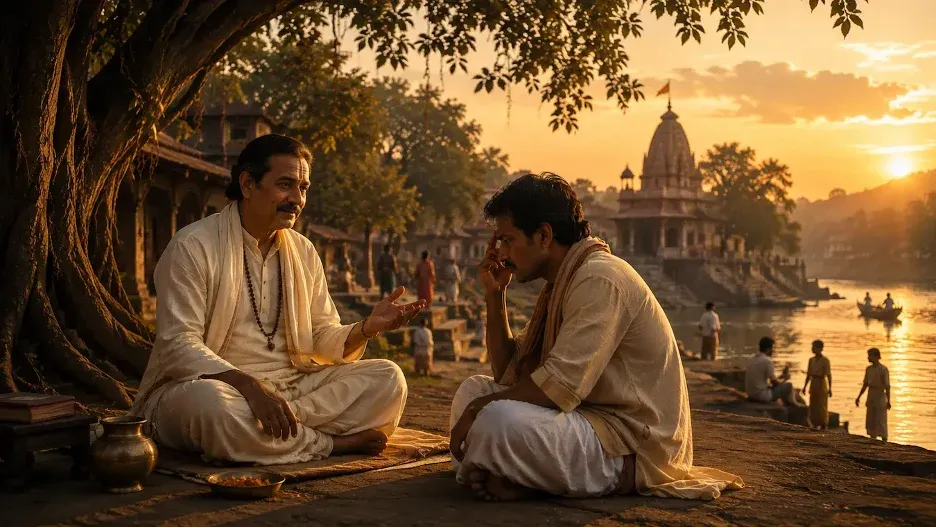
Sant Eknath looked at him and told him something unexpected: he would die in seven days. The man was shaken. Believing the saint could see his future, he returned home to settle his affairs.
Suddenly, the concerns that had occupied so much space in his mind began losing their importance. What did it matter which political group was ahead, or whether a neighbor owned a bigger car? The attachments and worldly preoccupations that had previously seemed so compelling began to fade.
On the seventh day, he returned to Sant Eknath. The saint asked whether he was able to think of God now. The man replied that he had hardly forgotten Him.
What had changed? Not God. Not the man's mind. Not even the external world. His perspective had changed.
The knowledge of life's impermanence had become active in his intellect, and that changed the sentiments arising in his mind.
Swamiji uses this story to explain a principle: the knowledge we keep active in our intellect influences the direction of our thoughts and emotions. When we behave as though life will continue indefinitely, postponement seems harmless. There will always be tomorrow for prayer, tomorrow for reconciliation, tomorrow for beginning sadhana. But when the temporary nature of life becomes real to us, priorities rearrange themselves.
This is why Swamiji also refers to Steve Jobs's practice of asking himself, in essence, what he would prioritize if this were his last day. Its deeper purpose is not merely greater productivity, but overcoming carelessness and postponement.
The lesson is not to live every morning frightened that death may arrive. It is to live awake.
Wisdom Must Become Action
Recognizing the value of time is powerful, but recognition alone does not transform a life.
We may know that health matters and still neglect exercise. We may know that sadhana is important and still tell ourselves we will become regular "once things settle down."
Knowledge has to enter our choices. This resonates with the Bhagavad Gita's emphasis on action. In Bhagavad Gita 3.8, Shree Krishna instructs Arjun to perform his prescribed duties, explaining that action is superior to inaction. Applied to our relationship with time, this principle reminds us that spiritual understanding cannot remain a collection of good intentions. What we understand must gradually become what we practice.
Wisdom changes behavior when we remember it at the moment of choice.

A person may spend years agreeing that time is precious. The real test arrives in ordinary moments: when there are twenty free minutes, when the alarm rings, when the mind asks for another half hour of distraction, or when spiritual practice competes with something easier and more immediately pleasurable. These small decisions are where philosophy becomes life.
Swamiji's teachings on the intellect help explain why. When spiritual knowledge remains active within the intellect, it can guide the mind. When that knowledge becomes dormant, the senses and habits begin deciding our direction for us. The problem, therefore, is not always that we lack knowledge. Often, we fail to keep the right knowledge active when we need it most.
Free Time Reveals What We Value
Modern life has created a strange contradiction. We have extraordinary tools for saving time, yet many people feel that they never have enough of it. A five-minute phone check becomes twenty minutes. One short video leads to another. None of this is the central problem. The deeper issue is unconscious use. If we do not consciously decide what our free time is for, something else will.
That is why a useful modern application of Swamiji's teaching is:
Give your free time a purpose before distraction gives it one.
Purpose does not mean filling every empty minute with work. Time spent exercising can support the body through which we fulfill our responsibilities. Time given wholeheartedly to family can nourish relationships. Sleep restores physical and mental capacity. Sadhana nourishes spiritual growth. Seva directs our abilities toward something beyond ourselves.
Rest and waste are not the same thing. Rest renews us. Distraction often leaves us wanting more distraction.
The relevant question is not whether every minute produced an external result, but the direction our choices are taking us. A person can complete twenty tasks and still neglect what is most important; another may spend an hour quietly in prayer and that hour may be deeply purposeful. Busyness is not proof that time has been well used.
Time Can Become an Offering
There is an even deeper way to understand purposeful time.
If time is God's gift, then our use of time can become part of our offering back to Him.
Sadhana is an obvious expression of this. When we reserve time for meditation, prayer, contemplation, scriptural wisdom, or loving remembrance of God, we are consciously directing the mind toward its highest destination. But spiritualizing time need not stop when formal sadhana ends. The duties of ordinary life can also be approached with a higher consciousness: work performed with sincerity rather than egoistic obsession, family responsibilities as opportunities to practice patience and selflessness, difficult circumstances as occasions to practice tolerance and faith.
The outer activity may look ordinary while the inner orientation changes.
This protects us from a common misunderstanding about spiritual time management: dividing life into "spiritual time" and "everything else," as though our relationship with God belonged only to the minutes we spend in meditation. The deeper aspiration is to gradually bring divine consciousness into the way we use the whole day. Then an hour is no longer valuable merely because we accomplished something. It becomes valuable because of what we became while using it and where it carried our consciousness.
A 7-Day Sacred Time Audit
Before trying to redesign your entire schedule, spend one week simply observing it.
For seven days, record how your time is actually being used. Don't attempt a perfect routine yet, since the purpose of this exercise is awareness.
Use these categories:
1. Spiritual practice: prayer, meditation, scriptural study, contemplation, devotional activities
2. Health and exercise
3. Family and meaningful relationships
4. Meaningful work or study
5. Necessary responsibilities
6. Service and helping others
7. Rest and genuine renewal
8. Unconscious or low-value distraction
Be especially attentive to discretionary time, the periods in which you have some freedom to choose. Notice whether spiritual practice received a conscious place in your day, or whether it was repeatedly left for whatever time happened to remain.
At the end of each day, notice which activities strengthened you and which simply consumed time. At the end of the week, look for patterns. Perhaps the issue is not three hours of obvious waste, but ten minutes here and fifteen there, repeated throughout the day, or your freshest hours going to low-value activity while sadhana waits for when your mind is already exhausted.
Do not condemn yourself for what you discover.
Don't judge the week. Study it.
Then choose one small change.
You might protect fifteen minutes for morning sadhana before looking at your phone. You might reclaim half an hour of habitual scrolling, or create a device-free family meal. One conscious change is more valuable than an elaborate schedule abandoned after three days.
A simple morning remembrance can also help:
"I have been given another day. May I use it well."
And at night:
"How did I use the day I was given?"
These are not exercises in guilt. They are ways of keeping the value of time alive in the intellect.

Key Takeaways
• Time is a gift of God. Its value goes far beyond productivity because it is the medium through which we use the opportunity of human life.
• Human life is spiritually precious. It gives us the capacity to seek wisdom, purify the mind, practice devotion, serve, and move toward God.
• Day and night steadily consume our lifespan. Remembering impermanence can awaken us from carelessness without making us fearful.
• Knowledge must become action. Bhagavad Gita 3.8 reminds us that understanding must express itself through purposeful action.
• Rest is not wasted time. Health, relationships, spiritual practice, service, and genuine renewal can all be meaningful uses of the day.
• Free time carries responsibility. When we do not consciously direct it, distractions can quietly claim it.
• Begin with awareness, not perfection. Observe where your time actually goes and make one meaningful change.
Frequently Asked Questions
1. Why is time so precious in human life?
Time is precious because it is inseparable from life itself. Every passing day uses a portion of our finite human opportunity, one that gives us the capacity for self-reflection, sadhana, devotion, and conscious progress toward God. Swami Mukundananda therefore asks us to consider time a gift of God rather than something to squander carelessly.
2. What does Swami Mukundananda teach about wasting time?
Swamiji teaches that freedom and free time are privileges, and every privilege brings responsibility. He cautions against allowing unnecessary surfing, games, gossip, and similar activities to consume the opportunity we have received. His emphasis is not simply on being more productive, but on using time for our genuine welfare, the welfare of the soul, and the benefit of society.
3. What if I don't even have time for a 7-day audit?
This is often the clearest sign that the audit is needed, though the audit does not need to become another burden. Start with two or three minutes at night, or track only your discretionary time for the first few days. Even a small amount of observation can reveal patterns that are difficult to notice while we are moving through a busy day.
4. Does valuing time mean I should always be productive?
No. Purposeful use of time is broader than constant output. Sleep, exercise, meaningful relationships, and spiritual practice can renew the body and mind and support a balanced life. The more useful distinction is between activities that serve a meaningful purpose and unconscious distractions that consume time without leaving us rested, strengthened, or spiritually enriched.
5. How can spirituality help me use my time wisely?
Spiritual wisdom clarifies what life is ultimately for. When the intellect remembers that life is temporary and the human form is a precious opportunity, priorities begin to change. Instead of merely asking how to fit more into the day, we begin learning how to direct the day toward what truly matters.
Further Resources