

From the Editor’s Desk
Seva or selfless service is the purest expression of devotion. It is not merely an external activity, but an inner attitude that transforms every moment into worship. When the heart is filled with love for the Divine, it naturally seeks an outlet, and that outlet is seva. Through seva, the body, mind, and soul align in harmony to express gratitude to God/Guru. In this sense, true selfless seva aligns one’s actions with higher ideals.
In this issue of JKYog’s E-Journal, Samarpan, we dive deeper into the essence of spiritual seva by utilizing the Vedic knowledge (i.e., tattva jnana) taught by Swami Mukundananda ji. We delve into how spiritual seva shifts our perspective from “helping” to “serving” to “receiving.” The more we learn to serve selflessly, the more we discover the joy of living in harmony with the Divine will.
Vedic Wisdom & Application
Theme of the Month
Awakening the Inner Self through Spiritual Seva
Reflection Questions
- What is the Value of Spiritual Seva?
- How does the Inner Journey of Seva Help Souls to Evolve?
- What Should be the Attitude or Bhav of True Sevaks?
- What are the Options for Seva in JKYog?
Seva, or selfless service, has always been the lifeblood of the bhakti tradition. At first glance, seva may resemble philanthropy, for both involve giving time, resources, and energy to others. Yet, on a deeper plane, seva in the bhakti philosophy is far more than altruism or humanitarian aid. Philanthropy often seeks to alleviate suffering or uplift society, worthy goals in themselves, but seva transcends these aims. Seva is the living expression of bhakti. When one serves with the singular intention of pleasing God, without any expectation of reward or recognition, such service purifies the heart and awakens the inner self.
What is the Value of Spiritual Seva?
Vedic scriptures explain that devotion transforms into ultimate submission, and this manifests as a life dedicated to spiritual service. Saints have described it as devotion in action, where love ceases to remain a feeling confined to the heart and becomes a living, breathing reality. In his commentary on the Ishavasya Upanishad, Swamiji explained that devotion matures into surrender, and surrender finds expression in seva. The devotee no longer regards the body, mind, or wealth as personal possessions, but as sacred instruments for God’s work.
वायुरनिलममृतमथेदं भस्मान्तꣳ शरीरम् ।
ॐ क्रतो स्मर कृतꣳ स्मर क्रतो स्मर कृतꣳ स्मर ॥ १७॥
vāyuranilamamṛitamathedaṁ bhasmāntaṁ śharīram
oṁ krato smara kṛitaṁ smara krato smara kṛitaṁ smara
May my prana now merge into my Pranadhar, Who is the Bestower of nectar-like sweetness. May this body burn in the fire of devotion and become holy ash. Om! O Enjoyer of my bhakti yajna! To You, I dedicate all my devotional efforts. Please remember me (grace me), Your devotee. I offer my all to you. Please remember to consummate my deepest aspiration (Ishavasya Upanishad, pp. 154).
Swamiji explained the essence of devotion to be sacrifice, samarpan, or surrender of the soul. This involves not just chanting God’s name but engaging the entire being in a devotional offering for the Creator. The beautiful story of Hanuman ji’s advice to Vibhishan illustrates this point, that it is not sufficient to chant Lord Ram's name without doing His seva, because true devotion lies in selfless service.

The Narad Bhakti Darshan also resonates with this insight that seva is the spontaneous outcome of love. Just as a mother tirelessly serves her child in the joy of giving, the devotee serves the Lord out of pure affection with no desire for reciprocation. This dimension of seva is not limited to great saints or rare souls, but to every spiritual aspirant.
Spiritual seva is not confined to grand acts. The smallest deed, when performed with a spirit of devotion, becomes luminous with divine grace. A flower offered in love is greater than riches given with pride. What matters is not the magnitude of the act but the purity of intention behind it. Such seva can take countless forms – acts that connect others to the Divine through teaching, writing, creating, designing, organizing, singing, feeding, comforting, or even simply smiling at another soul with kindness. The form may differ, but the essence is the same; it is an offering at the lotus feet of God/Guru.
Seva is also deeply transformative. In serving without selfish desire, the heart gradually cleanses itself of ego and worldly attachment. It teaches humility, dissolves pride, and reminds us that all the skills and abilities we possess belong to God. We become instruments through which the joy and love flow. In this way, seva purifies the heart, strengthens devotion, and awakens inner joy through a series of practical experiences, repeated contemplation, and divine graces for the effort to serve.
How does the Inner Journey of Seva Help Souls to Evolve?
Seva, under the expert guidance of a true Guru, enables souls to evolve in their perspective and attitude – from one of helping others to serving God to being blessed with the opportunity to serve God/Guru.
-
Helping – The Ego-Centered Beginning
The path of seva also confronts us with the subtle working of the ego. One may engage in seva externally, yet internally harbor pride, attachment, or expectation of recognition. When the ego contaminates service, the act may still benefit others, but it ceases to nourish the soul of the doer.
Many devotees first approach seva with the mindset of “helping.” The intention is noble, for example, serving food at a temple, participating in community clean-up, or contributing to a temple’s devotional events. Yet subtly, the ego lingers: I am the one who gives. Others are the receivers. This creates an unspoken hierarchy between the doer and the beneficiary. Helping alleviates external needs, but it often leaves the inner self untouched, because the sense of I remains intact. For example, a volunteer may feel satisfied thinking, “I helped to clean up the community park on Earth Day,” but the subtle thought persists: “They needed me, I did something important.”

2. Serving – The Bhakti-Centered Shift
Through satsang, scriptural study, and guidance of a true Guru, the devotee realizes that seva is not about self-importance, but self-offering. The focus shifts from I am not helping others but I am serving God who resides in them. Seva becomes an act of worship, a way of adorning the altar of the Lord with the flowers of one’s actions. The actions remain the same (e.g., cooking, cleaning, organizing, etc.), but the consciousness transforms. The ego softens and humility deepens. For example, a devotee who prepares Bhog (to be savored as Prasad) no longer thinks, “I am feeding people,” but instead, “I am offering food to the Lord, who will bless it and nourish His children.”
Consider another example of two youth volunteers at a local temple. Initially, their motivation was to accumulate hours for a college résumé. They diligently engaged in seva, yet their hearts remained untouched. Gradually, through satsang and reflection, they came to perceive the value of seva as a privilege rather than an obligation. During different seva experiences, they each had an epiphany of how their actions were in service to God. Following their inner realization, each one’s quality of service transformed. What began as a résumé-building activity blossomed into devotion with a humble heart and no form to record seva hours.

3. Receiving – Understanding the Divine Secret of Seva
Over time, and again, under the guidance of a true Guru, the devotee makes a knowledge-based discovery of the greatest paradox of seva: the more one gives, the more one receives. What is received is not material, like praise, recognition, or worldly benefit, but divine, like peace, joy, humility, and an inner realization of the relationship between the sevak (spiritual aspirant) and Sevya (the Lord). It is in the belief that in serving, the heart is served, and in offering, the soul is uplifted. Swamiji emphasizes in His talks that seva is not a loss of time or energy, but the highest investment in spiritual growth. Through seva, the devotee receives God’s grace in abundance.
One moving example from a JKYog volunteer captures this transformation. A devotee initially joined seva activities with the thought of “helping” at festivals by arranging shoes, distributing prasad, and setting up chairs in the hall. Over time, under Swamiji’s guidance, the person realized these actions were not “helping the temple" but opportunities to purify the heart by serving God. The same tasks, once performed with fatigue and complaint, became filled with joy when seen as offerings at Shree Radha Krishna’s Lotus Feet. The shift in perception awakened an inner sweetness and sense of connection that was never previously experienced.
Similarly, another volunteer who thought that seva was a way to get people to contribute their time and money is now grateful for the opportunities to serve God/Guru. This inner transformation would not have been possible without the grace of comprehension of true knowledge and recognition of the graces bestowed by the Guru.
Thus, we see how seva evolves from helping (i.e., ego-centered giving) to serving (i.e., devotion-centered offering) to receiving (i.e., grace-centered awakening). Each stage is not discarded but deepened, until the devotee realizes that seva was never about what they gave; it was always about what they received from God.
What Should be the Attitude or Bhav of True Sevaks?
In His lecture on Mantra 17 of the Ishavasya Upanishad, Swamiji has beautifully explained that true seva is a birthright (i.e., dayabhak) of the soul. True and selfless sevaks should aspire to dedicate every act at God’s divine altar to consecrate each act for His pleasure, and in doing so, may the whole body burn to ashes in the fire of devotion. Such an elevated state can only be attained by developing an attitude or seva bhav that transports an ordinary soul to the height of selfless devotion. Swamiji expands on the principles.
- All seva should be done for the pleasure of the Sevya (God) and not for one’s own sake. This is very difficult to achieve due to our material conditioning and tendency for self-serving needs since endless lifetimes.
- All seva should be free of even the subtlest desire for reciprocation from God/Guru or fellow devotees. When one claims to engage in selfless seva, but expects reciprocation in some form or the other, then the expectation violates the principle of selflessness and is more in the nature of a tradeoff or a business transaction.
- True selfless seva builds on the internal belief and conviction that a worldly soul has nothing worthy to offer God/Guru in seva. Everything we possess is material in nature, whereas God/Guru is a divine entity. The only thing He values is the loving devotion with which a sevak makes an offering.
- Selfless seva is about remembering that God is Sarva Samarth (i.e., omnipotent) and Satya Sankalp (i.e., possessor of anything by wishing for it, yet free of personal desires). In other words, He does not need anything from us. He presents us with opportunities to serve Him as a blessing. Thus, we must believe that by engaging in any seva, we are the recipients of His divine grace – an opportunity to purify the true self (soul) by dedicating our actions to the all-pure object of loving devotion.
- The pinnacle of seva bhav, even when performing ongoing service, is to believe that we still are unprofitable servants of God/Guru. Having received countless divine graces, we have offered nothing in comparison. We could have given or done a whole lot more than the present state.

True selfless seva requires not only doing but being. It is about shaping one’s inner disposition. It demands humility, surrender, and the willingness to erase one’s sense of self-importance. The Ishavasya Upanishad concludes with a prayer (Mantra 18) that the devotee may discard all selfishness and be embraced by the effulgence of the Divine. Seva, in this light, is not merely an activity but a practice of dissolving the ego into God’s will. The Narad Bhakti Darshan also urges spiritual aspirants to cultivate ahaitu ki bhakti or love without motive. God/Guru, being infinitely compassionate and kind, accepts whatever is offered in seva as long as it is grounded in loving devotion. As Shree Krishna told Arjun:
यत्करोषि यदश्नासि यज्जुहोषि ददासि यत् |
यत्तपस्यसि कौन्तेय तत्कुरुष्व मदर्पणम् || 27||
yat karoshi yad ashnasi yaj juhoshi dadasi yat
yat tapasyasi kaunteya tat kurushva mad-arpanam
Whatever you do, whatever you eat, whatever you offer as oblation to the sacred fire, whatever you bestow as a gift, and whatever austerities you perform, O son of Kunti, do them as an offering to Me (Bhagavad Gita, 9.27).
When seva is performed with this consciousness, even the smallest act becomes divine worship. A smile offered to a stranger, food prepared for the community, or an Aarti offering at a temple – each is sanctified when performed for the Lord’s pleasure. A beautiful example of this sentiment is expressed in the Shiv Manas Pooja authored by Jagadguru Adi Shankaracharya, where each thought and action is an offering to God.
What are the Options for Seva in JKYog?
Every soul has unique talents and resources. Seva does not demand uniformity but encourages each devotee to channel their gifts for God/Guru’s service. JKYog offers many opportunities to serve God/Guru.
The key lies not in the magnitude of the gift, but in the spirit of its offering. We are reminded of the beautiful message of Shree Krishna to Arjun:
पत्रं पुष्पं फलं तोयं यो मे भक्त्या प्रयच्छति |
तदहं भक्त्युपहृतमश्नामि प्रयतात्मन: || 26||
patram pushpam phalam toyam yo me bhaktya prayachchhati
tadaham bhaktyupahritam ashnami prayatatmanah
If one offers to Me with devotion a leaf, a flower, a fruit, or even water, I delightfully partake of that item offered with love by My devotee in pure consciousness (Bhagavad Gita, 9.26).
What God values is the love behind the act, not its material scale. A devotee once asked Swamiji whether their small contribution mattered when others gave a lot more. Swamiji gently explained that God measures devotion, not quantity. Just as the tiny squirrel received Shree Ram’s loving caress for rolling in sand during the bridge-building activity, so too every act of seva, however small, is cherished by God/Guru when offered in love.
Seva is paradoxical in its fruit; the more we give, the more we awaken and discover our inner strength, joy, and humility. In this spirit, every moment of life can be spiritualized. In awakening the inner self through selfless service, the devotee tastes the sweetness of divine love in every breath, every step, and every action.

Conclusion
Seva in the bhakti path is not a side practice but the crown of devotion. It bridges the gap between inner love and outer expression, between contemplation and action. All Vedic scriptures converge on the truth that seva is the natural blossoming of bhakti.

Tools for Your Personal Growth
Where are you in your attitude toward seva or seva bhav? Use this tool to assess yourself. A downloadable tracking sheet is available for you to use.
If you need to speak with anyone about this topic or your practice, please feel free to contact us at mailto:[email protected]. Please also give us some time to respond. Thank you.

Gems of Wisdom from Swamiji
Here are a few YouTube video titles with related links and books where Swamiji has described the construct of seva bhav in relation to the purpose of our lives.
- The Soul’s True Purpose Beyond Death – Seva, The Secret to a Meaningful Life (Ishavasya Upanishad, Part 19, Mantra 17)
- Seeking Selfless Love for God | Bhakti Lectures
- Mukundananda, S. (2025). Ishavasya Upanishad. Rupa Publications Pvt Ltd: New Delhi, India.
- Mukundananda, S. (2024). Spiritual Secrets from Hinduism: Essence of the Vedic Scriptures. Rupa Publications Pvt Ltd: New Delhi, India.
- Mukundananda, S. (2022). Bhagavad Gita – The Song of God, Westland Publications: Chennai, India.

Hold Your Breath! Check out Upcoming Events
We are very excited to share two amazing events with you!
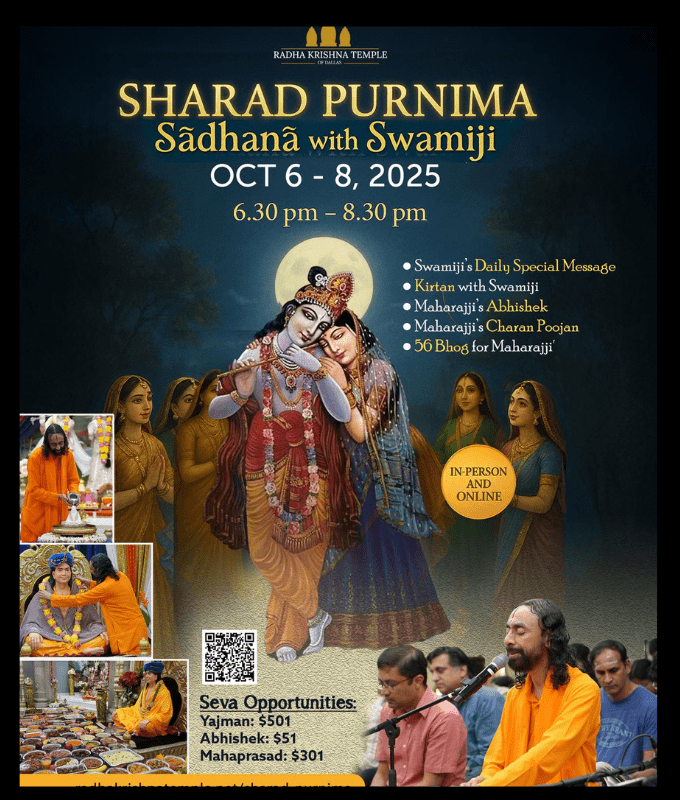
Sharad Purnima Sadhana with Swamiji
JKYog devotees know that Jagadguruttam Shree Kripalu ji Maharaj, the 5th original Jagadguru of Indian history, descended on this planet on Sharad Purnima in 1922. For us, this day is a celebration of eternal love and infinite bliss, embodied by both the descension of Shree Maharajji and the Gopis of Braj, who participated in the Maha-Raas with Shree Radha Krishna on this night.
As per the tenth canto of the Bhagwatam, the one night of the Maha-Raas was divinely extended by Shree Krishna to last for a duration equivalent to one night of Brahma ji, i.e., one Kalpa, a Hindu unit of time that is approximately 4.32 billion human years. This blessing allowed the Gopis to experience the dance of divine love bliss with Shree Krishna for what seemed like (from our perspective) an immeasurably long time. The powerful experience transcended the perception of time, even for the Gopis.
These contextual events make Sharad Purnima very special for us. We are blessed that Swamiji will grace us with his presence on this occasion.
- Date: October 6 – 8, 2025 – 6:30 to 8:30 PM CDT
- Website: https://www.radhakrishnatemple.net/sharad-purnima
Here are the highlights of the 3-day Sadhana:
- Daily Special Message by Swamiji
- Daily Kirtan with Swamiji
- Shree Maharajji’s Abhishek (October 6th)
- Shree Maharajji’s Charan Poojan (October 6th)
- 56 Bhog for Shree Maharajji (October 8th)
We invite you to join us on this auspicious and free event to rejoice collectively.
JKYog’s Bhakti Kirtan Retreat with Swamiji
We are extremely blessed to have the opportunity to partake in the devotional bliss of the Bhakti Kirtan Retreat with Swamiji. Held at the exquisitely beautiful Radha Krishna Temple of Dallas (Allen), we have the most wonderful opportunity to soak in the bliss of Swamiji’s Pad Vyakhyas filled with divine knowledge and sweet ras for three days.
Swamiji invites you to take advantage of this incredible opportunity to purify your heart and accumulate spiritual treasures that will stay with you eternally. Register now, if not done already.
- Dates: October 24 to 26, 2025 (7:00 AM to 9:00 PM; ends at 1:00 PM on 26th)
- Venue: 1450 N Watters Rd, Allen, TX 75013
- Details: https://www.radhakrishnatemple.net/bhakti-kirtan-retreat


JKYog Transforming Communities
Here, we share evidence of amazing activities and news about the programs and initiatives of JKYog and its various U.S. centers.
Swami Mukundananda’s Path Of Bhakti YouTube Channel

Swamiji's Path Of Bhakti YouTube Channel is dedicated to sharing timeless wisdom on the path of devotion. Through discourses on the Bhagavad Gita, Shrimad Bhagavatam, Shree Krishna Leelas, stories of saints, and practical guidance to improve the quality of devotion and spiritual practice, the channel helps seekers strengthen their faith, deepen their love for God, and apply bhakti principles in daily life.
Significance
In a world filled with material distractions, this channel offers clarity and direction. Swamiji presents profound scriptural truths in a way that is relatable and practical, bridging the gap between timeless scriptural teachings and their applicability to modern living. By emphasizing both relevant scriptural knowledge and heartfelt devotion, the channel serves as a highly valued tool for simultaneously nurturing spiritual growth and inspiring the intellect.
Impact on Listeners
Tens of thousands of viewers worldwide find solace, strength, and inspiration through these lectures. Many viewers testify to experiencing greater peace of mind, stronger faith in God, and a renewed commitment to living with devotion. For those unable to attend Satsangs in person, the channel serves as a virtual spiritual community, guiding seekers steadily on their journey of bhakti.
Subscribe to The Path of Bhakti and be uplifted daily with Swamiji’s wisdom on devotion and divine love.

JKYog’s Bhagavad Gita Krishna Bhakti App
JKYog’s Bhagavad Gita Krishna Bhakti App provides users with a comprehensive set of features for spiritual guidance, devotion, and learning, all based on the teachings of the Bhagavad Gita and Swami Mukundananda.
This month, we share the most precious tool – the Bhagavad Gita scripture, encapsulated within this app.
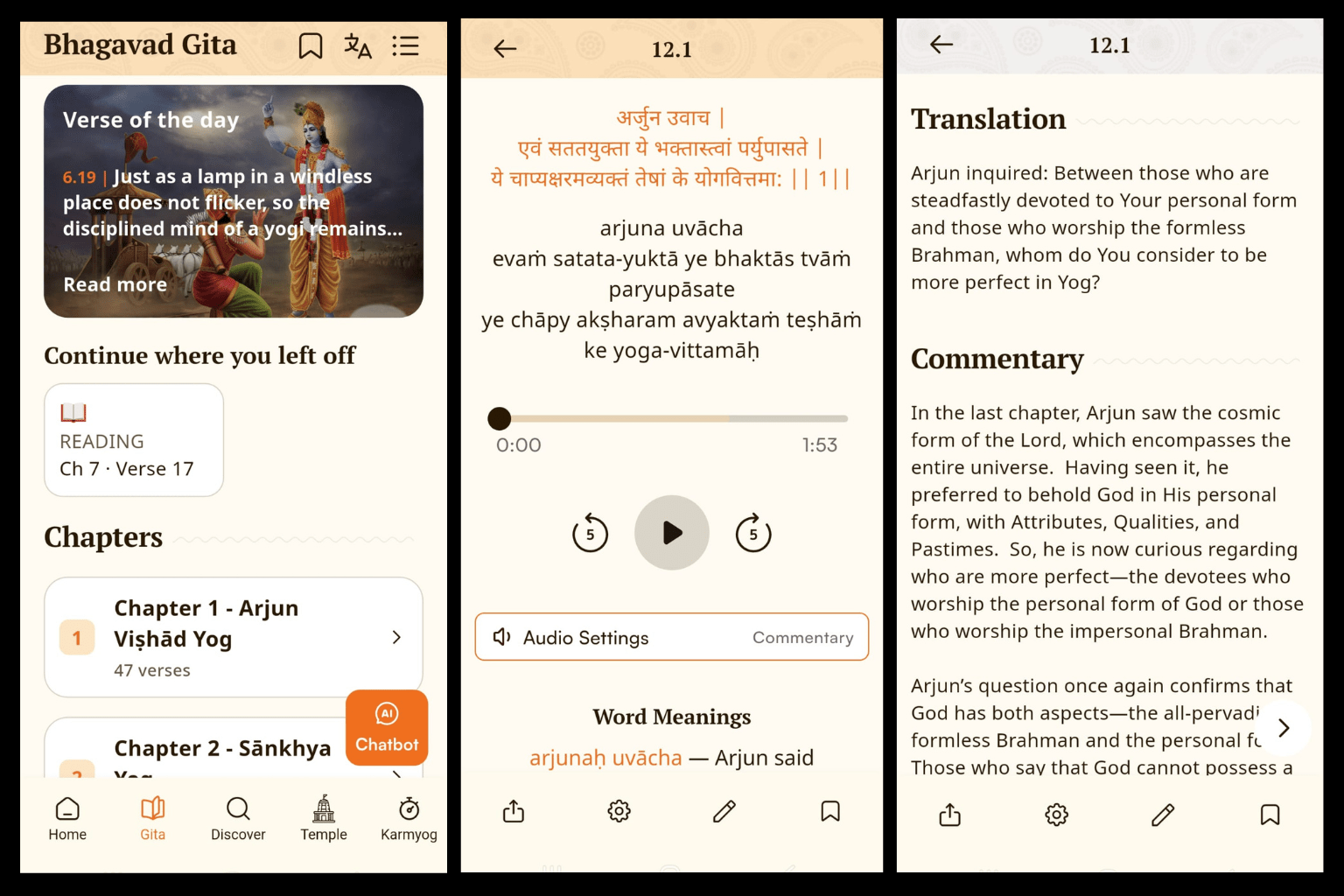
The Bhagavad Gita at Your Fingertips
The Bhagavad Gita Krishna Bhakti App has become a powerful medium for spiritual seekers worldwide by bringing the timeless wisdom of the Bhagavad Gita into daily life.
From the daily “Verse of the Day” to the bookmarked last chapter verse reading, the app houses all 700 verses, complete with transliteration, word-by-word meaning, and translations in multiple languages. Swamiji’s illuminating commentary, available in both text and audio, makes the scripture accessible and deeply relevant to modern challenges.
Here are the features that set this free app apart:
- It has a unique blend of simultaneous access to both audio and visual commentary. This dual approach strengthens retention, enabling seekers not only to understand but also to internalize and apply the wisdom as practical guidance for daily living.
- With its portable, user-friendly design, seekers can immerse themselves in the divine message anywhere, anytime – transforming commutes, quiet moments, or leisure into opportunities for inner growth.
For readers and listeners alike, this app is proving to be a life-changing companion on the path of self-purification and Krishna bhakti.
If you have not already downloaded the app, do it now!
Download the App: https://www.jkyog.org/radha-krishna-bhakti-app