
From the Editor’s Desk
Life seems to move swiftly, carrying us through responsibilities, aspirations, and routines with the quiet assumption that there will always be more time. Yet the Vedic scriptures gently remind us that human life is both precious and temporary. Such reflection is not meant to create fear, but to awaken inner awareness and inspire us to live with greater purpose.
Human birth is a rare opportunity to realize our true nature and deepen our eternal relationship with God. Utilizing Vedic knowledge (i.e., tattva jnana) taught by Swami Mukundananda ji, in this issue of JKYog’s E-Journal, Samarpan, we explore the urgency of this life and how to make the most of it before it slips away.

Vedic Wisdom & Application
Challenge of the Month
Before Life Slips Away: Remembering What Truly Matters
Reflection Questions
- Why Do We Ignore Life’s Subtle Warnings?
- What Truly Accompanies the Soul at the End of Life?
- How Does Vedic Wisdom Transform Our Perspective?
- How Can We Make the Most of Life Before It Slips Away?

Human life often moves forward with the quiet assumption that there will always be more time. Responsibilities, ambitions, and relationships take center stage, while spiritual growth is gently deferred to a later stage. Yet the scriptures caution that this assumption itself is the greatest illusion. Life is uncertain, and its end can arrive without notice.
Plans extend into the future, attachments deepen, and the present moment is easily overlooked. Beneath this sense of continuity lies a subtler truth: life does not unfold on our terms, and its course remains uncertain. The sages recognized that when this truth is ignored, life is lived mechanically; when it is acknowledged, it becomes purposeful.
The wise cultivate an awareness that is both simple and profound; the remembrance that life is temporary. This awareness is not meant to create fear, but to awaken clarity. When we recognize that each passing day brings us closer to life’s inevitable conclusion, we begin to value time differently. Moments are no longer taken for granted or spent carelessly, but seen as precious opportunities for inner growth, devotion, and self-realization.
In this light, we begin to understand that the purpose of human existence is not merely to live and achieve, but to realize our eternal relationship with God. When this understanding is combined with an awareness of life’s fleeting nature, it creates a natural urgency. This urgency is not restless or anxious; it is purposeful and serene, guiding us to make meaningful use of the present before the opportunity quietly passes.
Why Do We Ignore Life’s Subtle Warnings?
Human beings do not lack intelligence, yet they often lack awareness. The signs of impermanence are ever-present. The body changes, time moves quietly yet swiftly, and circumstances shift without notice. Still, the mind resists pausing to reflect on what these signs are gently indicating.

This resistance is not without cause. It arises from a deep identification with the temporary. The Vedas describe this condition as being under the influence of Maya, an illusion that makes the fleeting appear lasting. Under its influence, the mind becomes absorbed in worldly things, for example, routines, ambitions, relationships, and distractions, postponing deeper reflection for a later time that seldom arrives.
Swamiji illustrates this tendency through the story of a man who once asked Yamraj to warn him before his final moment. When that moment came, the man complained that no warning had been given. Yamraj reminded him of the signs he had already received, i.e., greying hair, weakening senses, and the gradual decline of the body. Each was a gentle signal inviting awareness, yet each had been overlooked.
Shree Krishna explained this point to Arjun when educating him about the core philosophy of existence, enabling him to transcend the dualities of life:
नास्ति बुद्धिरयुक्तस्य न चायुक्तस्य भावना |
न चाभावयत: शान्तिरशान्तस्य कुत: सुखम् || 66||
nasti buddhir-ayuktasya na chayuktasya bhavana
na chabhavayatah shantir ashantasya kutah sukham
But an undisciplined person, who has not controlled the mind and senses, can neither have a resolute intellect nor steady contemplation on God. For one who never unites the mind with God there is no peace; and how can one who lacks peace be happy? (Bhagavad Gita, 2.66)
Swamiji beautifully illumines this concept by explaining that one who fails to master their internal impulses and thoughts will struggle to connect with the divine or find true spiritual joy. It is impossible to let go of physical cravings without first experiencing a more fulfilling spiritual satisfaction. Lacking that deeper peace, a person remains trapped by worldly desires, much like a honeybee that cannot pull itself away from the sweetness of a flower.
Worldly attachment further deepens the avoidance of reflecting on the temporary nature of this life. The more one’s identity becomes tied to possessions, roles, and relationships, the more difficult it becomes to acknowledge their changing nature. This rare human life is often spent in pursuits that do not endure, while the deeper purpose remains unattended.
Beneath all this lies a subtle unease. To recognize life’s finite nature is to accept that control is limited. The ego resists this realization, preferring distraction over introspection and movement over stillness.
Yet when this resistance begins to soften, a quiet transformation takes place. Awareness of life’s impermanence does not diminish enthusiasm for living; it refines it. It brings clarity to our choices, depth to our actions, and sincerity to our spiritual efforts. What was once postponed begins to feel essential, and the present moment reveals itself as far more valuable than before.

What Truly Accompanies the Soul at the End of Life?
From this reflection, a deeper question naturally arises. When everything external is subject to being left behind when we, the souls, transmigrate to the next life, what truly remains with us?
Vedic wisdom offers a clear and introspective answer. The physical body, formed of the five elements, returns to nature. Yet the conscious self, the soul, continues its journey. It does not travel alone, nor does it carry the possessions that were carefully accumulated over a lifetime. Instead, it moves forward accompanied by the subtle desires and aspirations of its inner life. Shree Krishna explained this concept to Arjun:
शरीरं यदवाप्नोति यच्चाप्युत्क्रामतीश्वर: |
गृहीत्वैतानि संयाति वायुर्गन्धानिवाशयात् || 8||
shariram yad avapnoti yach chapy utkramatishvarah
grihitvaitani sanyati vayur gandhan ivashayat
As the air carries fragrance from place to place, so does the embodied soul carry the mind and senses with it, when it leaves an old body and enters a new one (Bhagavad Gita 15.8).
Just as the breeze that carries the fragrance of the flowers is unseen yet unmistakable, the impressions we cultivate quietly shape what continues beyond this life. These impressions, known as sanskars, include our thoughts, desires, habits, and emotional tendencies. Together, they form the subtle and causal bodies of the senses, mind, intellect, and ego, which accompany the soul onward.

Swamiji emphasizes that while material wealth is left behind, spiritual treasures endure. Devotion, faith, knowledge, and remembrance of God become the true assets of the soul. In contrast, everything external gradually loses relevance at the final threshold.
This truth becomes especially clear in moments of sudden loss, when people realize how little of what they possess truly belongs to them. What once seemed indispensable quickly fades in importance, offering a glimpse into a deeper reality that is otherwise easy to overlook.
The story of Yamraj further brings this understanding into focus. When the man, having overlooked all prior warnings, finally recognized that Yamraj had come for him, he attempted to offer his wealth in exchange for more time. The gesture, though desperate, revealed a fundamental misunderstanding. That which had occupied his entire life could not serve him when it mattered most.
The scriptures go a step further in explaining that the final moment is not separate from the rest of life; it reflects it. The mind naturally turns toward what it has attached to or practiced for life. If it has been absorbed in one’s family, financial worries, people who hurt them, or any other, it returns to them. If it has been trained in divine remembrance, it turns toward God/Guru with ease. When this truth is deeply contemplated, it quietly reshapes our priorities. The focus of life shifts from accumulation to inner cultivation. The awareness that only the state of our consciousness travels forward when the soul transmigrates brings clarity to how we think, act, and live.
Seen in this light, life is no longer merely something to be lived, but something to be prepared with awareness. Each moment becomes an opportunity to refine the inner self that continues beyond it.
How Does Vedic Wisdom Transform Our Perspective?
When the continuity of the soul is understood, a quiet shift begins to take place. Life is no longer seen merely in terms of the body and its experiences, but in relation to the conscious self that exists beyond them. Shree Krishna explains to Arjun why he must not think of himself as the doer or slayer of enemies but remember the eternality of the soul, that takes on new forms in each life based on one’s karmas.
वासांसि जीर्णानि यथा विहायनवानि गृह्णाति नरोऽपराणि |
तथा शरीराणि विहाय जीर्णान्यन्यानि संयाति नवानि देही || 22||
vasansi jirnani yatha vihaya
navani grihnati naro ’parani
tatha sharirani vihaya jirnanya
nyani sanyati navani dehi
As a person sheds worn-out garments and wears new ones, likewise, at the time of death, the soul casts off its worn-out body and enters a new one (Bhagavad Gita 2.2).
Through this lens, the body is understood as a temporary covering, necessary for a time, but not central to one’s true identity. What we often fear is not the loss of existence, but the loss of what is familiar. This insight softens that fear and replaces it with understanding.
Similarly, the fear of death or abhinivesh is grounded in the desire for eternality, because we are tiny fragments of the Eternal Supreme Lord. Swamiji beautifully explains in His commentary on the Ishavasya Upanishad’s Mantra 2, that jijiviṣha or aspiration to live should be a source of inspiration. Instead of desiring life due to a fear of death or a lack of detachment from the material world, souls must aspire to live for a hundred years, to utilize the rare human form as an opportunity to serve God. By renouncing material desires for self-gratification, this verse underscores the importance of engaging in work to please God, without attachment to the action or its outcome.
This is possible when we practice karm yog (Bhagavad Gita 18.17). When actions are free from the pride of doership and performed as a service to God, then devotees renounce the desire for outcomes as well. By shifting the motivation from personal gain to divine service, with divine grace, we become capable of breaking the shackles of karmic bondage.
This perspective deepens the vision further by declaring that the soul is eternal. It is not subject to coming into being or passing away. As this truth begins to settle within, the changing nature of life is seen with greater balance. This understanding will gradually transform our priorities. When we recognize that our time in this body is limited, we will value it differently. The focus shifts from accumulation to inner refinement, from external validation to spiritual alignment.
This is the difference when the vision is transformed. As Shree Krishna beautifully explains (Bhagavad Gita, 2.69), what appears as day to the ignorant is night to the wise, and what appears as night becomes their day. In other words, the mundane things that most people pursue lose their urgency for the wise, while what was once neglected becomes deeply meaningful.
This transformation does not distance us from life. Rather, it deepens our engagement. Actions become guided by one’s spiritual instead of material dharma, relationships become expressions of care rather than possession, and challenges are approached as opportunities for growth. The awareness that life is passing does not diminish participation; it brings sincerity, focus, and depth to it.

In this way, Vedic wisdom refines how we live within it.
How Can We Make the Most of Life Before It Slips Away?
With this understanding of life’s transience and the soul’s onward journey, the question naturally becomes practical. How, then, should we live?
The Vedic scriptures place great significance on the final moment of life, not because it stands apart, but because it reflects the tendencies cultivated throughout. The Vedic Scriptures explain that whatever one remembers at that time determines one's next life. This remembrance is not a sudden effort, but the natural expression of lifelong practice. Swamiji emphasizes that the key lies in how we live each day. The remembrance of life’s end becomes meaningful only when it inspires remembrance of God. When the mind is trained to turn toward the Divine regularly, it does so naturally when it matters most.
This begins with simple yet sincere practices.
- Daily reflection helps us remain aware of how we are using our time. Moments of prayer, chanting, and meditation gradually purify the mind. Over time, these impressions shape our inner tendencies.
- Life itself offers constant reminders. The passing of time, changes in the body, and the uncertainties we encounter can all serve as signs (संकेत), gently drawing our attention inward. When received with awareness, they become a support on the path rather than sources of discomfort.
- Live in the world with a sense of sacredness while remaining inwardly detached. This balance allows for full participation in life without becoming bound by it.
- The true measure of life is not how much we accumulate, but how deeply we remain connected. As Chanakya Pandit emphasized, “That moment is the greatest loss in which one does not remember God.”
When life is lived in this way, each day becomes meaningful. Awareness deepens, priorities become clearer, and the mind becomes naturally inclined toward the Divine. What awaits at the end is not unfamiliar, but a continuation of a connection already cultivated.

Tools for Your Personal Growth & Application
Here is a simple, reflective tool to live with awareness and intention while we have this grace-filled opportunity in life. A downloadable file is available for you to use.
Gems of Wisdom from Swamiji & Application
Here are a few YouTube video titles with related links and books where Swamiji has described the value of this human life and how to live a purposeful life before it slips away.
Watch this video to learn the depth of this concept from Swamiji
- Where Your Mind Dwells at Death (Short)
- Death's Wake Up Call: The Lesson He Learned (Short)
- Mukundananda, S. (2025). Ishavasya Upanishad. Rupa Publications Pvt Ltd: New Delhi, India.
- Mukundananda, S. (2024). Nourish Your Soul: Inspirations from and Lives of Great Saints. Rupa Publications Pvt Ltd: New Delhi, India.
- Mukundananda, S. (2022). Bhagavad Gita – The Song of God, Westland Publications: Chennai, India.

Hold Your Breath! Check out Upcoming Events & Application
This month, we present the most sought-after program with opportunities to establish a personal connection with Swamiji.
Life Transformation Programs: The Gateway to True Inner Transformation
Unlock your full potential with Swamiji’s LTP in June 2026. This multi-city tour continues across the US. These in-person programs offer a unique opportunity to learn the art and science of managing the mind and mastering mindsets for happiness and fulfillment. Learn the joys of pure scriptural knowledge to increase your devotion and application of scriptural principles.
June 2026 LTP-US Tour Schedule:
-
New York, NY: May 30 to June 2
- Focus: Bhagavad Gita for Everyday Living
- Register: jkyog.org/NY
-
Connecticut LTP: June 3 – June 6, 2026
-
Focus: Mindsets for Happiness & Fulfillment
-
Register: https://www.jkyog.org/events/CT
-
-
New Jersey LTP: June 7 – June 11, 2026
-
Focus: Mindsets for Happiness & Fulfillment
-
Register: https://www.jkyog.org/events/NJ
-
-
Virginia LTP: June 12 – June 18, 2026
-
Focus: Mindsets for Happiness & Fulfillment
-
Register: https://www.jkyog.org/events/VA
-
-
Florida LTP: June 22 – June 25, 2026
-
Focus: Mindsets for Happiness & Fulfillment
-
Register: https://www.jkyog.org/events/FL
-
-
Philadelphia LTP: June 26 – June 30, 2026
-
Focus: Inspiring Stories from Saints
-
Register: https://www.jkyog.org/events/PA
-
Note: Registration is mandatory for these free events. Secure your spot early via the links above or through the Swami Mukundananda App.

JKYog Transforming Communities
In this feature, we highlight the transformative programs and initiatives of JKYog. This month, we provide some information on a truly transformational course.
My Daily Sadhana: The Pathway to Inner Transformation
My Daily Sadhana is a structured online platform developed by Swami Mukundananda ji, and is now presented in a brand new and attractive portal. It offers a 29-module course, with 229 lessons covering Vedic philosophy and principles of the path of karma, jnana, and bhakti.
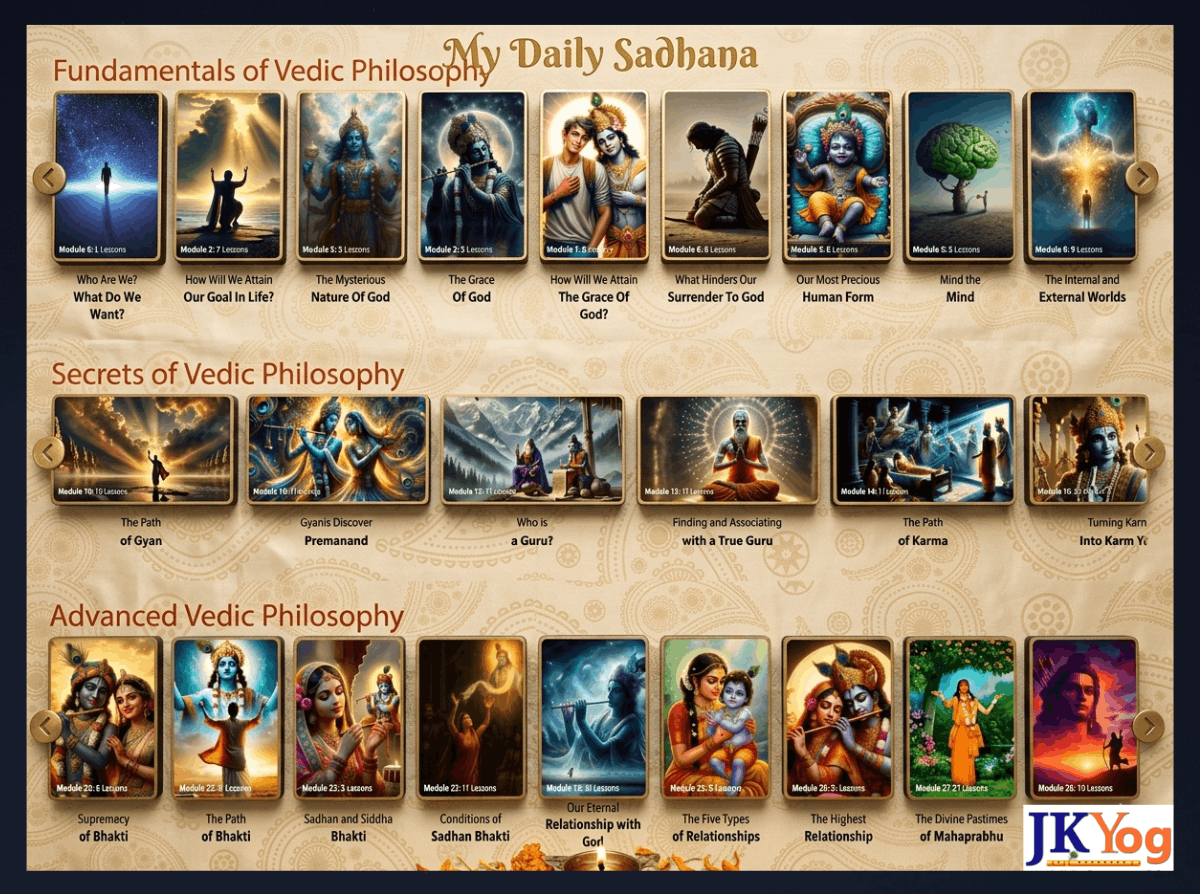
The course is divided into three curriculum levels: (1) Fundamentals of Vedic Philosophy, (2) Secrets of Vedic Philosophy, and (3) Advanced Vedic Philosophy, each containing increasingly more complex spiritual concepts. The program emphasizes internal transformation through the practical approach of Shravan, Manan, and Nididhyasan.
The course is designed to integrate Vedic wisdom into one’s daily life through application exercises on systematic spiritual practice, mind management, and personal growth through self-paced lessons, including video lectures, guided meditation for each Lesson, review quizzes to self-assess comprehension of knowledge, and the daily prayer, a devotional kirtan in Swamiji’s voice, and the Guru and Radha Krishna Aartis.
Check out the details if you have not already taken the course: https://www.jkyog.org/courses/my-daily-sadhana

JKYog’s Bhagavad Gita Krishna Bhakti App
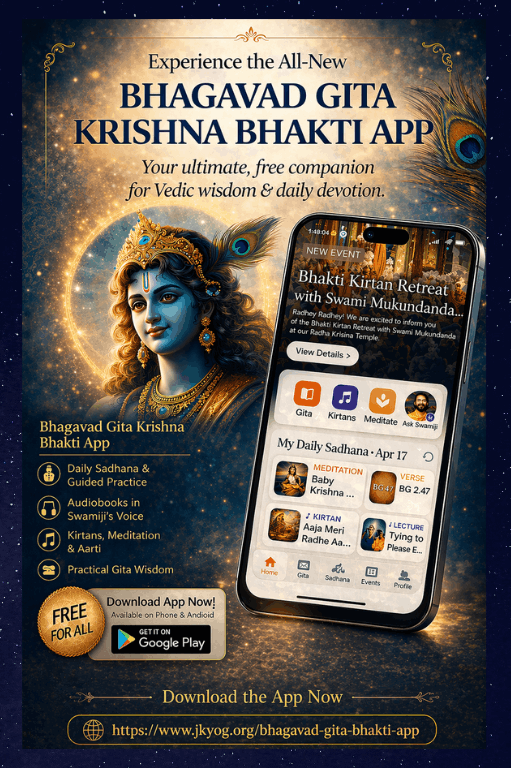
Welcome to the BGKB App Quiz!
How well do you know this app? Go from the Beginner to the Bonus Round Level!
Beginner Level:
- What is the primary purpose of the Bhagavad Gita Krishna Bhakti App?
- Is the app free to download?
- Name one feature available in the app.
- On which platforms is the app available?
Intermediate Level
- What section in the app would you use for daily spiritual practice?
- Who provides the audiobooks and teachings featured in the app?
- What type of music can you listen to within the app?
- What feature helps users stay consistent with their daily devotion?
- Where can you find upcoming spiritual events in the app?
Advanced Level
- What is “Daily Sadhana” and how does the app support it?
- Which feature allows users to ask spiritual questions directly?
- How does the app personalize the user’s spiritual journey?
- What types of content are included under “Practical Gita Wisdom”?
- How can one deepen understanding of the Bhagavad Gita in daily life?
Fun Bonus Round
- What icon would you tap to listen to devotional songs?
- Which section would you explore for guided meditation?
- What’s one benefit of using the app daily?
- True or False: The app includes both audio and visual learning content.
- If you want to recommend the app to a friend, what feature would you highlight first?
If you have not already downloaded the app, do it now!
Download the App: https://www.jkyog.org/radha-krishna-bhakti-app