
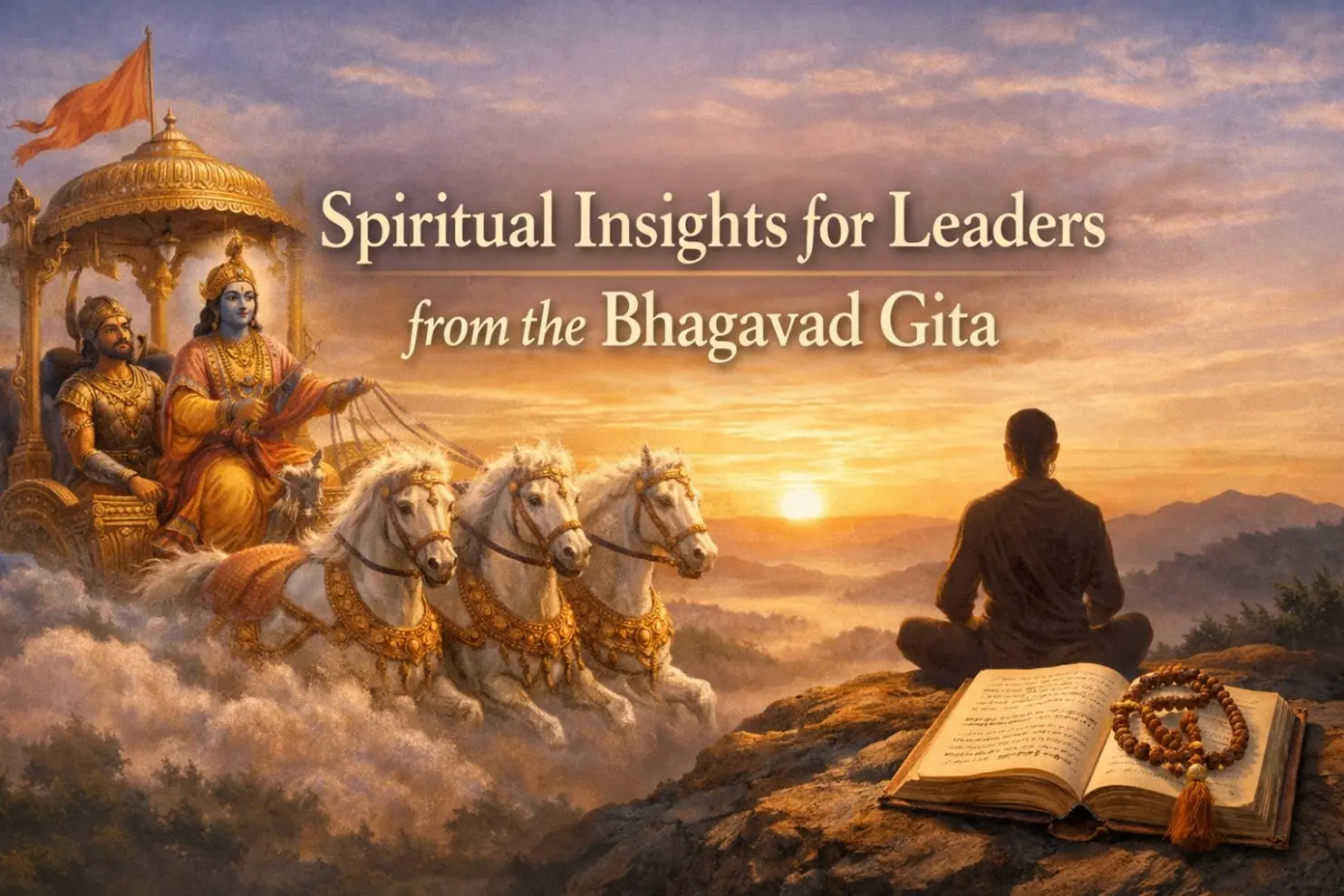
The Moment That Defines a Leader: When Inner Clarity Fails
There comes a moment in every leader’s life when everything looks fine on the outside.
But inside, something begins to shake.
The plan is unclear. The stakes are high. The pressure is rising. And everyone is looking at you for answers.
You are expected to decide.
But within… there is hesitation.
Doubt.
Weight.
Silence.

If you think this is weakness—look again.
More than 5,000 years ago, on the battlefield of Kurukshetra, a warrior stood between two armies and collapsed.
Arjun, the greatest archer of his time, lowered his bow.
His voice shook. His heart broke. His mind refused to cooperate.
Arjun did not lack skill.
He did not lack knowledge.
He did not lack responsibility.
He lacked inner clarity.
And in that moment, Lord Krishna did not say:
“Be strong.”
He said:
“Understand.”
What followed became the eternal wisdom of the Bhagavad Gita, not a manual for war, but a science of inner leadership.
Because leadership has never been about controlling external circumstances.
It has always been about mastering yourself within them.
Swami Mukundananda Ji teachings, rooted in the Gita’s 700 verses, begins and ends with one foundational insight:
Inner victory is the foundation of all outer success.
In this blog, we draw on ten of most transformative teachings – each one rooted in a specific Gita verse, each one carrying the power to reshape not just how you lead, but who you are becoming as a leader. Read slowly. These words are meant to be absorbed, not merely read.

01 · The Battlefield Is Within You First: Mastering the Mind in Leadership
Before Arjun could lift his bow, he had to settle his mind. Before you can lead your team, your organization, or your family, you must first govern the six inches between your ears.
But if you do not manage your own mind, Swami Mukundananda Ji teaches, everything else will eventually collapse under the weight of your own inner disorder.
“Elevate yourself through the power of your mind, and not degrade yourself, for the mind can be the friend and also the enemy of the self.”
(Bhagavad Gita 6.5)
This is the real battlefield.
Not your competition.
Not your circumstances.
Not other people.
Your own mind.
Swamiji often explains:
An untrained mind does not just disturb you; it disturbs everything you lead.
A restless mind creates:
- reactive decisions
- emotional leadership
- unstable environments
But Gita offers a precise solution:
“Lord Krishna said: O might-armed son of Kunti, what you say is correct; the mind is indeed very difficult to restrain. But by practice and detachment, it can be controlled.”
(Bhagavad Gita 6.35)
Two disciplines:
- Abhyasa (practice) – the repeated practice of bringing the mind back to God through meditation and devotional study.
- Vairagya (detachment) – the gradual loosening of emotional dependence on outcomes that fuel the mind’s anxiety.
Leadership begins here. Before strategy. Before execution. With the discipline of the inner world. Even 10-15 minutes of genuine meditation each morning begins to reshape reactions into responses, confusion into clarity, and scattered energy into purposeful presence.
Great leaders who feel calm under pressure are not naturally calm. They are trained inwardly. And the Gita is their training manual.
02 · Your Struggles Are Preparing You

When life becomes difficult, the mind asks:
“Why is this happening to me?”
The Gita gently answers:
“This is happening for you.”
“O son of Kunti, the contact between the senses and the sense objects gives rise to fleeting perceptions of happiness and distress. These are non-permanent and come and go like the winter and summer seasons. O descendant of Bharat, one must learn to tolerate them without being disturbed.”
(Bhagavad Gita 2.14)
Swamiji teaches that this world is not a random collection of events. It is precisely, lovingly designed for each soul’s growth.
Every experience or challenge is shaping you:
- The failed project teaches resilience.
- The betrayal teaches discernment.
- The delay teaches patience.
- The unexpected setbacks teaches humility.
Lord Krishna did not remove Arjun’s crisis. He revealed its purpose. And that is the transformation that the Gita asks of every leader.
From: “Why is this happening to me?” To: “What is this teaching me?”
The moment you make that shift; you stop being a victim of your circumstances and start learning and growing.
Every leader has their Kurukshetra.
The question is not whether it will come. It is whether you will let it break you or let it reveal who you truly are.
03 · Redefining Success: Focus on Action, Not Results [Karm Yog]

Modern leadership is obsessed with results. Metrics. Targets. Rankings. Validation.
“You have a right to perform your prescribed duties, but you are not entitled to the fruits of your actions. Never consider yourself to be the cause of the results of your activities, nor be attached to inaction.”
(Bhagavad Gita 2.47)
“One who prudently practices the science of work without attachment can get rid of both good and bad reactions in this life itself. Therefore, strive for Yog, which is the art of working skillfully.”
(Bhagavad Gita 2.50)
Swamiji explains:
Success is not what you achieve. It is how you act. Not the result but the consciousness, the integrity, and the full-hearted devotion with which every action is performed.
This changes everything for a leader. You move from:
- Anxiety about outcomes -à Energy invested in excellence.
- Comparison with others à Contribution from your own authentic gifts.
- Fear of failure à Focus on right action.
And paradoxically results improve. Because the energy that was wasted on worry, comparison, and fear is now entirely available for genuine effort and creative problem-solving.
Swamiji identifies four disciplines that together free a leader from the anxiety of outcome-based thinking:
Perform your duty fully without craving the results.
The fruits are not yours to possess, they belong to God.
Give up the ego of doership. God is the ultimate source of all capacity.
Never become attached to inaction. Act, even when the outcome is uncertain.
Together, these dissolve the two great poisons of leadership: the arrogance of success and the paralysis of anticipated failure. The leader who internalizes this becomes:
Calm because they are not enslaved by outcomes.
Consistent because their effort does not depend on their last result.
Deeply effective because undistracted energy always produces excellence.
04 · Be Concerned But Never Disturbed: The Secret of Calm Leadership

There is a distinction that every leader must understand deeply:
- Concern sees the problem clearly and acts with precision.
- Disturbance loses inner balance and makes the problem worse.
The Gita’s ideal leader is called sthitaprajna meaning the person of steady wisdom. This not an emotional figure. It is someone who feels deeply, cares profoundly, and engages fully and yet remains inwardly stable while doing so.
“One whose mind remains undisturbed amidst misery, who does not crave for pleasure, and who is free from attachment, fear, and anger, is called a sage of steady wisdom.”
(Bhagavad Gita 2.56)
The Gita describes such a leader as:
“Just as a lamp in a windless place does not flicker, so the disciplined mind of a yogi remains steady in meditation on the Supreme.”
(Bhagavad Gita 6.19)
Steady.
Clear.
Unshaken.
Regardless of what is happening outside.
This is the inner life of the spiritually disciplined leader.
Swamiji emphasizes:
Your inner state is not a private matter. It is your most powerful leadership communication before you speak a single word.
Imagine this:
A team in crisis.
Deadlines collapsing.
Pressure rising.
One leader enters—panicked.
Another enters—calm, grounded, focused.
Who do people follow?
Before solving the problem—
become the stability.
Gita devotes 18 consecutive verses from 2.54 to 2.72 to the complete portrait of the sthitaprajna. Read that passage regularly. Let it become your personal mirror. Let it show you where you are steady and where you still flicker.
05 · Turn Work into Worship: The Power of Karm Yog in Leadership
What if leadership was not pressure? And started feeling like purpose?
This is the precise shift the Bhagavad Gita invites every leader to make. Not a reduction of effort. Not an abandonment of ambition. But a complete transformation of the spirit in which every action is performed.
“Whatever you do, whatever you eat, whatever you offer as oblation to the sacred fire, whatever you bestow as a gift, and whatever austerities you perform, O son of Kunti, do them as an offering to Me.”
(Bhagavad Gita 9.27)
This is Karm Yog – the most liberating leadership philosophy ever articulated. Its essence is captured in two principles that together dissolve every form of leadership anxiety.
Swamiji describes it as:
Give your best effort to every action completely, sincerely, devotedly.
Surrender the results entirely to God without clinging, without fear.
This dissolves the ego that claims credit for success. It dissolves the fear that collapses under failures. It dissolves the burnout that comes from measuring your worth entirely by outcomes you cannot fully control. What remains is a leader who works with:
Full engagement because the effort is their offering.
Complete freedom because the results belong to God.
Sustainable energy because the work itself becomes spiritually replenishing.
A leader who works this way creates something remarkable in their team. When the leader genuinely does not need the credit, politics dissolve. When the leader genuinely does not fear failure, risk-taking becomes possible. When the leader’s work is a form of worship, the culture around them elevates not because they demanded it, but because they demonstrated it.
This is Karm Yog. And it is available to you today in every meeting, every email, every decision. Offer it. All of it.
06 · Stop Blaming, Start Leading: Reclaim Your Inner Power
Blame is the most subtle form of powerlessness.
Arjun began the Bhagavad Gita by blaming. He blamed the circumstances for being impossible. Every argument he made was externally directed.
And every one of those arguments kept him paralyzed.
It took Shree Krishna 18 chapters, the entire Bhagavad Gita, to return Arjun to the one truth that could set him free:
“Elevate yourself through the power of your mind, and not degrade yourself, for the mind can be the friend and also the enemy of the self.”
(Bhagavad Gita 6.5)
Swamiji distils this with characteristic precision:
The moment you stop blaming, you reclaim your power.
You cannot control circumstances. You cannot control other people. You cannot control outcomes. But you can always, without exception, control your response. And your response is where your leadership actually lives.
When a leader genuinely owns their responses including their reactive moments, their failures of judgment, their unkind words, their poor decisions, something profound shifts in the culture around them. Mistakes stop being feared and start being acknowledged. Feedback becomes welcomed rather than avoided. Trust deepens not because everyone is performing perfectly, but because everyone is genuinely committed to learning and growing.
Reclaiming that power is the beginning of true leadership sovereignty.
Elevate yourself by your own self. Not waiting for circumstances to change. Not waiting for others to act differently. Rising now, with what you have, from exactly where you are.
07 · Your Words Shape Your Leadership Impact
Words are not neutral.
It is creative force.
Every word a leader speaks is a seed planted in the soil of another person’s mind. What grows from the seed will either nourish the garden of your organization or slowly poison it. The Bhagavad Gita addresses this with a precision that no modern communication training can match, giving four specific qualities that make speech both truthful and wise.
“Words that do not cause distress, are truthful, inoffensive, and beneficial, as well as regular recitation of the Vedic scriptures – these are declared as austerity of speech.”
(Bhagavad Gita 17.15)
Four tests. Four filters for every word before it leaves your mouth. Swami Mukundananda Ji teaches that before speaking, especially in a charged moment ask:
- Is it true?
- Is it kind?
- Is it necessary?
- Is it the right time?
The Gita does not ask you to choose between truth and kindness. A mature leader delivers both simultaneously the truth spoken with such genuine care and respect that it can be heard, received and used.
Our words are a direct expression of what lives in our minds, and our minds are shaped by what we feed them. A mind nourished daily on the Gita’s wisdom naturally produces speech that is measured, compassionate, and purposeful.
Words can either heal or harm. Leaders are remembered not just for their decisions but for how they made people feel. A sharp word spoken in frustration can damage in seconds what took years to build. A word of genuine encouragement, spoken at the right moment with the right spirit, can change the direction of a person’s life.
Your words are seeds. What you plan will grow in your team, your culture, your legacy.
Choose consciously. Speak from the best of who you are not the worst of how you feel.
08 · The Size of the Problem Is the Size of the Mind
Problems are inevitable.
Suffering is optional.
It is one of the Bhagavad Gita’s most practically liberating teachings, and Swami Mukundananda Ji returns to it again and again: life will give every leader problems that is completely non-negotiable. But how large these problems become in your mind, how long they paralyze you, how much energy they drain, this is entirely within your power to determine.
“They come and go… one must learn to tolerate them without being disturbed.”
(Bhagavad Gita 2.14)
Arjun’s collapse on the battlefield was not caused by the facts of his situation. Those facts had not changed from the previous day. What had changed was his interpretation – one catastrophic story, amplified by an untrained mind, was enough to fell the greatest warrior in the world.
Swamiji teaches the discipline of seeing events as they actually are, stripped of the amplifying lens of fear, ego, and past conditioning. Not minimizing real problems. Not denying genuine difficulty. But seeing them clearly, in their true proportions, without the inflation that anxiety adds and without the deflation that avoidance creates.
From accurate perception comes accurate response.
From accurate response comes effective leadership.
From effective leadership comes genuine resolution.
Every challenge navigated with wisdom makes you more resourceful. Every difficulty endured with grace makes you more resilient. Every setback met with integrity makes you more credible and more trusted.
09 · You Cannot Give What You Do Not Have
Burnout is not from doing too much.
It is from not refilling enough.
The most common complaint among leaders today is exhaustion, loss of purpose, disconnect from what matters most is a symptom of exactly this. They have been giving from an empty vessel. Drawing indefinitely from a well that is never replenished.
“The steady mind is like a lamp in still air.”
(Bhagavad Gita 6.19)
A steady lamp. Not dramatic. Not flickering. Burning constantly and reliably – illuminating everything around it, night after night, without depletion.
This is what daily inner practice produces. Swami Mukundananda Ji teaches: Go within daily because that is where your strength comes from.
The prescription is both ancient and immediately practical:
Begin each day before the noise begins.
Spend time in meditation, prayer, the sincere study of scripture.
Offer the day ahead to God before you enter it.
End the day with gratitude and reflection.
Through Shravan – deeply hearing divine knowledge – and Manan – sincerely contemplating it – the intellect is gradually illumined. An illumined intellect governs the mind. A governed mind produces measured speech. Measured speech builds trust and culture. The entire chain of outer leadership excellence flows from this single daily inner practice.
Without this inner nourishment, leadership becomes exhausting – a relentless performance from an increasingly empty stage. With it, leadership becomes sustainable. Meaningful. Even joyful. Because the leader is no longer drawing only from their own finite reserves. They are connected to something inexhaustible.
10 · You Are Not Your Setback – Arise
The Gita’s most powerful moment does not come at the climax of battle. It comes at the moment of complete collapse.
Arjun, the greatest warrior of his time sits in his chariot, bow slipping from his fingers, body shaking, mind overwhelmed. He tells Lord Krishna he would rather die than fight. He has given up.
And Lord Krishna responds with the most important words in all of spiritual leadership:
“O Parth, it does not befit you to yield to this unmanliness. Give up such petty weakness of heart and arise, O vanquisher of enemies.”
(Bhagavad Gita 2.3)
But before the call to arise, Lord Krishna gives Arjun and every leader the deepest possible reason to do so:
“The soul is neither born, nor does it ever die; nor having once existed, does it ever cease to be. The soul is without birth, eternal, immortal, and ageless. It is not destroyed when the body is destroyed.”
(Bhagavad Gita 2.20)
Swami Mukundananda Ji teaches the most practically transformative truth a leader can possess.
You are not your failure.
You are not your fear.
You are not your current limitation.
You are the eternal soul and that soul cannot be defeated.
This gives a quality of courage that no confidence building exercise can manufacture. It is the courage that comes from knowing at a level deeper than thought that your identity is not at the mercy of your circumstances. That behind and beneath everything you are being called to face, there is a divine intelligence that supports, guides, and ultimately carries those who surrender to its care.
Every leader will face their version of Arjun’s chariot. The moment when you feel unequal to what is being asked. When the weight is too much. When the path forward is invisible.
The Gita’s answer is always the same.
Uttiṣhṭha.
Arise.
Not when you feel ready. Not when the fear has passed. Now. Because you are more than you mind is telling you. Because God is closer than your next breath. Because the world genuinely needs what only you can offer.
11 · Your Life Is the Message
Leadership is not taught.
It is lived.
“By performing their prescribed duties, King Janak and others attained perfection. You should also perform your duties to set an example for the good of the world. Whatever actions great persons perform, common people follow. Whatever standards they set, all the world pursues.”
(Bhagavad Gita 3.21)
People do not follow what you say. They follow what you are. Your calmness under pressure. Your discipline in the stillness before the day begins. Your integrity when no one is watching. Your courage to rise after falling. Your kindness with the person who least expects it. Your devotion to something greater than personal recognition.
These become your real influence. This becomes your legacy.
Swamiji’s teaching:
Transform yourself and leadership transforms automatically.
The outer world changes when the inner world does. Teams follow what leaders have become. Cultures reflect who stands at their center. And the Gita gives every leader the precise science for that inner transformation.
The Bhagavat Gita was not spoken to a perfect man. It was spoken to a struggling one. Which means it was spoken to you.
Not to make life easier. But to make you stronger. Not to remove challenges. But to reveal your capacity to rise above them.
So, when your moment comes –
And it will –
Remember:
You are not alone.
You are not unprepared.
You are not incapable.
You are being called.
Arise.

Call to Action: Begin the Journey Within
Read all 700 verses of the Bhagavad Gita—free and complete—with commentary by Swami Mukundananda Ji
Holy Bhagavad Gita 🌎 Website: https://www.holy-bhagavad-gita.org/
 JKYog
JKYog
Frequently Asked Questions
Q. What does the Bhagavad Gita teach about leadership?
Leadership begins with inner mastery—mind control, detachment, balance, and leading by example.
Q. What is Karm Yoga?
Doing your duty with excellence while letting go of results (BG 2.47).
Q. What is a sthitaprajna?
A calm, steady leader unaffected by success or failure (BG 2.54–72).
Q. Where can I read the Gita commentary?
At holy-bhagavad-gita.org
Q. How do I start?
Meditate daily, read one verse, and act with awareness.