
Success Is Rising, Stress Is Exploding

We live in an age obsessed with achievement.
Students measure their worth through grades. Professionals chase promotions that never seem enough. Startup founders track growth charts like heart monitors. Social media quietly whispers that everyone else is ahead.
The modern definition of success has become deeply tied to outcomes. Results determine identity. Performance determines self esteem. Recognition determines happiness.
And the consequence is visible everywhere.
Burnout. Anxiety. Decision fatigue. Fear of failure. Constant comparison.
People are not tired because they work hard. They are tired because they worry constantly about results they cannot control.
Ironically, the harder we chase success, the more stressed we become.
Thousands of years ago, a similar crisis unfolded on a battlefield. A warrior named Arjuna stood frozen before action, overwhelmed by doubt, fear, and emotional conflict. His problem was not lack of skill. It was mental paralysis caused by attachment to consequences.
The wisdom shared with him in the Bhagavad Gita was not merely spiritual philosophy. It was a battlefield guide for navigating chaos, responsibility, and pressure.
The Gita teaches a revolutionary idea.
You can pursue excellence without suffering.
You can work intensely without anxiety.
You can succeed without stress.
The transformation begins not by changing your goals, but by changing your mindset.
 JKYog Team
Modern Battlefield: From Kurukshetra to Corporate Life
The battlefield described in the Gita mirrors modern life more closely than we imagine.
Today’s Kurukshetra is the workplace deadline, the competitive exam hall, the struggling startup, or even personal relationships filled with expectations.
Consider a startup founder whose company funding depends on the next quarter’s results. Or a student awaiting exam outcomes that seem to define their future. Or a professional constantly refreshing performance metrics.
The pressure rarely comes from action itself.
It comes from attachment to outcomes.
The Gita reframes this entirely. It teaches that stress is not born from work. Stress arises from psychological ownership of results.
This insight leads us to the first and most powerful lesson.
Karma Yoga: Excellence in Action Without Anxiety
One of the most quoted verses of the Gita states:
BG 2.47: You have a right to perform your prescribed duties, but you are not entitled to the fruits of your actions. Never consider yourself to be the cause of the results of your activities, nor be attached to inaction.
At first glance, this sounds counterintuitive. Modern culture trains us to work for results. Promotions, grades, profits, and recognition appear to justify effort.
Yet the Gita separates two domains clearly.
Action belongs to you.
Outcome does not.
You control preparation, effort, integrity, and attention. You do not control market conditions, other people’s decisions, timing, or luck.
Stress begins when we demand ownership over both.
Karma Yoga, often translated as devoted action, encourages full engagement with work while releasing psychological dependence on results.
This does not mean lack of ambition. It means purified ambition.
A surgeon focuses entirely on performing the procedure perfectly rather than obsessing about reputation. An athlete concentrates on technique instead of scoreboard anxiety. A writer commits to clarity instead of viral success.
When attention shifts from reward to execution, performance improves naturally.
Process excellence replaces outcome obsession.
And paradoxically, success becomes more likely.
NATO: Not Attached To Outcomes

A practical way to understand this teaching is through the NATO Principle.
Not Attached To Outcomes.
Attachment does not mean caring about results. It means emotionally tying your identity to them.
Attachment sounds like this:
- If I fail, I am worthless.
- If this project fails, my career is over.
- If I am not recognized, my effort meant nothing.
Detachment replaces these thoughts with clarity:
- I will give my best effort.
- Results will emerge from many factors.
- My worth is independent of outcomes.
A tennis player attached to winning becomes tense during crucial points. Muscles tighten. Judgment declines. Mistakes increase.
A player focused purely on execution remains relaxed and adaptive.
The same applies to work life.
A manager obsessed with quarterly results may panic under uncertainty. Another who focuses on daily decision quality builds sustainable success.
Detachment is not indifference.
It is emotional freedom during action.
The Gita calls this mental independence yoga in action.
Mastering the Mind: Your Greatest Ally or Enemy
The Gita states:
BG 6.6: For those who have conquered the mind, it is their friend. For those who have failed to do so, the mind works like an enemy.
Modern neuroscience confirms what ancient wisdom already understood. Much of human suffering comes not from events, but from uncontrolled mental reactions.
The mind constantly travels between past regret and future anxiety.
- Replay past mistakes.
- Predict worst case scenarios.
- Compare endlessly with others.
Rarely does it stay present.
The Gita describes the mind as turbulent, powerful, and difficult to control. Yet it also offers practical methods.
🔄 Failure as Feedback, Not Final Judgment
Failure as Feedback, Not Final Judgment
One of the deepest sources of stress is the fear of failure. Modern culture often treats failure as a final judgment on intelligence, talent, or worth. The Bhagavad Gita offers a different perspective. When actions are performed with detachment from results, failure stops being a personal verdict and becomes a source of learning.
Shree Krishna teaches that our responsibility lies in sincere effort, not guaranteed success. When outcomes are not tied to identity, setbacks lose their emotional weight and instead provide valuable feedback for growth. We see this principle in modern life as well. Startups pivot after early failures, athletes lose competitions before winning championships, and many professionals change careers after discovering their true strengths.
The Gita’s insight is simple yet powerful. Detachment reduces fear, and freedom from fear improves performance. When failure is viewed as part of the journey rather than its end, stress decreases and growth accelerates.
“Be steadfast in yoga, O Arjuna. Perform your duty and abandon attachment to success or failure. Such evenness of mind is called Yoga.”
— Bhagavad Gita 2.48
🌿 Comparison and the Loss of Dharma

In modern life, stress often begins when we compare our journey with someone else’s success. Comparison pulls attention away from our own path and leads to imitation rather than authenticity. The Bhagavad Gita warns against this misalignment and encourages individuals to follow their own Dharma, their natural role and inner calling.
BG 3.35: It is far better to perform one’s natural prescribed duty, though tinged with faults, than to perform another’s prescribed duty, though perfectly. In fact, it is preferable to die in the discharge of one’s duty, than to follow the path of another, which is fraught with danger.
Krishna’s message is clear. Fulfillment does not come from outperforming others but from living in alignment with one’s true nature. When we focus on our own purpose instead of competing for validation, work becomes meaningful and stress begins to fade.
The Science of Flow State and the Gita
Modern psychology describes flow as a state of peak performance where focus deepens, time fades, and work feels effortless. What science calls flow, the Bhagavad Gita describes through Karma Yoga.
🕉️ How Karma Yoga Naturally Creates Flow
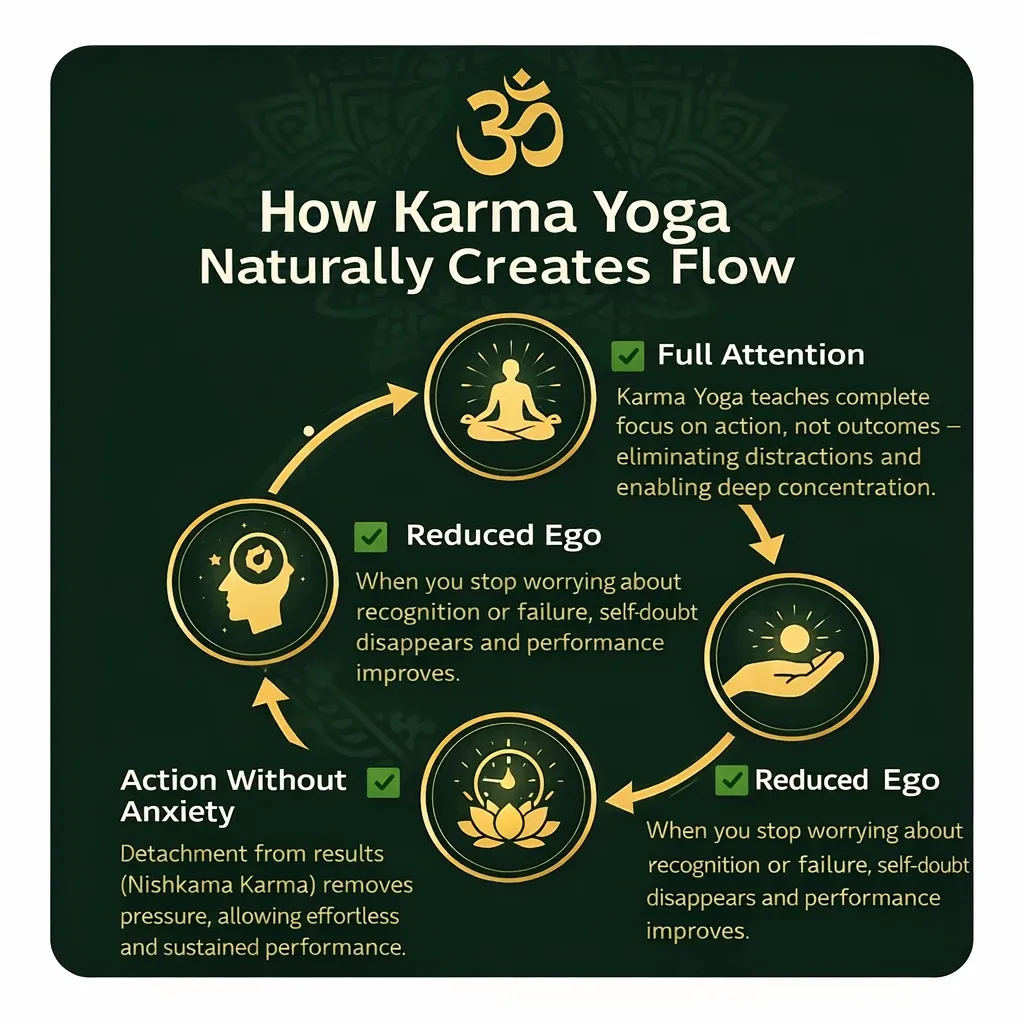
✅ Full Attention
Karma Yoga teaches complete focus on action, not outcomes — eliminating distractions and enabling deep concentration.
✅ Reduced Ego
When you stop worrying about recognition or failure, self-doubt disappears and performance improves.
✅ Present Moment Awareness
Acting in the present moment keeps the mind calm and fully engaged — a core condition of flow.
✅ Action Without Anxiety
Detachment from results (Nishkama Karma) removes pressure, allowing effortless and sustained performance.
✨ Ancient Wisdom Meets Modern Science
Flow happens when action is done with focus, balance, and detachment — exactly what Shree Krishna taught Arjuna.
Karma Yoga turns work from stress into effortless excellence.
Leadership Lessons from Shree Krishna
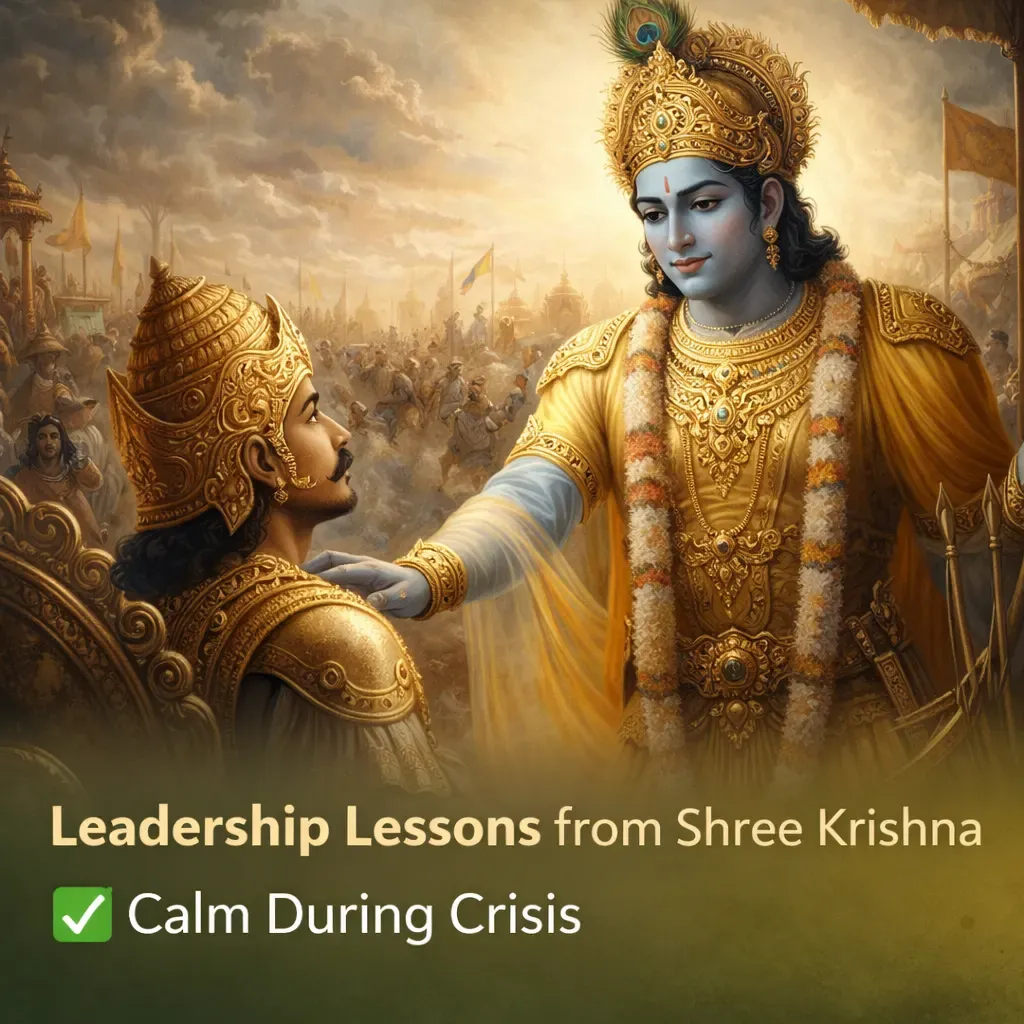
On the battlefield of Kurukshetra, Shree Krishna demonstrated one of history’s greatest models of leadership — not through authority, but through wisdom, calmness, and empowerment.
He did not fight the war for Arjuna.
He guided Arjuna to find clarity and act for himself.
Shree Krishna reminds him:
BG 2.37: If you fight, you will either be slain on the battlefield and go to the celestial abodes, or you will gain victory and enjoy the kingdom on earth. Therefore arise with determination, O son of Kunti, and be prepared to fight.
This is leadership at its highest level — awakening action in others, not controlling them.
🌿 Core Leadership Traits from Shree Krishna
✅ Calm During Crisis
While chaos surrounded the battlefield, Shree Krishna remained composed, showing that emotional stability inspires confidence in uncertain times.
✅ Clarity Without Force
He offered wisdom, not commands. True leaders influence through understanding, not fear.
✅ Guidance Instead of Control
Shree Krishna acted as a mentor and coach, helping Arjuna think clearly rather than dictating decisions.
✅ Empowering Others to Act
The final choice was always Arjuna’s — proving that great leadership builds independent thinkers.
💼 Relevance to Modern Leadership Challenges
Today’s leaders face pressures similar to Kurukshetra:
- Managing teams under constant deadlines
- Motivating people without micromanaging
- Making ethical decisions amid uncertainty
Shree Krishna’s model teaches that leadership is not about dominance but direction.
✨ A true leader does not create followers —
they create capable decision-makers.
🌼 Inner Success vs External Success
Modern society often measures success through wealth, recognition, and achievement. While these bring temporary satisfaction, they do not guarantee lasting fulfillment. The Bhagavad Gita shifts attention toward inner success, which includes peace of mind, clarity of purpose, emotional stability, and self mastery.
“One who is self-controlled and remains steady in pleasure and pain, honor and dishonor, is truly established in wisdom.”
— Bhagavad Gita 2.56
Krishna teaches that true victory begins within. When inner stability comes first, achievements grow naturally without disturbing peace. Outer success becomes sustainable only after inner victory is achieved.
Work as Worship: Meaning Driven Productivity

Productivity becomes powerful when work is connected to purpose, not ego.
The Bhagavad Gita teaches that action gains meaning when it is offered to something higher than personal gain.
Shree Krishna advises:
“Whatever you do, whatever you eat, whatever you offer or give away… do that as an offering unto Me.”
— Bhagavad Gita 9.27
This transforms work from obligation into worship.
🌱 From Ego-Driven Work to Purpose-Driven Work
Modern life often links careers to status, salary, or comparison — creating anxiety and dissatisfaction. The Gita shifts the mindset toward service and contribution.
- Service Mindset: Work becomes an act of helping others.
- Contribution Mindset: Success is measured by impact, not applause.
- Mission-Oriented Careers: Purpose replaces pressure.
🌍 Everyday Examples of Work as Worship
👩🏫 Teachers shaping future generations
🩺 Doctors serving humanity through healing
🛠️ Engineers solving real-world problems
When work serves a larger good, motivation becomes intrinsic and sustainable.
✨ The Gita reminds us:
Work done only for ego exhausts us.
Work offered with purpose energizes us.
Meaning-driven productivity shifts us from career anxiety to meaningful engagement — where work no longer drains life, but expresses it.
Meditation and Mindfulness

Meditation in the Gita is not escape from responsibility. It is mental training.
Even brief daily stillness strengthens awareness. Instead of reacting automatically, you begin observing thoughts.
A professional receiving criticism pauses before reacting defensively. A student facing failure analyzes calmly rather than collapsing emotionally.
Mindfulness anchors attention in the present task.
When fully present, anxiety loses fuel because anxiety depends on imagined futures.
Practical steps inspired by this teaching include:
- Taking five minute breathing breaks during work.
- Creating technology free moments.
- Ending workdays with intentional closure.
- Practicing focused single tasking.
Mental mastery transforms effort from stressful struggle into deliberate engagement.
Samatvam: The Art of Emotional Balance

The Gita declares:
BG 2.48: Be steadfast in the performance of your duty, O Arjun, abandoning attachment to success and failure. Such equanimity is called Yog.
Equanimity, or Samatvam, means maintaining inner stability regardless of success or failure.
Modern culture amplifies emotional extremes.
Success leads to temporary highs followed by fear of losing status. Failure leads to self doubt and withdrawal.
Both disturb clarity.
The Gita teaches that outcomes are temporary waves.
Praise fades. Criticism fades. Profit fluctuates. Setbacks pass.
A calm mind performs better in both victory and defeat.
Consider elite athletes. Those who celebrate excessively often lose focus. Those devastated by loss struggle to recover.
Balanced individuals learn continuously.
Equanimity allows learning without ego interference.
It transforms failure into feedback and success into responsibility rather than arrogance.
This emotional steadiness reduces chronic stress while improving long term performance.
Process Over Product: The Hidden Secret of High Performers
One of the most practical insights from the Gita is the shift from product to process.
Modern achievement systems reward outcomes, yet excellence arises from disciplined processes.
A musician practices scales daily without audience applause. A scientist runs experiments that may fail repeatedly. A writer edits endlessly before publication.
The Gita assures:
“No effort in this world is lost or wasted.” (2.40)
Every sincere effort builds competence even if immediate results are invisible.
When focus rests on process quality:
- Work becomes meaningful each day.
- Motivation becomes internal.
- Progress compounds naturally.
Outcome focused workers experience emotional roller coasters.
Process focused workers experience steady growth.
Stress decreases because satisfaction comes from execution itself.
Ego Management: Working Beyond Recognition
Another major source of stress is ego attachment.
We often work not just to achieve but to be seen achieving.
Recognition becomes addictive. Lack of appreciation feels like injustice.
The Gita proposes a powerful alternative.
Perform action as an offering to a higher purpose.
This higher purpose may be service, excellence, contribution, or personal growth.
When work becomes offering rather than self-advertisement:
- Criticism hurts less.
- Praise becomes secondary.
- Motivation stabilizes.
Healthcare workers serving patients, teachers shaping minds, or engineers solving real problems often experience deeper fulfillment than those chasing status alone.
Ego reduction frees mental energy previously consumed by comparison and validation seeking.
Balanced Living: The Forgotten Foundation of Success

The Gita also emphasizes moderation.
Sustainable excellence requires regulated living.
Irregular sleep, excessive work, poor diet, and constant stimulation weaken mental clarity.
Balanced routines support performance:
- Adequate sleep restores cognition.
- Regular exercise stabilizes mood.
- Periodic rest prevents burnout.
- Mindful recreation refreshes attention.
Success without balance becomes self-defeating.
The Gita promotes disciplined yet humane living, where productivity and wellbeing coexist.
Swami Mukundananda’s Insights on Stress Free Success
Modern spiritual teacher Swami Mukundananda often explains that stress is not created by work itself but by the way the mind relates to outcomes.
According to him, the Gita encourages individuals to combine maximum effort with mental surrender.
Work with dedication. Strive for excellence. But release the emotional burden of results.
When actions are offered to a higher purpose rather than performed solely for personal recognition, work becomes joyful and meaningful.
Swami Mukundananda emphasizes that mastering the mind is the key to living the Gita's teachings. When the mind is disciplined, success no longer creates arrogance, and failure no longer creates despair.
Instead, both become opportunities for growth.
From Burnout to Balance: Krishna’s Timeless Call
The battlefield never disappeared.
Today it appears as overflowing inboxes, endless deadlines, and silent expectations.
Like Arjuna on the battlefield of Kurukshetra, many people stand overwhelmed in the middle of their own struggles.
Arjuna dropped his bow not because he was weak but because his mind was drowning in doubt and overthinking.
Krishna did not remove the battlefield.
He transformed Arjuna's perspective.
He taught him to act without anxiety about results, follow his own Dharma, maintain balance, and surrender the burden of outcomes.
When Arjuna released attachment, clarity returned and purpose replaced fear.
The same lesson applies today.
Peace does not come from escaping life’s battles. It comes from fighting the right battle with the right mindset.
Conclusion: Success Through Inner Alignment
The Bhagavad Gita offers a timeless blueprint for living with purpose and peace.
Work sincerely.
Detach from outcomes.
Master the mind.
Follow your Dharma.
Live with balance.
When success is pursued with this mindset, stress begins to dissolve.
Achievements no longer control your happiness. Instead, they become expressions of inner alignment.
Success then stops being a burden and becomes a natural result of clear thinking and steady effort.
Call To Action
🌿 Continue the Journey of Mind Mastery
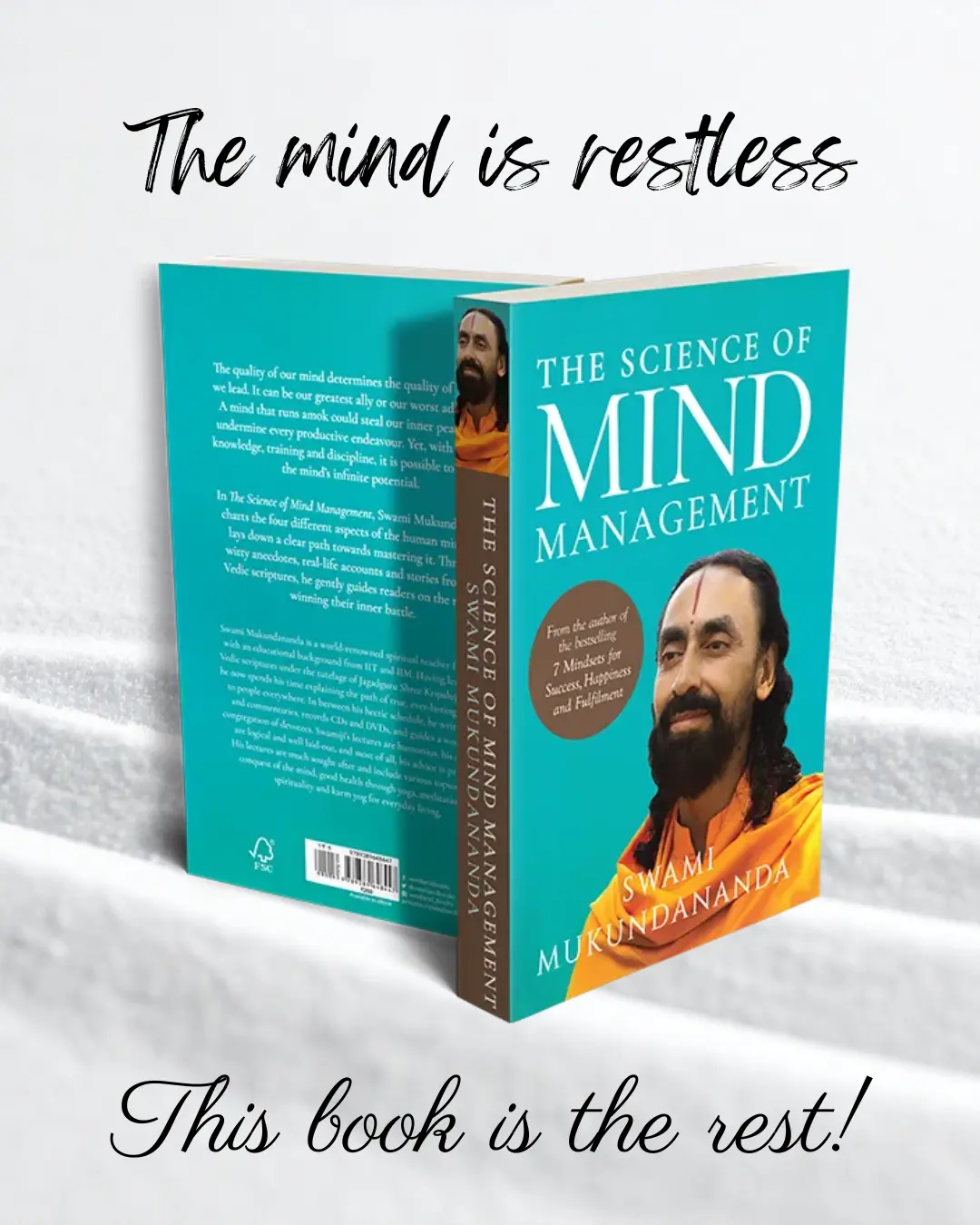
The wisdom of the Bhagavad Gita reminds us that success becomes truly meaningful when the mind is calm, focused, and aligned with purpose. If you would like to explore these teachings more deeply, Swami Mukundananda’s books offer practical guidance on mastering the mind, overcoming stress, and living with clarity
📖 Recommended reading:
By applying these insights, you can learn to work with dedication, remain detached from outcomes, and build a life of success without stress.
❓ FAQs — Success Without Stress: Lessons from the Gita
1. What does the Gita say about success?
The Gita teaches that true success comes from doing your duty sincerely without attachment to results, which reduces stress and anxiety.
2. Why does result-attachment cause burnout?
When self-worth depends on outcomes like money or recognition, pressure increases. Detached action helps preserve mental energy.
3. What is Svadharma?
Svadharma means following your natural strengths and purpose. Working against your nature often leads to burnout.
4. How did Shree Krishna help Arjuna overcome stress?
Krishna guided Arjuna to shift from overthinking to purposeful action by focusing on duty and surrendering outcomes.
5. Are Gita teachings relevant today?
Yes. Its lessons on balance, clarity, and disciplined action directly apply to modern work stress and burnout.
Related Blog you might be interested
JKYog Team