

Supremacy of Bhakti: The Ultimate Path to Realization
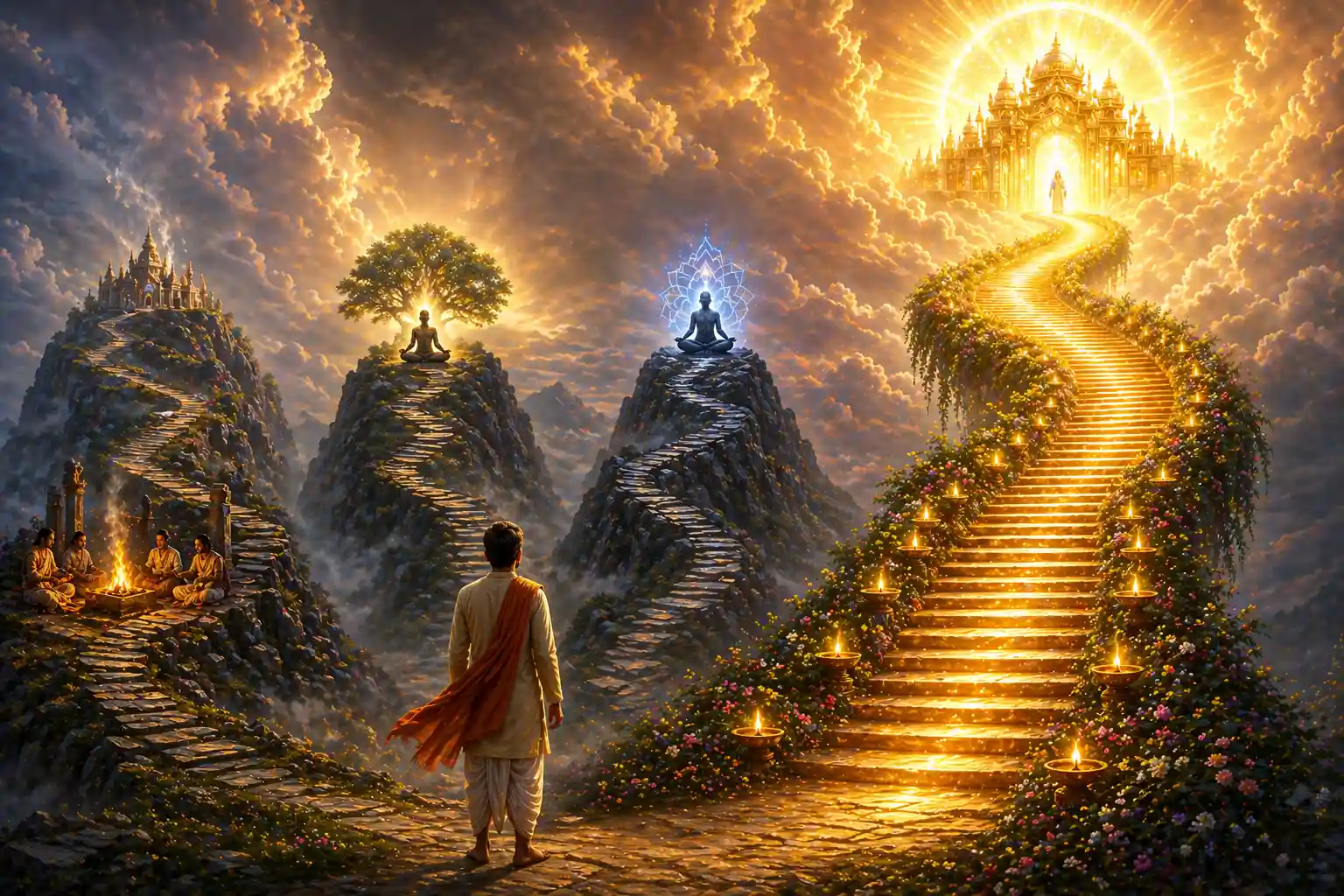
From time immemorial, humanity has been in search of the highest truth—the ultimate reality that lies beyond the fleeting experiences of the material world. In the vast landscape of spiritual practices, seekers often find themselves at a crossroads, wondering which path truly leads to ultimate realization.
Should one engage in the rigorous rituals of Karma, seek intellectual liberation through Jnana, master the mind through Ashtanga Yoga, or surrender in love through Bhakti?
The Vedas, Upanishads, and countless spiritual traditions present various paths to reach this goal: the path of action (Karma), the path of knowledge (Jnana), and the path of meditation (Yoga). Each of these paths offers profound insights and disciplines, yet the sages repeatedly guide us toward a deeper, more intimate approach—the path of Bhakti, or loving devotion.
According to the great sage Narad Ji, who deeply compared these diverse spiritual paths—Karma, Jnana, Ashtanga Yoga, and Bhakti—the verdict is clear: Bhakti Sadhana stands as the supremely superior spiritual path.
The journey of the soul is not merely about intellectual understanding or mechanical practice; it is about connection. As the heart longs for fulfillment beyond worldly achievements, it gradually realizes that neither rituals nor dry knowledge can fully satisfy its deepest yearning. This longing finds its answer in Bhakti—the path that transforms spiritual pursuit into a loving relationship with the Divine.
Swami Mukundananda beautifully expresses this truth:
“The soul does not seek liberation alone; it seeks loving union with God.”
This insight sets the foundation for understanding why Bhakti is not just another path—it is the culmination of all paths.
To truly understand why the path of loving devotion triumphs over all other spiritual disciplines, we must profoundly examine the limitations of alternative paths, the inevitable necessity of divine grace, and the ultimate levels of God realization. In this comprehensive guide, we will explore these ancient truths, complete with the profound Sanskrit and scriptural quotations that illuminate the supremacy of Bhakti.
The Incomplete Nature of Karma: The Path of Rituals
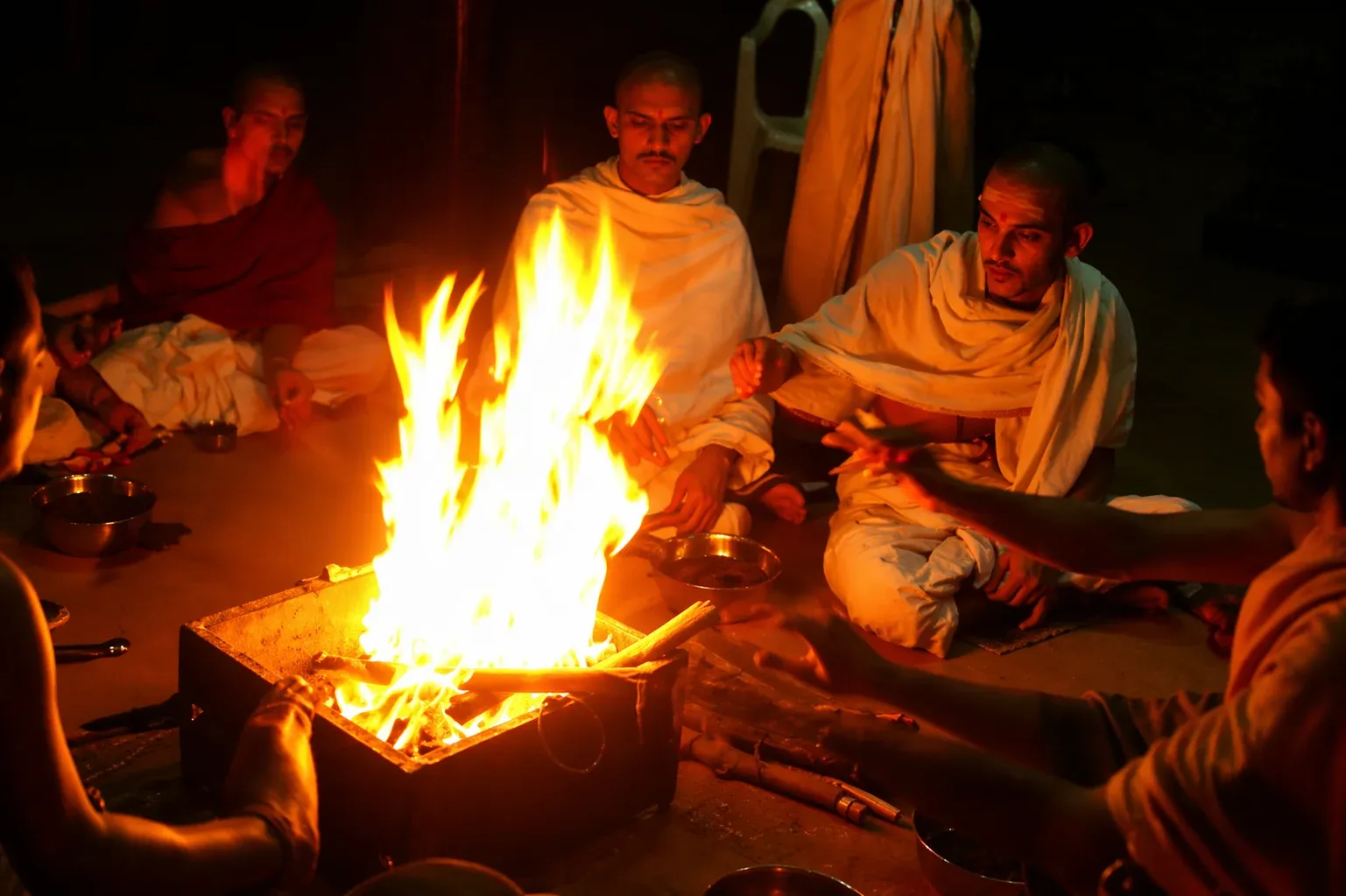
At the outset of their spiritual journey, many seekers are naturally drawn to the path of Vedic rituals, known as Karma or Karma Kanda. This is the path of action, heavily focused on performing prescribed duties, fire sacrifices, and ceremonies. However, as a standalone path, it is deeply flawed and fundamentally insufficient for effecting true release from the material illusion known as Maya, or for helping a seeker achieve true God realization.
These rituals are designed to purify the mind and bring harmony to life. However, as highlighted by Swamiji , this path is inherently limited.
The core problem with the path of Vedic rituals is that it is bound by incredibly strict rules. For a ritual to be fruitful, there are six essential components (Upakaran) that must be perfectly fulfilled:
- देश (Desh) – the correct place
- काल (Kaal) – the correct time
- पदार्थ (Padarth) – pure materials
- कर्ता (Karta) – a qualified performer
- मंत्र (Mantra) – flawless pronunciation
- कर्म (Karma) – precise execution
Fulfilling all six of these stringent conditions is a monumental, if not impossible, task in the modern era. The scriptures explicitly state:
The scriptures acknowledge the practical difficulty of performing Vedic rituals in the present age:
“षड्भिः संपद्यते धर्मस्तेऽति दुर्लभतराः कलौ”
Deeper Explanation
- षड्भिः (ṣaḍbhiḥ) → by six (refers to the six conditions)
- संपद्यते धर्मः (sampadyate dharmaḥ) → dharma (rituals) is successfully performed
- तेऽति दुर्लभतराः (te ati durlabhatarāḥ) → those are extremely rare/difficult
- कलौ (kalau) → in the age of Kali (present age)
This highlights why the path of rituals alone is not sufficient, guiding seekers toward the more accessible and powerful path of Bhakti.
The scriptures further emphasize the unique nature of the present age. Although Kaliyuga is filled with countless challenges, it offers one extraordinary advantage:
"कलेर्दोषनिधे राजन् अस्ति ह्येको महान् गुणः ।
कीर्तनादेव कृष्णस्य मुक्तसंगः परं व्रजेत् ॥" (Srimad Bhagavatam 12.3.51)
Translation:
O King, Kali Yuga is an ocean of faults, yet it has one great virtue: simply by chanting the name of Krishna, one becomes free from material bondage and attains the Supreme.
This highlights a profound shift—from complex rituals to the simplicity of devotion—making Bhakti the most accessible and powerful path in this age.
Even if achieved, the result is limited to Swarga (heavenly realms)—a temporary reward that does not free the soul from the cycle of birth and death.
Swami Mukundananda remarks:
“Rituals can refine your life, but they cannot define your liberation.”
Thus, Karma without devotion remains incomplete.
Swami Mukundananda beautifully expresses this truth:
“The soul does not seek liberation alone; it seeks loving union with God.”
This insight sets the foundation for understanding why Bhakti is not just another path—it is the culmination of all paths.
The Ceiling of Intellect: Why Jnana Yoga Falls Short
If physical rituals cannot liberate us, what about the path of intellect and knowledge? This brings us to Jnana Sadhana or Jnana Yoga. The path of knowledge is designed to help a practitioner become situated in Atma Jnana, which translates to self-knowledge.
When rituals fail to satisfy, seekers turn inward toward Jnana Yoga, the path of knowledge. This path leads to the realization:
“I am not the body; I am the soul.”
While this is a significant breakthrough, it is not the final destination. The text reminds us :
📖 Srimad Bhagavatam 1.5.12
नैष्कर्म्यमप्यच्युतभाववर्जितं
न शोभते ज्ञानमलं निरञ्जनम् ।
कुतः पुनः शश्वदभद्रमिश्रं
न चार्पितं कर्म यदप्यकारणम् ॥
Even pure knowledge does not shine without devotion to God.
Knowledge can remove ignorance, but it cannot create love. Without love, realization remains incomplete.
As Swami Mukundananda explains:
“Knowledge tells you who you are, but devotion tells you where you belong.”
Without Bhakti, Jnana cannot lead to the ultimate realization of God.
However, realizing that you are a soul (Atma) rather than a physical body is merely the first step. The critical limitation of Jnana Yoga is that self-knowledge alone will not suffice in achieving liberation from the powerful grip of Maya. This text reminds us.
Even a highly elevated Jnani (seeker of knowledge) requires an essential missing ingredient to transcend their limits: the addition of Bhakti. Without adding the loving devotion of Bhakti to their practice, a Jnani cannot achieve Brahma Jnana (knowledge of the Supreme). It is only from this Brahma Jnana—sparked by devotion—that true release from Maya can finally occur.
When Knowledge Bows Before Love: Uddhava in Vrindavan
In one of his discourses, Swami Mukundananda beautifully shares an example that illustrates how knowledge, no matter how refined, falls short before the power of Bhakti.
When Shree Krishna sent Uddhava—His highly learned and enlightened friend and cousin to Vrindavan, the intention was to console the Gopis through spiritual wisdom. Uddhava was a महान ज्ञानी, deeply immersed in philosophy and scriptural understanding. From his perspective, knowledge was the highest means of realization.
However, what he encountered in Vrindavan transformed his understanding forever.
The Gopis were not engaged in intellectual discourse, nor were they practicing structured meditation. Their entire being was absorbed in one thing alone—pure, selfless, and unconditional love for Krishna. Every breath they took, every thought they had, revolved around Him.
They did not seek liberation.
They did not aspire for knowledge.
They did not even wish to relieve their own suffering.
Their only desire was Krishna.
Standing before such overwhelming devotion, Uddhava realized that his philosophical knowledge was powerless in comparison. What he had cultivated through years of study, the Gopis embodied effortlessly through love.
In that moment, knowledge bowed before devotion.
Humbled by their exalted state, Uddhava prayed:
“Let me be born as a blade of grass in Vrindavan, so that I may receive the dust of the feet of these great devotees.”
This profound episode perfectly illustrates the declaration of Narad Ji:
“सा तु कर्मज्ञानयोगेभ्योऽपि अधिकतरा”
Bhakti is superior to Karma, Jnana, and Yoga.
Uddhava represents Jnana (knowledge)—refined, disciplined, and intellectually profound.
The Gopis represent Bhakti (devotion)—pure, spontaneous, and all-consuming.
And yet, in this divine encounter:
- Knowledge stood in awe
- Wisdom became silent
- And devotion alone shone supreme
This is not merely a comparison—it is a revelation.
Narad Ji’s statement is not theoretical; it is lived reality. The Gopis did not “understand” Krishna—they belonged to Him. Their love transcended philosophy, surpassing even the highest levels of ज्ञान.
The Discipline of Yoga and Its Final Barrier

The Hidden Secret of Ashtanga Yoga
Perhaps the most famous spiritual export to the modern world is Yoga, specifically referring to the traditional eight-fold path known as Ashtanga Yoga. Ashtanga Yoga is undeniably powerful; it grants the practitioner immense control over the perturbations and chaotic fluctuations of the human mind.
Through severe austerities and mental discipline, an Ashtanga Yogi can successfully destroy the lower material modes of nature: Tamogun (the mode of ignorance) and Rajogun (the mode of passion).
But here lies the insurmountable hurdle: Ashtanga Yoga cannot, by its own mechanical practices, conquer Sattvagun (the mode of goodness). To go beyond the mode of goodness and completely transcend material nature requires the grace of God, and attaining God's grace strictly demands surrender.
People often conveniently ignore this fact because it does not fit into a purely secular or mechanical agenda of meditation, but the architect of Ashtanga Yoga himself made this explicitly clear. Maharishi Patanjali, the author of the Yoga Sutras, repeatedly emphasized surrender to the Supreme. In his 196 sutras, he highlights this concept three distinct times:
"ईश्वर प्रणिधान" "समाधि सिद्धि ईश्वर प्रणिधाना"
Maharishi Patanjali is explicitly stating that even the greatest Ashtanga Yogi cannot reach the ultimate goal without the addition of Bhakti.
The scriptures go even further in declaring that without devotion, even the most refined spiritual practices lose their true value. This truth is beautifully expressed in a profound verse:
“जोगु कुजोगु ज्ञानु अज्ञानु।
जहँ नहिं राम प्रेम प्रधानु॥”
Translation:
Yoga or misdirected yoga, knowledge or ignorance—everything is meaningless where the love of God (Ram Prem) is not supreme.
This verse leaves no room for ambiguity—without devotion, spirituality becomes hollow, and with devotion, even the simplest practice becomes divine.
Whether it is yoga or misdirected effort, knowledge or ignorance—none of it holds significance where divine love is absent. This emphasizes that without Bhakti, even the highest paths fail to lead to ultimate realization.
This is precisely why Narad Ji declares:
“सा तु कर्मज्ञानयोगेभ्योऽपि अधिकतरा”
Bhakti is superior to all other paths.
Narada Bhakti Sutra 25: The Declaration of Supremacy
The 25th sutra of Narad Ji states:
Sanskrit (Original):
सा तु कर्मज्ञानयोगेभ्योऽप्यधिकतरा ॥ २५ ॥
Transliteration:
sā tu karma-jñāna-yogebhyo ’py adhikatarā
Meaning:
Bhakti is indeed superior to the paths of Karma (action), Jnana (knowledge), and Yoga (meditation).
This is not a casual comparison—it is a decisive philosophical conclusion. Narad Ji is not dismissing other paths but placing them in perspective. Bhakti is not one among many; it is the culmination of all.
The Ultimate Verdict: No Liberation Without Devotion.
The fundamental truth underlying all Vedic scriptures is that every single spiritual path is inherently incomplete without Bhakti. This reality is beautifully encapsulated in the phrase:
"योग कुयोग ज्ञान अज्ञानु जह नहीं राम प्रेम प्रधानु"
This profound quote establishes that without the primacy of divine love, Yoga becomes mere useless exertion, and knowledge transforms into ignorance.
The path of Ashtanga Yoga is renowned for its ability to control the mind and senses. Through rigorous discipline, the yogi transcends lower material tendencies.
However, Swamiji, explains even this path has a critical limitation: it cannot transcend the final layer of material nature—Sattvagun—without divine grace.
Maharishi Patanjali himself emphasizes:
Even the path of Ashtanga Yoga, though powerful in controlling the mind, ultimately requires surrender to the Divine. Maharishi Patanjali himself emphasizes this repeatedly in the 196 Yoga Sutras:
“ईश्वरप्रणिधानाद् ॥
ईश्वरप्रणिधानाद्वा ॥
समाधिसिद्धिरीश्वरप्रणिधानात् ॥”
These sutras highlight that through surrender to God (Ishvara Pranidhana), one attains perfection in meditation. This clearly indicates that even the highest yogic practices reach completion only through devotion.
Thus, even the path of Yoga ultimately culminates in surrender, reinforcing the indispensable role of Bhakti in spiritual realization.
Swami Mukundananda states:
“Effort purifies the mind, but surrender attracts God’s grace.”
Ved Vyas, the great compiler of Vedic literature, delivers the ultimate verdict in the Srimad Bhagavatam regarding the absolute necessity of devotion:
The scriptures go even further in emphasizing that knowledge and action, when devoid of devotion, fail to lead to ultimate realization. This profound truth is expressed in the Srimad Bhagavatam:
नैष्कर्म्यमप्यच्युतभाववर्जितं
न शोभते ज्ञानमलं निरञ्जनम् ।
कुतः पुनः शश्वदभद्रमिश्रं
न चार्पितं कर्म यदप्यकारणम् ॥
Even pure knowledge, free from all material contamination, does not shine if it is devoid of devotion to the Supreme Lord. What then can be said of actions that are not offered to Him?
In this verse, Ved Vyas declares that Niranjan Jnana—knowledge that is completely devoid of Bhakti—cannot help a soul cross the ocean of Maya. If pristine spiritual knowledge is useless without devotion, then what to speak of those Vedic actions and karmic duties that are not offered to God? Every single spiritual endeavor, to be effective, absolutely demands the addition of Bhakti.
The Nectar of Immortality: The Amrit Analogy
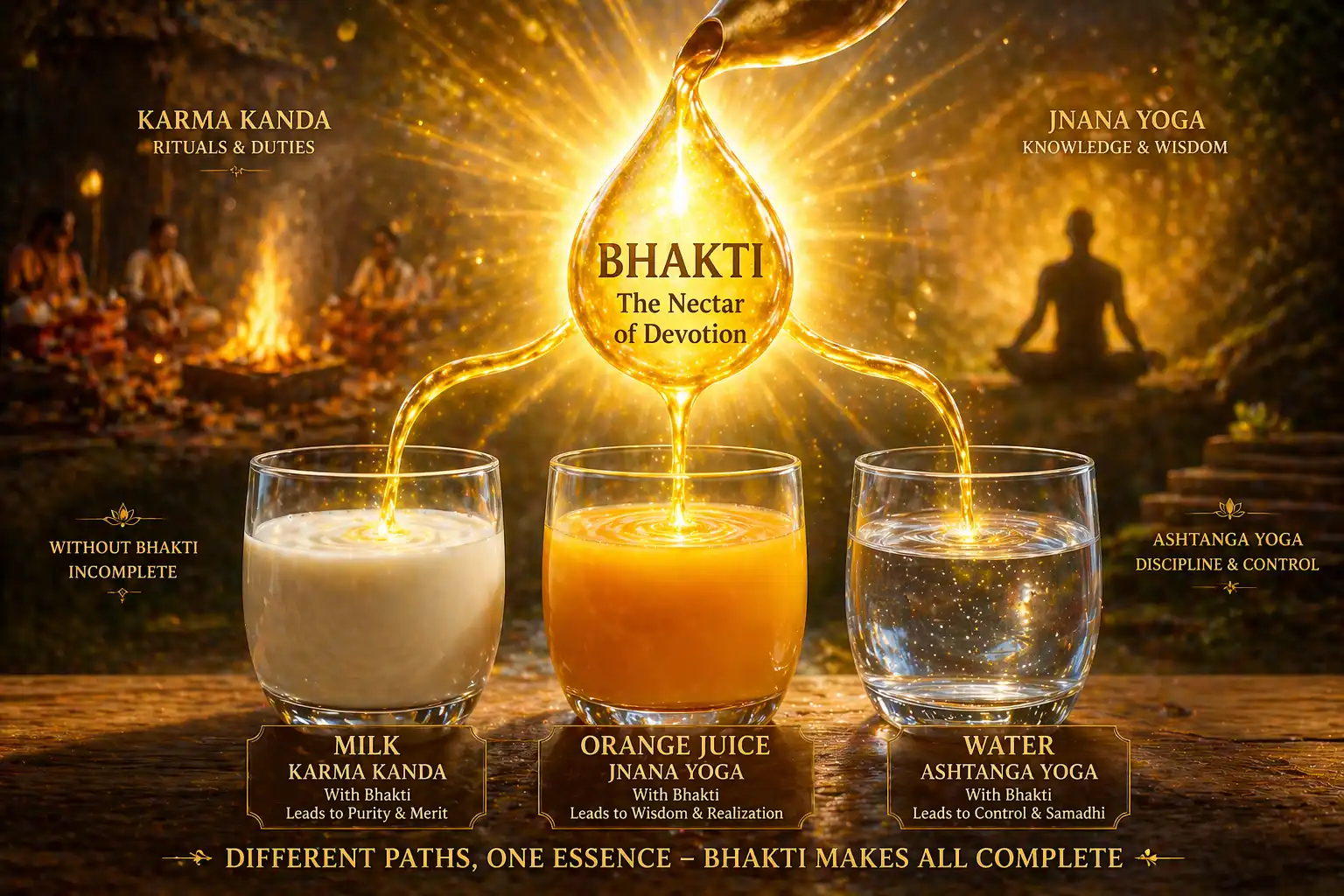
To beautifully illustrate how Bhakti empowers all other practices, Swami ji tells ua to look at the analogy of Amrit (the ambrosia or nectar of immortality).
Imagine you possess this divine Amrit. How do you consume it?
- You could mix it into a glass of milk.
- You could mix it into a glass of orange juice.
- You could stir it into plain water.
- Or, you could simply drink the Amrit just as it is.
- In every single one of these scenarios, the end result is exactly the same: you will become immortal. But what is the active ingredient causing this immortality? It is certainly not the orange juice, the milk, or the water; the power lies entirely in the Amrit itself.
Likewise, the milk, juice, and water represent the paths of Karma, Jnana, and Ashtanga Yoga. They are merely vehicles. The active ingredient that actually grants spiritual liberation is the devotion mixed into them. Because devotion is the true active ingredient of liberation, Narad Ji himself defines Bhakti perfectly:
"अमृत स्वरूपा" (Amritaswoorpa)
Bhakti is the very form of nectar; it is the essence that makes any spiritual practice alive and fruitful.
The Three Tiers of God Realization
To fully grasp why Bhakti is the pinnacle of spiritual sadhana, we must understand the nature of God Himself. The Supreme Divine Entity is not one-dimensional; He manifests and can be realized in three distinct levels: as Brahman, as Paramatma, and as Bhagavan.
Ved Vyas, the author of the Bhagavatam, reveals this profound metaphysical truth:
To fully grasp Bhakti’s supremacy, we must understand the nature of God.
Ved Vyas states:
The Supreme Truth is realized in three forms:
"वदन्ति तत्त्वविदस्तत्त्वं यज्ज्ञानमद्वयम्
ब्रह्मेति परमात्मेति भगवानिति शब्द्यते"
The Tattvavetas (the knowers of the ultimate truth) declare that the one Supreme Divine Entity manifests in this world in these three progressive aspects:
1. Brahman (The Distant Realization) Brahman is the all-pervading, formless aspect of divinity. It is the cosmic energy that saturates all of existence. The scriptures describe this state a
"निर्गुण निर्विशेष निराकार" (Nirgun: without material qualities, Nirvishesh: without distinctions, Nirakar: without form). This aspect is realized through the path of Jnana Yoga.
2. Paramatma (The Closer Realization) Paramatma is the aspect of God where He resides as the indwelling witness seated within the hearts of all living beings. Realizing this localized, guiding aspect of divinity is the ultimate goal of the path of Ashtanga Yoga.
3. Bhagavan (The Complete Realization) Bhagavan is the supreme, ultimate manifestation of God. This is when the Divine descends in His personal, localized form to lovingly interact with devotees and perform divine pastimes (leelas). This complete realization of the Supreme Divine Personality is exclusively granted by the path of Bhakti.
Swami ji explains this with a Metaphor: The Approaching Train

How do these three levels of realization compare to one another? The relationship between Brahman, Paramatma, and Bhagavan can be perfectly understood through the brilliant analogy of a train arriving at a station.
Imagine you are standing on a dark railway platform waiting for a train.
The Brahman Realization: Look far down the tracks into the distance. From miles away, all you can see is a single, blinding headlight piercing the darkness. You cannot see the train itself, only its light. This is akin to the path of Jnana. It leads to a distant realization of the Supreme as the all-pervading, formless light of Brahman. You know the divine exists, but your experience lacks personal detail.
The Paramatma Realization: As the train comes closer to the station, the sheer light gives way to a shimmering, massive physical form rushing toward you. You can now perceive the shape and the power of the entity, though it is still in motion and not fully distinct. This is the realization granted by Ashtanga Yoga, which brings you closer to realizing the indwelling Paramatma.
The Bhagavan Realization: Finally, the train pulls into the station and comes to a complete halt right in front of you on the platform. The doors open, you see the passengers, you see the conductor, and you exclaim, "Oh my God, this is the Coromandel Express!" You now have complete, intricate, and intimate knowledge of the train. This is the ultimate realization granted by Bhakti. It reveals God not just as a distant light or an indwelling force, but in His complete, personal form as the Supreme Divine Personality.
The Universal Scriptural Verdict
The scriptures unanimously declare:
"योग कुयोग ज्ञान अज्ञानु जह नहीं राम प्रेम प्रधानु"
Without divine love, yoga becomes ineffective and knowledge becomes ignorance.
Ved Vyas further states:
"नकर्म्युत भाव वर्जितम न शोभते ज्ञानमलम निरंजनम"
Even pure knowledge cannot liberate without devotion.
The Bhagavad Gita Conection
After examining the limitations of Karma, Jnana, and Yoga, the conclusion of Narad Ji in the Narada Bhakti Sutra becomes clear:
सा तु कर्मज्ञानयोगेभ्योऽप्यधिकतरा ॥ २५ ॥
Bhakti is superior to Karma, Jnana, and Yoga.
This is not merely a philosophical claim—it is a truth echoed and firmly established in the Bhagavad Gita itself. Lord Krishna, the Supreme Divine Personality, confirms this in a powerful and definitive statement:
Bhagavad Gita 18.55
भक्त्या मामभिजानाति यावान्यश्चास्मि तत्त्वतः ।
ततो मां तत्त्वतो ज्ञात्वा विशते तदनन्तरम् ॥
Transliteration:
bhaktyā mām abhijānāti yāvān yaśh chāsmi tattvataḥ
tato māṁ tattvato jñātvā viśhate tad-anantaram
Translation:
Only through loving devotion can I be truly known as I am. Having thus known Me in truth, one enters into My divine being.
The Deeper Connection
This verse serves as the direct validation of Narad Ji’s declaration.
Krishna does not say that He can be fully realized through action, knowledge, or meditation alone. Instead, He uses the word:
“भक्त्या” — through devotion alone.
This is significant. While Karma refines our actions, Jnana clarifies our identity, and Yoga steadies the mind, none of them, by themselves, can reveal the complete reality of God.
The word " मामभिजानाति" implies a deep, personal, and intimate knowing—not just intellectual understanding, but a direct experiential realization of the Divine. This aligns perfectly with the idea that Bhakti leads to the realization of Bhagavan, the complete personal form of God, whereas other paths lead only to partial realizations.
From Knowing to Union
The second part of the verse further elevates this understanding:
“विशते तदनन्तरम्”
One enters into Him thereafter.
This reveals a profound truth—Bhakti is not merely the means to reach God; it is also the gateway to union with Him. The seeker does not remain separate but becomes absorbed in divine presence.
This beautifully reinforces the essence of your blog:
Bhakti is both the journey and the destination.
The Final Synthesis
Narad Ji gives the conclusion.
The Bhagavad Gita provides the confirmation.
Together, they establish an unshakable spiritual truth:
- Karma prepares
- Jnana clarifies
- Yoga disciplines
- Bhakti fulfills
It is only through Bhakti that the seeker moves from knowing about God to truly knowing and experiencing God.
As this verse makes clear, the ultimate realization is not achieved through effort alone, but through love, surrender, and devotion.
Thus, what Narad Ji declares as the highest truth is beautifully affirmed by Lord Krishna Himself—only through Bhakti can the Supreme be truly known and ultimately attained.
The Transformative Power of Bhakti

Bhakti is not merely a practice—it is a profound inner transformation. It does not begin with external rituals, nor does it end with intellectual understanding. Instead, it works quietly yet powerfully within the heart, reshaping the very foundation of our being.
When a seeker walks the path of Bhakti, something subtle begins to change. The ego, which once dominated thoughts and actions, slowly starts to dissolve. The constant need for recognition, control, and self-importance begins to fade. In its place arises a sense of humility—a realization that we are not the center of existence, but participants in a divine relationship. This dissolution of ego is not forced; it happens naturally as love for the Divine deepens.
As ego diminishes, the heart opens. Bhakti awakens a form of love that is unlike worldly attachment. It is not based on expectation or condition; it is pure, selfless, and expansive. This love begins to permeate every aspect of life—how one thinks, speaks, and interacts with others. The world is no longer seen as a place of competition, but as an expression of the Divine presence.
And with this awakening of love comes something even more extraordinary—divine grace. Unlike other paths that rely heavily on personal effort, Bhakti invites the grace of God into the seeker’s life. Progress is no longer limited by one’s own capacity; it is uplifted by a higher power. Obstacles that once seemed insurmountable begin to dissolve, not merely through effort, but through surrender.
This is what makes Bhakti unique among all spiritual paths. In Karma, one acts. In Jnana, one understands. In Yoga, one disciplines the mind. But in Bhakti, one loves—and in that love, everything else is fulfilled.
Over time, the seeker realizes a beautiful truth: Bhakti is not just a method to reach God—it is itself the experience of being with God. The separation between the journey and the destination begins to blur. Every prayer becomes a meeting, every remembrance becomes a connection, and every moment becomes an opportunity to experience the Divine.
Swami Mukundananda expresses this realization with great depth:
“In Bhakti, the journey itself becomes the destination.”
This means that the seeker does not wait for some distant moment of enlightenment to experience fulfillment. The very act of loving God becomes fulfillment. The path is no longer a means to an end—it is the end itself.
Thus, Bhakti transforms not only the goal of life but the experience of living. It turns ordinary existence into a sacred journey, where every step is infused with meaning, and every moment becomes an expression of divine love.
Integrating All Paths Through Bhakti
Bhakti does not reject other paths—it completes them.
- Karma becomes selfless service
- Jnana becomes loving understanding
- Yoga becomes surrendered meditation
- suggest practical application
Key Takeaways: Supremacy of Bhakti
- Bhakti is the highest path: As declared in Narada Bhakti Sutra 25, devotion surpasses Karma, Jnana, and Yoga in leading to ultimate realization.
- Karma alone is insufficient: Rituals (Karma Kanda) are bound by strict conditions and yield only temporary results like heavenly pleasures—not liberation .
- Jnana has limitations: Self-knowledge helps us understand our spiritual identity, but without devotion, it cannot lead to complete God-realization .
- Yoga requires surrender: Even the disciplined path of Ashtanga Yoga reaches completion only through Ishvara Pranidhana (surrender to God), which is an expression of Bhakti .
- Bhakti is the essential element: Like nectar (Amrit), Bhakti is the active force that gives power to all spiritual practices.
- Three levels of realization:
- Brahman (through Jnana)
- Paramatma (through Yoga)
- Bhagavan (through Bhakti—the highest realization)
Practical Applications of Bhakti in Daily Life
Understanding the supremacy of Bhakti is powerful—but its real transformation begins when it is lived. Here are practical, simple ways to apply these teachings in everyday life:
1. Transform Daily Actions into Devotion (Karma → Bhakti)
Instead of abandoning action, spiritualize it.
- Offer your work, studies, or responsibilities to God
- Before starting any task, mentally dedicate it:
“This is for You” - Practice निष्काम कर्म (selfless action)
This turns ordinary work into worship
2. Add Love to Knowledge (Jnana → Bhakti)
Don’t let spirituality remain intellectual.
- While reading scriptures, reflect emotionally—not just logically
- Ask: “How does this bring me closer to God?”
- Practice gratitude and humility alongside knowledge
This converts knowledge into realization
3. Practice Surrender in Meditation (Yoga → Bhakti)
- Begin meditation with a feeling of surrender
- Instead of just controlling the mind, offer the mind to God
- Use simple prayers like:
“Guide me, I am Yours”
This transforms discipline into divine connection
4. Develop a Personal Relationship with God
Bhakti is not abstract—it is relational.
- Talk to God daily (like a friend, parent, or beloved)
- Share your struggles, joys, and thoughts
- Cultivate feelings of love, dependence, and trust
Swami Mukundananda says:
“God listens not to the language of the mind, but to the language of the heart.”
5. Chant and Remember (Naam Jap)
- Repeat God’s name daily (e.g., Radhe Krishna, Ram, Hari)
- Set aside even 5–10 minutes for chanting
- Practice constant remembrance (स्मरण) during the day
This keeps the mind connected to the Divine
6. Infuse Emotions into Worship
Bhakti is powered by feeling.
- While praying or doing rituals, focus on love, not perfection
- Even a simple prayer with devotion is more powerful than elaborate rituals without feeling
This overcomes the limitations of Karma Kanda
7. See God in All Beings
- Treat others with compassion and respect
- Serve others as a form of serving God
- Practice seva (selfless service)
This expands Bhakti beyond personal practice
8. Accept Life as Divine Will
- Practice surrender in challenges
- Replace anxiety with trust:
“This is part of God’s plan for me”
This dissolves ego and deepens faith
9. Balance Effort and Grace
- Continue your efforts (Karma, Jnana, Yoga)
- But recognize that final realization comes by grace
Bhakti attracts that grace
10. Make Bhakti a Lifestyle, Not an Activity
- Don’t limit devotion to temples or prayer time
- Carry remembrance into:
- Work
- Conversations
- Decisions
This turns life itself into continuous devotion
Simple Daily Routine (Easy Implementation)
- Morning: Short prayer + gratitude
- During day: Offer actions mentally
- Evening: Reflection + chanting
Conclusion: The Path of Divine Love
In the grand analysis of spiritual methodologies, the evidence overwhelmingly points in one direction. Karma Kanda traps one in temporary celestial cycles without breaking Maya. Jnana Yoga yields self-knowledge but lacks the power to grant supreme divine realization without devotion. Ashtanga Yoga controls the mind but falls short of transcending material nature without surrender to the Lord.
It is only Bhakti—the pure, nectar-like path of loving devotion (Amrit Swarupa)—that serves as the vital life force of all spiritual endeavors. By bringing the seeker face-to-face with the personal form of Bhagavan, Bhakti provides the most complete, intimate, and ultimate realization of the Supreme. For this reason, Narad Ji profoundly concludes that among all spiritual disciplines, Bhakti Sadhana is undeniably the most superior path of all.
The message of Narad Ji is timeless and universal:
Bhakti is not one option among many—it is the heart of spirituality. , every path without devotion remains incomplete. Only Bhakti brings the seeker face-to-face with the Supreme in His fullest form.
Let us end with a profound verse:
"भक्त्या मामभिजानाति यावान्यश्चास्मि तत्त्वतः" (Bhagavad Gita 18.55)
Only through Bhakti can I be truly known.
And in the words of Swami Mukundananda:
“When love for God awakens, liberation follows effortlessly.”
🌟 Final Call to Action
👉 For more life-changing teachings, subscribe to the official YouTube channels:
👉 Watch the complete Narad Bhakti Sutra series on the Bhagavad Gita Krishna Bhakti Channel:
Buy the "Narad Bhakti Sutras" by Swami Mukundananda
Now that we’ve explored the divine wisdom of the Narad Bhakti Sutras, it’s time to take the next step on your spiritual journey. To deepen your understanding of the Narad Bhakti Sutras, we highly recommend Swami Mukundananda’s commentary, which beautifully unpacks each mantra providing a clear and practical guide for modern seekers.
Order the Book: Swami Mukundananda’s Commentary
Unlock the deeper wisdom of the Narad Bhakti Sutras with this insightful commentary by Swami Mukundananda. Perfect for modern seekers who wish to explore the divine teachings in greater depth.
Order the Book Now (India)Order the Book Now (USA)
FAQs: Supremacy of Bhakti
1. Why is Bhakti considered superior to Karma, Jnana, and Yoga?
Bhakti is considered superior because it alone leads to complete and personal realization of God. While Karma purifies actions, Jnana gives knowledge, and Yoga disciplines the mind, Bhakti establishes a direct loving connection with the Divine.
2. Can Karma or Jnana lead to liberation without Bhakti?
No. Scriptures clearly state that actions and knowledge, when devoid of devotion, cannot grant ultimate liberation. They become effective only when infused with Bhakti.
3. Why is Bhakti especially important in Kaliyuga?
In Kaliyuga, complex rituals and intense disciplines are difficult to perform perfectly. Bhakti, especially through simple practices like chanting and remembrance, offers an accessible and powerful path to spiritual realization.
4. What does it mean that Bhakti is both the means and the goal?
In Bhakti, the process itself is the fulfillment. Loving God is not just a way to reach Him—it is itself the experience of being connected with Him.
5. How can a beginner start practicing Bhakti?
A beginner can start with simple steps like chanting God’s name, offering daily actions to God, reading scriptures with devotion, and cultivating a personal relationship with the Divine through prayer and remembrance.