

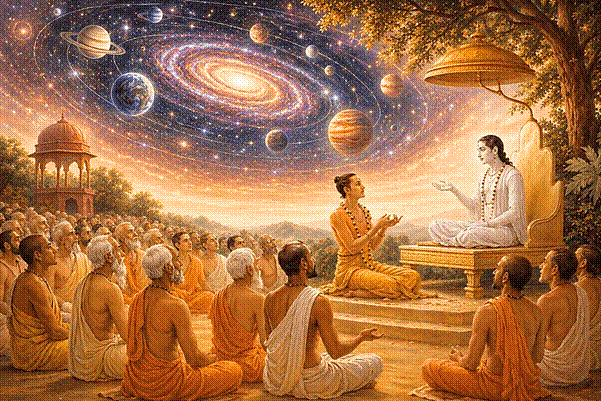
As the dialogue between Jadbharat and Rahugan draws to its close, so too does the samvad between Vidur and Maitreya Muni. At this juncture, Parikshit grows curious, and asks Shukadev, “Maharaj, you described this world as consisting of seven oceans and seven continents. Could you please enlighten me further on the geography of creation?”
While the Western world once believed the earth to be the center of the universe, the Bhagavat revealed profound cosmological truths over five millennia ago. Shukadev not only describes the geography of Mrityulok (mortal realm) but also the mountains and rivers of Bharatvarsh, and the vast architecture of the cosmos. He speaks of the three Trilokis, the five Mandals, and the seven Lokas; realms of both swarg and narak. In unravelling these mysteries, he explains how the earth, with all its continents and oceans, is but a speck within the immeasurable grandeur of existence.

Beyond Realms & Repentance
● Chandramandal (realm: Chandralok) rests on the gravitational pull of Bhumandal (realm: Bhulok, our earthly plane). Bhumandal itself rotates on the gravitational influence of Suryamandal (realm: Swarlok). Between Bhu (Bhulok) and Swa (Swarlok) lies the intermediate space, the Antariksh known as Bhuva. Together, Bhu–Bhuva–Swa form the first Triloki, the foundational tier of existence.
● Suryamandal rotates on the gravitational pull of Parameshthi Mandal (realm: Janalok). Between Swa and Jana lies another expanse of Antariksh, called Maha, thus forming the second Triloki: Swa–Maha–Jana.
● Parameshthi Mandal rotates on the gravitational pull of Swayambhu Mandal (realm: Brahmalok, abode of Brahma). Between Janalok and Brahmalok stretches the Antariksh Tapa. Together, Jana–Tapa–Satya constitute the third Triloki.
We often hear of the ‘seventh heaven’ or ‘saatwan aasman.’ The Bhagavat offers their detailed exposition, describing the ascending planes of existence: Bhu, Bhuva, Swa, Maha, Jana, Tapa, and Satya, culminating in the highest realm. It also speaks of the lower regions: Atal, Vital, Sutal, Talatal, Mahatal, Rasatal, and Patal.
Against this backdrop, Shukadev begins to unveil the torments of the nether worlds, showing how each sinful act leads to a corresponding state of suffering. With each account, the narration grows heavier, each consequence more harrowing. Parikshit, shaken to the core, cries out, “Maharaj, these regions are a living nightmare! If karma can hurl us into such states, how can one ever escape such a fate?” In truth, Parikshit himself did not need to wrestle with this question. This was a divine leela—God inspiring him to ask so that Shukadev’s answer would be preserved for the generations to come.
Parikshit presses further, “No one can entirely avoid sin. How then may we be saved? The Karmakand prescribes prayascitta (acts of atonements)—should we follow those?”
Shukadev replies, “Mere prayascitta is not of much help, for it does not cleanse the mind.”
Consider a simple analogy. A person may commit a crime, be punished, and serve time in prison. Upon release, he is no longer legally an offender—but has his inner nature changed? Not necessarily. Some even begin plotting their next crime while still behind bars. Punishment or external atonement does not uproot the tendency to sin. Shukadev compares this to an elephant’s bath: the animal cleans itself thoroughly, only to throw dust upon its body again.
Shukadev then points to the ultimate remedy—bhakti.
Just as the rising sun dispels the thick fog of winter, devotion to the Lord removes the darkness of sin. It not only erases past sins but uproots the ignorance within that gives rise to sinful tendencies in the first place. Thus, one who embraces bhakti need not rely on separate acts of atonement.
के चत्केवलया भक्त्या वासुदेवपरायणा:।
अघं धुन्वन्त कात्स् न्यन नीहारमव भास्कर:॥ 6.1.15 ॥
Only a rare soul who embraces pure, unalloyed devotional service to Shree Krishna can completely uproot the weeds of sinful actions, ensuring they never sprout again. This is achieved effortlessly through the power of devotion, much like the sun instantly dispels the densest fog with its radiant rays.
With this, Shukadev begins recounting the story of Ajamil.

Gone Astray
Ajamil was once a learned brahman, disciplined and jitendriya—master of his senses. Grounded in Vedic knowledge, he lived a life of purity and restraint. Yet in a moment of weakness, he fell for a prostitute. Abandoning his ideals, he began living with her on the outskirts of the village and gradually descended into sinful ways. With that woman, he fathered many children, and his conduct became so notorious that the villagers feared him. Gone were the days when he used to chant Vedic mantras; his name now became synonymous with infamy. Mothers would even frighten their children, saying, “Drink your milk, or Ajamil will come.”
Though Ajamil had forgotten God, God had not forgotten him. The Lord keeps the account of every soul, and His promise never fails.
As Shree Krishna declares in the Bhagavad Gita:
कौन्तेय प्रतिजानीहि न मे भक्त: प्रणश्यति ~ Verse 9.31
O son of Kunti, declare it boldly that no devotee of Mine is ever lost.
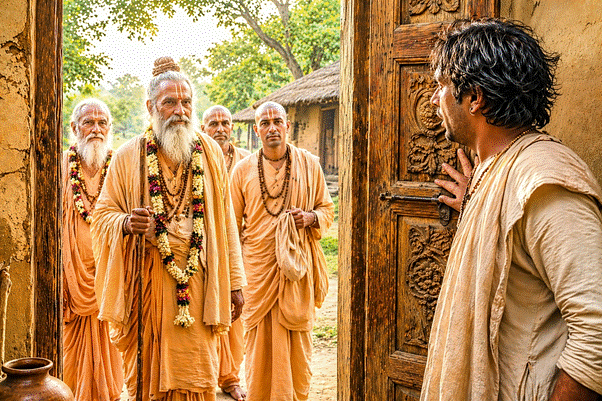
One day, a group of sages arrived in the village. They followed a strict rule—to spend the night only in the home of a devotee of Vishnu. As they inquired about who among the villagers was a Vaishnav, someone mischievously directed them to Ajamil. Taking this at face value, the sages went to his house and knocked. When Ajamil opened the door and saw their holy attire, he was taken aback. He felt deeply unworthy of such exalted company. The saints asked, “We heard you are a devotee. May we stay here?” Ajamil was conflicted. On one hand, he knew he was undeserving; on the other, a thought arose—If such holy souls stay in his home, perhaps their presence may bring him some auspiciousness. With that hope, he welcomed them.
That night, before resting, the saints sat together and engaged in satsang. Ajamil listened from a distance, and their words pierced his heart. A deep sense of remorse welled up within him. “What have I done with my life? I was blessed with spiritual knowledge, yet I squandered it.” Regret consumed him through the night. By morning, he could bear it no longer. Falling at the feet of the sages, he confessed: “I must speak the truth. I am no Vaishnav. In fact, I am infamous here as a sinner. My greed to host you was so strong that I lied. Please forgive me.”
A Second Chance
The sages listened to Ajamil’s confession and said, “What you have done is not right. Yet, since you have spoken the truth with sincerity, we shall bless you.” Ajamil folded his hands and said, “Maharaj, at this stage, my mind does not turn towards God. How can I engage in devotion?”
The saints, in their compassion, found a way to guide even the fallen Ajamil and reconnect him with the Divine. They said, “Then do just this much—name your youngest child Narayan.” Ajamil accepted their instruction with reverence. And this simple act became the turning point in his life. When his tenth child was born, he named him ‘Narayan’. Deeply attached to the boy, he constantly called out, “Narayan, Narayan.” Unknowingly, he had begun chanting the Lord’s name.
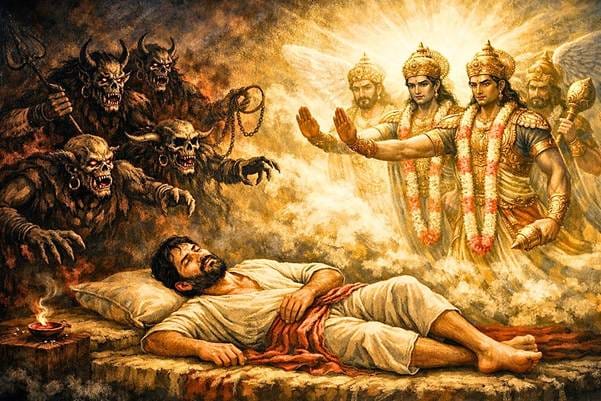
At the time of death, the mind naturally gravitates towards that to which it is most attached. Ajamil, absorbed in thoughts of his son, called out “Narayan!”—and lost consciousness. In that moment, he witnessed a startling vision. From one side came the Yamaduts (messengers of Yamraj)—grotesque and fearsome. “He is a sinner,” they declared. “Take him for punishment.” From the other side appeared the Vishnuduts (messengers of Lord Vishnu)—radiant beings, adorned with divine ornaments. They intervened, “Do not touch him.”
The Yamaduts protested, “We are carrying out our duty. Who are you to stop us?”
The Vishnuduts replied, “You do not even know the true nature of your duty. Go back and ask your master, Yamraj.” With that, they drove the Yamaduts away.
Witnessing this exchange, Ajamil regained consciousness. What he had seen and heard shook him deeply. A revelation dawned—he had been pulled back from the brink of damnation and given a chance to transform his life. He realized that he had long been asleep in moh-nidra (the slumber of ignorance). That sleep had been broken. And now, he was truly awake.
As the Ramcharitmanas states:
जानिअ तबहिं जीव जग जागा।
जब सब बिषय बिलास बिरागा ॥ ~ Verse 1.2.93
“In this night-like world, the yogis remain awake—those who are devoted to the highest truth and free from illusion. A soul is truly awake only when it develops detachment from all worldly pleasures.”
Ajamil renounced his attachments and journeyed to Haridwar. Even today, near Haridwar, there is a site called Ajamil Ka Tila—where he performed his austerities. Through sincere effort and deep devotion, his bhakti gradually matured to perfection, and God then took him to the divine abode.
म्रियमाणो हरेनाम गृणन् पुत्रोपचारतम् ।
अजामलोऽप्यगाद्धाम कमुत श्रद्धया गृणन् ॥ 6.2.49 ॥
At the time of his death, Ajamil, though ailing, called out the holy name of the Lord in the pretext of addressing his worldly son. Yet, Ajamil was still delivered and attained the Abode of God. Therefore, if one chants the holy name with faith, avoiding any spiritual transgression, undoubtedly such a soul will surely return to the divine Abode.
It is vital to note that Ajamil did not attain spiritual perfection by a single utterance of “Narayan.” That moment was the turning point—a divine intervention that awakened him, giving him the chance to transform and attain God.
Truth Laid Bare
However, the episode did not end there.
When the Yamaduts were driven away, they returned to Yamaraj, bewildered. “Maharaj, who were those resplendent beings who stopped us? We were only performing our duty, carrying away a sinner as instructed. We believed you to be the supreme authority—is there someone beyond you?”
Yamaraj replied with humility: “O Yamaduts, I am not supreme. I am appointed by God and act only on His command. I preside only over Mrityulok, while countless other lokas have their own guardians.” He explained further, “True dharma for a human being is to engage in devotion to God. And the simplest way to practice that devotion is by chanting His divine Names. Ajamil may have lived a sinful life, but at the end, his heart awakened to bhakti. He sought guidance from the saints and obeyed it. That is why he named his child Narayan. And by the virtue of repeatedly calling out that name, he was blessed. This is the power of bhakti, and that is why the Vishnuduts stopped you from taking him.”
Through Ajamil’s example, Shukadev instructs Parikshit:
सङ्केत्यं परिहास्यं वा स्तोभं हेलनमेव वा।
वैकुण्ठनामग्रहणमशेषाघहरं विदुः॥ 6.2.14 ॥
“Whether the Name of the Lord is chanted indirectly, in jest, casually, or even neglectfully—it has the power to destroy countless sins.”
Such is the extraordinary power of the divine Name. Therefore, even if the mind resists, continue chanting. Just as parents first teach children the external act of bowing in a temple, the inner spirit of devotion develops gradually over time.
एतावानेव लोकेऽस्मन् पुंसां धम: पर: स्मृत:।
भक्तयोगो भगवत तन्नामग्रहणादभ:॥ 6.3.22 ॥
Devotional service, which commences with the chanting of the holy Name of the Lord, stands as the supreme religious practice for all human beings.
Thus, Shukadev reassured Parikshit—and through him, all of us—that bhakti-yog stands as the highest path in human life, cleansing all past sins. With this, Shukadev concluded the account of Ajamil.
Frequently Asked Questions
Question: What is the practical takeaway from Ajamil’s story for our daily life?
Begin where you are. Even if the mind is not pure or inclined towards devotion, take small steps—chanting, remembrance, or association with the wise. Ajamil did not transform overnight, but one sincere decision changed his trajectory. The lesson is simple: no effort in bhakti is ever wasted, and no one is beyond redemption.
Question: If bhakti removes the root of sin, why do even devotees sometimes struggle with weaknesses?
Bhakti is a gradual process. While it begins purifying immediately, deep-rooted tendencies may take time to dissolve. Just as the sun rises gradually before fully dispelling darkness, devotion steadily weakens impurities until they are completely eradicated. The key is consistency and sincerity, not instant perfection.